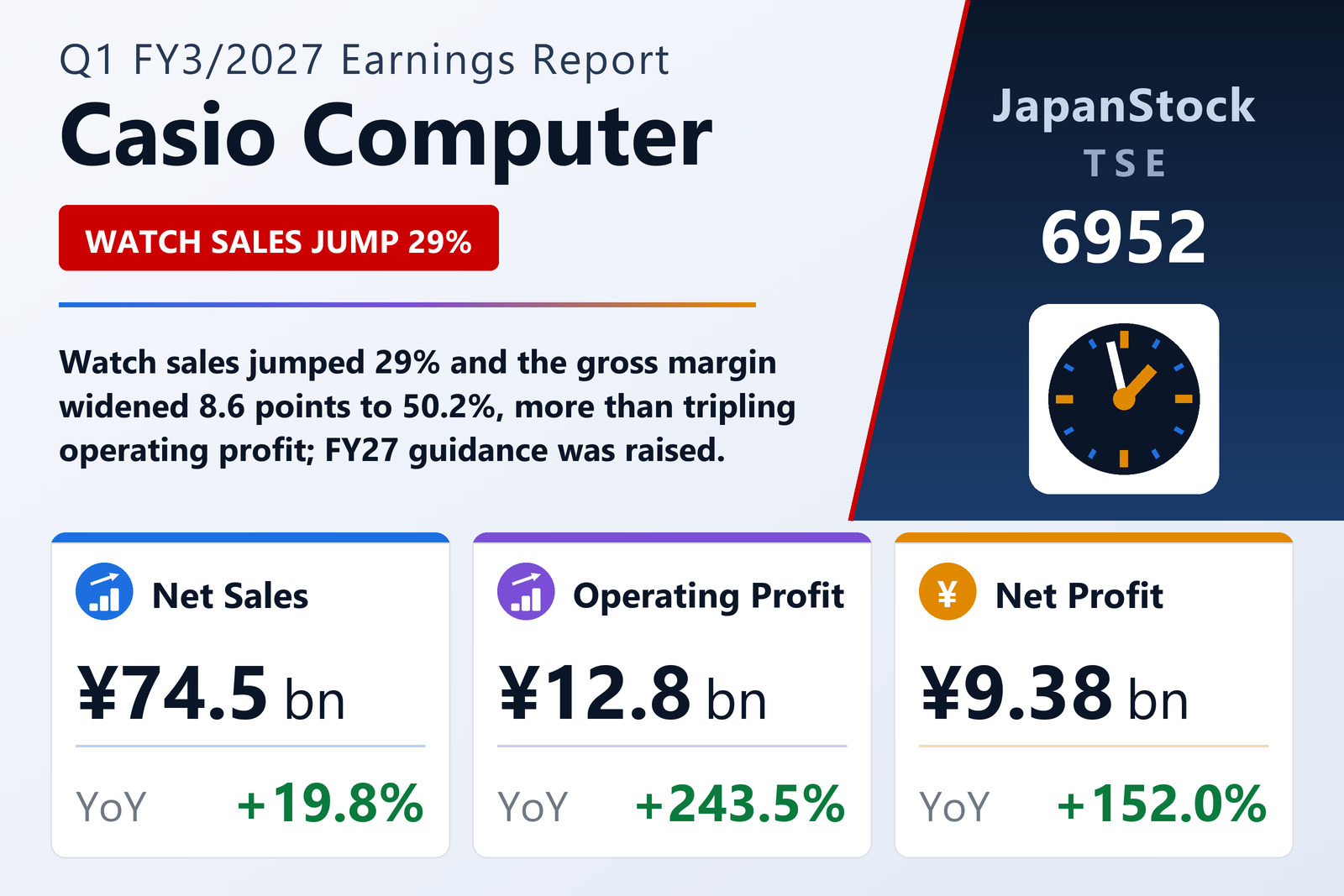
Casio Computer Co., Ltd. (TSE: 6952), the Tokyo-based maker of G-SHOCK watches, scientific calculators and electronic musical instruments, reported consolidated results for the first quarter of the fiscal year ending March 2027 — the three months from April 1 to June 30, 2026 — under Japanese GAAP. Net sales rose 19.8% to ¥74,511 million, operating profit rose 243.5% to ¥12,811 million, ordinary profit rose 206.7% to ¥13,423 million and profit attributable to owners of the parent rose 152.0% to ¥9,377 million. Basic earnings per share came to ¥41.92 against ¥16.32 a year earlier; no diluted figure is disclosed because no dilutive potential shares exist. Every one of those lines had contracted in the year-earlier quarter — sales fell 4.6%, operating profit 17.6%, ordinary profit 21.4% and net profit 39.8% — so the comparison is against a notably weak base. The company said the global economy held up broadly firm through the quarter despite energy-price increases and associated cost pressure stemming from heightened tensions in the Middle East.
G-SHOCK and CASIO WATCH lift timepiece sales 29%
The Timepieces segment did essentially all of the work. External sales in the segment climbed 29.0% to ¥51,008 million from ¥39,527 million, and segment profit jumped 177.3% to ¥11,776 million from ¥4,246 million, lifting the segment margin to 23.1% from 10.7%. Casio attributed the gain to its two-brand strategy: G-SHOCK and CASIO WATCH each grew by double digits year on year, and the segment expanded in every region except the Middle East. Within G-SHOCK, sales widened for the classic square-cased 5000 and 5600 series and the octagonal 2100 series, with new collaboration models also selling well. CASIO WATCH was led by the A158WA and MTP-1302D, which the company said brought in new users among women and younger buyers and continued to grow globally, while mechanical models in the EDIFICE line also performed strongly. Ambassador marketing, run continuously over recent periods, was cited as a contributing factor.
Consumer segment inches ahead as EdTech pulls orders forward
The Consumer segment — which houses the EdTech calculator business and the Sound business of electronic musical instruments — grew more modestly, with external sales up 6.0% to ¥21,297 million, though segment profit still rose 189.2% to ¥3,392 million from ¥1,173 million. EdTech sales increased as orders for scientific calculators were pulled forward in regions entering their new-school-term demand period; Sound was flat, with tough market conditions persisting globally. The Other segment shrank, with external sales down 14.2% to ¥2,206 million, and narrowed its loss to ¥280 million from ¥529 million. Unallocated corporate costs — mainly parent-company head-office administration and basic research — widened to ¥2,077 million from ¥1,160 million, so the ¥14,888 million total for the reportable segments translated into the reported ¥12,811 million of operating profit.
Cost of sales barely moved, widening the gross margin by 8.6 points
The profit leverage came from the top of the income statement. Cost of sales rose only 2.2% to ¥37,090 million while sales rose 19.8%, so gross profit jumped 44.5% to ¥37,421 million and the gross margin widened to 50.2% from 41.7% — an 8.6-point improvement. Selling, general and administrative expenses grew 11.0% to ¥24,610 million, split between salaries and bonuses of ¥9,023 million (up 10.6%) and other SG&A of ¥15,587 million (up 11.2%), well below the pace of the top line. The operating margin therefore reached 17.2% against 6.0%. Below the operating line, non-operating income was flat at ¥846 million — interest income improved to ¥547 million from ¥421 million while foreign-exchange gains fell to ¥156 million from ¥392 million — and non-operating expenses were ¥234 million. Extraordinary items were minimal on both sides this year (gains of ¥238 million, losses of ¥59 million) against a year-earlier quarter that carried ¥2,700 million of extraordinary gains, including ¥1,567 million from the sale of affiliate shares, and ¥1,685 million of extraordinary losses. Pre-tax profit rose 152.3% to ¥13,602 million at an effective tax rate of 31.0%, unchanged from a year earlier.
Guidance raised across every line on Q1 strength and U.S. tariff refunds
Casio revised upward the full-year and first-half forecasts it had published on May 14, citing the first quarter's performance together with refunds of U.S. tariffs and other information available at present. Full-year net sales guidance was lifted by ¥5.0 billion to ¥300,000 million (+8.6%), operating profit by ¥8.0 billion to ¥34,000 million (+47.4%), ordinary profit by ¥8.0 billion to ¥34,000 million (+32.4%) and profit attributable to owners of the parent by ¥5.0 billion to ¥23,500 million (+28.9%), implying full-year EPS of ¥106.50. For the six months to September, the company guides to net sales of ¥150,000 million (+13.1%), operating profit of ¥20,500 million (+116.1%), ordinary profit of ¥20,500 million (+91.0%) and net profit of ¥13,500 million (+67.7%), for first-half EPS of ¥60.86. The first quarter already accounts for 37.7% of the full-year operating-profit target and 39.9% of the net-profit target against only 24.8% of forecast sales — a distinctly front-loaded start on the earnings lines. The plan assumes exchange rates of ¥155 to the U.S. dollar and ¥180 to the euro.
Balance sheet flat as buybacks offset retained earnings
Total assets were essentially unchanged at ¥351,353 million at June 30, down ¥122 million from ¥351,475 million at the March year-end. The composition shifted within liquid assets: cash and deposits rose to ¥109,184 million from ¥94,677 million while securities fell to ¥29,998 million from ¥55,992 million; finished-goods inventory rose to ¥47,768 million from ¥43,386 million. Total liabilities edged down to ¥115,691 million from ¥116,284 million. Net assets rose to ¥235,662 million from ¥235,191 million and shareholders' equity to ¥235,628 million from ¥235,163 million, taking the equity ratio to 67.1% from 66.9%. Retained earnings advanced ¥4,318 million to ¥138,005 million, but capital returns absorbed most of that: Casio cancelled treasury stock on April 30 under a January 29 board resolution, cutting capital surplus and treasury stock by ¥4,457 million each, and separately bought back ¥6,044 million of its own shares under a May 14 resolution. Shares issued fell to 234,461,814 from 237,720,914 and the weighted-average count for the quarter dropped to 223,709,259 from 228,045,848, which is why EPS grew 156.9% against a 152.0% rise in net profit. A weaker yen added ¥1,655 million of translation gains to other comprehensive income, lifting comprehensive income 250.1% to ¥11,575 million.
FY3/27 dividend forecast left undisclosed
Casio paid an interim dividend of ¥22.50 and a year-end dividend of ¥22.50 for the year ended March 2026, for an annual ¥45.00. For the year ending March 2027 the dividend line is left blank across all four columns: the company states explicitly that the FY3/27 dividend forecast is undetermined, and records no revision to any previously announced dividend forecast. No quarterly consolidated statement of cash flows was prepared for the period; depreciation was ¥2,432 million against ¥2,499 million a year earlier, and goodwill amortisation was ¥43 million in both periods. There were no material changes to the scope of consolidation, no changes to accounting policies or estimates, and the quarterly consolidated financial statements were not subject to review by a certified public accountant or an audit firm. Casio published supplementary explanatory materials and held an earnings briefing on the same day.
| Metric | Q1 FY3/2027 | Q1 FY3/2026 | YoY |
|---|---|---|---|
| Net sales (¥ million) | 74,511 | 62,191 | +19.8% |
| Cost of sales (¥ million) | 37,090 | 36,288 | +2.2% |
| Gross profit (¥ million) | 37,421 | 25,903 | +44.5% |
| Gross margin (%) | 50.2 | 41.7 | +8.6 pt |
| SG&A expenses (¥ million) | 24,610 | 22,173 | +11.0% |
| Operating profit (¥ million) | 12,811 | 3,730 | +243.5% |
| Operating margin (%) | 17.2 | 6.0 | +11.2 pt |
| Ordinary profit (¥ million) | 13,423 | 4,377 | +206.7% |
| Profit attributable to owners of parent (¥ million) | 9,377 | 3,721 | +152.0% |
| Basic EPS (¥) | 41.92 | 16.32 | +156.9% |
| Comprehensive income (¥ million) | 11,575 | 3,306 | +250.1% |
| Timepieces — net sales (¥ million) | 51,008 | 39,527 | +29.0% |
| Timepieces — segment profit (¥ million) | 11,776 | 4,246 | +177.3% |
| Consumer — net sales (¥ million) | 21,297 | 20,092 | +6.0% |
| Consumer — segment profit (¥ million) | 3,392 | 1,173 | +189.2% |
| Other — net sales (¥ million) | 2,206 | 2,572 | −14.2% |
| Total assets (¥ million, vs FY3/26 year-end) | 351,353 | 351,475 | −0.0% |
| Shareholders' equity (¥ million, vs FY3/26 year-end) | 235,628 | 235,163 | +0.2% |
| Equity ratio (%, vs FY3/26 year-end) | 67.1 | 66.9 | +0.2 pt |
| FY3/27 net sales guidance (¥ million) | 300,000 | — | +8.6% |
| FY3/27 operating profit guidance (¥ million) | 34,000 | — | +47.4% |
| FY3/27 ordinary profit guidance (¥ million) | 34,000 | — | +32.4% |
| FY3/27 net profit guidance (¥ million) | 23,500 | — | +28.9% |
| FY3/27 EPS guidance (¥) | 106.50 | — | — |
| Annual dividend (¥, FY3/27 forecast vs FY3/26 actual) | Undisclosed | 45.00 | — |
JapanStockPulse provides informational content only and does not constitute investment advice. Figures are taken from the company's published earnings short report and may be subject to subsequent revision.