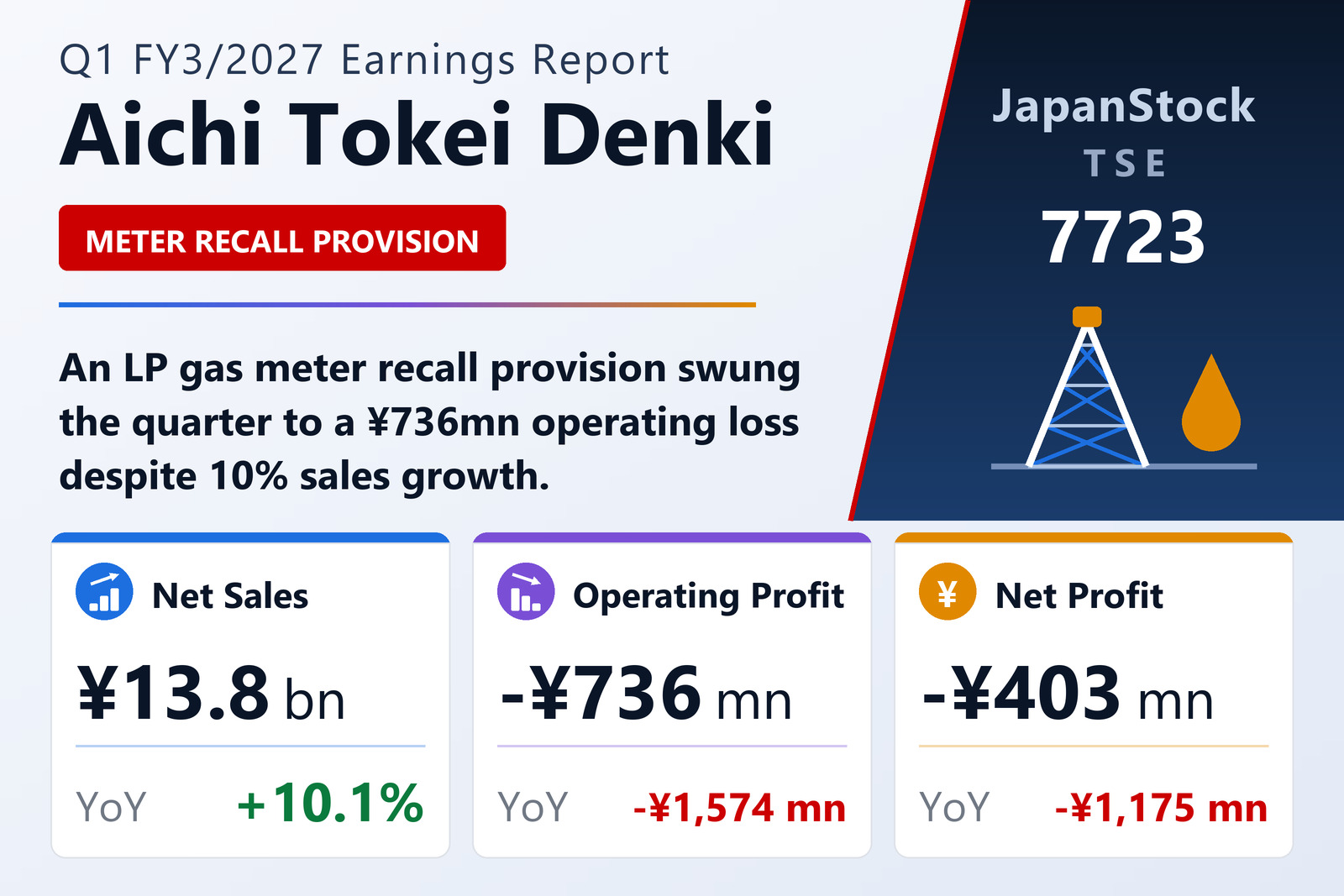
Aichi Tokei Denki Co., Ltd. (TSE: 7723; Nagoya Stock Exchange), a Nagoya-based manufacturer of gas meters, water meters and flow-measurement sensors, reported consolidated results for the first quarter of the fiscal year ending March 31, 2027 — the three months to June 30, 2026 — under Japanese GAAP. Net sales rose 10.1% to ¥13,783 million from ¥12,517 million, but the company swung to an operating loss of ¥736 million from an ¥838 million operating profit, to an ordinary loss of ¥584 million from ¥1,073 million of ordinary profit, and to a net loss attributable to owners of the parent of ¥403 million from a ¥772 million profit. Basic earnings per share were −¥26.29, against ¥50.22 a year earlier; there are no dilutive securities outstanding. Comprehensive income was a negative ¥560 million, versus positive ¥625 million.
Where the loss came from
The ¥1,574 million year-on-year deterioration at the operating line, on ¥1,266 million of extra revenue, is almost entirely an expense story — and almost all of it sits below gross profit. Selling, general and administrative expenses jumped 71.2% to ¥3,599 million from ¥2,102 million, an increase of ¥1,497 million. The company attributes the bulk of that to an additional accrual to its product-warranty provision covering remediation of a defect in certain products, a programme it began in the prior fiscal year. The provision on the balance sheet climbed ¥1,289 million during the quarter, to ¥2,418 million from ¥1,129 million at March 31, 2026 — the single largest movement anywhere in the accounts.
Gross profit did the rest of the damage, slipping 2.7% to ¥2,863 million even as sales grew a tenth. Cost of sales rose 14.0% to ¥10,919 million, outpacing revenue, and the gross margin narrowed to 20.8% from 23.5%. Management points to a shift in product mix and higher procurement prices for raw materials and components. Below the operating line the picture was steadier: non-operating income fell to ¥165 million from ¥245 million, mainly on lower dividend income of ¥122 million (against ¥202 million), while non-operating expenses were a negligible ¥13 million. A ¥180 million tax credit — a ¥206 million deferred-tax benefit against ¥25 million of current tax — narrowed the pre-tax loss of ¥584 million to the ¥403 million bottom-line loss. Notably, the company states that excluding the defect-remediation costs, both sales and every profit line were running ahead of plan.
Divisional sales: gas equipment and instrumentation drive the top line
Aichi Tokei Denki omits formal segment disclosure because the Measuring Instruments-related business accounts for almost all of the group, but it publishes divisional sales. That business generated ¥13,767 million, up 10.1%, with the rump Special Equipment business contributing ¥15 million, ¥1 million more than a year earlier. Within measuring instruments, gas-related equipment rose 12.6% to ¥7,478 million: household LP gas meters gained as replacement demand recovered, though products tied to the "Aichi Cloud" data-distribution service fell against a strong comparative quarter, while city-gas equipment advanced on Japan's continuing switch to smart meters and on exports centred on China and Taiwan.
Water-related equipment rose 2.9% to ¥4,780 million, with a solid domestic public-sector market and unusually high proceeds from scrap-meter sales — a direct benefit of higher raw-material prices — offsetting weaker exports to North America and China. The two smaller lines grew fastest: private-sector sensors and systems rose 18.6% to ¥729 million, built on the group's electromagnetic and ultrasonic flowmeters sold into factory energy-saving and environmental applications, and instrumentation rose 30.0% to ¥779 million as construction work on previously booked large projects progressed. In short, demand was not the problem this quarter; the cost of standing behind an installed base was.
The guidance cut — and what management says caused it
Aichi Tokei Denki revised the full-year FY3/2027 forecast it issued on May 8, 2026. Sales guidance is unchanged at ¥60,480 million (+2.3%), with the company saying domestic and overseas demand is tracking broadly in line with plan. Every profit line, however, was marked down because the defect-remediation costs are being charged to SG&A as an addition to the product-warranty provision. Operating profit guidance falls to ¥3,730 million from ¥4,960 million — a ¥1,230 million or 24.8% reduction, and 20.8% below the ¥4,710 million booked in FY3/2026. Ordinary profit guidance drops to ¥4,070 million from ¥5,320 million (−¥1,250 million, −23.5%; −21.9% year on year), and net profit to ¥3,570 million from ¥4,610 million (−¥1,040 million, −22.6%; −25.7% year on year). Forecast EPS falls to ¥232.70 from ¥300.49, against ¥312.16 delivered last year.
The company is unusually specific about the defect. It concerns LP gas meters, where a faulty component causes the battery voltage to drop and a warning to be displayed. Aichi Tokei Denki states there is no safety issue such as gas leakage, but says that after weighing recent incidence rates and how customers actually use the equipment, it decided to replace all commercial-use LP gas meters fitted with the component ahead of their statutory verification expiry dates. That decision — a voluntary acceleration rather than a regulatory recall — is what converts a manageable warranty line into a roughly ¥1.2 billion hit to this year's operating profit.
Dividend still rising, to ¥120.00
Despite the loss quarter and the profit downgrade, the shareholder-return plan is untouched. Aichi Tokei Denki paid ¥113.00 per share for FY3/2026 (a ¥45.00 interim plus a ¥68.00 year-end dividend) and continues to guide an annual ¥120.00 for FY3/2027, split evenly as ¥60.00 interim and ¥60.00 year-end. The filing explicitly records no revision to the dividend forecast published on May 8, 2026. On the reduced ¥232.70 EPS guidance the payout ratio works out at roughly 52%, comfortably covered, and the company's balance sheet gives it ample room to absorb the timing mismatch.
Balance sheet: fortress equity, a doubled warranty provision
Total assets fell ¥3,758 million to ¥66,526 million. Current assets dropped ¥3,968 million to ¥38,218 million, chiefly on collection of trade receivables — notes, accounts receivable and contract assets fell to ¥9,229 million from ¥12,409 million — while non-current assets edged up ¥209 million to ¥28,307 million as purchases of property, plant and equipment more than offset a decline in investment securities caused by falling share prices. Cash and deposits stood at ¥9,046 million.
Total liabilities fell to ¥15,546 million from ¥17,700 million. The ¥1,289 million increase in the product-warranty provision was more than absorbed by a ¥1,480 million reduction in income taxes payable (to ¥28 million from ¥1,508 million) and lower trade payables, at ¥3,720 million against ¥4,626 million. Net assets fell ¥1,604 million to ¥50,979 million, mainly on dividend payments out of retained earnings, but because total assets fell faster the equity ratio actually improved to 76.6% from 74.8% — one of the sturdier balance sheets among Japan's mid-cap machinery names. No quarterly cash flow statement was prepared; depreciation for the quarter, including amortisation of intangibles, was ¥307 million against ¥250 million a year earlier. The quarterly financial statements are unaudited and unreviewed, and there were no changes to the scope of consolidation or to accounting policies.
| Metric | Q1 FY3/2027 | Q1 FY3/2026 | Change |
|---|---|---|---|
| Net sales (¥ million) | 13,783 | 12,517 | +10.1% |
| Gross profit (¥ million) | 2,863 | 2,941 | −2.7% |
| SG&A expenses (¥ million) | 3,599 | 2,102 | +71.2% |
| Operating profit / (loss) (¥ million) | −736 | 838 | −¥1,574m |
| Ordinary profit / (loss) (¥ million) | −584 | 1,073 | −¥1,657m |
| Net profit / (loss) attrib. to owners (¥ million) | −403 | 772 | −¥1,175m |
| Comprehensive income (¥ million) | −560 | 625 | −¥1,185m |
| Basic EPS (¥) | −26.29 | 50.22 | −¥76.51 |
| Depreciation (¥ million) | 307 | 250 | +22.8% |
| Total assets (¥ million; vs Mar 31, 2026) | 66,526 | 70,284 | −5.3% |
| Net assets (¥ million; vs Mar 31, 2026) | 50,979 | 52,583 | −3.1% |
| Product warranty provision (¥ million; vs Mar 31, 2026) | 2,418 | 1,129 | +114.2% |
| Equity ratio (vs Mar 31, 2026) | 76.6% | 74.8% | +1.8 pt |
| FY3/2027 operating profit guidance (¥ million) | 3,730 | 4,960 | −24.8% |
| FY3/2027 EPS guidance (¥) | 232.70 | 300.49 | −22.6% |
| Annual dividend (¥) | 120.00 | 113.00 | +¥7.00 |
JapanStockPulse provides informational content only and does not constitute investment advice. Figures are taken from the company's published earnings short report and may be subject to subsequent revision.