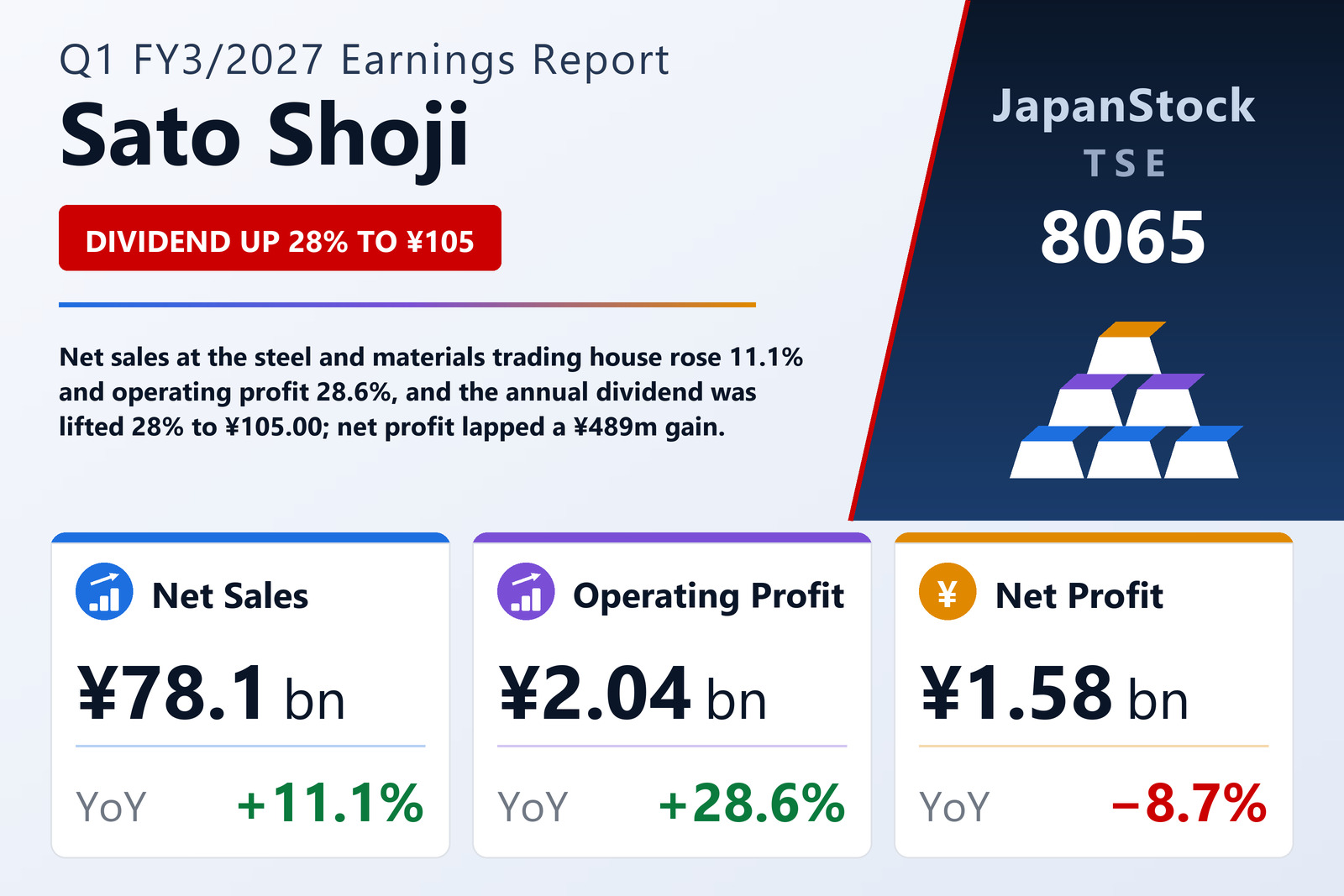
Sato Shoji Corporation (TSE: 8065), the Tokyo-based trading house that distributes steel, non-ferrous metals, electronic materials and industrial goods, reported consolidated results for the first quarter of the fiscal year ending March 2027 — the three months from April 1 to June 30, 2026 — under Japanese GAAP. Net sales rose 11.1% to ¥78,128 million, operating profit rose 28.6% to ¥2,041 million and ordinary profit rose 24.5% to ¥2,330 million. Profit attributable to owners of the parent, however, fell 8.7% to ¥1,576 million, and basic earnings per share slipped to ¥76.11 from ¥82.22. Alongside the numbers the company raised both its half-year and full-year forecasts and lifted its dividend plan for the year to ¥105.00 per share. Management described a domestic environment in which heightened tensions in the Middle East were pushing up a range of costs and slowing procurement cycles for production materials, with supply-chain risk leaving the outlook uncertain.
A new overseas segment carried the top line while steel slipped
Sato Shoji reorganised its reporting structure this quarter, from six segments to seven, carving out a new Overseas Group segment so that faster-growing offshore operations — previously split across the product-based segments — are shown in one place; domestic sites were likewise regrouped by the business segment each location belongs to, and prior-year comparatives have been restated on the new basis. On that basis the Overseas Group was the quarter's engine, with external sales up 45.0% to ¥14,735 million and segment profit up 148.8% to ¥833 million on strong sales of high-performance materials for AI servers and sharply higher shipments of components for semiconductors, LCDs and hard disk drives. Non-ferrous Metals grew external sales 43.9% to ¥9,076 million and segment profit 53.6% to ¥75 million, helped by firm commercial-vehicle demand and rising ingot prices. Electronics lifted sales 32.7% to ¥4,886 million on laminates for printed wiring boards, but segment profit fell 14.2% to ¥230 million as exports of LCD and semiconductor materials and component sales were weak. Steel — still the largest segment by far — saw external sales fall 2.3% to ¥45,019 million and segment profit fall 1.6% to ¥790 million: commercial-vehicle demand held up, but the construction-sector business lapped a large project booked in the prior year. Life Products grew sales 14.0% to ¥2,607 million with profit down 13.1% to ¥106 million on higher import costs; Machinery & Tools grew sales 4.2% to ¥825 million and narrowed its operating loss to ¥27 million from ¥54 million; Business Development saw sales fall 5.4% to ¥977 million and profit fall 49.4% to ¥31 million on soft demand.
The earnings decline sits below the ordinary-profit line
Every line down to ordinary profit improved. Gross profit rose 16.5% to ¥6,502 million — faster than the 11.1% sales gain, so the gross margin widened to 8.3% from 7.9% — while selling, general and administrative expenses rose 11.7% to ¥4,461 million, leaving the operating margin at 2.6% against 2.3%. Net non-operating income improved slightly, with non-operating income of ¥478 million (against ¥402 million, including ¥348 million of dividends received) outweighing non-operating expenses of ¥188 million (against ¥117 million, mainly ¥145 million of interest paid). The break comes at the extraordinary items. In the year-earlier quarter the company booked a ¥489 million gain on the sale of policy shareholdings in extraordinary income, which the company itself cites as the principal reason net profit fell; this year there was no comparable gain, and the quarter instead carried a ¥94 million loss on the sale of investment securities. As a result pre-tax quarterly profit fell 7.0% to ¥2,238 million from ¥2,407 million even as ordinary profit rose. Income taxes of ¥661 million, against ¥680 million, represented a slightly heavier effective rate of 29.5% versus 28.2%, taking quarterly net profit to ¥1,577 million from ¥1,727 million and profit attributable to owners of the parent to ¥1,576 million from ¥1,726 million. Earnings per share fell 7.4% — less than the 8.7% profit decline — because the weighted average share count shrank 1.4% to 20,713,763 from 21,004,471; diluted EPS was ¥75.09 against ¥80.99.
Guidance raised for both the half year and the full year
Sato Shoji revised its published forecasts upward for both periods. First-half guidance now calls for net sales of ¥160,000 million (+12.4%), operating profit of ¥4,800 million (+48.7%), ordinary profit of ¥5,100 million (+44.9%) and profit attributable to owners of ¥3,600 million (+22.8%), for interim EPS of ¥173.80. Full-year guidance calls for net sales of ¥325,000 million (+11.2%), operating profit of ¥10,300 million (+34.2%), ordinary profit of ¥10,500 million (+28.6%) and profit attributable to owners of ¥8,100 million (+23.3%), for EPS of ¥391.04. The company attributed the interim revision to Overseas Group sales and profit running ahead of plan — driven by expanding demand for AI-server high-performance materials and semiconductor components — together with solid commercial-vehicle demand and surging non-ferrous metal prices. For the second half it additionally cited an expected rise in steel prices and demand for construction work to improve working environments in response to extreme heat. Measured against the revised plan, the first quarter delivered 24.0% of forecast full-year sales but only 19.8% of forecast operating profit and 19.5% of forecast profit attributable to owners, implying the company expects margins to build through the rest of the year.
Dividend plan raised to ¥105.00, up 28% on the year
The headline shareholder-return item is a revision to the dividend forecast, flagged in the earnings release as a change from the previously announced plan. Sato Shoji now intends to pay an interim dividend of ¥50.00 and a year-end dividend of ¥55.00, for an annual total of ¥105.00 against the ¥82.00 paid for the year to March 2026 (¥38.00 interim plus ¥44.00 year-end) — an increase of ¥23.00, or 28.0%. Against forecast EPS of ¥391.04 the planned payout represents a ratio of roughly 26.9%. The company said full details of both the earnings-forecast revision and the dividend increase are set out in a separate notice released the same day, July 31, 2026, covering the revision of consolidated forecasts for the first half and the full year and of the dividend forecast.
Higher investment securities lift the equity ratio to 42.9%
Total assets ended the quarter at ¥182,592 million, up ¥1,383 million from ¥181,208 million at the March year-end, with the increase concentrated in investments and other assets, which rose ¥987 million on higher investment securities. Total liabilities fell ¥269 million to ¥103,993 million. Net assets rose ¥1,653 million to ¥78,599 million, of which retained earnings contributed ¥664 million and the valuation difference on available-for-sale securities ¥815 million. Shareholders' equity reached ¥78,312 million from ¥76,642 million and the equity ratio improved to 42.9% from 42.3%. That securities revaluation is also why comprehensive income more than doubled: total other comprehensive income of ¥988 million — the ¥815 million securities gain plus ¥171 million of foreign-currency translation adjustment — against negative ¥466 million a year earlier took comprehensive income to ¥2,565 million, up 103.5% from ¥1,260 million. Depreciation for the quarter was ¥332 million against ¥300 million; no quarterly consolidated statement of cash flows was prepared. The company reported no material change to the scope of consolidation, no changes in accounting policies or estimates and no restatements, and the quarterly consolidated financial statements were not subject to review by a certified public accountant or an audit firm.
| Metric | Q1 FY3/2027 | Q1 FY3/2026 | YoY |
|---|---|---|---|
| Net sales (¥ million) | 78,128 | 70,329 | +11.1% |
| Gross profit (¥ million) | 6,502 | 5,579 | +16.5% |
| SG&A expenses (¥ million) | 4,461 | 3,992 | +11.7% |
| Operating profit (¥ million) | 2,041 | 1,587 | +28.6% |
| Operating margin (%) | 2.6 | 2.3 | +0.3 pt |
| Ordinary profit (¥ million) | 2,330 | 1,871 | +24.5% |
| Pre-tax quarterly profit (¥ million) | 2,238 | 2,407 | −7.0% |
| Profit attributable to owners of parent (¥ million) | 1,576 | 1,726 | −8.7% |
| Basic EPS (¥) | 76.11 | 82.22 | −7.4% |
| Diluted EPS (¥) | 75.09 | 80.99 | −7.3% |
| Comprehensive income (¥ million) | 2,565 | 1,260 | +103.5% |
| Total assets (¥ million, vs FY3/26 year-end) | 182,592 | 181,208 | +0.8% |
| Net assets (¥ million, vs FY3/26 year-end) | 78,599 | 76,945 | +2.1% |
| Shareholders' equity (¥ million, vs FY3/26 year-end) | 78,312 | 76,642 | +2.2% |
| Equity ratio (%, vs FY3/26 year-end) | 42.9 | 42.3 | +0.6 pt |
| FY3/27 net sales guidance (¥ million) | 325,000 | — | +11.2% |
| FY3/27 operating profit guidance (¥ million) | 10,300 | — | +34.2% |
| FY3/27 ordinary profit guidance (¥ million) | 10,500 | — | +28.6% |
| FY3/27 profit attributable to owners guidance (¥ million) | 8,100 | — | +23.3% |
| FY3/27 EPS guidance (¥) | 391.04 | — | — |
| Annual dividend (¥, FY3/27 forecast vs FY3/26 actual) | 105.00 | 82.00 | +¥23.00 |
JapanStockPulse provides informational content only and does not constitute investment advice. Figures are taken from the company's published earnings short report and may be subject to subsequent revision.