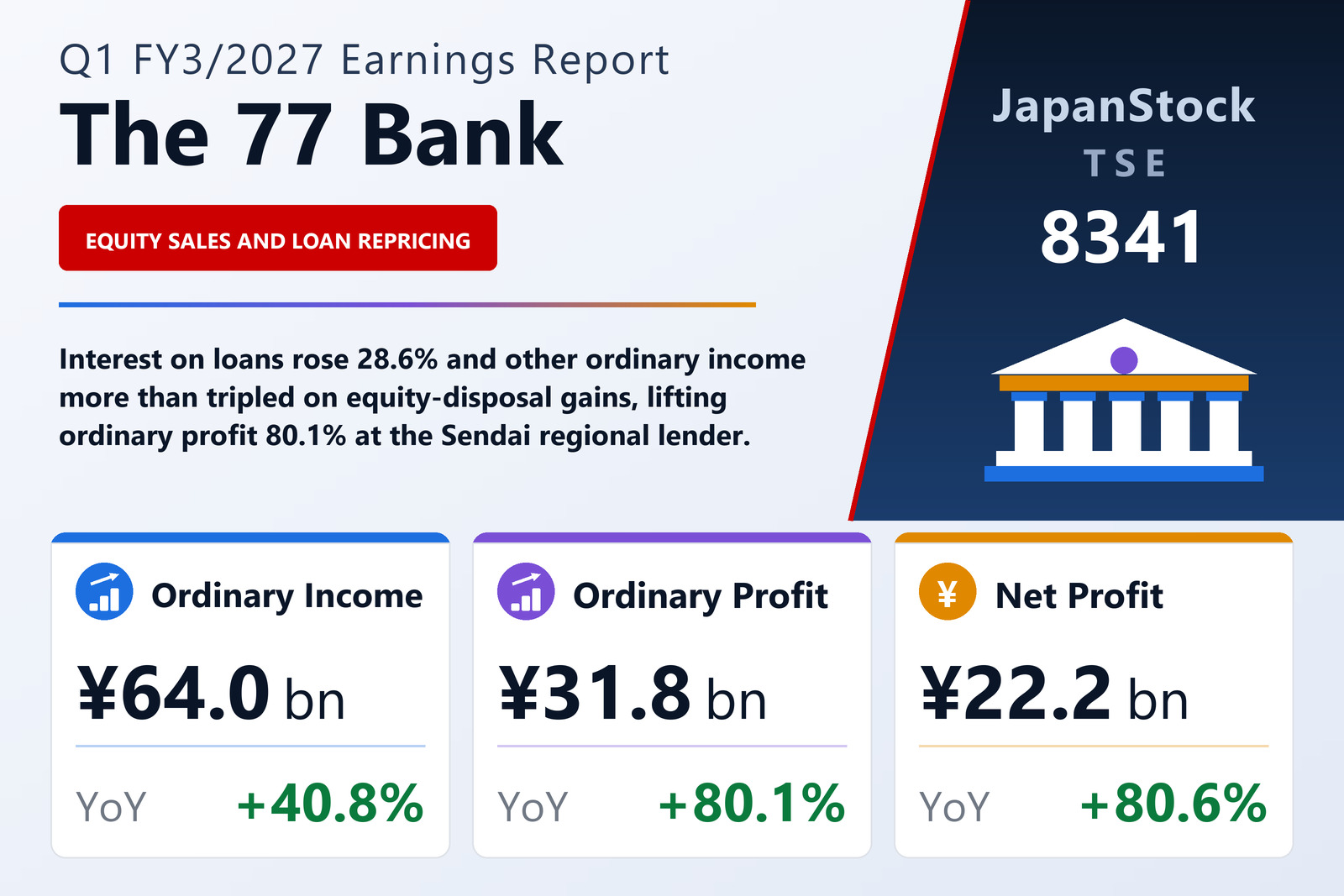
The 77 Bank, Ltd. (TSE: 8341), the Sendai-based regional lender that anchors the banking market of Miyagi Prefecture and is listed on both the Tokyo and Sapporo exchanges, reported consolidated results for the first quarter of the fiscal year ending March 2027 — the three months from April 1 to June 30, 2026 — under Japanese GAAP. Ordinary income rose 40.8% to ¥63,975 million, ordinary profit rose 80.1% to ¥31,789 million and profit attributable to owners of the parent rose 80.6% to ¥22,204 million. Basic earnings per share were ¥99.52 against ¥55.20 a year earlier, with no diluted figure reported. The bank made no revision to the full-year forecast it published on May 13, 2026, saying results are broadly tracking plan.
Interest income and equity disposals drove a 41% jump in the top line
The ¥18,565 million increase in ordinary income came from two places. Interest income rose 23.8% to ¥39,496 million from ¥31,898 million, split between interest on loans, up 28.6% to ¥22,934 million, and interest and dividends on securities, up 20.6% to ¥15,556 million. The larger proportional move was in other ordinary income, which more than tripled to ¥14,446 million from ¥3,934 million on gains from the sale of equities. Fees and commissions income contributed ¥6,300 million, up 10.6%. The bank's supplementary presentation shows where the interest line came from on a non-consolidated basis: net interest income rose 18.9% to ¥33.6 billion, with the average yield on loans widening to 1.38% from 1.15% while the average loan balance grew 7.3% to ¥6,648.0 billion, and the average yield on securities rising to 2.38% from 1.95%.
Deposit costs and bond losses took part of it back
Ordinary expenses rose 15.9% to ¥32,185 million from ¥27,764 million, a ¥4,421 million increase. Funding costs rose 54.4% to ¥6,833 million, with interest on deposits up 59.9% to ¥5,857 million as the average cost of deposits climbed to 0.27% from 0.17% — the other side of the same rate cycle that lifted loan yields. Other operating expenses rose 40.7% to ¥10,814 million from ¥7,685 million on larger losses from sales of Japanese government and other bonds; on a non-consolidated basis, gains and losses on bonds swung to a ¥7.0 billion loss from a ¥2.7 billion loss. Working the other way, general and administrative expenses fell 2.0% to ¥13,120 million and other ordinary expenses fell to ¥320 million from ¥1,544 million as credit costs turned into a small net reversal — a ¥0.1 billion credit against ¥1.6 billion of cost a year earlier, a ¥1.7 billion swing. With core gross business profit of ¥36.9 billion against non-consolidated expenses of ¥12.4 billion, the core overhead ratio fell to 33.52% from 40.04%.
Comprehensive income of ¥76.7 billion is not the same as profit
Comprehensive income more than doubled to ¥76,689 million from ¥37,543 million — roughly 3.5 times the ¥22,204 million of net profit — and the gap is not earnings. Net unrealised gains on available-for-sale securities added ¥54,720 million to other comprehensive income during the quarter, against ¥25,154 million a year earlier; deferred hedge gains of ¥24 million and a ¥260 million negative remeasurement on retirement benefits took total other comprehensive income to ¥54,484 million. These are mark-to-market movements booked directly in equity rather than realised income, and they reverse if markets fall. The scale is visible in the bank's disclosure of unrealised valuation gains on its securities book: ¥281.7 billion at June 30, against ¥202.1 billion at the March year-end and ¥99.1 billion a year before that, with equities alone accounting for ¥235.8 billion and investment trusts and other holdings a further ¥113.5 billion. The bond portfolio, by contrast, carried an ¥81.1 billion unrealised loss. Over the quarter the Nikkei 225 rose to 70,062 from 51,063 while the 10-year JGB yield rose to 2.68% from 2.34%.
Large-corporate lending drove a 7.4% expansion in the loan book
Total assets grew 0.8% to ¥10,514,778 million from ¥10,432,807 million at the March year-end. Deposits including negotiable certificates of deposit rose ¥51.8 billion to ¥8,999.8 billion on growth in personal and public-sector deposits; loans rose ¥80.0 billion to ¥6,683.9 billion on demand from large corporates; and securities rose ¥54.7 billion to ¥3,023.5 billion on additions to equities and investment trusts. On a period-end, non-consolidated, year-on-year basis the loan book was 7.4% larger at ¥6,708.8 billion, with lending to large corporates up 16.8% to ¥1,889.4 billion, to small and medium-sized enterprises up 6.6% to ¥2,944.2 billion and to individuals up 3.6% to ¥1,417.7 billion, while lending to local government bodies fell 7.7% to ¥457.5 billion. Net assets rose 9.5% to ¥757,674 million from ¥691,904 million, and the ratio of net assets to total assets improved to 7.2% from 6.6%. That figure is simply period-end net assets divided by period-end total assets; the bank states explicitly that it is not the capital adequacy ratio defined by Japan's capital-adequacy notification, so it should not be read as a Basel capital measure. Disclosed non-performing loans under the Financial Reconstruction Act stood at ¥126.2 billion, a ratio of 1.85% against 1.86% at the March year-end.
Full-year guidance unchanged after a 36% first-quarter run rate
The bank left the forecast published on May 13 intact. For the six months to September it guides ordinary profit of ¥44,500 million, up 26.4%, profit attributable to owners of ¥31,000 million, up 27.5%, and earnings per share of ¥138.95. For the full year it guides ordinary profit of ¥89,500 million, up 14.0%, net profit of ¥61,500 million, up 13.8%, and earnings per share of ¥275.66. As is customary for Japanese banks, no top-line forecast is given. Measured against that plan, the first quarter delivered 35.5% of the full-year ordinary-profit target and 36.1% of the net-profit target — a front-loaded start that reflects the timing of the equity disposals more than a run rate the bank is guiding to. There were no extraordinary gains and no material extraordinary losses; the effective tax rate was 30.1% against 30.4%. The group reports a single segment, banking, with leasing and other financial services treated as immaterial. No consolidated cash-flow statement was prepared for the period; depreciation was ¥603 million against ¥642 million. There was no material change to the scope of consolidation, no change in accounting policies or estimates, and the quarterly consolidated financial statements were not subject to review by a certified public accountant or an audit firm.
The ¥104.00 dividend forecast is post-split, not a cut
On April 1, 2026 the bank carried out a 3-for-1 split of its common shares. Per-share earnings are restated as if the split had occurred at the start of the prior fiscal year, so the ¥99.52 against ¥55.20 comparison is like-for-like. The dividend figures are not on that basis. For the year ended March 2026 the bank paid an interim ¥113.00 and a year-end ¥147.00 for an annual ¥260.00, and the release states those are the actual amounts paid before the split. The FY3/27 forecast, unchanged from the previous announcement, is an interim ¥52.00 and a year-end ¥52.00 for an annual ¥104.00, on a post-split basis. Placed side by side the two numbers look like a 60% reduction; adjusted for the split they are not. The ¥260.00 paid last year is equivalent to ¥86.67 on the new share count, so the ¥104.00 forecast is a 20.0% increase — or, expressed the other way, ¥104.00 post-split is equivalent to ¥312.00 before the split. Against forecast earnings per share of ¥275.66 the annual dividend implies a payout ratio of about 37.7%. Shares issued including treasury stock were 229,967,238 at the quarter-end, restated for the split and unchanged from the year-end; treasury shares fell to 6,764,206 from 6,868,968, and the weighted-average share count for the quarter was 223,103,898.
| Metric | Q1 FY3/2027 | Q1 FY3/2026 | YoY |
|---|---|---|---|
| Ordinary income (¥ million) | 63,975 | 45,410 | +40.8% |
| Interest income (¥ million) | 39,496 | 31,898 | +23.8% |
| — Interest on loans (¥ million) | 22,934 | 17,835 | +28.6% |
| — Interest and dividends on securities (¥ million) | 15,556 | 12,896 | +20.6% |
| Fees and commissions income (¥ million) | 6,300 | 5,696 | +10.6% |
| Other ordinary income (¥ million) | 14,446 | 3,934 | +267.2% |
| Ordinary expenses (¥ million) | 32,185 | 27,764 | +15.9% |
| — Funding costs (¥ million) | 6,833 | 4,426 | +54.4% |
| — General and administrative expenses (¥ million) | 13,120 | 13,387 | −2.0% |
| Ordinary profit (¥ million) | 31,789 | 17,646 | +80.1% |
| Profit attributable to owners of parent (¥ million) | 22,204 | 12,289 | +80.6% |
| Basic EPS (¥, split-adjusted) | 99.52 | 55.20 | +80.3% |
| Comprehensive income (¥ million) | 76,689 | 37,543 | +104.2% |
| Total assets (¥ million, vs FY3/26 year-end) | 10,514,778 | 10,432,807 | +0.8% |
| Net assets (¥ million, vs FY3/26 year-end) | 757,674 | 691,904 | +9.5% |
| Net assets / total assets (%, not a regulatory capital ratio) | 7.2 | 6.6 | +0.6 pt |
| FY3/27 H1 ordinary profit guidance (¥ million) | 44,500 | — | +26.4% |
| FY3/27 H1 net profit guidance (¥ million) | 31,000 | — | +27.5% |
| FY3/27 full-year ordinary profit guidance (¥ million) | 89,500 | — | +14.0% |
| FY3/27 full-year net profit guidance (¥ million) | 61,500 | — | +13.8% |
| FY3/27 full-year EPS guidance (¥) | 275.66 | — | — |
| FY3/27 annual dividend forecast (¥, post-split basis) | 104.00 | 86.67 | +20.0% |
| FY3/26 annual dividend paid (¥, pre-split basis) | — | 260.00 | — |
JapanStockPulse provides informational content only and does not constitute investment advice. Figures are taken from the company's published earnings short report and may be subject to subsequent revision.