A March 20 year-end, and a quarter measured against a boom
Yamato Corporation (TSE: 1967), a Gunma-based construction contractor specialising in plumbing, HVAC and building-equipment work, disclosed consolidated first-quarter results for the fiscal year ending March 2027 under Japanese GAAP on August 3, 2026. One detail governs every comparison that follows: Yamato's fiscal year ends on 20 March, not 31 March. The quarter under review therefore runs from March 21 to June 20, 2026, and the full year runs to March 20, 2027 — so this filing captures a slightly earlier slice of the calendar than a standard Japanese first quarter.
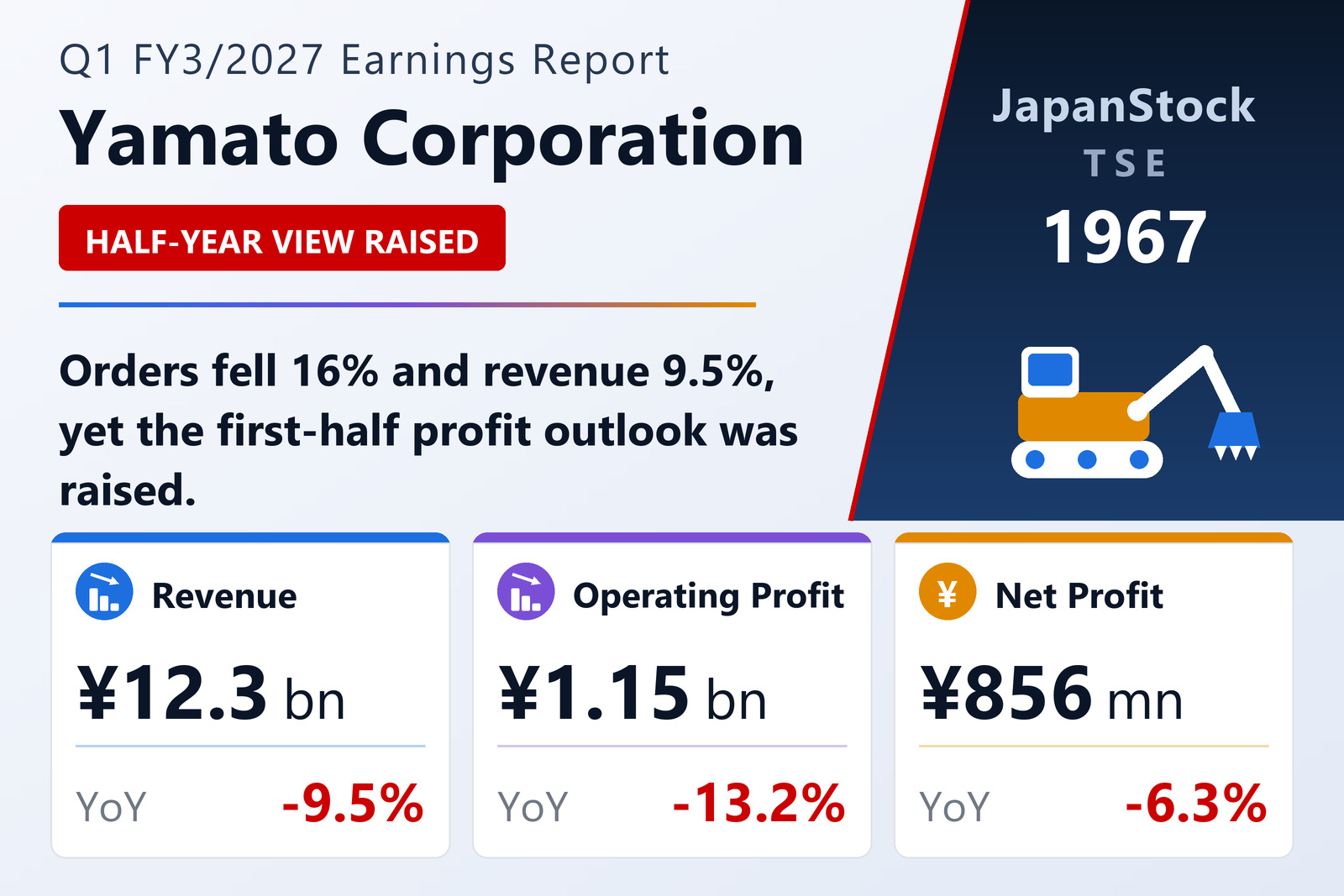
Every headline line fell. Revenue came in at ¥12,297 million, down 9.5% from ¥13,582 million. Operating profit fell 13.2% to ¥1,154 million from ¥1,330 million, ordinary profit fell 15.2% to ¥1,212 million from ¥1,430 million, and net profit attributable to owners of parent fell 6.3% to ¥856 million from ¥914 million. Orders received, the leading indicator for a contractor, fell hardest of all — down 15.6% to ¥13,106 million.
The base matters more than the direction here. In the same quarter a year earlier, revenue had grown 13.5%, operating profit 68.6%, ordinary profit 60.5% and net profit 50.3%. This is a decline against a boom, not against a normal quarter: the ¥1,154 million of operating profit this year still sits comfortably above the ¥789 million the same period implied two years ago at that 68.6% growth rate. The operating margin held up better than the absolute figures suggest, at 9.4% against 9.8%, so the shortfall came far more from volume than from pricing or cost control.
Why net profit fell only 6.3% when ordinary profit fell 15.2%
Three things happened below the operating line, and each narrowed the decline. First, non-operating income was thinner (¥83 million against ¥120 million) while non-operating expenses were roughly flat, which is what pushed the ordinary-profit fall (15.2%) below the operating line. Second, extraordinary items swung sharply in the company's favour: a ¥41.9 million gain on the sale of investment securities against just ¥0.6 million of extraordinary losses this year, versus ¥24.3 million of extraordinary losses a year earlier (¥4.5 million of impairment and ¥19.8 million on fixed-asset disposals). Pre-tax profit therefore fell only 10.8%, to ¥1,254 million from ¥1,406 million. Third, the effective tax burden eased: total income taxes of ¥389 million against ¥482 million, an effective rate of 31.0% versus 34.3%. After ¥9 million attributable to non-controlling interests, the bottom line was down just 6.3%.
Then comes the line that moved the other way entirely. Earnings per share rose to ¥38.25 from ¥36.86, up 3.8%, on a net profit that fell 6.3%. The arithmetic is the share count: the weighted-average number of shares for the quarter was 22,385,819 against 24,804,370 a year earlier, a 9.8% reduction following share repurchases. Shares issued stood at 24,127,652 with 1,741,921 held in treasury at the quarter-end. There is no diluted figure. Comprehensive income, meanwhile, was the one growth line on the whole statement — ¥1,540 million, up 81.3% from ¥850 million — but that owes almost everything to a ¥695 million positive movement in the valuation difference on available-for-sale securities, against a ¥55 million negative movement a year earlier. It is a mark-to-market swing on the investment portfolio, not trading performance.
Construction carries the group; the roadside station carries the growth rate
Yamato reports two segments, and the filing states its segment figures before inter-segment eliminations. Construction, the core business, produced revenue of ¥12,147 million, down 9.6%, and segment (operating) profit of ¥1,114 million, down 14.5% — roughly 99% of group revenue, and a segment margin of 9.2% against 9.7%. Commercial Facility Operation, which consists of the "Michi-no-Eki Maebashi Akagi" roadside station the group runs, produced revenue of ¥153 million, essentially unchanged at +0.0%, and segment profit of ¥40 million, up 46.4% from ¥27 million.
The small segment is the more interesting of the two in percentage terms. Flat revenue and a 46.4% profit increase means the roadside station's operating margin widened from 18.1% to 26.6% — a margin gain achieved on identical turnover, which points to mix or cost management inside the facility rather than to footfall. It remains too small to move the group: at ¥40 million it is 3.5% of consolidated operating profit. Inter-segment eliminations amounted to just ¥3 million of revenue.
Orders down 15.6%, with plumbing and HVAC the drag
The order book is where the quarter's real information sits, and the company's supplementary breakdown shows the decline was concentrated rather than general. Consolidated orders received totalled ¥13,106 million against ¥15,532 million, down 15.6%. Within that, the group's largest category — plumbing and HVAC, at 61.7% of all orders — fell 17.1% to ¥8,092 million, and that single line accounts for roughly ¥1,668 million of the ¥2,426 million total decline. Building and civil engineering fell hardest in percentage terms, down 40.2% to ¥482 million, and refrigeration and cold storage fell 29.4% to ¥677 million. Electrical and telecommunications was comparatively resilient, down 6.7% to ¥2,509 million and gaining share within the mix, from 17.3% to 19.1%.
Only one line grew: water-treatment plant, up 3.3% to ¥1,194 million, lifting its share of orders to 9.1% from 7.4%. The construction subtotal fell 15.8% to ¥12,953 million, while the roadside station's ¥153 million was flat. On a parent-only basis orders fell 14.8% to ¥11,005 million. One consolation for the backlog: at ¥13,106 million of orders against ¥12,297 million of revenue, the book-to-bill ratio was still above 1.0 — the order book grew slightly during the quarter even as intake fell year on year.
Debt repaid, cash built, equity ratio up to 71.4%
The balance sheet moved in the direction shareholders generally want. Total assets stood at ¥60,231 million at June 20, 2026, down ¥1,535 million (2.5%) from ¥61,766 million at the March 20 year-end, mainly on lower notes and accounts receivable from completed construction contracts and lower contract assets. Total liabilities fell ¥1,810 million (9.6%) to ¥17,100 million, chiefly on reduced short-term borrowings. Net assets rose ¥275 million (0.6%) to ¥43,130 million, as a higher valuation difference on available-for-sale securities and the quarter's profit outweighed dividends paid out of retained earnings.
Two line items tell the story more plainly than the totals. Cash and deposits rose to ¥12,452 million from ¥8,352 million — up ¥4,100 million — while short-term borrowings fell to ¥645 million from ¥3,450 million, a ¥2,805 million repayment. The company paid down roughly ¥2.8 billion of debt and still added ¥4.1 billion of cash in a single quarter, which is what a contractor's balance sheet looks like when receivables and contract assets convert. Shareholders' equity reached ¥42,998 million from ¥42,731 million, taking the equity ratio to 71.4% from 69.2%, and net assets per share to ¥1,920.79 from ¥1,908.83. No quarterly consolidated cash-flow statement was prepared; the filing discloses depreciation of ¥149 million, goodwill amortisation of ¥5 million and customer-related asset amortisation of ¥9 million for the period.
Interim forecast raised, full year held — a smaller decline, not growth
The guidance response to a down quarter was, unusually, to raise part of it. Taking recent trends and the outlook into account, Yamato revised its first-half forecast upward in a separate release published the same day, "Notice of Revision to Earnings Forecast", while leaving the full-year consolidated outlook unchanged from the figures published with the May 7, 2026 tanshin. The revised first half calls for revenue of ¥26,500 million (+0.4%), operating profit of ¥2,200 million (−9.1%), ordinary profit of ¥2,500 million (−9.4%), net profit of ¥2,000 million (−8.6%) and EPS of ¥89.33. The unchanged full year calls for revenue of ¥55,000 million (+1.2%), operating profit of ¥4,800 million (−11.1%), ordinary profit of ¥5,200 million (−15.0%), net profit of ¥4,300 million (−6.3%) and EPS of ¥192.08.
Read the shape of those numbers carefully, because "raised" does not mean "growing": every raised first-half profit line still sits below last year's first half. What the company upgraded was the size of the expected decline, not the direction. The progress arithmetic is undemanding either way. Q1's ¥1,154 million of operating profit is 52% of the ¥2,200 million first-half target and 24% of the ¥4,800 million full-year target — meaning the raised interim guide implies a second quarter of only about ¥1,046 million, below the quarter just reported, and the second half is guided to ¥2,600 million against a first half of ¥2,200 million.
On returns, the dividend forecast for the year to March 2027 is ¥77.00 per share, paid entirely at the year-end with no interim payment, against ¥60.00 for the prior year — an increase of ¥17.00, or 28.3%, on guided earnings that fall 6.3%. That implies a payout ratio of about 40% on forecast EPS of ¥192.08, and the dividend forecast was left unrevised from the prior announcement. Set beside the buybacks that lifted first-quarter EPS, the shareholder-return posture is markedly more expansionary than the earnings trajectory.
Strategy: industrialising the building site
Management frames the year through a long-term plan rather than the quarter. The group has set a 2035 long-term vision — "Building the future with construction products" — with the stated aim of becoming the leading company in construction industrialisation by 2035, and has drawn up a medium-term plan covering 2026 to 2028. Under it, the "Yamato Techno Park" facility is being brought on stream to deepen the industrialisation of on-site work, alongside human-capital and DX investment aimed at raising productivity. For a plumbing and HVAC contractor facing a shortage of skilled workers, shifting labour off the site and into a controlled facility is the direct structural answer to the cost problem.
The operating environment is doing little to help in the meantime. Public investment held firm and private capital spending continued to recover, but construction material prices and labour costs kept rising, project schedules lengthened, skilled workers remained scarce and work-style reform demands ongoing adjustment — which is why management describes the outlook for the group's environment as still not one for optimism. More broadly, it flags price increases, persistently high energy costs and heightened geopolitical risk from Middle East tensions as clouding the domestic and overseas economic picture. On the technical notes: there was no significant change in the scope of consolidation, no special accounting treatments applied to the quarterly statements and no changes in accounting policy or estimates, and the quarterly consolidated financial statements were not reviewed by a certified public accountant or audit firm.
| Metric | Q1 FY3/2027 | Q1 FY3/2026 | Change |
|---|---|---|---|
| Revenue (¥ million) | 12,297 | 13,582 | −9.5% |
| Operating profit (¥ million) | 1,154 | 1,330 | −13.2% |
| Operating margin | 9.4% | 9.8% | −0.4 pt |
| Ordinary profit (¥ million) | 1,212 | 1,430 | −15.2% |
| Pre-tax profit (¥ million) | 1,254 | 1,406 | −10.8% |
| Net profit attrib. to owners of parent (¥ million) | 856 | 914 | −6.3% |
| Comprehensive income (¥ million) | 1,540 | 850 | +81.3% |
| EPS (¥) | 38.25 | 36.86 | +3.8% |
| Weighted-average shares | 22,385,819 | 24,804,370 | −9.8% |
| Orders received (¥ million) | 13,106 | 15,532 | −15.6% |
| Construction revenue (¥ million) | 12,147 | 13,431 | −9.6% |
| Construction segment profit (¥ million) | 1,114 | 1,303 | −14.5% |
| Commercial Facility Operation revenue (¥ million) | 153 | 153 | +0.0% |
| Commercial Facility Operation profit (¥ million) | 40 | 27 | +46.4% |
| Total assets (¥ million; vs Mar 20, 2026) | 60,231 | 61,766 | −2.5% |
| Net assets (¥ million; vs Mar 20, 2026) | 43,130 | 42,855 | +0.6% |
| Equity ratio (vs Mar 20, 2026) | 71.4% | 69.2% | +2.2 pt |
| Net assets per share (¥; vs Mar 20, 2026) | 1,920.79 | 1,908.83 | +0.6% |
JapanStockPulse provides informational content only and does not constitute investment advice. Figures are taken from the company's published earnings short report and may be subject to subsequent revision.