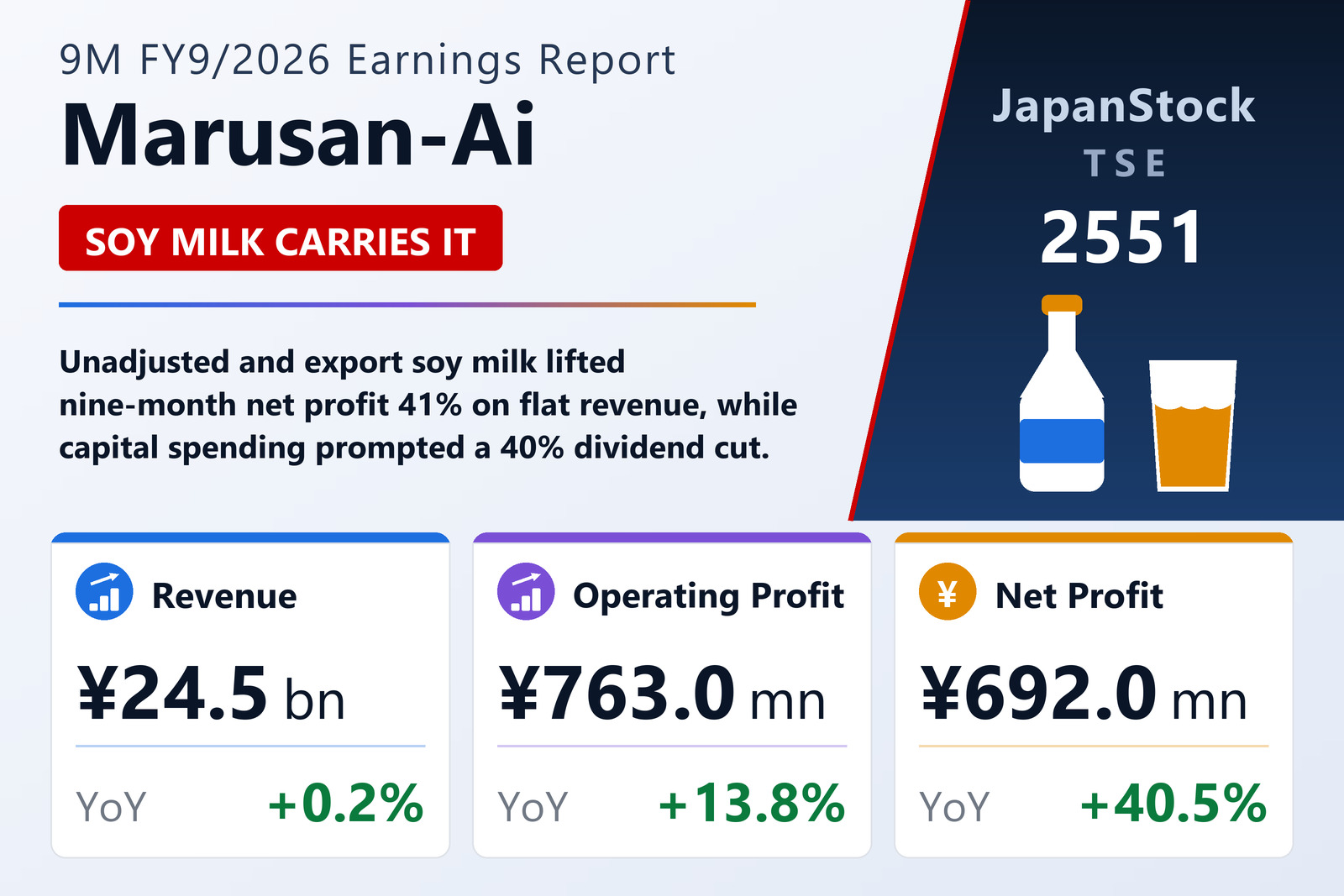
Marusan-Ai Co., Ltd. (NSE: 2551) reported consolidated results for the nine months from September 21, 2025 to June 20, 2026 under Japanese GAAP. Revenue was essentially flat, up 0.2% to ¥24,532 million, but profitability improved sharply down the income statement: operating profit rose 13.8% to ¥763 million, recurring profit 23.6% to ¥812 million — helped by foreign-exchange gains on top of the operating improvement — and profit attributable to owners of the parent 40.5% to ¥692 million. Earnings per share jumped to ¥309.05 from ¥217.83, and comprehensive income rose 77.0% to ¥782 million. The company notes that while Japan's economy is recovering gradually, downside risks from Middle East developments and financial-market volatility still warrant caution.
Soy milk grows, miso shrinks by design
The Soy Milk & Beverages business — 88% of group revenue — grew 4.5% to ¥21,524 million. Within it, soy milk rose 4.7% to ¥18,946 million on steady demand for unadjusted soy milk and exports, while beverages added 3.1% to ¥2,578 million, led by almond drinks. Marusan-Ai describes the soy-milk market as progressing soundly, with rising health consciousness and broader interest in plant-based foods driving repeat purchase and wider use in cooking. The Miso business fell 48.5% to ¥932 million — not a demand failure but a deliberate portfolio move: as of March 2025 the group consolidated miso operations into subsidiaries and has since cut the number of SKUs and pursued a profit-focused sales strategy. The miso market itself, the company says, is stable in size even as volumes decline. Other Foods edged up 0.5% to ¥2,076 million on the "Tonyu Gurt" soy-yoghurt range, and there were no royalty or technical-guidance receipts this period against ¥0 million a year earlier.
| Business | Revenue (¥ million) | YoY |
|---|---|---|
| Soy Milk & Beverages | 21,524 | +4.5% |
| — of which soy milk | 18,946 | +4.7% |
| — of which beverages | 2,578 | +3.1% |
| Miso | 932 | -48.5% |
| Other Foods | 2,076 | +0.5% |
| Consolidated | 24,532 | +0.2% |
The balance sheet is being spent on capacity
Total assets rose ¥2,333 million to ¥29,355 million, and almost all of it sits in fixed assets, which grew ¥2,342 million to ¥15,560 million — driven by a ¥1,433 million increase in construction in progress. Current assets were flat at ¥13,795 million (down ¥9 million), with inventories up ¥268 million and cash up ¥126 million against a ¥601 million fall in receivables. That capital spending is being debt-funded: current liabilities rose ¥922 million to ¥13,256 million on a ¥1,100 million increase in short-term borrowings, and long-term liabilities rose ¥740 million to ¥8,410 million on a ¥772 million increase in long-term borrowings, taking total liabilities to ¥21,667 million. Net assets improved ¥670 million to ¥7,688 million on ¥580 million of retained-earnings growth, leaving the equity ratio at just 26.2%, up marginally from 26.0% — a far more leveraged profile than most of the Japanese food sector.
Guidance held; the dividend is where the story turns
Marusan-Ai made no change to the full-year forecast published on May 1, 2026: revenue of ¥32,886 million (flat), operating profit of ¥893 million (+4.2%), recurring profit of ¥973 million (+13.5%) and profit attributable to owners of ¥817 million (+14.7%), for EPS of ¥356.03. With ¥692 million already booked in nine months, the company needs only ¥125 million in the final quarter to reach the net-profit target. The dividend, however, is forecast at ¥30.00 per share for FY9/2026 against ¥50.00 paid for FY9/2025 — a 40% reduction — with the forecast unrevised from the prior announcement. Read alongside the ¥1.9 billion of new borrowings and the plant investment in construction in progress, the picture is of a company choosing to fund capacity for soy-milk growth ahead of shareholder returns. Marusan-Ai applies special accounting treatments permitted for quarterly consolidated statements; there were no changes to accounting policies or estimates. Shares issued were unchanged at 2,296,176.
| Metric | 9M FY9/2026 | 9M FY9/2025 | YoY |
|---|---|---|---|
| Revenue (¥ million) | 24,532 | 24,473 | +0.2% |
| Operating profit (¥ million) | 763 | 670 | +13.8% |
| Recurring profit (¥ million) | 812 | 657 | +23.6% |
| Profit attributable to owners (¥ million) | 692 | 493 | +40.5% |
| Comprehensive income (¥ million) | 782 | 442 | +77.0% |
| EPS (¥) | 309.05 | 217.83 | +41.9% |
| Total assets (¥ million) | 29,355 | 27,022 | +8.6% |
| Net assets (¥ million) | 7,688 | 7,017 | +9.6% |
| Equity ratio (%) | 26.2 | 26.0 | +0.2pt |
| Annual dividend per share (¥) | 30.00 | 50.00 | -40.0% |
| FY9/2026 guidance — revenue (¥ million) | 32,886 | — | +0.0% |
| FY9/2026 guidance — operating profit (¥ million) | 893 | — | +4.2% |
| FY9/2026 guidance — net profit (¥ million) | 817 | — | +14.7% |
JapanStockPulse provides informational content only and does not constitute investment advice. Figures are taken from the company’s published earnings short report and may be subject to subsequent revision.