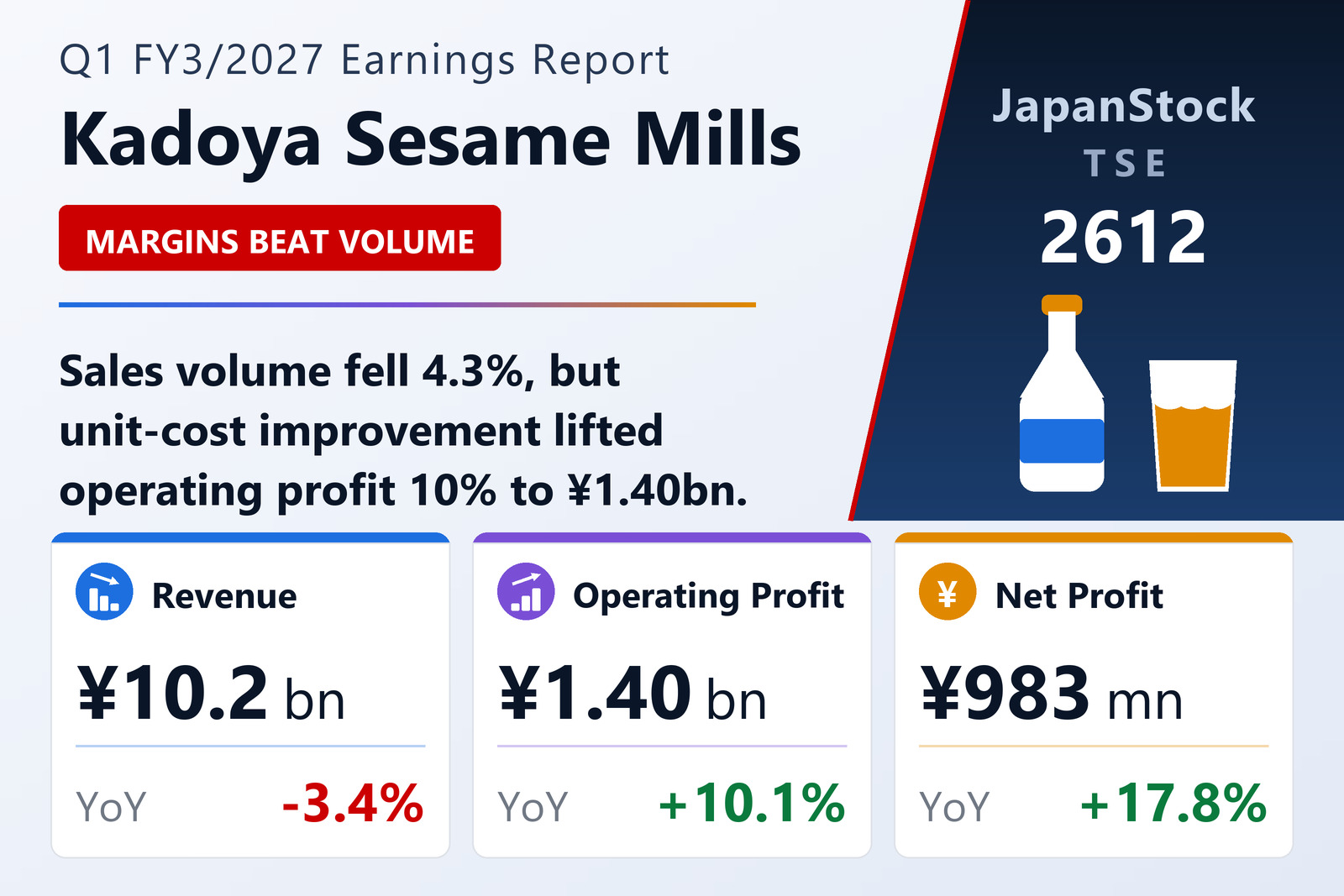
Lower revenue, higher profit — and the margin did all the work
Kadoya Sesame Mills Incorporated (TSE: 2612), Japan's leading sesame-oil maker and the company behind the country's best-known "Pure Sesame Oil" brand, disclosed consolidated results for the first quarter of the fiscal year ending March 2027 — April 1 to June 30, 2026 — under J-GAAP on August 3, 2026. Revenue came in at ¥10,203 million, down 3.4% from ¥10,566 million a year earlier, which had itself grown 10.0%. Every profit line moved the other way: operating profit rose 10.1% to ¥1,397 million, an increase of ¥129 million; ordinary profit rose 17.0% to ¥1,450 million, up ¥211 million; and net profit attributable to owners of parent rose 17.8% to ¥983 million, up ¥149 million.
The composition of the revenue decline is the key to reading the rest of the statement. Sales volume fell 4.3% while the average unit selling price rose 0.9% — so the shortfall was almost entirely a volume story, with pricing a small offset rather than a drag. That distinction matters for a branded food maker in a market where price revisions have been running across the whole industry: Kadoya lost cases, not price.
Earnings per share were ¥35.63 against ¥30.23 a year earlier, up 17.9%, with no diluted figure disclosed. Both periods are stated on a post-split basis: the company carried out a 3-for-1 split of its common stock effective April 1, 2026, and per-share figures for the prior year are restated as though the split had occurred at the start of that year. The one profit line that fell was comprehensive income, at ¥849 million against ¥895 million, down 5.1% — the difference sits in other comprehensive income, where a ¥133 million negative swing in the valuation of available-for-sale securities turned the prior year's ¥61 million gain into a ¥134 million loss. The quarterly consolidated statements were not reviewed by an accounting auditor, and no results briefing was held, though supplementary materials were published alongside the filing.
Gross margin widens 4.5 points as cost of sales falls 9.4%
Cost of sales fell to ¥6,929 million from ¥7,648 million, a 9.4% decline against a revenue decline of only 3.4%. That gap produced gross profit of ¥3,273 million, up 12.2%, and lifted the gross margin to 32.1% from 27.6% — a widening of 4.5 percentage points on a quarter with less revenue in it. The company attributes the improvement to two things working together: the lower sales volume itself, and a genuine improvement in cost per unit of product. Subsidiary-material costs and personnel costs both rose, and energy and materials prices stayed at high levels, but neither was enough to offset the unit-cost gain.
Selling, general and administrative expenses moved the other way, rising 13.7% to ¥1,876 million from ¥1,650 million — faster than any other line on the income statement, and enough to push the SG&A ratio to 18.4% of revenue from 15.6%. The company names three drivers: fees paid to outside experts for strengthening the management base and improving operations, higher personnel costs, and higher logistics costs. Net of all that, the operating margin still improved to 13.7% from 12.0%, and the ¥355 million of extra gross profit comfortably covered the ¥226 million of extra overhead.
The reason ordinary profit grew faster than operating profit — 17.0% against 10.1% — is a foreign-exchange swing below the operating line rather than anything in the trading business. Non-operating income of ¥54 million this quarter included a ¥23 million FX gain, against ¥28 million of non-operating income a year earlier that carried no FX gain at all; and non-operating expenses collapsed to effectively nil from ¥56 million, of which ¥55 million had been an FX loss. That roughly ¥78 million reversal is most of the ¥82 million by which the ordinary-profit gain exceeded the operating-profit gain. Income taxes totalled ¥466 million against ¥404 million, an effective rate of 32.1% against 32.6%.
Sesame Oil: households and restaurants both up, exports down on a tariff base effect
Sesame Oil, the larger of the two reported segments, produced revenue of ¥7,917 million, down 5.0% or ¥423 million, on sales volume that fell 2.9% — and yet segment profit rose to ¥1,261 million, an increase of ¥117 million, because cost of sales came in below the prior year despite high energy and materials prices. The segment accounts for 77.6% of group revenue and 90.3% of the reported segment-profit total.
The domestic picture inside that decline was positive on both counts. Household volume rose year on year even as food-price inflation made consumers more cautious about what they put in the basket, helped by a marketing programme designed to argue value rather than price: a kitchen-car campaign touring nine cities, run from the prior year into this one, letting shoppers taste and understand the aroma, flavour and uses of Pure Sesame Oil — with the emphasis on using it as a finishing oil poured over food rather than only as a cooking medium. Commercial and foodservice volume also rose, with restaurant channels generally firm and processing users holding a certain level of demand.
The decline came from exports, and it is a base effect rather than a demand problem. The year-ago quarter was temporarily inflated by pull-forward buying ahead of US tariffs coming into force; this year's reaction to that pull-forward pushed export volume below the prior year. The company is explicit that underlying export demand stayed firm once the one-off is stripped out, and it spent the quarter deepening its existing North American market — including promotional programmes with major wholesalers — while opening new channels in Latin America, APAC and EMEA. On the supply side, a new SCM division was established in April 2026 to begin strengthening the supply chain.
Food Sesame: private label and sesame paste lift volume 2.7%
Food Sesame was the growth half of the business, with revenue of ¥2,283 million, up 2.9% or ¥65 million, on sales volume up 2.7% — a near-perfect volume-driven gain. Household private-label products sold well precisely because consumers are economising, and sales rose in food sesame for processing users and for supermarket delicatessen counters as well as in sesame paste for restaurants. Segment profit reached ¥134 million, up ¥13 million, with the revenue gain from higher volume absorbing both an unfavourable shift in sales mix and higher costs across the board.
Adding the two together, segment revenue of ¥7,917 million and ¥2,283 million comes to ¥10,201 million, with a further ¥1 million of "other" revenue — purchased-goods sales — bringing the consolidated total to ¥10,203 million. Segment profit of ¥1,261 million and ¥134 million plus ¥1 million of other reconciles exactly to the reported ¥1,397 million operating profit, with no unallocated corporate layer in between.
Balance sheet: equity ratio climbs to 82.3% as the balance sheet shrinks
Total assets stood at ¥44,999 million at June 30, 2026, down ¥2,346 million from ¥47,346 million at the March 2026 year-end. The reductions were spread across working capital and investments: raw materials and supplies fell ¥799 million, notes and accounts receivable ¥749 million, investments and other assets ¥387 million, and cash and deposits ¥360 million. Liabilities fell further in proportional terms, down ¥1,940 million to ¥7,964 million, with income taxes payable down ¥551 million, the provision for bonuses down ¥526 million and notes and accounts payable down ¥349 million — the classic first-quarter pattern of settling the prior year's accruals.
Net assets ended at ¥37,034 million, down ¥406 million: retained earnings fell ¥278 million as the ¥983 million of quarterly profit was more than absorbed by ¥1,262 million of dividends, and the valuation difference on available-for-sale securities fell ¥133 million. Because liabilities shrank faster than equity, the equity ratio rose to 82.3% from 79.1% — one of the strongest capital positions in Japan's listed food sector, with shareholders' equity of ¥37,034 million equal to the entire net-asset figure and no minority interests.
Cash flow is the one line that reads worse than the profit statement. Operating cash flow fell to ¥836 million from ¥1,477 million, a 43.4% decline, even though pre-tax profit rose. Working capital was actually a source of cash — receivables released ¥749 million and inventories ¥820 million — but that was offset by a ¥526 million drawdown of the bonus provision, a ¥129 million drawdown of the directors' bonus provision, ¥350 million of payables reduction and ¥516 million of other liability reduction, and then by income taxes paid of ¥761 million against ¥545 million a year earlier. Investing activities used ¥118 million, mostly ¥100 million of property purchases, and financing used ¥1,080 million, of which ¥1,084 million was dividends paid in cash. Cash and equivalents closed the quarter at ¥11,622 million against ¥11,983 million at the start. Shares issued stood at 28,200,000 on a post-split basis with 584,286 held in treasury — a figure that includes 27,759 shares remaining in the company's BBT share-benefit trust — and the weighted average count was 27,615,061.
Guidance unchanged — and it implies profit falls sharply from here
Full-year guidance was left unchanged from the May 13, 2026 announcement, and it is a distinctly cautious set of numbers against what the first quarter just delivered. For the full year the company still expects revenue of ¥41,000 million, up 2.4%, operating profit of ¥2,900 million, down 24.0%, ordinary profit of ¥3,000 million, down 26.1%, and net profit of ¥2,050 million, down 24.7%, for EPS of ¥74.23. First-half guidance is revenue of ¥20,000 million, down 2.9%, operating profit of ¥1,800 million, down 26.7%, ordinary profit of ¥1,850 million, down 25.5%, and net profit of ¥1,250 million, down 26.0%, for EPS of ¥45.26.
Read against the quarter just reported, those targets are already well advanced. Q1's ¥1,397 million of operating profit is 78% of the ¥1,800 million first-half target and 48% of the ¥2,900 million full-year target; ordinary profit is at 78% and 48% of its two targets and net profit at 79% and 48%. Turned around, the guidance implies just ¥403 million of operating profit in the second quarter and ¥1,100 million across the entire second half — under a third of the full-year total from half the year. Revenue guidance is the one line where the arithmetic is less startling: Q1's ¥10,203 million is 51% of the half-year target and 24.9% of the full year, roughly a straight-line pace, which means the guidance implies the margin narrowing rather than the top line collapsing. Whether that reflects genuine cost pressure the company expects to arrive later in the year, or simple conservatism after a strong opening quarter, is the question the next filing will answer.
The dividend forecast is also unrevised: ¥47.00 per share for FY3/2027, paid entirely at year-end with no interim payment. Against FY3/2026's ¥137.00 — a figure stated on the pre-split basis, equivalent to about ¥45.67 post-split — that is a small increase, and it works out at a payout ratio of roughly 63% against the ¥74.23 of forecast EPS. Management framed the quarter as another step in the "fan-base management" programme it has been running under the purpose, vision and values set in April 2025 as it works toward its medium-term plan, in a food market where price revisions continue on high raw-material, labour, logistics and packaging costs, consumer thrift and corporate cost pass-through pressure coexist, and restaurant demand holds up on sustained inbound tourism. There was no significant change in the scope of consolidation, no special quarterly accounting treatments and no accounting-policy changes.
| Metric | Q1 FY3/2027 | Q1 FY3/2026 | Change |
|---|---|---|---|
| Revenue (¥ million) | 10,203 | 10,566 | −3.4% |
| Cost of sales (¥ million) | 6,929 | 7,648 | −9.4% |
| Gross profit (¥ million) | 3,273 | 2,918 | +12.2% |
| Gross margin | 32.1% | 27.6% | +4.5 pt |
| SG&A expenses (¥ million) | 1,876 | 1,650 | +13.7% |
| Operating profit (¥ million) | 1,397 | 1,267 | +10.1% |
| Operating margin | 13.7% | 12.0% | +1.7 pt |
| Ordinary profit (¥ million) | 1,450 | 1,239 | +17.0% |
| Net profit attrib. to owners of parent (¥ million) | 983 | 834 | +17.8% |
| Comprehensive income (¥ million) | 849 | 895 | −5.1% |
| EPS (¥; post 3-for-1 split) | 35.63 | 30.23 | +17.9% |
| Sesame Oil revenue (¥ million) | 7,917 | 8,341 | −5.0% |
| Sesame Oil segment profit (¥ million) | 1,261 | 1,143 | +10.3% |
| Food Sesame revenue (¥ million) | 2,283 | 2,218 | +2.9% |
| Food Sesame segment profit (¥ million) | 134 | 120 | +11.7% |
| Operating cash flow (¥ million) | 836 | 1,477 | −43.4% |
| Total assets (¥ million; vs Mar 31, 2026) | 44,999 | 47,346 | −5.0% |
| Net assets (¥ million; vs Mar 31, 2026) | 37,034 | 37,440 | −1.1% |
| Equity ratio (vs Mar 31, 2026) | 82.3% | 79.1% | +3.2 pt |
JapanStockPulse provides informational content only and does not constitute investment advice. Figures are taken from the company's published earnings short report and may be subject to subsequent revision.