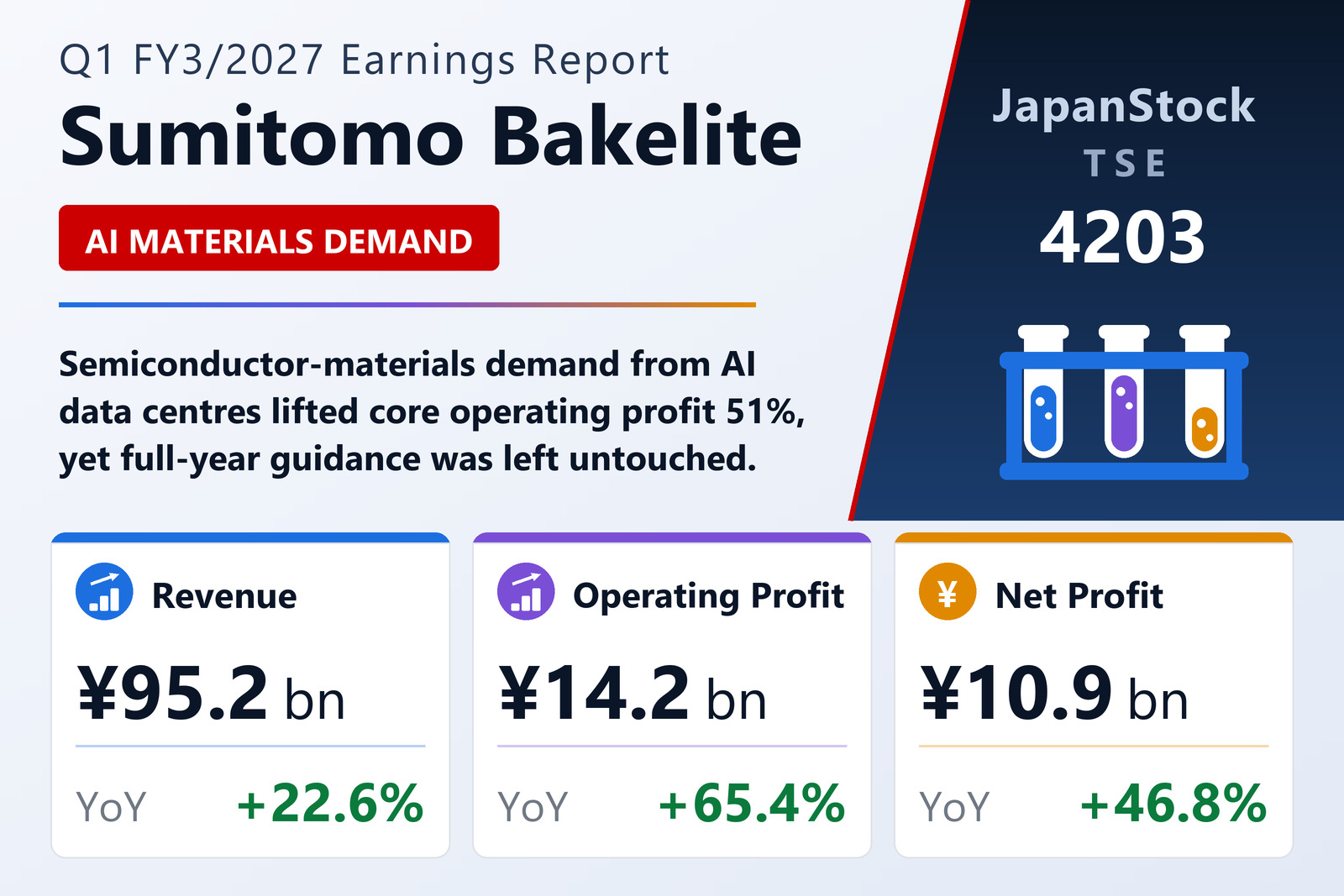
Sumitomo Bakelite Co., Ltd. (TSE: 4203), Japan's oldest phenolic-resin producer and today a supplier of semiconductor encapsulation materials, engineering plastics and medical films, reported consolidated first-quarter results for the three months to June 30, 2026 under IFRS. Revenue rose 22.6% to ¥95,211 million, core operating profit — the company's own headline earnings measure — jumped 51.2% to ¥13,625 million, operating profit climbed 65.4% to ¥14,218 million, profit before tax rose 60.0% to ¥15,414 million, and profit attributable to owners of the parent increased 46.8% to ¥10,933 million. Basic earnings per share came to ¥124.61, up from ¥84.99.
A note on terminology: Sumitomo Bakelite defines core operating profit exactly as revenue less cost of sales less selling, general and administrative expenses. It is the company's preferred measure of underlying earnings and is not a line item defined by IFRS itself; the IFRS operating profit figure sits above it this quarter because other income of ¥1,062 million outweighed other expenses of ¥469 million. A year earlier the relationship was reversed — other income was just ¥13 million against ¥426 million of other expenses — which is why reported operating profit grew faster (65.4%) than core operating profit (51.2%).
The core operating margin widened to 14.3% from 11.6% a year earlier. Management attributes the improvement to higher sales volumes, centred on expanding semiconductor demand, together with what it calls price optimisation and a year-on-year weaker yen. Those gains more than absorbed a rise in raw-material costs that the company links to instability in the Middle East.
Semiconductor materials do the heavy lifting
The Semiconductor Materials segment delivered revenue of ¥34,210 million, up 40.0%, and segment profit of ¥8,014 million, up 66.3% — a segment margin of 23.4% against 19.7% a year earlier. At roughly 36% of group revenue, the segment generated about 53% of total segment profit before corporate costs.
AI data-centre demand led the advance, with power-device applications the standout. Epoxy resin moulding compounds for semiconductor encapsulation sold well not only into power devices but also high-end smartphones, communications equipment and automotive chips, while Chinese demand expanded on the back of the country's semiconductor self-sufficiency policy. In mobility, magnet-fixing applications for hybrid vehicles grew. Photosensitive materials benefited from wider memory demand; bonding pastes were pulled up by power-management ICs and other power-device uses alongside continued strength in high-reliability automotive pastes; and the LαZ substrate-material series gained on component-embedded boards for power devices.
High-performance plastics nearly double segment profit
High-Performance Plastics posted revenue of ¥31,931 million, up 22.7%, and segment profit of ¥3,194 million, up 83.8%, lifting the segment margin to 10.0% from 6.7%. Beyond volume growth, the company says it passed raw-material cost increases through to selling prices, and a weaker yen against both the US dollar and the euro added a further tailwind.
Industrial resins grew on domestic semiconductor, building-material and grinding-wheel applications, with tyre applications expanding on ASEAN demand. Moulding compounds saw higher shipment volumes for electrical components in Asia and China, and North American automotive demand is described as recovering. In laminates, copper-clad laminate pricing was normalised and volumes of heat-dissipating insulation sheets for vehicles rose. Aircraft parts returned to growth on stronger European and US customer demand plus an emerging contribution from the repair-parts market.
Quality of Life grows, held back by a business exit
Quality of Life Products was the slowest of the three, with revenue of ¥28,870 million, up 6.7%, and segment profit of ¥3,794 million, up 2.9% — the only segment whose margin slipped, to 13.1% from 13.6%. Medical devices and pharmaceuticals grew on blood bags for Asia, steerable microcatheters for endovascular treatment at home and abroad, and domestic sales of gastrointestinal stents, but the exit from an unprofitable domestic dialysis blood-circuit business subtracted revenue. Diagnostics and bio-related products held firm in regenerative medicine and custom bio-ware.
Films and sheets saw a large volume increase as customers raised production and rebuilt inventories across pharmaceutical packaging, P-Plus food packaging and industrial films, helped by share gains in generic-drug packaging and new applications such as skin packs and P-Plus top seals. Industrial functional materials rose sharply as customers secured building materials and store-fixture stock, with an acquired hollow-polycarbonate business adding further sales; optical and insulation products expanded in automotive. Waterproofing sheets grew in rooftop applications for buildings, with home-renovation demand steady.
The tension: a blowout quarter, an unmoved forecast
This is where the release becomes interesting. Sumitomo Bakelite kept the full-year FY3/2027 plan it published on May 11, 2026 entirely intact: revenue of ¥337,000 million (+5.4%), core operating profit of ¥38,000 million (+10.2%), operating profit of ¥37,500 million (+5.7%), profit attributable to owners of the parent of ¥28,500 million (+1.7%) and EPS of ¥324.84. The forward-looking section of the filing states only that no revision has been made; it offers no explanation of why a quarter this far ahead of plan does not warrant one.
The arithmetic makes the gap plain. First-quarter core operating profit alone equals 35.9% of the full-year target and attributable profit 38.4% — both well above the 25% a flat year would imply — even though revenue progress is a more ordinary 28.3%. Holding the plan therefore embeds a marked deceleration: the remaining nine months are implicitly budgeted for roughly ¥241.8 billion of revenue, essentially flat year on year, and about ¥24.4 billion of core operating profit, some 4% below the same nine months of the prior year. On the attributable line the implied shortfall is steeper still, near 15%.
The filing does not spell out the reasoning, but the same document flags the ingredients of a cautious stance: raw-material prices lifted by Middle East instability, and a first quarter whose revenue was flattered by a weaker yen and by customers building inventory — in films, sheets and industrial functional materials the company explicitly credits customer stock-building for the volume surge, which is by nature a pull-forward rather than a run rate. Investors will get the first real test of whether the caution is conservatism or foresight when first-half figures arrive.
Balance sheet, cash flow and dividend
Total assets rose ¥19,312 million from the March year-end to ¥503,479 million, driven mainly by higher trade and other receivables and cash. Total liabilities increased ¥7,162 million to ¥140,683 million on larger trade payables and borrowings, while total equity grew ¥12,150 million to ¥362,796 million. Equity attributable to owners of the parent reached ¥359,468 million from ¥347,186 million, leaving the equity ratio at a still-robust 71.4%, marginally down from 71.7% only because assets grew faster.
Operating cash flow was ¥5,300 million, ¥702 million lower than a year earlier as the increase in receivables and income-tax payments offset stronger pre-tax profit and depreciation. Investing activities produced a net inflow of ¥1,356 million, thanks to proceeds from sales of investment securities exceeding capital expenditure, and financing activities used ¥3,025 million, chiefly commercial-paper issuance against dividend payments. Cash and equivalents ended the quarter at ¥130,290 million, up ¥5,538 million.
The dividend forecast for FY3/2027 is unchanged at ¥120.00 per share — ¥60.00 at the interim and ¥60.00 at year-end — up from ¥110.00 paid for FY3/2026, which comprised a ¥50.00 interim and a ¥60.00 final. Dividends of ¥5,264 million were paid to parent-company shareholders during the quarter.
| Metric | Q1 FY3/2027 | Q1 FY3/2026 | YoY |
|---|---|---|---|
| Revenue (¥ billion) | 95.21 | 77.67 | +22.6% |
| Core operating profit (¥ billion) | 13.63 | 9.01 | +51.2% |
| Operating profit (¥ billion) | 14.22 | 8.60 | +65.4% |
| Profit before tax (¥ billion) | 15.41 | 9.63 | +60.0% |
| Profit attrib. to owners (¥ billion) | 10.93 | 7.45 | +46.8% |
| Basic EPS (¥) | 124.61 | 84.99 | +46.6% |
| Core operating margin | 14.3% | 11.6% | +2.7 pt |
| Equity ratio (owners of parent) | 71.4% | 71.7% | -0.3 pt |
| Segment | Revenue | YoY | Segment profit | YoY |
|---|---|---|---|---|
| Semiconductor Materials | 34.21 | +40.0% | 8.01 | +66.3% |
| High-Performance Plastics | 31.93 | +22.7% | 3.19 | +83.8% |
| Quality of Life Products | 28.87 | +6.7% | 3.79 | +2.9% |
| Other | 0.20 | — | -0.01 | — |
| Corporate costs & eliminations | — | — | -1.37 | — |
| Consolidated | 95.21 | +22.6% | 13.63 | +51.2% |
| Metric | FY3/2027 plan | YoY | Q1 progress |
|---|---|---|---|
| Revenue (¥ billion) | 337.00 | +5.4% | 28.3% |
| Core operating profit (¥ billion) | 38.00 | +10.2% | 35.9% |
| Operating profit (¥ billion) | 37.50 | +5.7% | 37.9% |
| Profit attrib. to owners (¥ billion) | 28.50 | +1.7% | 38.4% |
| Basic EPS (¥) | 324.84 | — | 38.4% |
| Annual dividend (¥) | 120.00 | +9.1% | — |
JapanStockPulse provides informational content only and does not constitute investment advice. Figures are taken from the company's published earnings short report and may be subject to subsequent revision.