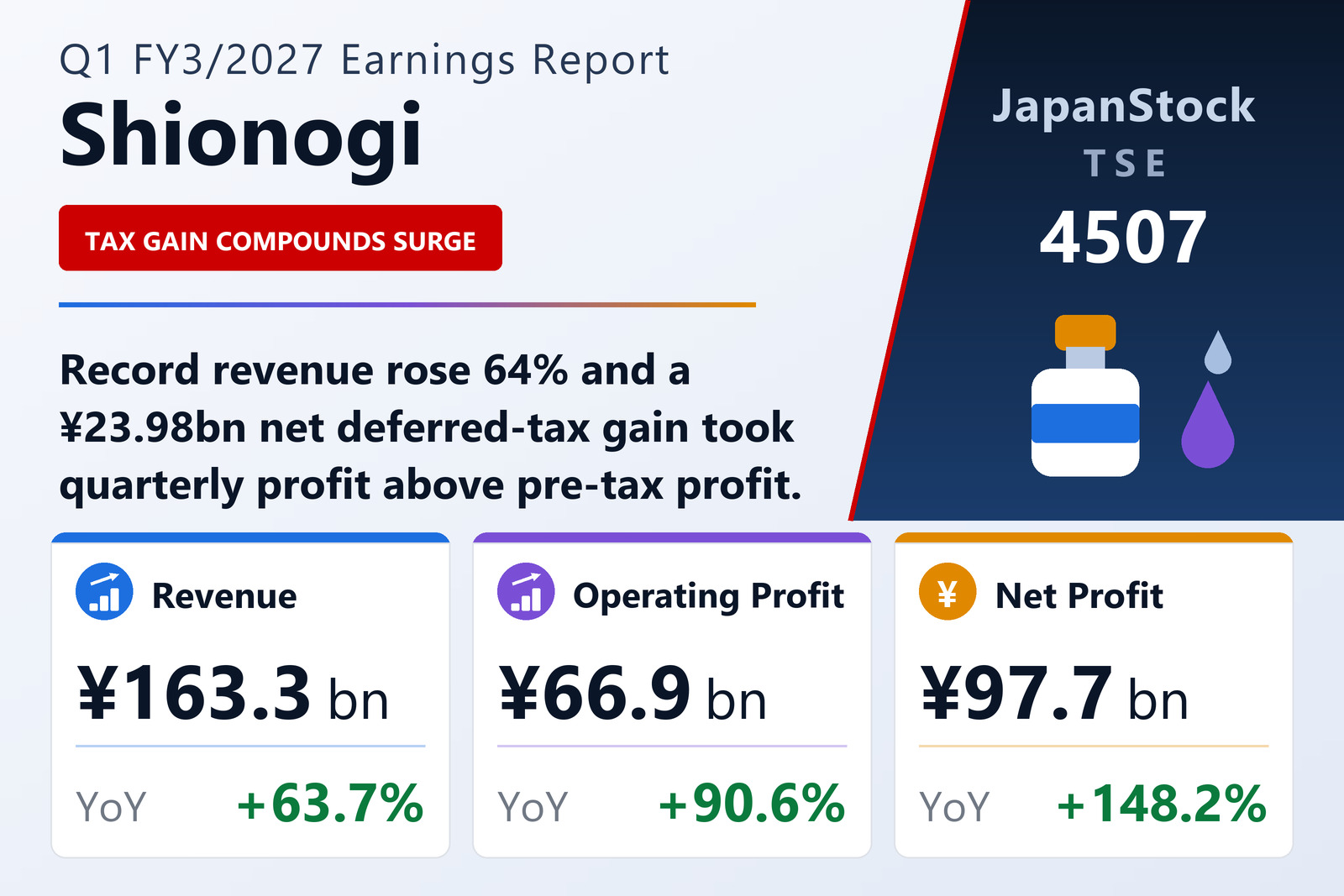
Shionogi & Co., Ltd. (TSE: 4507) reported consolidated first-quarter results for the year ending March 2027, covering April 1 to June 30, 2026, under IFRS. Revenue rose 63.7% to ¥163,310 million, operating profit rose 90.6% to ¥66,911 million, profit before tax rose 59.2% to ¥73,736 million, and profit attributable to owners of the parent rose 148.2% to ¥97,696 million. Basic earnings per share were ¥114.81 against ¥46.26 a year earlier, and diluted EPS was ¥114.78 against ¥46.25. The company said revenue, operating profit, pre-tax profit and attributable profit each set a first-quarter record.
Why net profit came in above pre-tax profit
The quarter's most striking line is not the revenue growth but the tax line. Quarterly profit of ¥97,718 million sits well above profit before tax of ¥73,736 million — an inversion that is possible only when income tax is a net credit rather than a charge. Shionogi booked an income-tax benefit of ¥23,982 million in the quarter, against a ¥6,980 million charge in the same period a year earlier.
The company attributes the swing to its U.S. subsidiary. Following the succession of the edaravone business, future taxable income at that entity is now considered probable, so a deferred tax asset was recognised against previously unrecognised tax-loss carryforwards. The balance sheet corroborates it: deferred tax assets jumped from ¥4,344 million at March 31, 2026 to ¥37,106 million at June 30, 2026. Readers should treat the resulting profit uplift as a non-cash, one-time recognition event rather than a repeatable earnings run-rate.
Where the revenue growth came from
Shionogi broke the top line into three buckets. Domestic prescription pharmaceuticals contributed ¥33.5 billion, up 137.3%, lifted by the consolidation of Torii Pharmaceutical, by sales of Radicut following the edaravone business succession, and by wider prescribing of the insomnia treatment Quviviq. Overseas subsidiaries and exports contributed ¥42.2 billion, up 196.6%, reflecting North American sales of edaravone — marketed as RADICAVA in the United States and Canada — together with higher sales of cefiderocol, sold as Fetroja in the U.S. and Fetcroja in Europe. Royalty income contributed ¥80.1 billion, up 25.3%, on higher royalties tied to growth in the ViiV Healthcare HIV franchise plus newly booked royalties related to the former JT pharmaceutical business.
Costs climbed, but equity income carried operating profit
The acquisitions cut both ways. Cost of sales rose to ¥30,795 million from ¥12,317 million on the Torii consolidation and the edaravone business; selling, general and administrative expenses rose to ¥45,150 million from ¥25,820 million on intangible amortisation, U.S. selling costs and Torii; research and development rose to ¥31,789 million from ¥24,888 million; and amortisation of product-related intangibles jumped to ¥15,824 million from just ¥485 million. Offsetting that, other income swelled to ¥27,772 million from ¥85 million — the cash flow statement shows equity-method investment income of ¥26,756 million, which the company links to ViiV Healthcare becoming an equity-method associate. On the company's own adjusted measures, core operating profit rose 103.5% to ¥72,479 million and EBITDA rose 129.8% to ¥93,360 million.
Pre-tax profit grew more slowly than operating profit for a related reason. With ViiV now equity-accounted, dividends received from it — previously recorded as finance income — are instead deducted from the carrying amount of the equity-method investment. Finance income eased to ¥12,147 million from ¥13,562 million while finance costs more than doubled to ¥5,322 million from ¥2,331 million.
Prior-year comparatives have been restated
The year-ago figures in this release are not the ones originally published. During the first quarter Shionogi finalised the provisional purchase accounting for three business combinations completed in FY3/2026 — the acquisition of Torii Pharmaceutical, the succession of the Japan Tobacco pharmaceutical business, and the acquisition of Akros Pharma — and retrospectively revised the FY3/2026 amounts. For Torii, identified intangibles were raised by ¥8,117 million and goodwill was cut from ¥19,918 million to ¥14,873 million. For the JT pharmaceutical business, the bargain purchase gain was raised from ¥43,781 million to ¥48,970 million. Separately, the accounting for the April 2026 edaravone acquisition and for the additional ViiV Healthcare stake both remain provisional, so further revisions are possible.
A ¥397.5 billion deal reshapes the balance sheet
On April 1, 2026 Shionogi acquired from Tanabe Pharma the business for edaravone, a treatment for amyotrophic lateral sclerosis sold as Radicut in Japan and RADICAVA in the United States, for total consideration of ¥397,490 million — ¥393,010 million in cash plus ¥4,480 million of contingent consideration. Provisionally, ¥354,878 million was allocated to intangible assets, principally marketing rights, and ¥34,064 million to goodwill. Since the acquisition date the business has contributed revenue of ¥25,985 million and profit of ¥870 million.
Total assets ended the quarter at ¥2,655,057 million, up from ¥2,585,519 million, as non-current assets swelled ¥453,222 million to ¥1,728,405 million while cash and cash equivalents fell ¥412,459 million to ¥298,937 million — the investing cash outflow included ¥391,877 million for the business transfer. Equity attributable to owners of the parent rose to ¥1,772,242 million from ¥1,689,301 million and the equity ratio improved to 66.7% from 65.3%. Operating cash flow was ¥43,109 million, modestly ahead of ¥41,043 million a year earlier; investing cash flow was an outflow of ¥423,731 million and financing an outflow of ¥34,138 million.
Guidance and dividend left untouched after a fast start
Shionogi kept the full-year forecast issued on May 12, 2026 in place: revenue of ¥700,000 million (+40.1%), operating profit of ¥220,000 million (+29.2%), profit before tax of ¥220,000 million (−9.3%) and attributable profit of ¥210,000 million (+0.4%), for EPS of ¥246.79. First-half guidance is revenue of ¥340,000 million (+59.7%), operating profit of ¥96,000 million (+29.8%), pre-tax profit of ¥96,000 million (−1.6%) and attributable profit of ¥108,000 million (+30.1%), for EPS of ¥126.91.
Two tensions are worth flagging. First, the quarter's ¥97,696 million of attributable profit already represents 46.5% of the full-year ¥210,000 million plan, yet the plan was not raised — consistent with management treating the tax benefit and the equity-income step-up as front-loaded rather than recurring. Second, the full-year shape is unusual on its own terms: revenue is guided up 40.1% and operating profit up 29.2%, but pre-tax profit is guided down 9.3% and attributable profit essentially flat at +0.4%, reflecting the loss of the ViiV dividends that previously flowed through finance income and the absence of the prior year's one-off bargain purchase gains. The annual dividend forecast is unchanged at ¥76.00 per share (¥38.00 interim plus ¥38.00 year-end), up from ¥71.00 paid for FY3/2026.
| Metric | Q1 FY3/2027 | Q1 FY3/2026 (restated) | YoY |
|---|---|---|---|
| Revenue (¥ billion) | 163.31 | 99.78 | +63.7% |
| Operating profit (¥ billion) | 66.91 | 35.10 | +90.6% |
| Core operating profit (¥ billion) | 72.48 | 35.62 | +103.5% |
| EBITDA (¥ billion) | 93.36 | 40.63 | +129.8% |
| Profit before tax (¥ billion) | 73.74 | 46.33 | +59.2% |
| Income tax benefit / (expense) (¥ billion) | +23.98 | -6.98 | n.m. |
| Profit attrib. to owners (¥ billion) | 97.70 | 39.36 | +148.2% |
| Basic EPS (¥) | 114.81 | 46.26 | +148.2% |
| FY3/2027 revenue guidance (¥ billion) | 700.00 | — | +40.1% |
| FY3/2027 attrib. profit guidance (¥ billion) | 210.00 | — | +0.4% |
JapanStockPulse provides informational content only and does not constitute investment advice. Figures are taken from the company's published earnings short report and may be subject to subsequent revision.