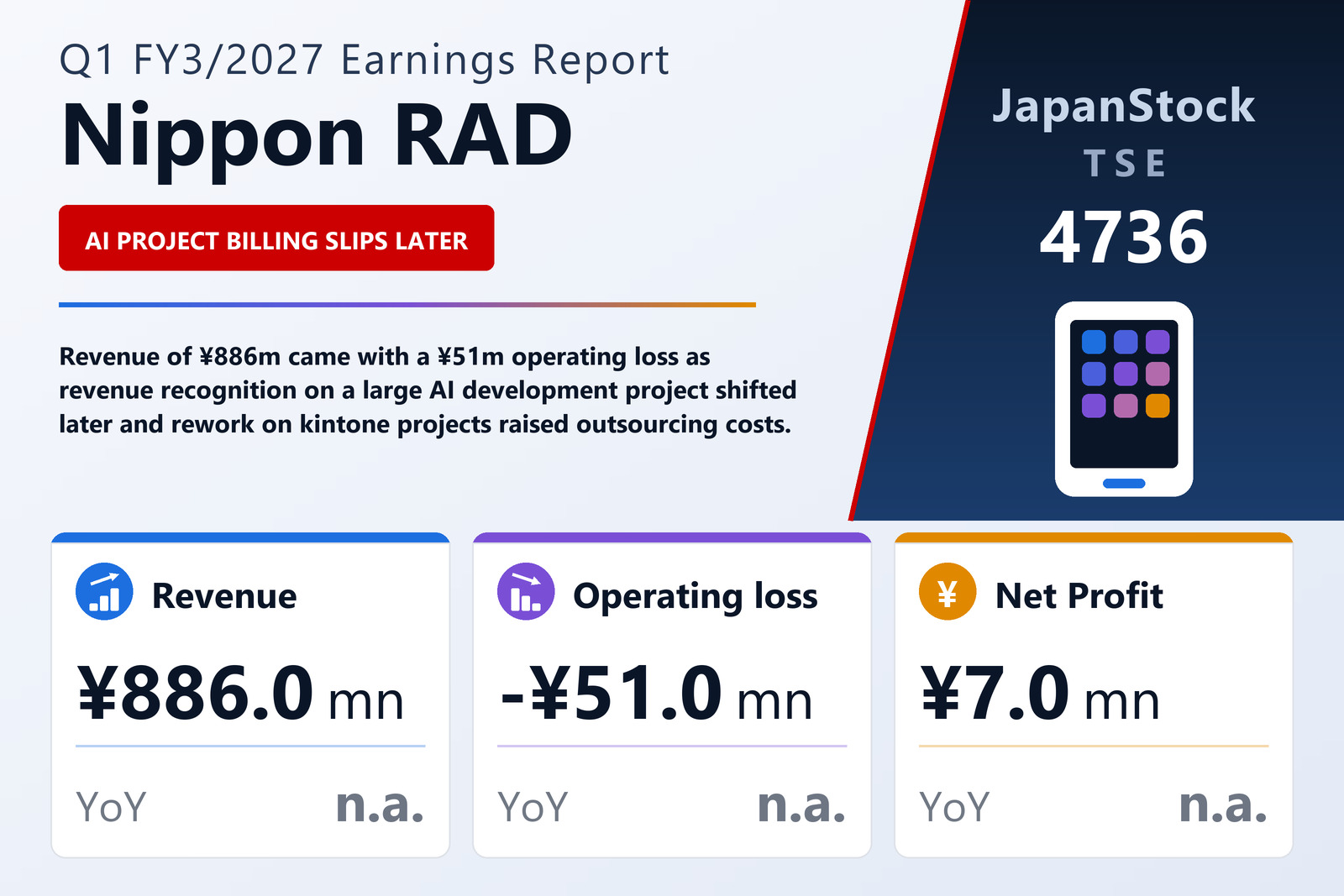
Nippon RAD Inc. (TSE: 4736), an IT specialist founded in 1971 and headquartered in the ARK Mori Building in Akasaka, Tokyo, reported consolidated first-quarter results for the three months to June 30, 2026 under Japanese GAAP. Revenue was ¥886 million, with an operating loss of ¥51 million, recurring profit of ¥18 million and profit attributable to owners of the parent of ¥7 million. An important caveat comes from the company itself: because the group did not prepare consolidated quarterly financial statements for the prior-year first quarter, no year-on-year comparison or analysis is provided.
Enterprise Solutions: stable resourcing, later billing
Enterprise Solutions revenue was ¥557 million. In on-site, dispatch-style system development, engineer utilisation held steady, led by existing customers, and functioned as the group's earnings base. Riding the wave of customers insourcing AI, Nippon RAD has begun trials that convert supplied engineering resources into what it calls FDE (Forwarded Development Engineer) roles assisting customers to add AI to their own systems — a shift that reduced revenue at some accounts. In contract development, the large project for a specific customer that applies the company's top-priority "AI-driven development" approach — flagged at the full-year results — has launched and is progressing; however, the more advanced development process and the nature of the acceptance-testing cycle mean revenue recognition has shifted later in the year than usual.
IoT Integration: strong demand, self-inflicted margin damage
IoT Integration revenue was ¥328 million. Promotional work — stronger web marketing on top of the traditional trade-show lead generation — brought in new enquiries and add-on orders from existing customers, and the business is described as running steadily. The company continues front-loaded investment in enhancing its own-brand platform (a "market-in" strategy driven by market insight) and in high-value-added solutions that integrate with customers' core systems. Two drags are named explicitly. In embedded, royalty income from in-vehicle security systems temporarily fell as the automotive industry restrained new investment and shipments softened against the global backdrop. And in enterprise kintone work, the company's "kinterp" ERP product was sold on cost efficiency — which caused projects to concentrate and grow larger, triggering frequent rework and a temporary jump in outsourcing and remediation costs that squeezed profit. Nippon RAD is converting the kintone business from an enterprise model to a DX model, reviewing the development environment, rebuilding the delivery structure and newly strengthening a quality-control function, aiming for early normalisation within the current year. On the growth side, it has doubled the size of the organisation pursuing evolution into an "image AI and video total-solution provider," with advanced VoIP product solutions and high-quality cameras aimed at government, defence and broadcasting markets, and has continued to invest ahead of revenue in its own IP video service.
| Segment | Revenue (¥ million) | Share |
|---|---|---|
| Enterprise Solutions | 557 | 62.9% |
| IoT Integration | 328 | 37.1% |
| Consolidated | 886 | 100.0% |
The industry backdrop, as the company sees it
Nippon RAD's own reading of its market is unusually direct. It describes a February market shock — which it labels the "Anthropic shock" — that spread temporary pessimism about the future of the SaaS business model, driving share prices down worldwide and putting software-development methodology under scrutiny. Customer DX investment remains strong, it says, but there is a growing recognition that customers can now build far more themselves. Demand for quasi-mandate contract software development is holding up, yet over a multi-year horizon the traditional model of supplying stable engineer headcount may become hard to sustain. The same change, the company argues, is creating very large new markets: full production deployment of generative AI, AI-driven development, insourcing support, legacy-system modernisation and more advanced cybersecurity. Companies are redefining IT spending from cost reduction to "strategic investment" tied directly to enterprise value. Against that, it flags cautious investment decisions and project delays at some customers stemming from the prolonged situation in the Middle East, and intensifying competition for advanced IT talent — making recruitment, development and reskilling its most important theme. The group's medium-term plan (2024–2027) is in phase one, focused on shifting the revenue structure from people to a product-asset base and evolving into what it calls a "data handler / data assembler" company.
Balance sheet essentially unchanged
Total assets were ¥4,964 million, up just ¥13 million from the March year-end. Current assets rose ¥8 million to ¥3,170 million: cash and deposits increased ¥403 million and work in process ¥12 million, while notes, accounts receivable and contract assets fell ¥430 million. Fixed assets rose ¥4 million to ¥1,793 million, with investment securities up ¥9 million against a ¥3 million decline in other investments. Liabilities rose ¥52 million to ¥1,475 million: current liabilities climbed ¥52 million to ¥824 million as a ¥286 million increase in other current liabilities outweighed a ¥190 million reduction in the bonus provision and a ¥32 million fall in trade payables; long-term liabilities were flat at ¥650 million, with a ¥10 million increase in retirement-benefit liabilities against a ¥9 million decline in other items. Net assets fell ¥38 million to ¥3,489 million, as a ¥6 million rise in the valuation difference on other securities was outweighed by a ¥44 million reduction in retained earnings from the dividend payment net of quarterly profit. The equity ratio eased to 70.3% from 71.3%.
On guidance, Nippon RAD states that as of this release there is no change to the full-year consolidated forecast announced with its results on May 11, 2026.
| Metric | Q1 FY3/2027 | Change vs March 31, 2026 |
|---|---|---|
| Revenue (¥ million) | 886 | — |
| Operating loss (¥ million) | -51 | — |
| Recurring profit (¥ million) | 18 | — |
| Profit attributable to owners (¥ million) | 7 | — |
| Current assets (¥ million) | 3,170 | +8 |
| Fixed assets (¥ million) | 1,793 | +4 |
| Total assets (¥ million) | 4,964 | +13 |
| Total liabilities (¥ million) | 1,475 | +52 |
| Net assets (¥ million) | 3,489 | -38 |
| Equity ratio (%) | 70.3 | -1.0pt |
JapanStockPulse provides informational content only and does not constitute investment advice. Figures are taken from the company’s published earnings short report and may be subject to subsequent revision.