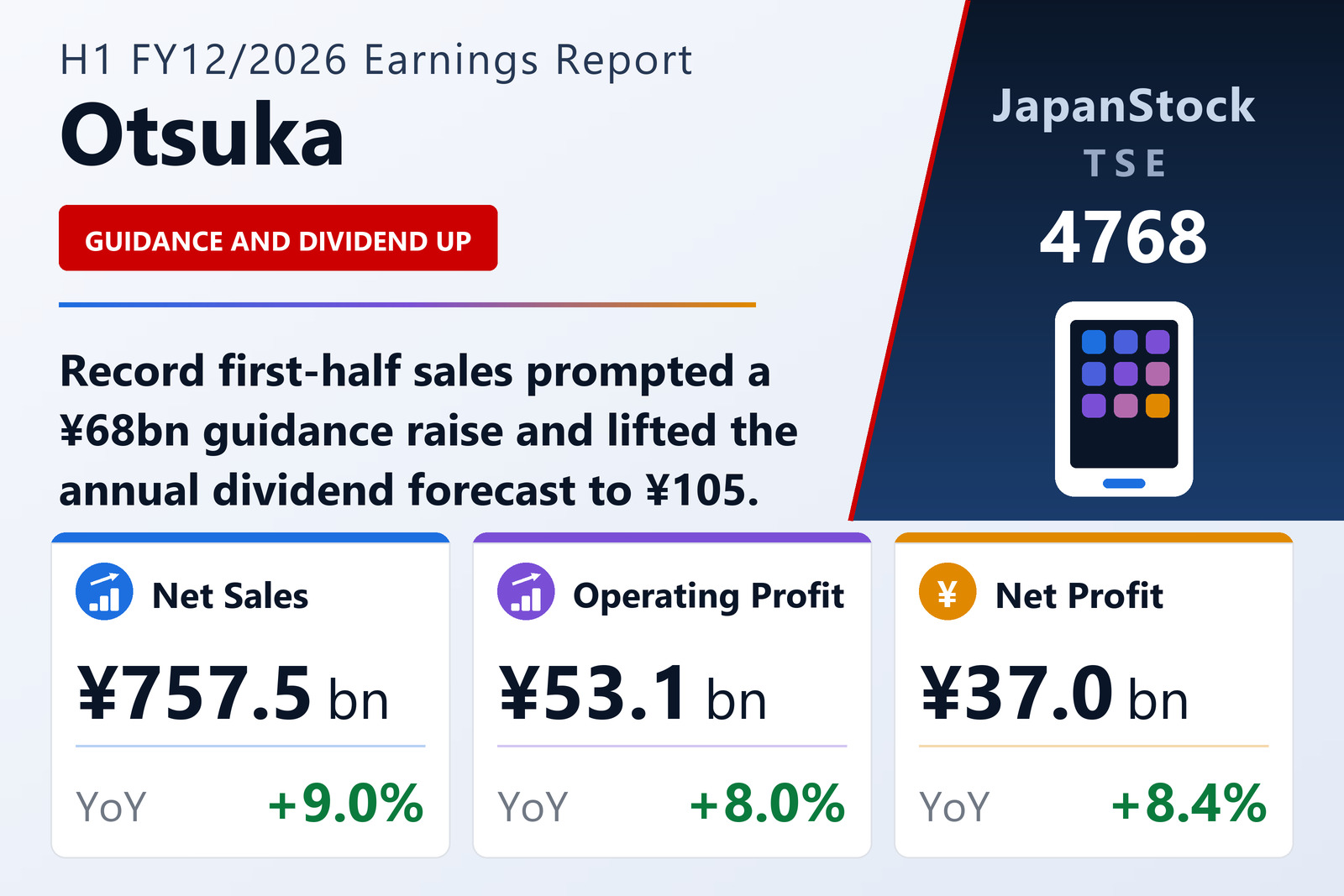
Otsuka Corporation (TSE: 4768), Japan's largest independent reseller and integrator of IT systems for small and mid-sized businesses, reported consolidated results for the first half of the financial year to December 2026 — the six months from January 1 to June 30, 2026 — under Japanese GAAP. Net sales rose 9.0% to ¥757,498 million, operating profit gained 8.0% to ¥53,088 million, ordinary profit advanced 9.4% to ¥54,824 million and profit attributable to owners of the parent increased 8.4% to ¥36,982 million. Basic earnings per share were ¥97.53, against ¥90.00 a year earlier, with diluted EPS of ¥97.36. Management noted that sales and every profit line set an interim record for a fourth consecutive year.
Growth cools against a very strong comparable
The headline growth rates, healthy in isolation, mark a sharp deceleration from the same period of 2025, when the company grew net sales 22.0% and operating profit 26.6% on the back of the Windows replacement wave. Against that comparable, this half's 9.0% top-line gain still outpaced a broadly stable Japanese IT-spending backdrop. Gross profit rose 7.6% to ¥138,542 million, slightly behind sales, so the gross margin eased to 18.3% from 18.5%; selling, general and administrative expenses climbed 7.4% to ¥85,454 million, leaving the operating margin essentially flat at 7.0%. Management cited corporate software budgets holding at high levels and steady demand for labour-saving and digitalisation projects aimed at productivity, competitiveness and cost reduction, under a 2026 slogan built around AI and security.
System Integration leads, Service & Support keeps compounding
The System Integration segment — consulting, system design and development, installation work and network build-out — lifted external sales 9.5% to ¥536,735 million, with packaged software singled out as the strongest growth line. Segment profit rose 9.7% to ¥43,531 million. The Service & Support segment, which covers supplies, hardware and software maintenance, telephone support and outsourcing, grew external sales 7.7% to ¥220,763 million, driven by the recurring-revenue franchises the company has been building for years: the "tanomeru" office-supplies mail-order business and the "tayoreru" support-services brand. Segment profit there was up a more modest 2.6% at ¥16,541 million. Unallocated head-office costs of ¥6,984 million bridge the ¥60,073 million segment total to reported operating profit.
Comprehensive income flat as valuation gains reverse
Comprehensive income was almost unchanged at ¥37,074 million, up just 0.2%, despite a ¥2.85 billion increase in net profit. The gap sits entirely in other comprehensive income, which swung from a positive ¥2,399 million a year earlier to a negative ¥369 million this half. The reversal came from mark-to-market and remeasurement items rather than operations: the valuation reserve on available-for-sale securities fell to ¥7,170 million from ¥7,673 million at the year-end, and the retirement-benefit remeasurement line turned negative, more than offsetting a positive swing in deferred hedge gains. Investors reading only the comprehensive-income line would therefore miss an underlying half of solid profit growth.
Balance sheet swells; equity ratio slips to 50.3%
Total assets expanded ¥94,097 million to ¥823,297 million from ¥729,200 million at December 31, 2025 — a 12.9% increase in six months. The company attributes it chiefly to notes and accounts receivable and contract assets, which jumped to ¥271,185 million from ¥219,579 million; merchandise inventory also rose to ¥69,138 million from ¥53,670 million. Liabilities grew ¥74,356 million to ¥403,968 million, led by notes and accounts payable at ¥215,411 million versus ¥159,850 million. Net assets advanced ¥19,741 million to ¥419,329 million on retained earnings. Because the asset base grew far faster than equity, the equity ratio fell to 50.3% from 54.1%. Operating cash flow was ¥42,577 million, ¥2,613 million lower year on year as inventories swung to a build; investing outflows widened by ¥10,783 million to ¥19,909 million on time-deposit placements, while financing outflows narrowed by ¥13,215 million to ¥17,331 million because dividend payments are now split between interim and year-end. Cash and equivalents ended the half at ¥258,955 million, up ¥5,334 million.
Full-year guidance revised upward on every line
Alongside the results the company published a formal revision of its full-year forecast, and it is an upgrade across the board. Compared with the guidance issued on February 2, 2026, net sales were raised ¥68,000 million (+5.2%) to ¥1,379,000 million, operating profit ¥4,300 million (+4.8%) to ¥94,300 million, ordinary profit ¥6,000 million (+6.7%) to ¥96,100 million and profit attributable to owners ¥3,770 million (+6.2%) to ¥64,900 million; forecast EPS moves to ¥171.15 from ¥161.21. Measured against FY12/2025 actuals, the new numbers imply sales growth of 4.2%, operating profit growth of 4.8%, ordinary profit growth of 5.0% and net profit growth of just 0.9% — the last line flattered in the prior year and now barely advancing. By segment, full-year sales are guided at ¥928.7 billion for System Integration (+2.9%) and ¥450.3 billion for Service & Support (+7.2%). Management flags memory-supply shortages as a headwind but expects corporate IT budgets to stay resilient on AI deployment and security-certification requirements.
Dividend raised at both the interim and the year-end
The dividend forecast was revised upward too. The board resolved on August 3 to pay an interim dividend of ¥55.00 per share for the period ended June 30 — ¥5.00 above the ¥50.00 previously guided — and simultaneously lifted the year-end forecast by ¥5.00 to ¥50.00. That takes the FY12/2026 annual dividend to ¥105.00, ¥15.00 more than the ¥90.00 paid for FY12/2025 (¥45.00 interim plus ¥45.00 year-end) and a payout ratio of roughly 61% on guided earnings. Payment of the interim dividend is scheduled to begin on September 2, 2026. The company said it would continue working toward further increases.
Two housekeeping notes accompany the filing: there was no material change in the scope of consolidation during the half, and the interim consolidated statements apply a special accounting treatment for tax expense, computed by applying an estimated effective tax rate for the full year to pre-tax interim profit. The interim report is not subject to audit review.
| Metric | H1 FY12/2026 | H1 FY12/2025 | YoY |
|---|---|---|---|
| Net sales (¥ billion) | 757.50 | 695.13 | +9.0% |
| Operating profit (¥ billion) | 53.09 | 49.17 | +8.0% |
| Ordinary profit (¥ billion) | 54.82 | 50.10 | +9.4% |
| Profit attrib. to owners (¥ billion) | 36.98 | 34.13 | +8.4% |
| Comprehensive income (¥ billion) | 37.07 | 36.99 | +0.2% |
| Basic EPS (¥) | 97.53 | 90.00 | +8.4% |
| System Integration sales (¥ billion) | 536.74 | 490.10 | +9.5% |
| Service & Support sales (¥ billion) | 220.76 | 205.03 | +7.7% |
| Equity ratio (%, vs Dec 31, 2025) | 50.3 | 54.1 | -3.8 pt |
| Annual dividend forecast (¥) | 105.00 | 90.00 | +16.7% |
JapanStockPulse provides informational content only and does not constitute investment advice. Figures are taken from the company's published earnings short report and may be subject to subsequent revision.