Deliveries slipped, but profit more than doubled
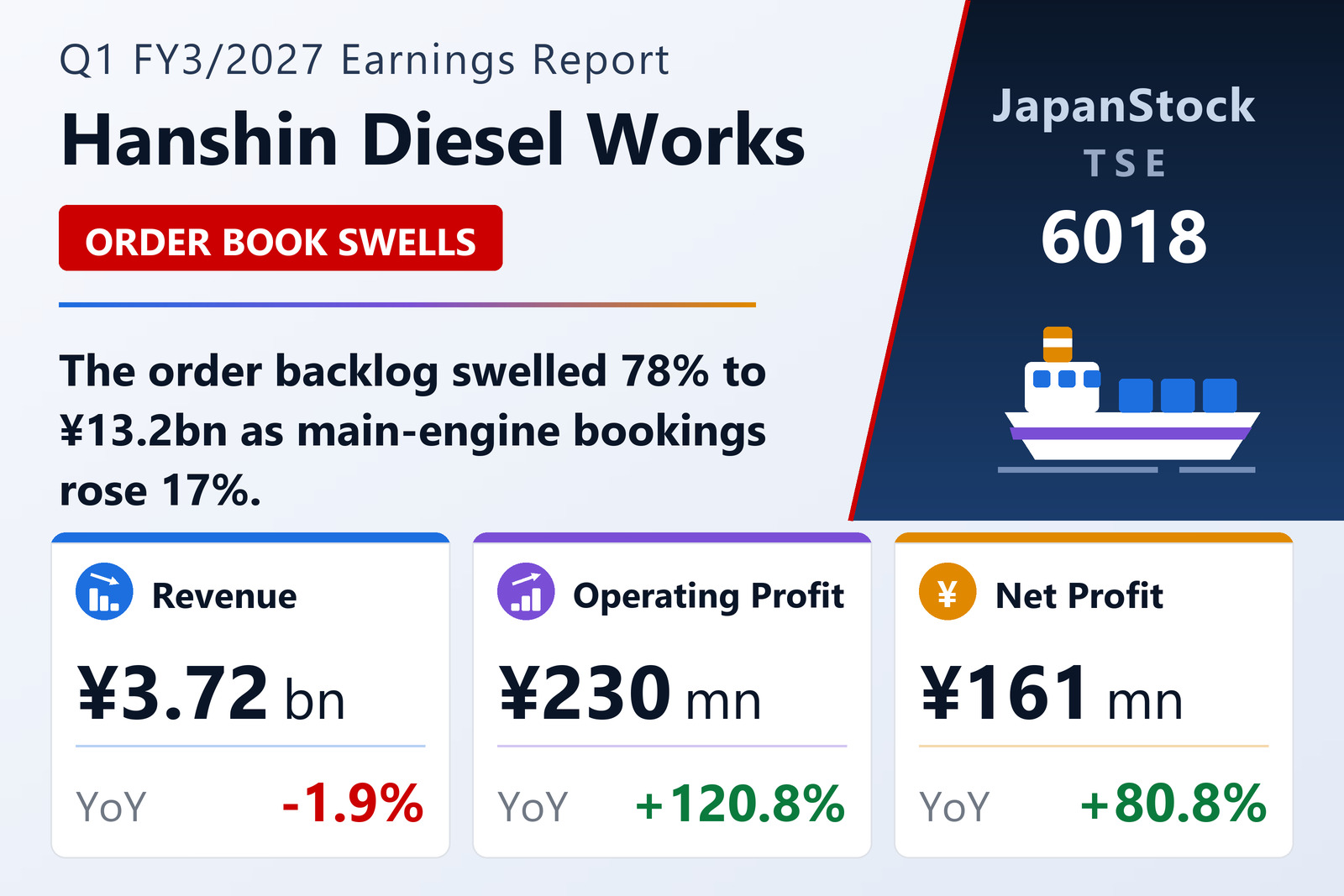
Hanshin Diesel Works, Ltd. (TSE: 6018), the Kobe-based builder of low-speed marine diesel engines, disclosed first-quarter results for the fiscal year ending March 2027 on August 3, 2026. This is a non-consolidated, parent-only filing prepared under Japanese GAAP, so every figure below is a parent-company number and the bottom line is simply "net profit" rather than profit attributable to owners of parent. Revenue for the three months to June 30, 2026 was ¥3,721 million, down 1.9% from ¥3,792 million. Operating profit more than doubled to ¥230 million, up 120.8% from ¥104 million; ordinary profit rose 101.7% to ¥241 million; and net profit rose 80.8% to ¥161 million. Basic earnings per share came to ¥49.88 against ¥27.61 a year earlier, with diluted EPS of ¥49.59 against ¥27.45.
The reversal is starker set against the base. The same quarter a year earlier had revenue up 39.6% but operating profit down 50.7%, ordinary profit down 45.1% and net profit down 46.4% — a quarter in which the company shipped more and earned less. This time the pattern inverted: cost of sales fell 8.1% while revenue fell only 1.9%, lifting gross profit 28.7% to ¥827 million and the gross margin to 22.2% from 17.0%, a gain of 5.3 percentage points. Management credits two things — continuing to pass accumulated increases in material costs through into main-engine pricing, and holding down general expenses. Those gains had to absorb two real cost increases first: higher personnel costs from expanded hiring and improved pay, and heavier depreciation following a renewal of the company's core systems, which took quarterly depreciation to ¥162 million from ¥132 million.
Below the operating line the arithmetic changes direction. Pre-tax profit was up a still faster 114.1% at ¥240.7 million from ¥112.4 million, helped by a much smaller special loss — ¥1.2 million of fixed-asset disposals this year against ¥7.5 million a year ago, which had included a ¥2.5 million write-down of investment securities. Net profit grew a slower 80.8% because the tax charge rose to ¥79 million from ¥23 million, an effective rate of 32.8% against 20.5%. That tax figure is an estimate by design: the company applies the special accounting treatment permitted for quarterly statements, computing tax expense by multiplying pre-tax quarterly profit by an estimated effective rate for the full year including this quarter.
The order book is the story — backlog up 78%, and all of it main engines
The number that deserves top billing is not on the income statement. Orders received rose 16.7% to ¥4,894 million, comfortably ahead of the ¥3,721 million the company actually billed, with main-engine orders up 17.9% to ¥3,336 million — 68.2% of intake — and parts and repair work up 14.2% to ¥1,558 million. Because intake ran well ahead of deliveries, the order backlog closed the quarter at ¥13,174 million, up 77.8% from ¥7,410 million a year earlier.
Two features make that backlog more than a headline. First, its size relative to the business: ¥13,174 million is about 3.5 times a single quarter's revenue and roughly 77% of the ¥17,200 million the company guides for the whole year — it already exceeds the ¥8,800 million of revenue guided for the first half on its own. Second, its composition: the supplementary disclosure shows the entire backlog sitting in main engines, with nothing carried in parts and repair work. Propulsion engines are the long-lead, high-value end of the product line, so a backlog concentrated there is a claim on future revenue rather than a queue of short-cycle service jobs.
Main engines down, parts and casting up
The revenue decline is entirely a deliveries story, and the company's sales breakdown localises it precisely. Main engines fell 10.9% to ¥2,163 million on a lower number of units shipped — domestic main-engine sales slipped 3.2% to ¥1,260 million while exports dropped 19.8% to ¥902 million. Everything else grew. Parts and repair work excluding CMR rose 11.6% to ¥1,379 million, and CMR — the casting and metal-machining business the company runs alongside marine engines — jumped 39.6% to ¥178 million, albeit from a small base. Taken together, parts and other non-engine revenue rose 14.2% to ¥1,558 million and its share of the total climbed to 41.9% from 36.0%. By destination, domestic sales rose 4.1% to ¥2,436 million while exports fell 11.4% to ¥1,285 million. The company reports as a single segment — marine engine-related business — so there is no separate segment table.
Coastal shipping is hard on owners but good for engine builders
Management's read of the environment explains why intake is running so far ahead of deliveries. Japan's economy showed movement toward improved corporate earnings and income conditions, while the global picture stayed uncertain: the filing cites tension in the Middle East lifting crude prices and supply risk, alongside currency volatility and rising interest rates. In the domestic coastal shipping market that is Hanshin's core customer base, conditions for shipowners remain difficult — a shortage of crew, rising vessel prices and higher interest rates. But freight and charter rates have been improving gradually, and replacement building is proceeding steadily as a result.
The supply side is the tighter constraint. Shipyards are struggling to expand building capacity because of their own labour shortages, and with owners moving early to reserve berths in light of their fleets' ages, the company reports that at some yards building slots are now filled five to six years out. That is the mechanism behind a 78% jump in backlog: orders are being placed years ahead of delivery, so intake and revenue have decoupled. Overseas, inquiries continue — led by tanker projects — and the company expects a degree of continuing demand from that channel.
A debt-free balance sheet, with the equity ratio up to 62.9%
Total assets stood at ¥24,935 million at June 30, 2026, down ¥862 million from ¥25,798 million at the March year-end. Current assets fell ¥431 million to ¥12,857 million: electronically recorded monetary claims rose ¥358 million, finished goods ¥117 million and work in process ¥112 million, against declines of ¥475 million in cash and deposits and ¥531 million in notes and accounts receivable. Non-current assets fell ¥430 million to ¥12,077 million, where a ¥148 million rise in investment securities was outweighed by a ¥500 million fall in long-term deposits held within other investments and a ¥38 million decline in deferred tax assets.
Liabilities came down faster than assets. Current liabilities fell ¥942 million to ¥5,935 million — notes and accounts payable down ¥156 million, electronically recorded obligations down ¥331 million, contract liabilities down ¥298 million and the provision for bonuses down ¥139 million on a seasonal payment. Non-current liabilities edged up ¥16 million to ¥3,303 million, mainly ¥12 million more in guarantee deposits received. Total liabilities fell ¥926 million to ¥9,238 million, and notably neither side of the balance sheet carries any borrowings at all.
Net assets rose ¥63 million to ¥15,696 million. Retained earnings actually fell ¥19 million — the ¥56.00 per share year-end dividend for FY3/2026 costs roughly ¥181 million against ¥161 million of quarterly profit — while valuation difference on available-for-sale securities added ¥83 million. Shareholders' equity was ¥15,672 million against ¥15,608 million and, because total assets shrank while equity grew, the equity ratio improved to 62.9% from 60.5%. Net assets per share were ¥4,834.33 against ¥4,814.81; the per-share figures are unusually large because the share count is small, with a weighted average of roughly 3.24 million shares outstanding. No quarterly cash flow statement was prepared for the period, so cash generation cannot be read directly — the ¥475 million decline in cash and deposits and the ¥500 million run-off of long-term deposits are the visible movements.
Guidance untouched — and the year is heavily back-loaded
The company left the guidance it published on May 15, 2026 completely unchanged. For the first half it continues to expect revenue of ¥8,800 million, up 31.2%, operating profit of ¥500 million, up 61.8%, ordinary profit of ¥550 million, up 51.5%, and net profit of ¥400 million, up 56.7%, for EPS of ¥123.31. For the full year it expects revenue of ¥17,200 million, up 22.6%, operating profit of ¥900 million, up 9.2%, ordinary profit of ¥1,000 million, up 4.8%, and net profit of ¥730 million, down 0.8%, for EPS of ¥224.97.
Two features of that guide are worth drawing out. The first is its shape: revenue is guided up nearly a quarter while the bottom line is guided flat to fractionally lower, which implies an operating margin of about 5.0% across the remaining nine months against the 6.2% just delivered — whether from mix, from the cost increases already flagged, or simply from conservatism. The second is the loading. Q1's ¥3,721 million is only 22% of the annual revenue target, and hitting the ¥8,800 million half-year figure requires ¥5,079 million of revenue in the second quarter, 37% more than the first delivered. Read alongside a backlog worth three and a half quarters of revenue, that back-loading looks less like a stretch than a scheduling fact.
The dividend forecast is unchanged and flat: ¥91.00 per share for FY3/2027, split ¥35.00 at the interim and ¥56.00 at the year-end, the same total as FY3/2026 — a payout ratio of about 40% on guided EPS of ¥224.97. There was no revision to either the earnings or the dividend forecast. The release came without supplementary materials or an earnings briefing, and the quarterly financial statements carry a voluntary interim review from the Osaka office of Hibiki Audit Corporation.
| Metric | Q1 FY3/2027 | Q1 FY3/2026 | Change |
|---|---|---|---|
| Revenue (¥ million) | 3,721 | 3,792 | −1.9% |
| Gross profit (¥ million) | 827 | 643 | +28.7% |
| Gross margin | 22.2% | 17.0% | +5.3 pt |
| Operating profit (¥ million) | 230 | 104 | +120.8% |
| Ordinary profit (¥ million) | 241 | 119 | +101.7% |
| Net profit (¥ million) | 161 | 89 | +80.8% |
| Basic EPS (¥) | 49.88 | 27.61 | +80.7% |
| Diluted EPS (¥) | 49.59 | 27.45 | +80.7% |
| Orders received (¥ million) | 4,894 | 4,194 | +16.7% |
| Order backlog (¥ million) | 13,174 | 7,410 | +77.8% |
| Main engine revenue (¥ million) | 2,163 | 2,428 | −10.9% |
| Parts, repairs & CMR revenue (¥ million) | 1,558 | 1,364 | +14.2% |
| Total assets (¥ million; vs Mar 31, 2026) | 24,935 | 25,798 | −3.3% |
| Net assets (¥ million; vs Mar 31, 2026) | 15,696 | 15,633 | +0.4% |
| Equity ratio (vs Mar 31, 2026) | 62.9% | 60.5% | +2.4 pt |
| Net assets per share (¥; vs Mar 31, 2026) | 4,834.33 | 4,814.81 | +0.4% |
JapanStockPulse provides informational content only and does not constitute investment advice. Figures are taken from the company's published earnings short report and may be subject to subsequent revision.