A guidance raise driven by one segment and a weaker yen
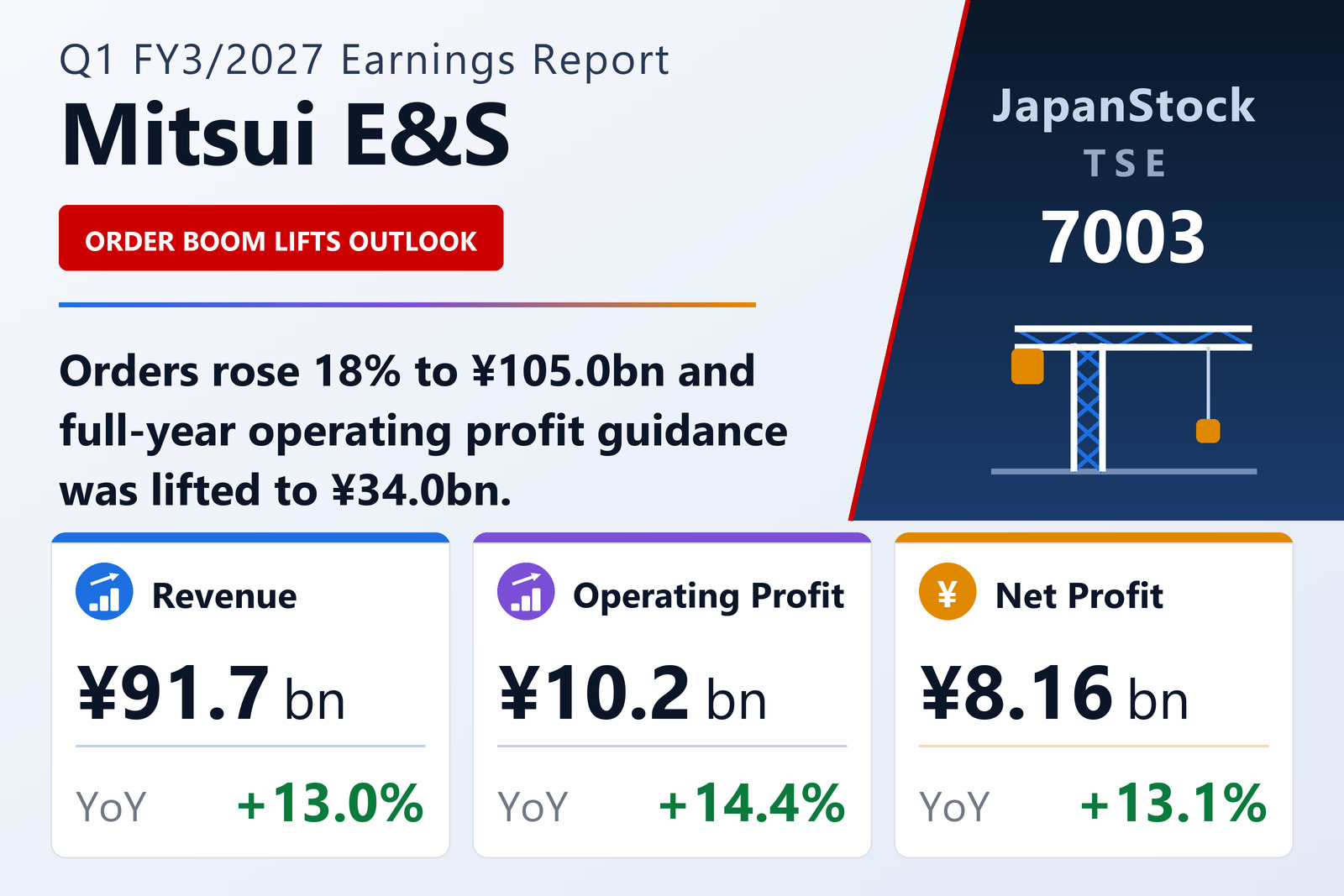
Mitsui E&S Co., Ltd. (TSE: 7003), the marine-engine and port-crane maker spun out of the former Mitsui Engineering & Shipbuilding, disclosed first-quarter results for the fiscal year ending March 2027 on August 3, 2026, under Japanese GAAP on a consolidated basis. Alongside them it published a separate notice revising full-year guidance upward. Operating profit guidance rises to ¥34,000 million from ¥32,000 million, a ¥2,000 million or 6.3% increase; ordinary profit to ¥39,000 million from ¥37,000 million, up 5.4%; and net profit attributable to owners of parent to ¥31,000 million from ¥30,000 million, up 3.3%, lifting forecast earnings per share to ¥307.23 from ¥297.33. Revenue guidance is unchanged at ¥370,000 million — the raise is entirely a margin story, not a volume one.
The company attributes it to two things. First, all four reporting segments executed their projects stably through the quarter; in particular, procurement and cost-escalation risk tied to the Middle East had been provisioned conservatively and has since run within expectations, so the contribution from the Logistics Systems segment was re-examined and revised up. In the segment-level guidance table that is the only line that moves: Logistics Systems operating profit goes to ¥10,000 million from ¥8,000 million, while Growth Business Promotion (¥8,000 million), Marine Propulsion Systems (¥12,000 million) and Peripheral Services (¥4,000 million) are all left exactly where they were. Second, the exchange-rate assumption underpinning the forecast was changed from ¥150 to ¥158 per US dollar — a mechanical tailwind for a group that books a large share of its marine and crane revenue abroad.
The raise deserves one important qualification. It is a raise against the company's own April forecast, not against last year. FY3/2026 actuals were revenue of ¥353,196 million, operating profit of ¥37,641 million, ordinary profit of ¥44,892 million and net profit of ¥38,456 million. Measured against those, the revised guidance still implies revenue up 4.8% but operating profit down 9.7%, ordinary profit down 13.1% and net profit down 19.4% year on year. Read the two together and the arithmetic is blunt: with ¥10,178 million already booked in the first quarter, the ¥34,000 million full-year target leaves ¥23,822 million for the remaining nine months, an average of about ¥7,941 million per quarter against the ¥10,178 million just delivered. The company is guiding to a slower rest of the year off a high prior-year base, and has moved that guidance up rather than down.
Every profit line up double digits in the first quarter
For the three months from April 1 to June 30, 2026, revenue rose 13.0% to ¥91,712 million from ¥81,151 million, an increase of ¥10,561 million. Operating profit rose 14.4% to ¥10,178 million from ¥8,896 million, up ¥1,282 million. Ordinary profit rose 14.9% to ¥11,657 million from ¥10,148 million, up ¥1,509 million. Net profit attributable to owners of parent rose 13.1% to ¥8,160 million from ¥7,214 million, up ¥946 million, for basic earnings per share of ¥80.87 against ¥71.50 and diluted EPS of ¥80.86. Each profit line grew slightly faster than revenue, and the company credits the gap to improved project economics in Growth Business Promotion and Peripheral Services on top of the higher volume.
Because operating profit more than doubled in the same quarter last year, the comparison base is not a soft one. Progress against the newly revised full-year targets is close to a straight-line pace: revenue is at 24.8% of the ¥370,000 million target, operating profit at 29.9% of ¥34,000 million, ordinary profit at 29.9% of ¥39,000 million and attributable profit at 26.3% of ¥31,000 million — comfortably ahead on the profit lines, which is what made room for the revision. The quarterly consolidated financial statements received a voluntary interim review from KPMG AZSA LLC, which issued an unmodified conclusion, and the filing reports no material subsequent events.
Marine propulsion orders jump 62% as logistics orders halve
Consolidated orders received rose 18.3% to ¥105,029 million from ¥88,798 million, an increase of ¥16,231 million — and the composition matters more than the total. Marine Propulsion Systems, the group's largest business, took orders of ¥67,141 million, up 62.4% or ¥25,805 million, lifting its share of group orders to 63.9% from 46.5%. Revenue in the segment rose 6.7% to ¥40,571 million as methanol-fuelled engines increased, but operating profit fell 7.0% to ¥3,828 million on higher materials and equipment prices. That is the tension in the quarter's best number: the forward book is filling fast while the margin on what is being delivered today is being squeezed by input costs.
Logistics Systems ran the opposite way. Orders fell 45.6% to ¥11,395 million because a single large project landed in the year-ago quarter, yet revenue rose 8.4% to ¥17,194 million on steady progress on large works and operating profit rose 3.8% to ¥3,051 million despite the same materials-price pressure. This is the segment whose full-year profit guidance was just raised. Growth Business Promotion was the quarter's standout on profitability: orders up 9.3% to ¥10,003 million on construction-machinery engines, revenue up 42.0% to ¥11,547 million as blast-furnace blower construction for steel mills and after-sales services progressed, and operating profit up 102.7% to ¥2,052 million. Peripheral Services saw orders slip 5.0% to ¥16,442 million against a large year-ago award, but revenue climbed 17.0% to ¥22,363 million and operating profit 82.9% to ¥1,600 million as ship-block fabrication and overseas subsidiary projects advanced.
The order backlog reflects the shift. Group backlog stood at ¥475,611 million at June 30, 2026, up ¥12,893 million or 2.8% from ¥462,718 million three months earlier, though still below the ¥489,973 million of a year before. Marine Propulsion Systems backlog rose 18.7% to ¥168,947 million from ¥142,295 million and now accounts for 35.5% of the group total, up from 30.8%. Management's read on the environment supports that: Japan's shipbuilding industry is expanding building capacity and productivity under the government's "Shipbuilding Industry Revitalisation Roadmap", with some yards already booking newbuild orders for 2030 delivery and domestic order backlogs staying high, while the logistics business retains a competitive edge in the United States and sees steady new-build, expansion and replacement demand across Asia and Japan. The group is executing "Mitsui E&S Rolling Vision 2026", announced in May 2026, which pairs dual-fuel LNG, LPG and methanol engine growth and ammonia-fuel development with capacity expansion and remote-operation and automated cranes in logistics.
Comprehensive income turns negative even as profit rises
The most striking number in the filing is not on the income statement. Quarterly comprehensive income was negative ¥895 million, against a positive ¥9,550 million a year earlier, even though quarterly net profit including non-controlling interests rose to ¥8,233 million from ¥7,222 million. The swing sits entirely in other comprehensive income, which was negative ¥9,128 million against a positive ¥2,328 million. Within that, the valuation difference on available-for-sale securities was negative ¥9,616 million; foreign-currency translation adjustments added ¥192 million and the share of equity-method affiliates ¥868 million, while retirement-benefit adjustments took away ¥548 million and deferred hedge gains ¥24 million.
None of that touches operating performance — it is a mark-to-market move on the group's listed equity holdings, visible on the balance sheet as the available-for-sale valuation reserve falling to ¥16,714 million from ¥26,329 million. It does, however, reach net assets, and it explains why shareholders' equity declined in a quarter of solid profit. Investors reading the group on comprehensive income rather than net profit will see a loss where the income statement shows a 13.1% gain, and the difference is a portfolio revaluation rather than anything in the yards or the engine shops.
A smaller balance sheet, a stronger equity ratio, and a cash outflow
Total assets fell ¥30,296 million to ¥464,257 million at June 30, 2026, from ¥494,554 million at the March year-end, driven by an ¥18,790 million fall in cash and deposits and a ¥13,724 million fall in investment securities. Liabilities fell further in absolute terms, down ¥25,101 million to ¥235,633 million, as short-term borrowings were cut by ¥12,000 million and trade payables by ¥3,253 million. Net assets fell ¥5,195 million to ¥228,624 million — quarterly profit was more than offset by dividend payments and the drop in the available-for-sale valuation reserve — with shareholders' equity at ¥223,873 million. Because the asset base shrank faster than equity, the equity ratio improved to 48.2% from 46.3%.
Cash flow is the other line that runs against the earnings. Operating activities used ¥1,375 million of cash, against an inflow of ¥14,539 million a year earlier: pre-tax profit and an increase in contract liabilities brought cash in, but a decline in other liabilities and tax payments took more out. Investing activities used ¥860 million, against an inflow of ¥5,458 million a year earlier, chiefly for purchases of tangible and intangible fixed assets. Financing activities used ¥16,788 million, against ¥3,130 million, mainly short-term borrowing repayment and dividends. Cash and cash equivalents ended the quarter at ¥35,706 million, down ¥18,883 million. Deleveraging and shareholder returns account for most of the drain, and management says it manages interest-rate and currency risk by keeping interest-bearing debt at an appropriate level and using forward contracts.
Dividend held at ¥60.00 against a 20% payout target
The dividend forecast for FY3/2027 is unchanged at ¥60.00 per share, split evenly as ¥30.00 at the interim and ¥30.00 at year-end. That compares with ¥57.00 paid for FY3/2026, though the shape of the prior year's payment was very different — ¥15.00 interim and ¥42.00 at year-end — so the interim doubles even as the annual total rises only 5.3%. On the revised EPS forecast of ¥307.23 the payout ratio works out at roughly 19.5%, consistent with the 20% payout-ratio target the company reaffirmed in the revision notice. Mitsui E&S explicitly declined to revise the dividend forecast alongside the profit raise, saying any change will be announced when the time is appropriate — so the higher profit guidance does not yet flow through to shareholders, and a payout-ratio-driven company holding its target while raising earnings guidance leaves an obvious question open for the interim results.
| Metric | Q1 FY3/2027 | Q1 FY3/2026 | Change |
|---|---|---|---|
| Revenue (¥ million) | 91,712 | 81,151 | +13.0% |
| Operating profit (¥ million) | 10,178 | 8,896 | +14.4% |
| Ordinary profit (¥ million) | 11,657 | 10,148 | +14.9% |
| Net profit attrib. to owners of parent (¥ million) | 8,160 | 7,214 | +13.1% |
| Comprehensive income (¥ million) | −895 | 9,550 | n.m. |
| Basic EPS (¥) | 80.87 | 71.50 | +13.1% |
| Orders received (¥ million) | 105,029 | 88,798 | +18.3% |
| Marine Propulsion Systems orders (¥ million) | 67,141 | 41,335 | +62.4% |
| Logistics Systems orders (¥ million) | 11,395 | 20,946 | −45.6% |
| Growth Business Promotion operating profit (¥ million) | 2,052 | 1,012 | +102.7% |
| Order backlog (¥ million; vs Mar 31, 2026) | 475,611 | 462,718 | +2.8% |
| Total assets (¥ million; vs Mar 31, 2026) | 464,257 | 494,554 | −6.1% |
| Net assets (¥ million; vs Mar 31, 2026) | 228,624 | 233,819 | −2.2% |
| Equity ratio (vs Mar 31, 2026) | 48.2% | 46.3% | +1.9 pt |
| Operating cash flow (¥ million) | −1,375 | 14,539 | n.m. |
| FY3/2027 operating profit guidance (¥ million) | 34,000 | 32,000 | +6.3% |
JapanStockPulse provides informational content only and does not constitute investment advice. Figures are taken from the company's published earnings short report and may be subject to subsequent revision.