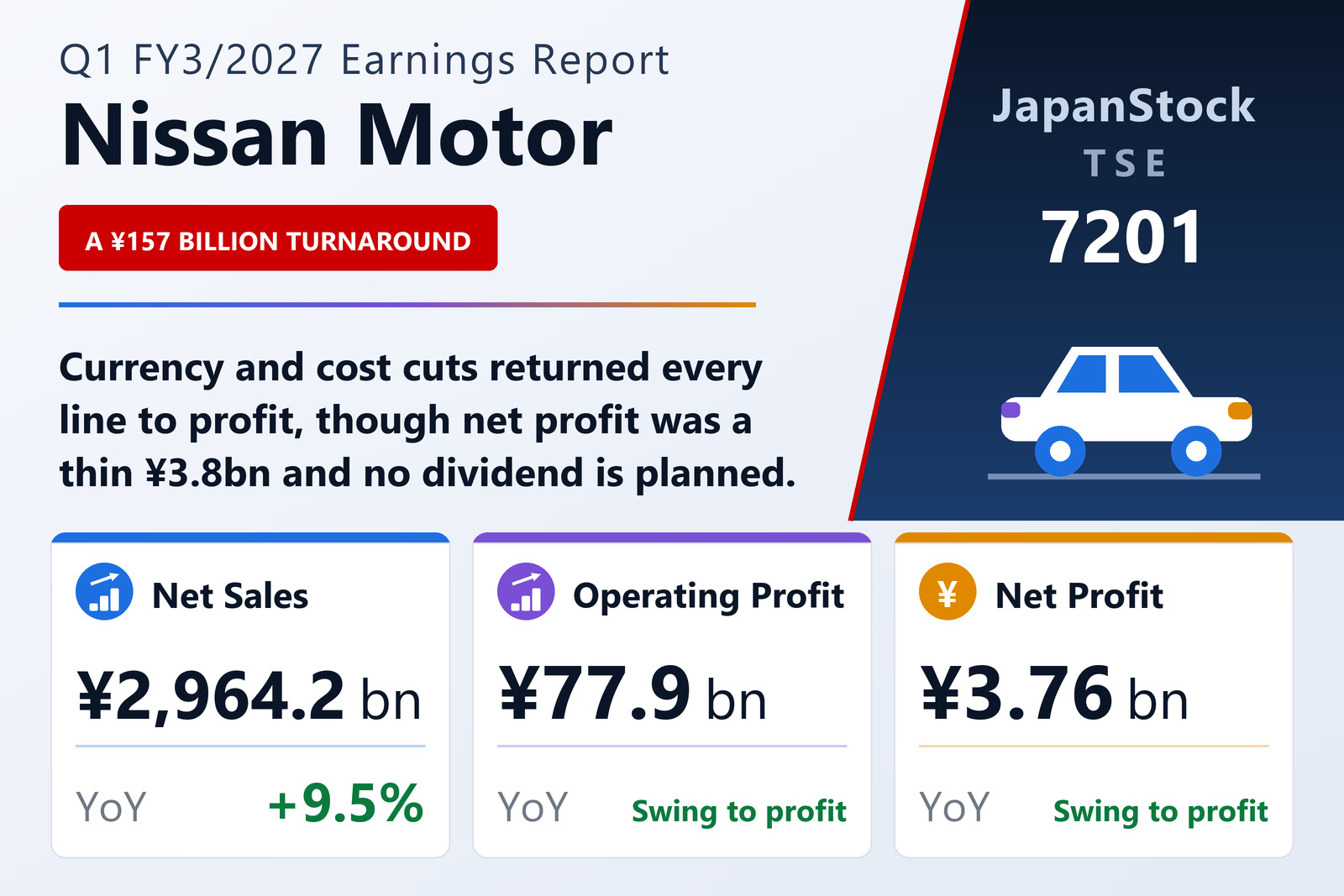
Nissan Motor Co., Ltd. (TSE: 7201) reported consolidated results for the first quarter of the fiscal year ending March 2027 — the three months to June 30, 2026 — under Japanese GAAP, returning to the black at every line of the income statement. Net sales rose 9.5% to ¥2,964,203 million from ¥2,706,906 million, an increase of ¥257,297 million. Operating profit came in at ¥77,889 million against an operating loss of ¥109,231 million a year earlier — a swing of roughly ¥157.0 billion. Ordinary profit was ¥49,094 million versus a ¥115,758 million loss, a ¥158.3 billion improvement, and net profit attributable to owners of the parent was ¥3,761 million against a loss of about ¥115.7 billion, a ¥119.5 billion improvement. Basic earnings per share were ¥1.08, up from a loss of ¥33.15; diluted EPS was ¥1.03.
A turnaround built on currency and cost, not volume
The swing did not come from selling more cars. Global industry total demand in the quarter was 21.15 million units, down 2.1% year on year, and Nissan's own global retail sales slipped 0.9% to 701,000 units. Management attributes the recovery in operating profit chiefly to currency movements and to cost-reduction activity — the first quarter reported under the company's current restructuring programme. That makes the quarter a demonstration that the cost base has been reset rather than evidence that demand for Nissan's line-up has turned.
Profit thins out below the operating line
Below operating profit the result narrows quickly. A non-operating loss of ¥28.8 billion — only ¥1.3 billion better than a year earlier — absorbed a large share of the operating result, leaving pre-tax profit at ¥40.8 billion, itself a ¥168.9 billion improvement helped by an extraordinary loss of ¥8.3 billion that was ¥10.6 billion smaller than the prior year's. After tax and minority interests, the bottom line was just ¥3,761 million, a net margin of roughly 0.1%. Comprehensive income, which captures currency translation and other movements, was far stronger at ¥88,488 million against negative ¥189,486 million a year earlier.
Balance sheet and cash flow
Total assets stood at ¥20,092,588 million as of June 30, 2026, up from ¥19,812,442 million at the March year-end. Net assets rose to ¥5,328,646 million from ¥5,241,668 million, with shareholders' equity of ¥4,875,486 million against ¥4,798,981 million, lifting the equity ratio marginally to 24.3% from 24.2%. Operating cash flow turned positive at ¥37.2 billion from an outflow of ¥84.2 billion a year earlier, a ¥121.4 billion swing driven mainly by the improvement in earnings. Investing activities consumed ¥215.1 billion versus ¥277.9 billion, a ¥62.7 billion smaller outflow reflecting lower net lease-vehicle spending in the sales finance business and lower restricted deposits on asset-backed securities, partly offset by smaller proceeds from fixed-asset disposals. Financing provided ¥110.5 billion against ¥367.3 billion, a ¥256.8 billion decrease driven by smaller net short-term borrowings.
Within the automotive business the picture is heavier: free cash flow was negative ¥323.9 billion for the quarter, and automotive net cash fell ¥201.2 billion from the March 31, 2026 level to ¥969.2 billion. The company had 3,713,998,612 shares issued including treasury stock, of which 218,590,239 were held in treasury, with an average of 3,496,138,917 shares outstanding during the quarter.
No dividend, full-year guidance left unchanged
Nissan paid no dividend for the year ended March 2026 and forecasts none for FY3/2027, with both the interim and year-end payouts guided at ¥0.00. Full-year guidance was left unchanged from the previous announcement: net sales of ¥13,000,000 million (+8.3%), operating profit of ¥200,000 million (+244.8%), net profit attributable to owners of ¥20,000 million and EPS of ¥5.72. No first-half forecast is provided. With ¥77.9 billion booked in the first quarter, the remaining nine months must deliver roughly ¥122.1 billion to hit the operating target — a back-loaded profile that leaves the full-year figure dependent on a substantial second-half contribution. The quarterly financial statements have not been subject to an audit review.
| Metric | Q1 FY3/2027 | Q1 FY3/2026 | YoY |
|---|---|---|---|
| Net sales (¥ billion) | 2,964.20 | 2,706.91 | +9.5% |
| Operating profit (loss) (¥ billion) | 77.89 | -109.23 | swing to profit |
| Ordinary profit (loss) (¥ billion) | 49.09 | -115.76 | swing to profit |
| Net profit (loss) attrib. to owners (¥ billion) | 3.76 | -115.76 | swing to profit |
| Basic EPS (¥) | 1.08 | -33.15 | swing to profit |
| Global retail sales (thousand units) | 701 | 707 | -0.9% |
| FY27 operating profit guidance (¥ billion) | 200.00 | 58.00 | +244.8% |
JapanStockPulse provides informational content only and does not constitute investment advice. Figures are taken from the company's published earnings short report and may be subject to subsequent revision.