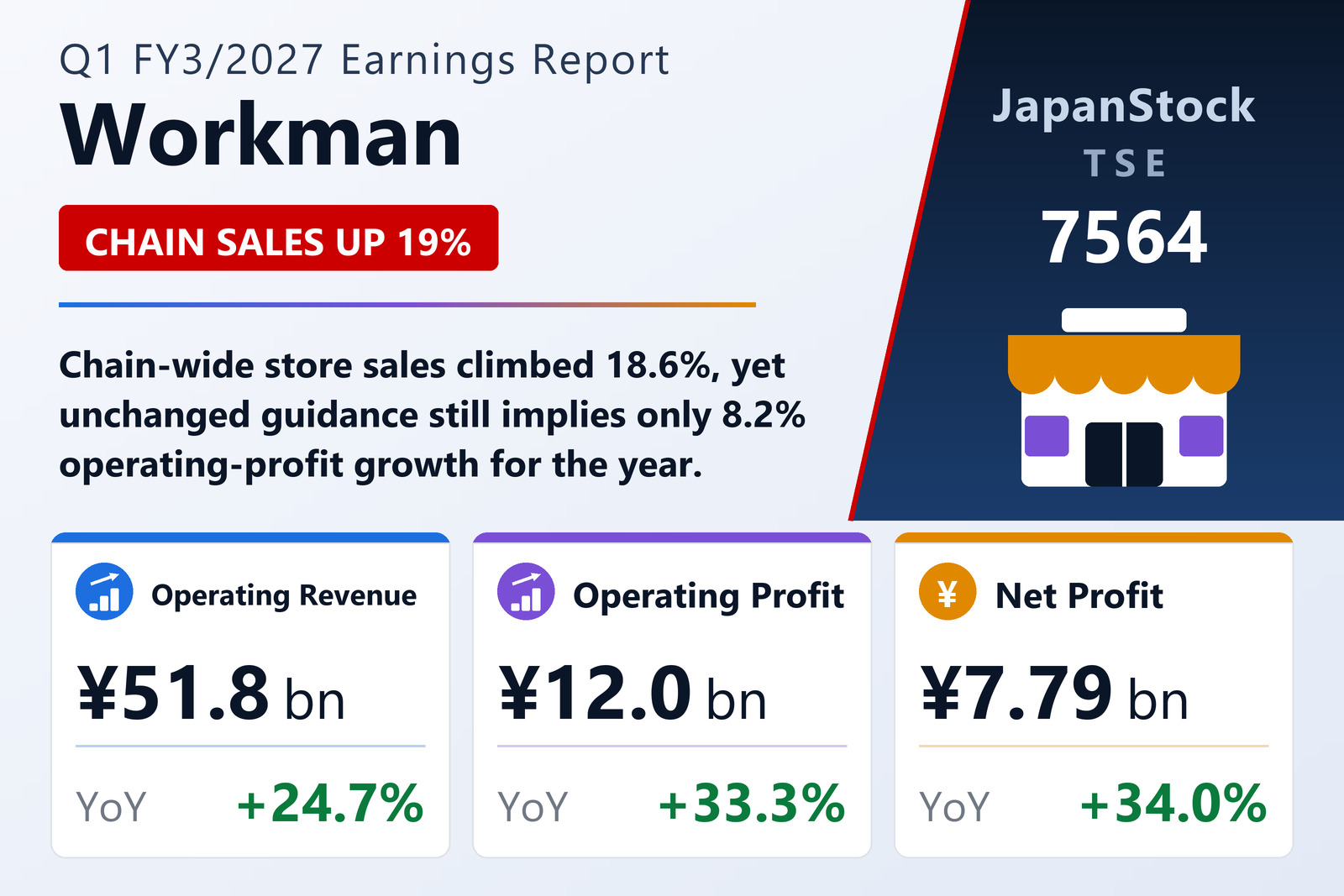
Workman Co., Ltd. (TSE: 7564), operator of Japan's largest chain of work-clothing and functional-apparel stores, reported results for the first quarter of the fiscal year ending March 2027 — the three months from April 1 to June 30, 2026 — under Japanese GAAP. Operating revenue rose 24.7% to ¥51,812 million, operating profit rose 33.3% to ¥12,031 million, ordinary profit rose 34.6% to ¥12,431 million and quarterly net profit rose 34.0% to ¥7,792 million. Earnings per share came to ¥95.48, against ¥71.28 a year earlier. Workman has no subsidiaries, so these are non-consolidated, parent-only figures.
Two top lines: company revenue and chain-wide store sales
Because the overwhelming majority of Workman outlets are run by franchisees, the company publishes two separate top lines and they measure different things. Chain-wide store sales — what shoppers actually spent across every store in the network — reached ¥67,561 million, up 18.6%, with same-store sales up 13.3%. Operating revenue, the figure that runs through Workman's own income statement, was ¥51,812 million: ¥14,014 million of operating income from franchisees (royalties and related items) plus ¥37,798 million of net sales, of which ¥29,769 million was merchandise supplied to franchise stores and ¥8,028 million came from directly operated stores.
Split by operating format, franchise stores generated ¥59,532 million of chain-wide sales, up 18.5% and 88.1% of the total, while directly operated stores contributed ¥8,028 million, up 19.8% and 11.9% of the total.
Why profit outgrew sales
Operating revenue grew faster than chain-wide sales, and profit faster still, because the mix moved toward merchandise Workman supplies itself while fixed costs barely moved. Cost of sales rose to ¥30,974 million from ¥24,939 million, leaving gross profit on operating revenue of ¥20,837 million against ¥16,620 million — a gross margin of 40.2%, roughly flat year on year. Selling, general and administrative expenses rose only to ¥8,806 million from ¥7,592 million, so the SG&A ratio fell to 17.0% of operating revenue from 18.3%. The result was an operating margin of 23.2%, up from 21.7%. Ordinary profit came in ¥400 million above operating profit on non-operating income including interest received and purchase discounts.
Private brands now three-quarters of the chain
Management attributed the quarter to its mass-market product policy under the Mid-Term Growth Vision 2030 and its stated goal of putting functional wear within reach of everyone. Product launches included MEDiHEAL innerwear, aimed at the growing recovery-and-fatigue-reduction category, alongside the XShelter heat-mitigation range and a UV-blocking parka. The shift toward private-brand goods accelerated further: private brands accounted for 74.9% of chain-wide store sales, up 6.4 percentage points year on year. On the demand side, Workman layered television commercials and printed flyers on top of its established social-media marketing and tied the campaigns more closely to in-store displays, aiming to widen the customer base and raise visit frequency.
The company was explicit that the operating environment was not easy. Unseasonable weather left summer merchandise selling sluggishly, while the weak yen and higher raw-material costs pushed up procurement prices — headwinds the quarter's growth came in spite of, not because of.
Store network reaches 1,107
Workman opened 13 stores in the quarter — 10 Workman Colors and three WORKMAN Plus — alongside two scrap-and-build replacements and 17 conversion renovations, taking the network to 1,107 stores. The mix is Workman 237, WORKMAN Plus 732, #Workman Girl 31, Workman Colors 97 and Workman Pro 10. Expansion for the Colors format is being driven through corporate franchising into shopping centres, while the Plus format is being refreshed through renovation and scrap-and-build. By contract type, franchise stores numbered 1,011, five more than at the previous year-end and including 13 corporate franchises, while directly operated stores — comprising Type-B contract stores, training stores and shopping-centre outlets — rose by eight to 96.
A balance sheet with almost no leverage
Total assets stood at ¥184,523 million, ¥734 million lower than at the March 2026 year-end. Current assets fell ¥1,296 million to ¥137,144 million as merchandise inventory dropped ¥7,093 million and cash and deposits fell ¥1,261 million to ¥82,482 million, partly offset by a ¥3,099 million increase in securities, a ¥2,760 million rise in the franchise-store loan account and ¥690 million more in receivables. Non-current assets rose ¥562 million to ¥47,379 million on land (+¥803 million) and buildings (+¥462 million).
Total liabilities fell ¥1,512 million to ¥30,287 million, with no meaningful interest-bearing debt. Net assets rose ¥778 million to ¥154,235 million as the ¥7,792 million quarterly profit and ¥246 million of deferred hedge gains were largely offset by ¥7,263 million of dividends paid. That left the equity ratio at 83.6%, up from 82.8% at the year-end — an unusually strong position for a retailer. Depreciation for the quarter was ¥998 million, up from ¥847 million.
Guidance untouched, and the gap that leaves
Workman made no change to the forecasts it published on May 11, 2026. For the first half it still guides operating revenue of ¥94,203 million (+23.7%), operating profit of ¥17,666 million (+22.3%), ordinary profit of ¥18,341 million (+23.3%), net profit of ¥11,310 million (+22.6%) and EPS of ¥138.58, with chain-wide store sales of ¥123,785 million (+21.9%). For the full year it guides operating revenue of ¥183,376 million (+14.0%), operating profit of ¥32,112 million (+8.2%), ordinary profit of ¥33,418 million (+9.3%), net profit of ¥22,329 million (+8.3%) and EPS of ¥273.60, with chain-wide store sales of ¥237,970 million (+13.7%).
That is the tension in this disclosure. First-quarter operating profit of ¥12,031 million already represents roughly 37.5% of the full-year plan, yet the plan asks for only 8.2% growth over the year as a whole. Holding the forecast implies about ¥20,081 million of operating profit across the remaining nine months, marginally below the roughly ¥20,650 million earned in the same nine months of the prior year. The tanshin gives no elaboration beyond stating that the May forecast is unrevised; the only cost signals in the document are the procurement-price pressure from the weak yen and raw materials, and the weather-sensitivity of seasonal merchandise. Workman reports as a single segment covering retail of work clothing and work-related goods, outdoor and sports wear, and casual wear.
Dividend held at ¥89, paid once a year
The dividend forecast for FY3/2027 is unchanged at ¥89.00 per share, the same as FY3/2026. Workman pays once a year at the fiscal year-end, so the interim figure of ¥0.00 is the company's normal schedule rather than a suspension. On guided EPS of ¥273.60 that is a payout ratio of about 33%. The ¥7,263 million of dividends paid during the quarter relate to the FY3/2026 year-end distribution.
| Metric | Q1 FY3/2027 | Q1 FY3/2026 | YoY |
|---|---|---|---|
| Chain-wide store sales (¥ billion) | 67.56 | 56.95 | +18.6% |
| Operating revenue (¥ billion) | 51.81 | 41.56 | +24.7% |
| Operating profit (¥ billion) | 12.03 | 9.03 | +33.3% |
| Ordinary profit (¥ billion) | 12.43 | 9.24 | +34.6% |
| Quarterly net profit (¥ billion) | 7.79 | 5.82 | +34.0% |
| EPS (¥) | 95.48 | 71.28 | +33.9% |
| Operating margin (%) | 23.2 | 21.7 | +1.5pt |
| Equity ratio (%, vs FY3/26 year-end) | 83.6 | 82.8 | +0.8pt |
| FY3/27 operating revenue guidance (¥ billion) | 183.38 | — | +14.0% |
| FY3/27 operating profit guidance (¥ billion) | 32.11 | — | +8.2% |
| Annual dividend forecast (¥) | 89.00 | 89.00 | unchanged |
JapanStockPulse provides informational content only and does not constitute investment advice. Figures are taken from the company's published earnings short report and may be subject to subsequent revision.