Revenue slipped 3%, profit fell far faster
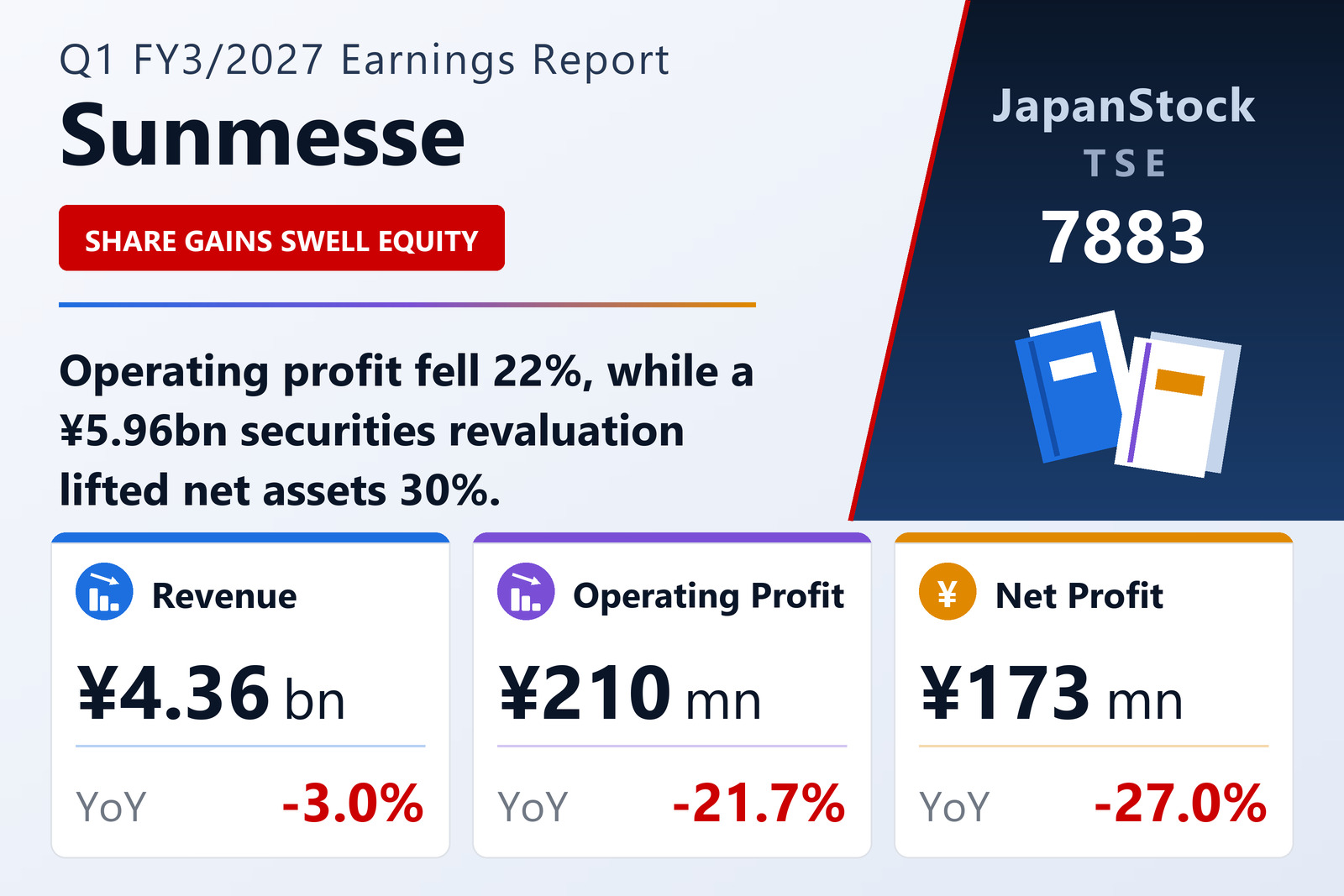
Sunmesse Co., Ltd. (TSE: 7883), the Gifu-based commercial printer, disclosed consolidated first-quarter results for the fiscal year ending March 2027 — April 1 to June 30, 2026 — under Japanese GAAP on August 3, 2026. Revenue was ¥4,356 million, down 3.0% year on year from ¥4,490 million. Operating profit fell 21.7% to ¥210 million from ¥268 million, ordinary profit fell 17.3% to ¥297 million from ¥359 million, and net profit attributable to owners of parent fell 27.0% to ¥173 million from ¥237 million. Earnings per share came in at ¥11.17 against ¥15.34 a year earlier; the company reports no diluted figure.
Two things make the decline look steeper than the top line alone suggests. The first is the comparison base: a year earlier revenue had risen 3.2%, operating profit 41.5%, ordinary profit 34.6% and net profit 33.0%, so this quarter is measured against an unusually strong quarter. The second is the cushioning effect of non-operating income further down the statement. Ordinary profit fell less than operating profit — 17.3% against 21.7% — because roughly ¥96 million of non-operating income, chiefly ¥75 million of dividends received and ¥17 million of property rental income, is very large relative to a ¥210 million operating profit. Net profit fell the most of the four lines, 27.0%, partly because the prior year carried ¥1 million of gains on the sale of investment securities while this quarter carried a ¥3 million loss on disposal of fixed assets.
Printing grew; the event business did all the damage
The consolidated revenue decline is not a printing problem. The Printing segment — the group's core — actually grew, with revenue of ¥4,315 million, up 1.9%, and segment profit of ¥226 million, up 2.1%. Inside it the mix moved sharply. Commercial printing, still by far the largest line, fell 6.8% to ¥2,546 million, while IPS-related work rose 23.6% to ¥878 million and packaging printing rose 30.6% to ¥471 million. Publishing printing was ¥171 million. These are the sub-lines the company chose to highlight and they do not sum to the segment total, so they should be read as the direction of travel rather than as a complete breakdown.
The Event segment is where the quarter was lost. Revenue fell 83.7% to just ¥41 million, and the segment swung to an operating loss of ¥17 million from a ¥44 million profit a year earlier, because a large project booked in the prior year did not repeat. The arithmetic is worth spelling out: that swing of about ¥62 million is more than the ¥58 million fall in consolidated operating profit. Strip the event business out and Sunmesse's operating result improved. Inter-segment elimination contributed about ¥0.9 million to reported profit, bridging the ¥209 million segment total to the ¥210 million consolidated figure.
A ¥5.96 billion securities revaluation reshapes the balance sheet
The real action in this quarter sits on the balance sheet rather than the income statement. Total assets rose to ¥28,310 million at June 30, 2026, from ¥22,583 million three months earlier — an increase of ¥5,727 million, or about 25%, in a single quarter. Almost all of it is one line: non-current assets rose ¥5,824 million to ¥20,143 million, driven by investment securities up ¥5,961 million to ¥12,852 million. Current assets barely moved, down ¥97 million to ¥8,167 million, as cash and deposits rose ¥731 million against an ¥850 million decline in notes and accounts receivable and contract assets.
On the other side, net assets rose ¥4,201 million — roughly 30% — to ¥18,390 million from ¥14,188 million, almost entirely the ¥4,119 million increase in the valuation difference on available-for-sale securities. Shareholders' equity reached ¥18,287 million from ¥14,086 million and the equity ratio improved to 64.6% from 62.4%. Non-current liabilities rose ¥1,947 million to ¥5,067 million, and that increase is essentially the tax shadow of the same revaluation: deferred tax liabilities rose ¥1,939 million. Current liabilities fell ¥422 million to ¥4,852 million, with accrued expenses and deposits received inside "other" up ¥240 million against notes and accounts payable down ¥220 million, income taxes payable down ¥154 million and the provision for bonuses down ¥288 million.
What this is not should be stated plainly. The gain is a mark-to-market revaluation of a securities portfolio recognised in other comprehensive income — it is not realised profit, it is not cash, and ¥1.9 billion of deferred tax has already been booked against it. It is also reversible: the same line would swing the other way if equity markets fell. That is why comprehensive income of ¥4,275 million, up 660.1% from ¥562 million, sits at roughly twenty-four times the ¥173 million of net profit the operating business actually earned. Sunmesse did not prepare a quarterly consolidated cash flow statement; the only cash-flow-adjacent figure disclosed is depreciation of ¥159 million, against ¥161 million a year earlier.
Guidance untouched — and already at odds with the first quarter
Full-year and half-year guidance for FY3/2027 is unchanged from the May 14, 2026 announcement. For the first half the company still expects revenue of ¥8,256 million (up 0.9%), operating profit of ¥15 million (down 82.0%), ordinary profit of ¥111 million (down 44.3%), net profit of ¥69 million (down 45.2%) and EPS of ¥4.50. For the full year it expects revenue of ¥17,236 million (up 0.6%), operating profit of ¥197 million (down 39.1%), ordinary profit of ¥378 million (down 30.3%), net profit of ¥241 million (down 47.5%) and EPS of ¥15.55.
Set those targets against the quarter just reported and the tension is obvious. Q1 alone earned ¥210 million of operating profit — more than the ¥197 million guided for the entire year, and fourteen times the ¥15 million guided for the first half. Taken literally, the half-year target implies an operating loss of roughly ¥195 million in the second quarter, and the full-year target implies the remaining nine months producing a small operating loss in aggregate. The net profit line tells the same story: ¥173 million booked in Q1 against a ¥69 million half-year target and a ¥241 million full-year target. Either the guidance is deliberately conservative or the company expects a genuinely loss-making quarter ahead; it says only that it will announce a revision promptly if one becomes necessary. Note also that this earnings report is unreviewed — Sunmesse said it planned to disclose a version carrying an auditor's review report on August 10, 2026.
Dividend held at ¥9.00 as the "Beyond Printing" repositioning takes shape
The dividend forecast for FY3/2027 is ¥9.00 per share — a ¥4.00 interim payment plus a ¥5.00 year-end payment — unchanged from the previous announcement and level with the ¥9.00 paid for FY3/2026. On forecast EPS of ¥15.55 that implies a payout ratio of about 58%; the ¥11.17 earned in the first quarter already covers most of the annual dividend.
Behind the numbers, Sunmesse is in the middle of a deliberate repositioning. Having marked its 90th anniversary last year, the company revised the management philosophy and company creed that it describes as its DNA, set its first corporate purpose along with a vision, mission and values, and adopted a new management vision — "Change -SX2035- Beyond Printing" — aimed at surviving a VUCA era and becoming a 100-year company. The stated destination is a transformation from printer to "integrated communications company", with sustainability management as the axis and economic and social value treated as two wheels of the same vehicle.
That repositioning has a hard commercial logic behind it. Management describes an economy where prolonged price rises, high resource and energy costs stemming from Middle East tensions and worries about logistics disruption weighed on both corporate activity and consumer spending, while uncertainty over U.S. trade policy and slowing overseas growth made exporters and capital spenders cautious; wage increases continued but real wage growth stayed limited and consumer sentiment lacked strength. Printing itself faces something more structural: digitisation continues to erode commercial and publishing print demand, paper, ink, energy, logistics and labour costs squeeze margins, competition makes passing those costs on difficult, and labour shortages are forcing a rethink of production systems. Against that backdrop, the two lines growing at more than 20% — IPS-related work and packaging printing — matter considerably more to the equity story than the 6.8% decline in traditional commercial printing.
| Metric | Q1 FY3/2027 | Q1 FY3/2026 | Change |
|---|---|---|---|
| Revenue (¥ million) | 4,356 | 4,490 | −3.0% |
| Operating profit (¥ million) | 210 | 268 | −21.7% |
| Ordinary profit (¥ million) | 297 | 359 | −17.3% |
| Net profit attrib. to owners of parent (¥ million) | 173 | 237 | −27.0% |
| Comprehensive income (¥ million) | 4,275 | 562 | +660.1% |
| Earnings per share (¥) | 11.17 | 15.34 | −27.2% |
| Printing segment revenue (¥ million) | 4,315 | 4,235 | +1.9% |
| Printing segment profit (¥ million) | 226 | 222 | +2.1% |
| Event segment revenue (¥ million) | 41 | 255 | −83.7% |
| Event segment profit / (loss) (¥ million) | −17 | 44 | to loss |
| Total assets (¥ million; vs Mar 31, 2026) | 28,310 | 22,583 | +25.4% |
| Net assets (¥ million; vs Mar 31, 2026) | 18,390 | 14,188 | +29.6% |
| Equity ratio (vs Mar 31, 2026) | 64.6% | 62.4% | +2.2 pt |
| Dividend per share forecast (¥) | 9.00 | 9.00 | unchanged |
JapanStockPulse provides informational content only and does not constitute investment advice. Figures are taken from the company's published earnings short report and may be subject to subsequent revision.