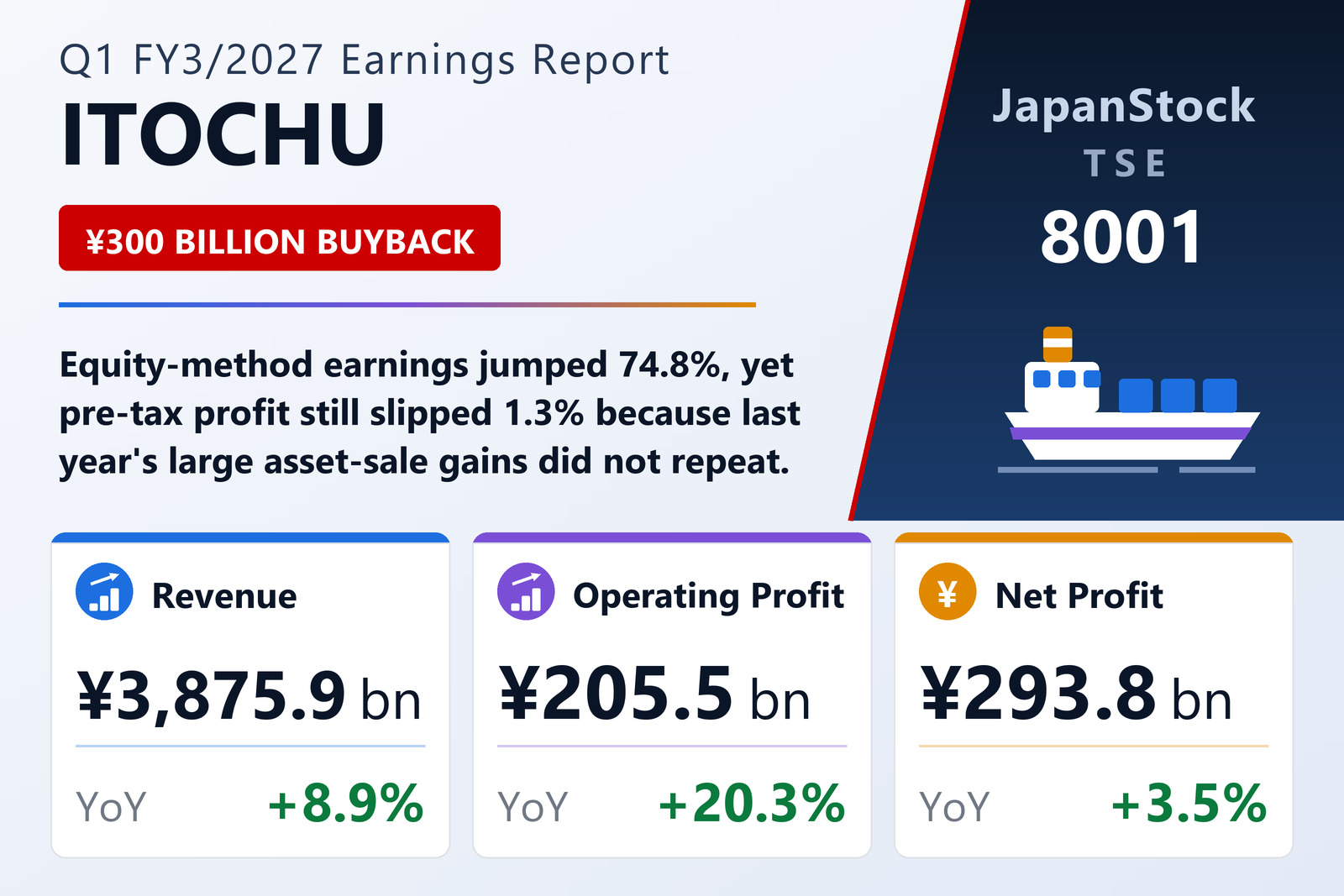
ITOCHU Corporation (TSE: 8001), one of Japan's largest general trading companies, reported consolidated first-quarter results for the three months to June 30, 2026 under IFRS. Revenue rose 8.9% to ¥3,875,861 million, operating profit climbed 20.3% to ¥205,455 million, and profit attributable to ITOCHU rose 3.5% to ¥293,763 million. Basic earnings per share were ¥42.02, up from ¥40.10, with no dilution. Profit before tax, however, edged down 1.3% to ¥369,999 million.
Gross profit does the heavy lifting
The operating line was carried almost entirely by trading volume and margin. Gross profit expanded 10.2% to ¥655,986 million from ¥595,362 million, with the company crediting Energy & Chemicals, Metals & Minerals, ICT & Financial Business, Machinery and General Products & Realty. Selling, general and administrative expenses grew more slowly, to ¥446,880 million from ¥420,360 million, held back by higher personnel costs and a weaker yen, while the provision for doubtful accounts fell to ¥3,651 million from ¥4,267 million on a smaller allowance against ordinary receivables. The net effect was a ¥34.7 billion year-on-year gain at the operating line — the strongest quarterly operating result the company has posted in the first quarter of a fiscal year.
Why pre-tax profit fell while operating profit surged
The answer sits one line below operating profit. Gains on investment securities collapsed to ¥38,144 million from ¥130,544 million a year earlier — a ¥92.4 billion swing that on its own more than wiped out the ¥34.7 billion operating gain and the ¥47.8 billion increase in equity-method income. The prior-year quarter had been inflated by one-off disposals of C.P. Pokphand and PROVENCE HUILES; this year's only comparable item was the sale of CIECO Azer. Two smaller headwinds compounded it: net financial income fell to ¥3,291 million from ¥5,670 million as interest expense rose to ¥27,777 million on higher yen rates and a larger debt balance, and dividends received slipped to ¥17,720 million from ¥19,938 million. Partly offsetting, gains on property and equipment rose to ¥2,334 million and other income to ¥9,151 million on better foreign-exchange results. A lighter tax charge — ¥66,349 million against ¥82,531 million, helped by the additional acquisition of Hitachi Construction Machinery — is what pushed the bottom line back into positive territory.
Equity-method earnings surge 75%
The standout line of the quarter was equity-method investment income of ¥111,624 million, up 74.8% from ¥63,869 million. The gain was broad-based, with Machinery, Metals & Minerals, Food and General Products & Realty all contributing. Machinery alone accounted for ¥33,858 million of it, up from ¥14,680 million, and the affiliates grouped under Other and Adjustments — which house ITOCHU's stake in CITIC Limited — contributed ¥32,028 million. That surge is the reason profit attributable to ITOCHU still rose 3.5% despite the securities-gain shortfall.
Segment scorecard: Energy & Chemicals and Machinery lead
Seven of ITOCHU's eight divisions grew their bottom-line contribution. Energy & Chemicals more than tripled to ¥64,345 million and Machinery rose 71% to ¥54,811 million, the two largest earners of the quarter. Metals & Minerals added 37% to ¥45,907 million, Textile 62% to ¥14,435 million, ICT & Financial Business 27% to ¥20,495 million and General Products & Realty 24% to ¥13,896 million. Food was the only division to fall, down 9% to ¥30,653 million, though it remains by far the biggest revenue generator at ¥1,422,708 million. Note that from the start of this fiscal year FamilyMart's management moved from The 8th Company to the Food division, with 70% of its attributable profit reallocated back to The 8th Company; prior-year figures have been restated accordingly. The steep decline in Other and Adjustments, from ¥118,361 million to ¥36,631 million, is where last year's large disposal gains sat.
| Division | Q1 FY3/27 (¥ billion) | Q1 FY3/26 (¥ billion) | YoY | of which equity-method (¥ billion) |
|---|---|---|---|---|
| Textile | 14.4 | 8.9 | +62.1% | 8.1 |
| Machinery | 54.8 | 32.0 | +71.0% | 33.9 |
| Metals & Minerals | 45.9 | 33.6 | +36.7% | 10.0 |
| Energy & Chemicals | 64.3 | 19.5 | +229.6% | 5.1 |
| Food | 30.7 | 33.8 | -9.4% | 10.4 |
| General Products & Realty | 13.9 | 11.2 | +23.9% | 3.2 |
| ICT & Financial Business | 20.5 | 16.1 | +27.2% | 7.5 |
| The 8th Company | 12.6 | 10.4 | +21.4% | 1.5 |
| Other, adjustments & eliminations | 36.6 | 118.4 | -69.1% | 32.0 |
| Total | 293.8 | 283.9 | +3.5% | 111.6 |
Balance sheet: bigger, and more leveraged
Total assets grew to ¥17,179,751 million from ¥16,732,815 million at March 31, 2026, lifted by higher inventories and trade receivables on stronger trading volume, an increase in equity-method investments, and yen weakness. Shareholders' equity rose to ¥6,770,822 million from ¥6,589,966 million and total equity to ¥7,191,223 million, leaving the shareholders' equity ratio unchanged at 39.4%; book value per share improved to ¥968.22 from ¥942.78. Gearing moved the other way: interest-bearing debt increased to about ¥4,161.2 billion from ¥3,672.7 billion and net interest-bearing debt to roughly ¥3,435.1 billion from ¥3,024.3 billion, pushing net debt-to-equity to 0.51 times from 0.46 times. The company attributes the increase mainly to additional stakes acquired in Hitachi Construction Machinery and ITOCHU-SHOKUHIN, plus dividend payments. Comprehensive income attributable to ITOCHU more than doubled to ¥367,919 million from ¥175,372 million, as a ¥20,941 million positive currency-translation adjustment and ¥58,271 million of other comprehensive income from equity-method investees replaced last year's heavy negative marks.
Operating cash flow more than halves
Cash generation was the weak spot. Operating cash flow fell to ¥106,562 million from ¥245,502 million, a drop of 56.6%. The culprit is the working-capital line: changes in operating assets and liabilities drained ¥180,838 million this quarter against ¥60,777 million a year earlier, a ¥120 billion deterioration the company traces to working-capital build in Energy & Chemicals and General Products & Realty. Dividends received from equity-method investees also fell, to ¥77,171 million from ¥126,201 million. Investing outflows widened to ¥71,789 million from ¥48,512 million on equity-method acquisitions in Machinery, General Products & Realty and ICT & Financial Business, leaving free cash flow of roughly ¥34.8 billion against ¥197.0 billion a year ago. Financing swung to a ¥40,353 million inflow from a ¥210,645 million outflow, as bond and loan proceeds of ¥469,078 million funded the stake purchases and ¥153,960 million of treasury-share buying. Period-end cash and equivalents stood at ¥673,419 million, up from ¥593,766 million at the March year-end.
A ¥300 billion buyback, and an unusually narrow forecast
Disclosed alongside the results as a subsequent event, ITOCHU's board resolved on August 3, 2026 to repurchase up to ¥300.0 billion of its own common shares between August 4, 2026 and January 29, 2027, using a combination of a tender offer and open-market purchases. The company had already bought back ¥153,960 million of stock during the quarter, and treasury holdings stood at 931,394,253 shares against 7,924,447,520 shares issued. Full-year guidance was left unchanged — and it takes an unusual form: ITOCHU forecasts only profit attributable to ITOCHU, at ¥950,000 million (+5.5%) with EPS of ¥136.75, and publishes no revenue, operating-profit or half-year forecast at all, because it plans and evaluates performance on a full-year basis. The first quarter's ¥293.8 billion represents 30.9% of that ¥950 billion target.
Dividend: mind the five-for-one split
ITOCHU executed a five-for-one common stock split effective January 1, 2026, and the per-share table needs care as a result. The FY3/2026 interim dividend of ¥100.00 is a pre-split figure while the ¥22.00 year-end is post-split, so the two halves cannot be added or compared directly; the full-year FY3/2026 dividend was ¥210.00 per share on a pre-split basis, equivalent to ¥42.00 post-split. For FY3/2027 the company maintains its forecast of ¥44.00 per share, split evenly between a ¥22.00 interim and a ¥22.00 year-end payment, with no revision from the previously announced plan. Prior-year per-share earnings and average share counts have likewise been restated as if the split had taken place at the start of that year.
| Metric | Q1 FY3/2027 | Q1 FY3/2026 | YoY |
|---|---|---|---|
| Revenue (¥ billion) | 3,875.86 | 3,558.93 | +8.9% |
| Gross profit (¥ billion) | 655.99 | 595.36 | +10.2% |
| Operating profit (¥ billion) | 205.46 | 170.74 | +20.3% |
| Equity-method earnings (¥ billion) | 111.62 | 63.87 | +74.8% |
| Gains on investment securities (¥ billion) | 38.14 | 130.54 | -70.8% |
| Profit before tax (¥ billion) | 370.00 | 374.81 | -1.3% |
| Profit attributable to ITOCHU (¥ billion) | 293.76 | 283.94 | +3.5% |
| Comprehensive income attrib. to ITOCHU (¥ billion) | 367.92 | 175.37 | +109.8% |
| Basic EPS (¥) | 42.02 | 40.10 | +4.8% |
| Operating cash flow (¥ billion) | 106.56 | 245.50 | -56.6% |
| Total assets (¥ billion) | 17,179.75 | 16,732.82 | +2.7% |
| Shareholders' equity ratio (%) | 39.4 | 39.4 | unchanged |
| Book value per share (¥) | 968.22 | 942.78 | +2.7% |
| FY3/2027 guidance — profit attributable (¥ billion) | 950.00 | — | +5.5% |
JapanStockPulse provides informational content only and does not constitute investment advice. Figures are taken from the company's published earnings short report and may be subject to subsequent revision.