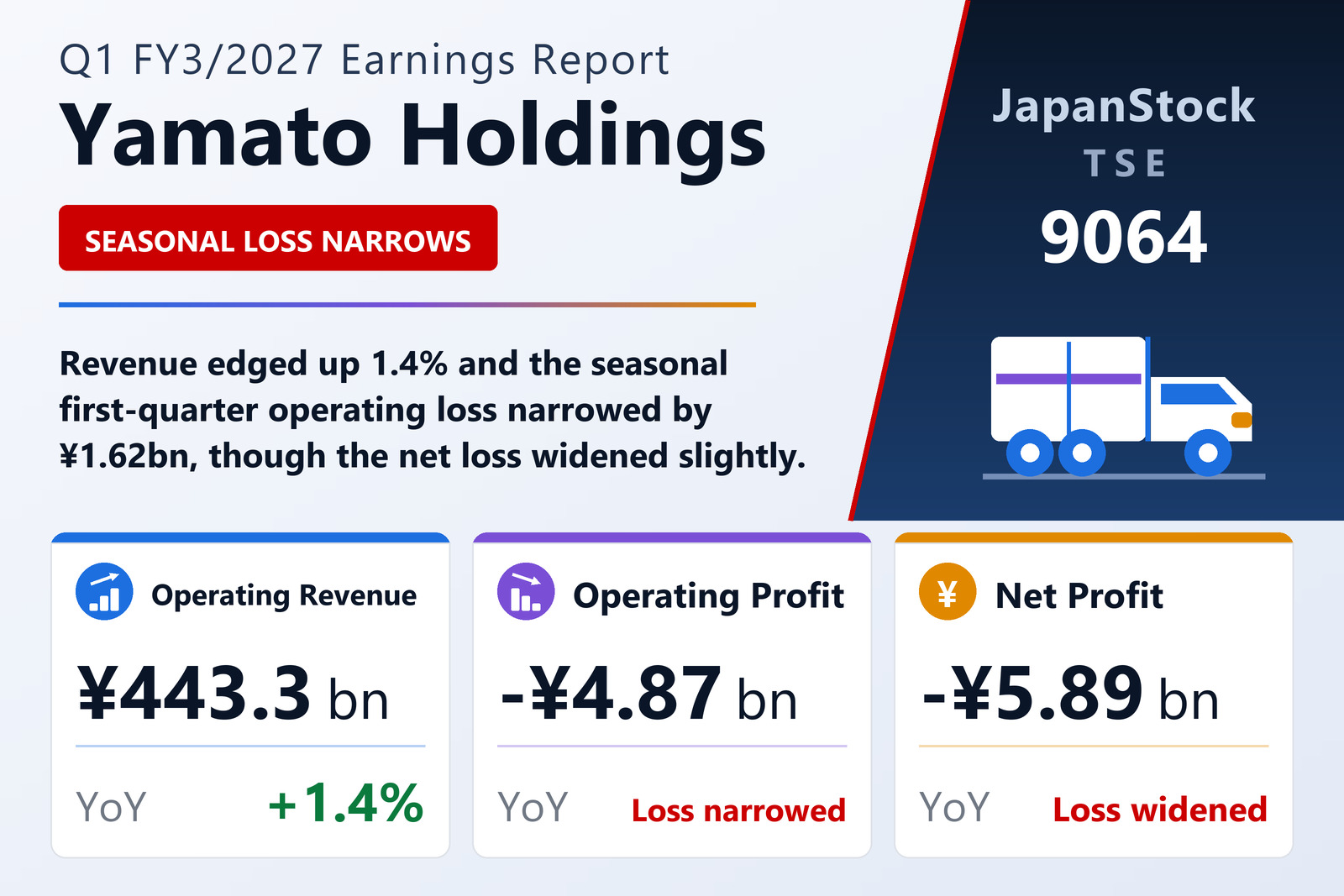
Yamato Holdings Co., Ltd. (TSE: 9064), Japan's largest parcel-delivery group and operator of the TA-Q-BIN network, reported consolidated results for the three months ended June 30, 2026 under Japanese GAAP. Operating revenue rose 1.4% to ¥443,332 million, an increase of ¥5,979 million, while the operating loss narrowed by ¥1,622 million to ¥4,871 million and the ordinary loss narrowed by ¥1,717 million to ¥4,938 million. The net loss attributable to owners of the parent widened by ¥463 million to ¥5,887 million. The first quarter is seasonally the weakest of Yamato's financial year.
Revenue growth outpaces cost inflation
Operating expenses rose ¥4,356 million to ¥448,203 million — less than the ¥5,979 million gain in revenue, which is the arithmetic behind the narrower operating loss. Top-line growth came from higher parcel volumes from small-business and individual customers in the Express division, price optimisation for large corporate accounts, and the continued expansion of corporate solutions. Cost increases reflected sustained human-capital investment — better pay and working conditions for employees and delivery partners — alongside higher energy prices and procurement costs. Data- and AI-driven transport planning and improved load factors offset part of that pressure. The quarter falls under the mid-term plan "Sustainability Transformation 2030 – 1st Stage", which targets a stronger TA-Q-BIN network, an expanded corporate and B2B business, and new business models.
Express still carries the seasonal loss
Express (TA-Q-BIN) external operating revenue edged up 0.4% to ¥364,680 million, but the segment still ran an operating loss of ¥13,139 million — narrower by ¥298 million year on year. The parcel mix shifted noticeably: combined TA-Q-BIN, TA-Q-BIN Compact and EAZY volumes fell 3.0% to 449 million units, while the smaller-format Nekopos and Kuroneko Yu-Packet services jumped 18.2% to 126 million units. Kuroneko Yu-Mail slipped 10.3% to 24 million units.
Corporate and cross-border units expand
Contract Logistics revenue rose 9.1% to ¥41,167 million and segment operating profit gained ¥694 million to ¥1,908 million; the division opened three new integrated business-solution hubs during the quarter — in Tokyo, Shiga and Okayama — taking the national total to nine. Global revenue grew 6.1% to ¥26,331 million with operating profit up ¥53 million to ¥2,660 million, helped by price optimisation for cross-border e-commerce customers, a wider customer base and better forwarding profitability after a revised procurement strategy. Mobility revenue rose 8.7% to ¥5,535 million with operating profit up ¥442 million to ¥2,050 million, while Other revenue fell 13.8% to ¥5,617 million and its operating profit slipped ¥113 million to ¥1,524 million.
Balance sheet and cash flow
Total assets stood at ¥1,290,906 million, up ¥10,735 million from March 31, 2026: lease assets rose ¥7,664 million as the new integrated business-solution hubs opened, and investment securities gained ¥5,980 million on unrealised equity valuations, against a ¥6,852 million drawdown in cash and deposits. Liabilities rose ¥20,594 million to ¥718,707 million, driven by a ¥46,041 million build in accrued expenses for summer bonuses (partly offset by an ¥18,137 million reduction in the bonus provision) and ¥9,264 million more in lease obligations, while notes and accounts payable fell ¥14,795 million. Net assets fell ¥9,858 million to ¥572,198 million after the net loss and ¥7,294 million of dividends paid, cushioned by ¥3,691 million of unrealised securities gains. The equity ratio slipped to 43.5% from 44.6%.
Operating cash flow was a ¥9,187 million inflow, ¥9,288 million lower than a year earlier. Investing outflows of ¥8,128 million were ¥6,118 million smaller, as purchases of property, plant and equipment dropped ¥8,220 million with leasing used more heavily, partly offset by ¥1,397 million more spent on startup investments. Financing outflows of ¥8,147 million were ¥23,705 million smaller, chiefly because treasury-share buybacks fell ¥18,924 million. Period-end cash and cash equivalents stood at ¥231,181 million, down ¥6,640 million.
Guidance left unchanged
Yamato left its first-half and full-year consolidated forecasts unchanged from the announcement of May 14, 2026, with management describing results as broadly on plan.
| Metric | Q1 FY3/2027 | Q1 FY3/2026 | YoY |
|---|---|---|---|
| Operating revenue (¥ billion) | 443.33 | 437.35 | +1.4% |
| Operating profit (loss) (¥ billion) | -4.87 | -6.49 | loss narrowed |
| Ordinary profit (loss) (¥ billion) | -4.94 | -6.66 | loss narrowed |
| Net profit (loss) attrib. to owners (¥ billion) | -5.89 | -5.42 | loss widened |
| Express segment revenue (¥ billion) | 364.68 | 363.23 | +0.4% |
| Contract Logistics revenue (¥ billion) | 41.17 | 37.73 | +9.1% |
| Equity ratio (%) | 43.5 | 44.6 | -1.1pt |
JapanStockPulse provides informational content only and does not constitute investment advice. Figures are taken from the company's published earnings short report and may be subject to subsequent revision.