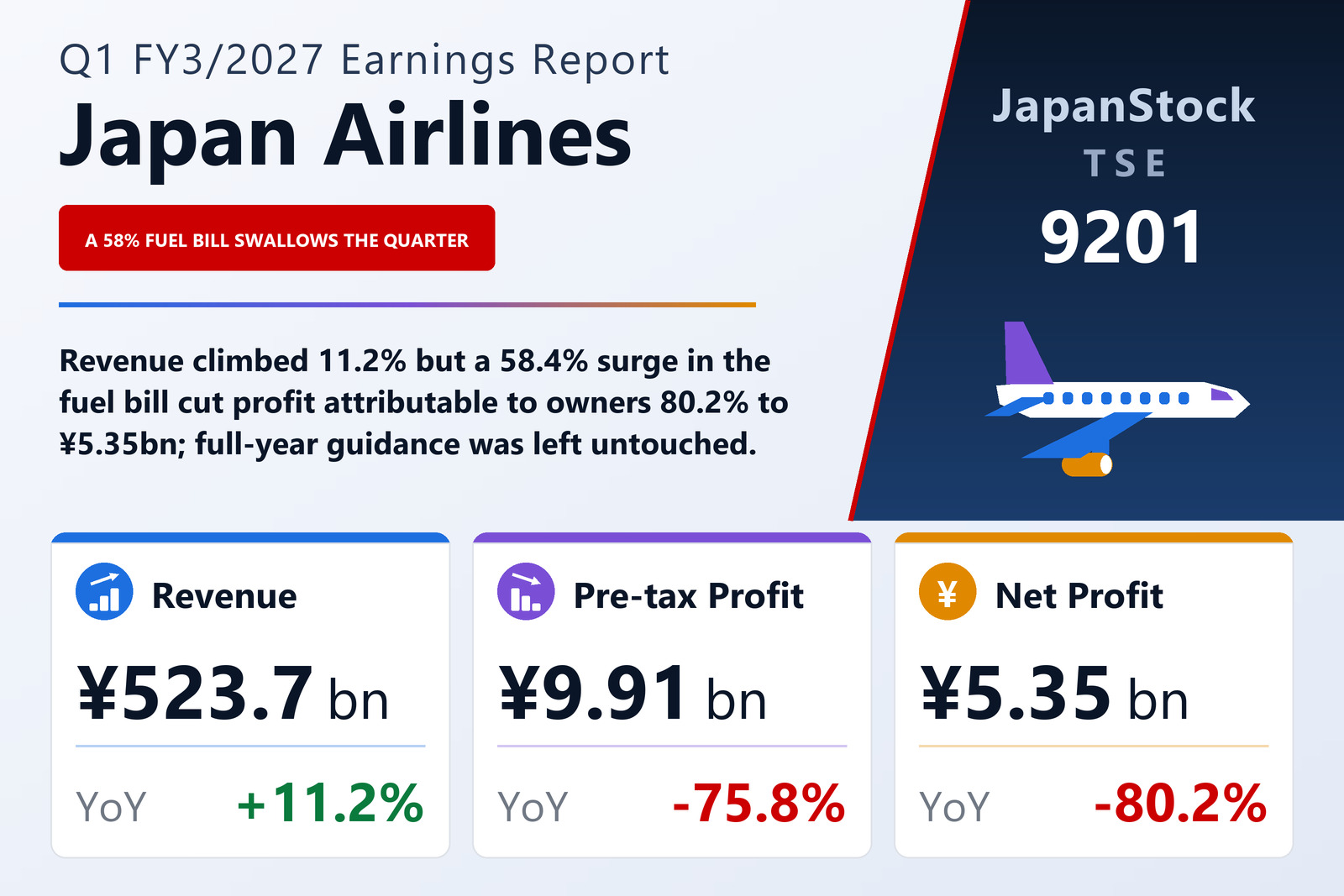
Japan Airlines Co., Ltd. (TSE: 9201) reported consolidated results for the first quarter of the fiscal year ending March 2027 — the three months from April 1 to June 30, 2026 — under IFRS. Revenue rose 11.2% to ¥523,737 million, but profit before finance and income taxes fell 72.1% to ¥12,703 million, profit before tax fell 75.8% to ¥9,907 million, and profit attributable to owners of the parent fell 80.2% to ¥5,353 million. Basic earnings per share came in at ¥9.09, down from ¥60.04. The attached quarterly statements were voluntarily reviewed by KPMG AZSA LLC, and the company held a briefing for institutional investors and analysts on August 3.
A note on the profit line: JAL defines profit before finance and income taxes — which it labels EBIT — as quarterly profit excluding income tax expense, interest, and other finance income and costs. The company presents it as a continuity measure for comparing performance across periods; it is JAL’s own metric, not an IFRS-defined subtotal.
A ¥54.9 billion fuel bill swallowed the revenue gain
The divergence between the top and bottom lines comes down almost entirely to one cost line. Operating expenses rose 18.7% to ¥516,853 million, well ahead of the 11.2% revenue increase. Within that, aircraft fuel cost ¥148,894 million, up 58.4% from ¥94,015 million — an increase of ¥54,879 million that on its own exceeded the ¥52,654 million gain in revenue. Management attributes the surge to the sharp spike in jet-fuel prices that followed escalating tensions in the Middle East, compounded by the continued weakness of the yen. Non-fuel operating expenses rose a far more modest 7.8% to ¥367,959 million (personnel ¥100,745 million, up 6.4%; depreciation, amortisation and impairment ¥42,814 million, up 5.0%; other operating expenses ¥224,399 million, up 8.9%). Other income also halved, to ¥3,959 million from ¥7,693 million. The EBIT margin collapsed to 2.4% from 9.7%, a 7.2-point decline.
Higher fares, marginally smaller traffic
Revenue growth was driven by pricing rather than volume. Full-service carrier international revenue rose 20.5% to ¥266,235 million, of which passenger revenue climbed 14.4% to ¥211,648 million — achieved while revenue passenger-kilometres fell 2.1% to 10.81 billion, available seat-kilometres fell 0.7% to 12.73 billion and the load factor slipped 1.2 points to 84.9%. In other words, the entire international passenger gain came from unit revenue, helped by firm inbound and Japan-originating business demand, an upward revision of the fuel-surcharge table, and tight supply as foreign carriers suspended Middle East services. International cargo and mail revenue jumped 52.4% to ¥54,143 million on a 13.7% rise in cargo tonne-kilometres to 880 million, as JAL added Kalitta Air freighter capacity on North American routes, launched a Cargolux codeshare in Europe and targeted high-yield pharmaceutical and AI-related shipments. Domestic revenue rose 3.7% to ¥147,764 million, with passenger revenue up 3.6% to ¥139,072 million even as passengers carried fell 2.7% to 8.83 million and the domestic load factor edged down 0.2 points to 79.3%.
Only the mileage and finance business made money
Segment results make the squeeze plain. The Full Service Carrier business turned in an EBIT loss of ¥812 million on revenue of ¥420,203 million (up 13.8%), against a ¥30,716 million profit a year earlier. The LCC business posted an EBIT loss of ¥134 million on revenue of ¥32,490 million (up 6.7%), versus a ¥4,235 million profit; within it, ZIPAIR carried 355,240 passengers (up 1.9%) and lifted its load factor 11.3 points to 88.5% as capacity fell 8.9%, while Spring Japan carried 179,545 passengers, down 35.9%. That left the Mileage, Finance and Commerce business as the group’s only meaningful profit engine, with revenue up 13.3% to ¥56,337 million and EBIT up 17.6% to ¥12,047 million — very nearly the whole of consolidated EBIT. The Other segment, chiefly travel, contributed ¥2,672 million.
Comprehensive income swings to a ¥16.7 billion loss
Below the profit line, after-tax other comprehensive income was a negative ¥22,307 million, against negative ¥2,123 million a year earlier, turning total comprehensive income into a ¥16,698 million loss versus a positive ¥25,988 million. The dominant item was the effective portion of cash-flow hedges, at negative ¥18,641 million (prior year: negative ¥6,742 million); financial assets measured at fair value through OCI contributed a further negative ¥3,664 million, reversing a positive ¥4,886 million a year earlier. Foreign-currency translation of overseas operations was a small positive ¥147 million. The hedge reserve within equity fell to ¥12,578 million from ¥31,747 million over the quarter.
Balance sheet strengthened by a hybrid share issue
Total assets rose to ¥3,373,785 million from ¥3,198,757 million, an increase of ¥175.0 billion driven mainly by cash. Liabilities rose ¥19.4 billion to ¥1,883,377 million on higher contract liabilities, while total equity rose ¥155.6 billion to ¥1,490,408 million, chiefly because JAL issued its first series of bond-type class shares on June 3, 2026, raising roughly ¥194.0 billion earmarked for Airbus A350 and Boeing 737-8 purchases. Equity attributable to owners of the parent reached ¥1,447,338 million from ¥1,289,639 million, lifting the equity ratio to 42.9% from 40.3%. Cash and equivalents ended the quarter at ¥1,157,424 million, up ¥147.2 billion, alongside an undrawn ¥150.0 billion commitment line. Operating cash flow was an inflow of ¥97,854 million (prior year: ¥81,027 million), investing an outflow of ¥66,568 million (¥24,265 million), and financing an inflow of ¥114,113 million (¥145,730 million).
Guidance untouched, but the start is unusually thin
JAL left its full-year forecast exactly as issued on April 30: revenue of ¥2,095,000 million (+4.1%), profit before finance and income taxes of ¥180,000 million (−17.4%) and profit attributable to owners of ¥110,000 million (−20.1%). No half-year forecast is published. The arithmetic bears noting: the quarter’s ¥5,353 million of attributable profit represents just about 4.9% of the ¥110 billion full-year target, and quarterly EBIT of ¥12,703 million is about 7.1% of the ¥180 billion EBIT plan — an unusually thin opening against a plan management chose not to revise. The annual dividend forecast is likewise unchanged at ¥96.00 (¥48 interim plus ¥48 year-end), matching the ¥96.00 paid for FY3/2026 though weighted slightly more toward the interim (previously ¥46 plus ¥50). Separately, JAL signed a capital and business alliance with Lifenet Insurance on April 30, acquiring shares in June and bringing it in as an equity-method affiliate.
| Metric | Q1 FY3/27 | Q1 FY3/26 | YoY |
|---|---|---|---|
| Revenue (¥ billion) | 523.74 | 471.08 | +11.2% |
| Profit before finance and income taxes (¥ billion) | 12.70 | 45.51 | -72.1% |
| Profit before tax (¥ billion) | 9.91 | 40.86 | -75.8% |
| Profit attrib. to owners of the parent (¥ billion) | 5.35 | 27.08 | -80.2% |
| Total comprehensive income (¥ billion) | -16.70 | 25.99 | n.m. |
| Basic EPS (¥) | 9.09 | 60.04 | -84.9% |
| Aircraft fuel expense (¥ billion) | 148.89 | 94.02 | +58.4% |
| EBIT margin (%) | 2.4 | 9.7 | -7.2 pt |
| Equity ratio (%) | 42.9 | 40.3 | +2.6 pt |
| FY3/27 profit attrib. guidance (¥ billion) | 110.00 | 137.67 | -20.1% |
JapanStockPulse provides informational content only and does not constitute investment advice. Figures are taken from the company's published earnings short report and may be subject to subsequent revision.