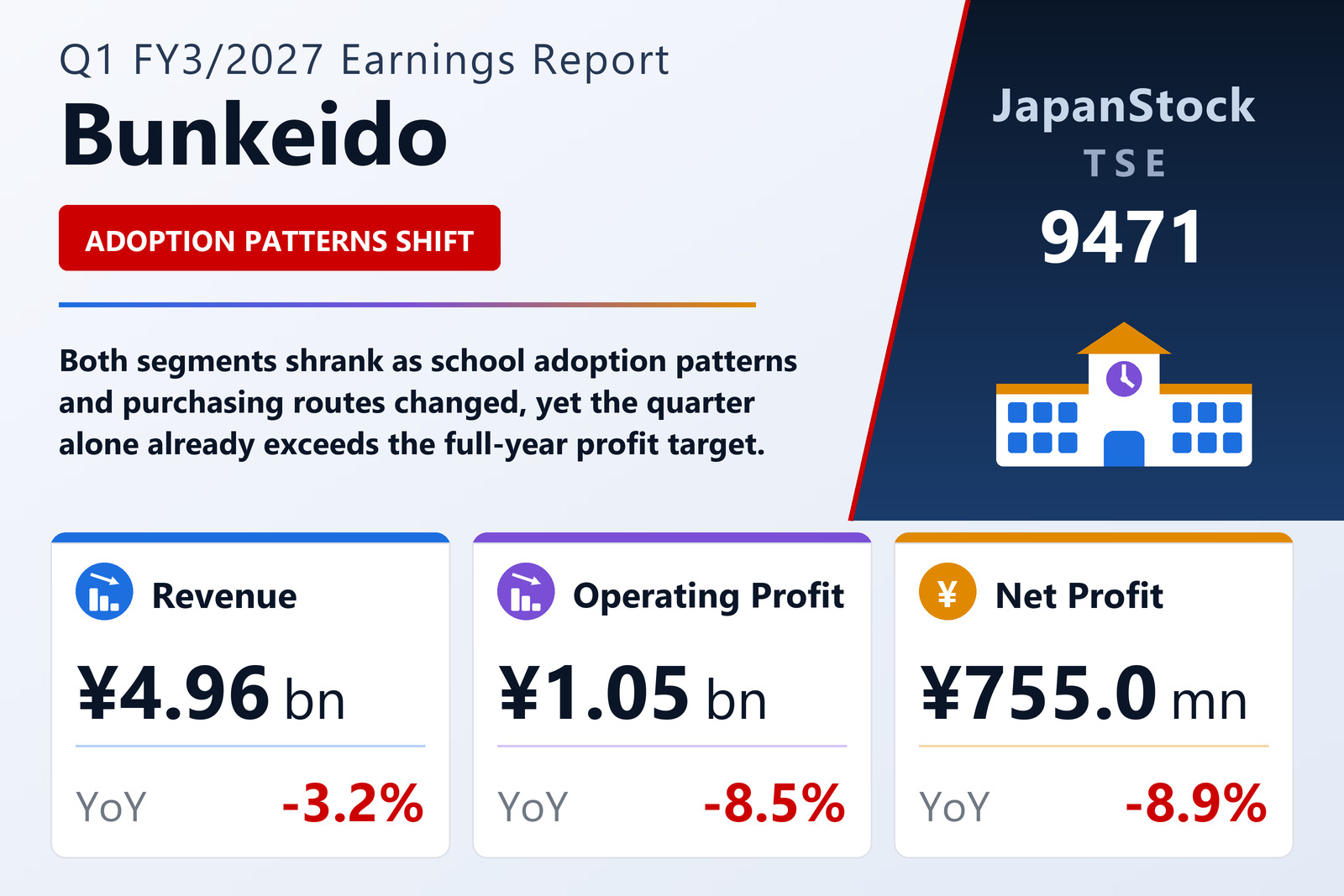
Bunkeido Co., Ltd. (NSE: 9471) reported consolidated first-quarter results for the three months to June 30, 2026 under Japanese GAAP. Revenue fell 3.2% to ¥4,956,852 thousand, operating profit fell 8.5% to ¥1,053 million, recurring profit fell 7.7% to ¥1,083,198 thousand and profit attributable to owners of the parent fell 8.9% to ¥755,404 thousand. Earnings per share were ¥118.76 against ¥130.83. Comprehensive income was essentially flat, up 0.3% to ¥847 million. The company notes that Japan's economy is recovering moderately, supported by improving employment and income conditions and by policy effects.
Bunkeido is explicit about the seasonality that dominates its numbers: the first quarter books sales of first-term materials, first-half publications and annual publications, so revenue is markedly higher than in any other quarter — while operating costs do not scale in proportion, so profit is disproportionately concentrated here. That single fact is what makes the guidance arithmetic below so unusual.
Both segments decline, for different reasons
Publishing, 72% of revenue, fell 2.4% to ¥3,575,465 thousand with operating profit down 4.3% to ¥1,093,142 thousand. Within it the picture was mixed. Assessment materials for elementary schools sold well: paper-based designs that accurately evaluate learning from fundamentals through application, digital plans supporting attainment, and — notably — tablet-deliverable assessment questions aimed at reducing teachers' workload all found favour, lifting sales. Drill and practice materials, by contrast, declined as competition intensified and adoption needs fragmented, even though both paper-based and tablet-using designs were well received. Junior-high materials held revenue flat: new-term workbooks were hit by adoption restrictions, but early shipments of summer-holiday materials made up the gap. Elementary-school textbooks are in their third year since the 2024 revision, and junior-high textbooks in their second since 2025.
Teaching Materials & Equipment fell harder — revenue down 5.4% to ¥1,381,387 thousand and operating profit down 15.3% to ¥238,931 thousand. Raw-material costs rose, classroom usage frequency trended lower, and adoption conditions shifted materially: changes to the sample works printed in textbooks, altered adoption timing, and an increase in local authorities buying in bulk with public funds. The "sewing set" and "calligraphy set" ranges both lost sales as purchasing routes in schools diversified, and home-economics materials for junior and senior high schools declined as parents' cost-sensitivity pushed demand toward cheaper products.
| Segment | Revenue (¥ thousand) | Revenue YoY | Operating profit (¥ thousand) | Profit YoY |
|---|---|---|---|---|
| Publishing | 3,575,465 | -2.4% | 1,093,142 | -4.3% |
| Teaching Materials & Equipment | 1,381,387 | -5.4% | 238,931 | -15.3% |
| Consolidated revenue | 4,956,852 | -3.2% | — | — |
A balance sheet that swings with the school calendar
Total assets rose ¥396,952 thousand to ¥20,271,539 thousand, liabilities fell ¥337,387 thousand to ¥3,894,430 thousand and net assets rose ¥734,339 thousand to ¥16,377,108 thousand, lifting the equity ratio to 80.7% from 78.7% — among the least leveraged balance sheets on the Japanese market. The movements are seasonal rather than structural: trade notes and receivables rose ¥1,877,469 thousand because elementary-school material receivables settle at the end of term (end of July) as a rule, while merchandise and finished goods fell ¥1,159,190 thousand as the first-term shipments cleared. Cash and deposits declined ¥385,016 thousand, securities fell ¥199,140 thousand and work in process rose ¥195,651 thousand. On the liability side, short-term borrowings fell ¥160,000 thousand and accrued payables (in other current liabilities) fell ¥406,688 thousand, while income taxes payable rose ¥183,938 thousand. Retained earnings accounted for ¥641,865 thousand of the equity increase.
Guidance held — and the second half is loss-making by design
Bunkeido made no change to the forecast published on May 11, 2026. For the first half it guides revenue of ¥8,397 million (+0.6%), operating profit of ¥1,992 million (+11.6%), recurring profit of ¥2,078 million (+14.0%) and net profit of ¥1,453 million (+14.4%), for EPS of ¥228.63. For the full year: revenue of ¥12,187 million (+0.3%), operating profit of ¥840 million (+7.3%), recurring profit of ¥959 million (+12.3%) and net profit of ¥625 million (+13.1%), for EPS of ¥98.34. Read those two rows together and the seasonality becomes stark: the full-year operating-profit target of ¥840 million is lower than the ¥1,053 million already earned in the first quarter, and less than half the ¥1,992 million guided for the first half — the company plans to run at a loss across the back half of the year, as it does every year. The dividend forecast is unchanged at ¥40.80 per share (¥20.40 interim plus ¥20.40 year-end), up from ¥39.25 for FY3/2026 (¥21.40 interim plus ¥17.85 year-end). Shares issued stood at 6,600,000 with 239,280 in treasury.
| Metric | Q1 FY3/2027 | Q1 FY3/2026 | YoY |
|---|---|---|---|
| Revenue (¥ thousand) | 4,956,852 | 5,125,605 | -3.2% |
| Operating profit (¥ million) | 1,053 | 1,151 | -8.5% |
| Recurring profit (¥ million) | 1,083 | 1,174 | -7.7% |
| Profit attributable to owners (¥ million) | 755 | 829 | -8.9% |
| Comprehensive income (¥ million) | 847 | 844 | +0.3% |
| EPS (¥) | 118.76 | 130.83 | -9.2% |
| Total assets (¥ thousand) | 20,271,539 | 19,874,587 | +2.0% |
| Net assets (¥ thousand) | 16,377,108 | 15,642,769 | +4.7% |
| Equity ratio (%) | 80.7 | 78.7 | +2.0pt |
| Annual dividend per share (¥) | 40.80 | 39.25 | +3.9% |
| H1 FY3/2027 guidance — operating profit (¥ million) | 1,992 | — | +11.6% |
| FY3/2027 guidance — revenue (¥ million) | 12,187 | — | +0.3% |
| FY3/2027 guidance — operating profit (¥ million) | 840 | — | +7.3% |
| FY3/2027 guidance — net profit (¥ million) | 625 | — | +13.1% |
JapanStockPulse provides informational content only and does not constitute investment advice. Figures are taken from the company’s published earnings short report and may be subject to subsequent revision.