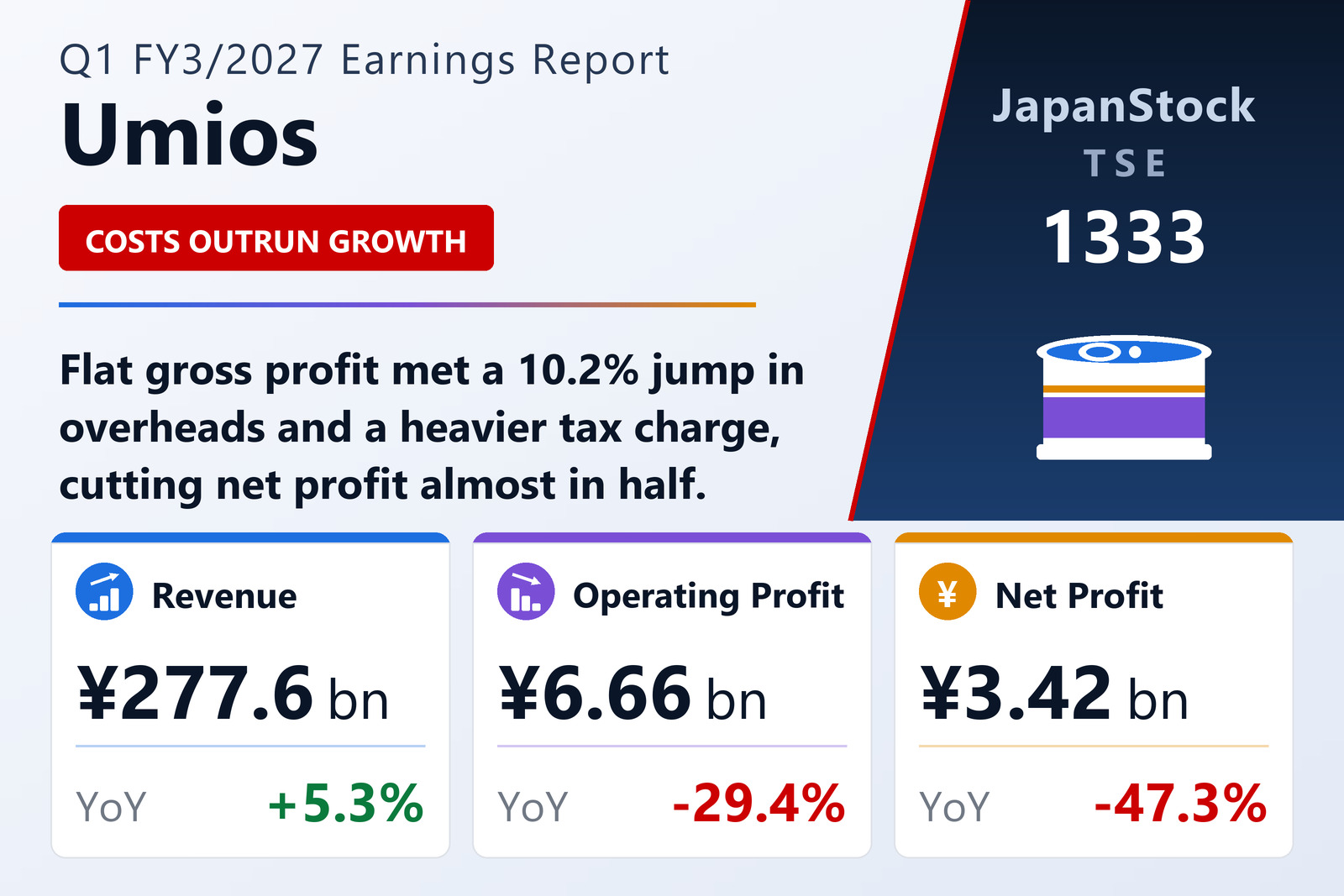
Umios Corporation (TSE: 1333), the Tokyo-listed seafood and food group formerly known as Maruha Nichiro, reported consolidated first-quarter results for the three months to June 30, 2026 under Japanese GAAP. Revenue rose 5.3% to ¥277,595 million, but operating profit fell 29.4% to ¥6,656 million, ordinary profit fell 31.3% to ¥6,422 million, and profit attributable to owners of the parent dropped 47.3% to ¥3,424 million. Quarterly earnings per share came in at ¥22.72 against ¥43.01 a year earlier, with no dilution. The result reverses the direction of the comparable quarter, when operating profit had risen 23.1%.
Volume grew; the margin did not
The top line performed. Revenue added ¥13,998 million year on year, a 5.3% advance that outpaced the 2.6% growth booked in the same quarter of the prior year. The problem sat immediately below it: cost of sales climbed 6.1% to ¥238,897 million, faster than revenue, so gross profit rose only 0.5% to ¥38,697 million from ¥38,494 million. The consolidated gross margin thinned to 13.9% from 14.6% — a 0.66-point compression that, applied to this quarter's revenue base, is worth roughly ¥1.8 billion of foregone profit on its own.
Selling, general and administrative expenses then did the rest of the damage, rising 10.2% to ¥32,040 million from ¥29,066 million — roughly twice the pace of sales growth and an increase of ¥2,974 million, more than fourteen times the ¥203 million of incremental gross profit the extra volume produced. That single scissors effect explains essentially the whole ¥2,772 million decline at the operating line.
Interest costs bite; a heavier tax charge halves the bottom line
Below operating profit, non-operating income edged up to ¥1,892 million from ¥1,855 million: equity-method investment income more than tripled to ¥309 million from ¥99 million and miscellaneous income rose to ¥1,023 million from ¥854 million, but dividends received fell to ¥559 million from ¥902 million. Non-operating expenses grew faster, to ¥2,127 million from ¥1,940 million, driven by interest expense of ¥1,370 million, up 39.2% from ¥984 million as borrowings and Japanese rates both rose. A smaller foreign-exchange loss of ¥637 million, against ¥803 million, provided partial relief. Ordinary profit therefore fell slightly faster than operating profit, down 31.3%.
Extraordinary items were a modest net positive. Extraordinary gains rose to ¥2,094 million from ¥1,846 million, with the mix shifting sharply: a gain on sale of fixed assets of ¥1,659 million replaced last year's ¥15 million, while the gain on sale of investment securities shrank to ¥427 million from ¥1,815 million. Extraordinary losses grew to ¥160 million from ¥65 million, including a ¥101 million loss on disposal of fixed assets and a ¥36 million loss on sale of shares in affiliates. Pre-tax quarterly profit ended 24.9% lower at ¥8,356 million.
The final blow came from tax. Income taxes rose 42.8% to ¥4,305 million even as pre-tax profit fell by a quarter, lifting the effective tax rate to 51.5% from 27.1%. Quarterly net profit consequently halved to ¥4,051 million from ¥8,109 million. Profit attributable to non-controlling interests absorbed ¥626 million, down from ¥1,610 million, leaving the parent-company figure at ¥3,424 million. Note that Umios applies the tanshin's simplified interim tax method — some consolidated subsidiaries estimate an effective rate for the full year and apply it to interim pre-tax profit — so the quarterly rate should not be read as a permanent step-up.
Comprehensive income moved the other way, jumping 84.1% to ¥4,928 million. Other comprehensive income swung to a positive ¥877 million from a negative ¥5,432 million, principally because the foreign-currency translation adjustment turned to a positive ¥190 million from a negative ¥6,040 million a year earlier. Comprehensive income attributable to owners of the parent was ¥4,410 million against ¥3,294 million.
Segments: seafood resources profit halves
All three reporting segments saw profit fall. Seafood Resources — the fishing and aquaculture arm — grew external sales 14.9% to ¥29,877 million, the fastest of any segment, yet segment profit halved to ¥379 million from ¥765 million, an unusually thin 1.3% margin on external sales that points to raw-material and feed costs outpacing catch and farm-gate prices. Food Distribution, by far the largest unit, lifted external sales 5.7% to ¥196,182 million but saw profit fall 17.7% to ¥3,742 million. Processed Foods was the weakest of all: external sales slipped 1.1% to ¥46,255 million while profit fell 45.2% to ¥2,121 million. Only the Other category — logistics and real estate — improved, with profit up 11.1% to ¥872 million on broadly flat sales.
Investors should note a boundary change. From this quarter, part of the sales function of the aquaculture unit inside Seafood Resources was transferred to the marine trading unit inside Food Distribution, in order to consolidate and strengthen sales capability. Prior-year segment figures shown here have been restated on the new basis, so the year-on-year comparisons above are like-for-like.
| Segment | External sales Q1 FY3/27 | External sales Q1 FY3/26 | YoY | Segment profit Q1 FY3/27 | Segment profit Q1 FY3/26 | YoY |
|---|---|---|---|---|---|---|
| Seafood Resources | 29,877 | 26,010 | +14.9% | 379 | 765 | -50.5% |
| Food Distribution | 196,182 | 185,562 | +5.7% | 3,742 | 4,549 | -17.7% |
| Processed Foods | 46,255 | 46,784 | -1.1% | 2,121 | 3,874 | -45.2% |
| Reportable segments total | 272,315 | 258,358 | +5.4% | 6,243 | 9,189 | -32.1% |
| Other (logistics, real estate) | 5,279 | 5,239 | +0.8% | 872 | 785 | +11.1% |
| Adjustments | — | — | — | -458 | -546 | — |
| Consolidated | 277,595 | 263,597 | +5.3% | 6,656 | 9,428 | -29.4% |
Balance sheet: assets up, equity down
Total assets grew to ¥774,975 million at June 30, 2026 from ¥751,702 million three months earlier, an increase of ¥23,273 million concentrated almost entirely in working capital. Inventories rose 9.1% to ¥266,928 million from ¥244,733 million, trade receivables and contract assets edged up to ¥146,109 million from ¥143,722 million, and cash and deposits fell to ¥48,316 million from ¥54,141 million. Fixed assets were essentially flat at ¥295,676 million, with goodwill amortising down to ¥7,131 million from ¥7,622 million.
That inventory build was funded with debt. Short-term borrowings jumped to ¥159,596 million from ¥137,386 million, commercial paper to ¥30,000 million from ¥29,000 million and long-term borrowings to ¥91,716 million from ¥89,494 million, with bonds unchanged at ¥51,000 million — total interest-bearing debt of roughly ¥332.3 billion against ¥306.9 billion at the year-end. Total liabilities rose to ¥485,996 million from ¥460,215 million.
Net assets fell to ¥288,979 million from ¥291,487 million, and shareholders' equity to ¥245,724 million from ¥247,236 million, pushing the equity ratio down to 31.7% from 32.9%. Retained earnings dipped to ¥157,137 million from ¥157,947 million as roughly ¥4.2 billion of dividends exceeded the quarter's profit, while treasury stock rose to ¥2,170 million from ¥478 million. The treasury share count moved to 1,883,417 from 553,212 — but almost the entire increase reflects shares held by the company's BBT and J-ESOP share-benefit trusts, which rose to 1,750,428 from 420,428, rather than an open-market buyback. Depreciation for the quarter was ¥4,558 million against ¥4,422 million, and goodwill amortisation ¥483 million against ¥390 million. No quarterly cash flow statement was prepared.
A 51% stake in Malaysian pet food
The most strategically significant disclosure sits in the notes rather than the numbers. On June 29, 2026 the board resolved to acquire, through a newly established holding company, a 51% voting stake in Pet World International Sdn. Bhd., the Malaysian holding company of a pet-care manufacturing and distribution group. The cash consideration is MYR 283 million, or approximately ¥11,308 million at the June 30, 2026 rate of ¥39.88 to the ringgit, with completion scheduled for September 2026. Acquisition-related costs, resulting goodwill and the fair values of assets and liabilities acquired have not yet been determined.
Umios frames the deal as an extension of a pet-food business it already runs across North America, Europe and Japan on the back of its marine-sourcing and food-safety infrastructure. Management cites forecast global pet-food market growth of 5–7% a year through 2032, with Asia the fastest region at a roughly 8% compound annual rate on rising middle-class incomes and pet ownership, and describes the target as holding a dominant brand position in Malaysia. For a group whose core seafood and food-distribution margins are visibly compressing, a higher-margin consumer adjacency in a structurally growing Asian market is a logical, if modest, redeployment of capital.
Guidance held, dividend nudged higher
Umios left its full-year FY3/2027 forecast, first published on May 11, 2026, entirely unchanged: revenue of ¥1,110,000 million (+0.4%), operating profit of ¥32,000 million (+2.6%), ordinary profit of ¥30,000 million (-4.0%), profit attributable to owners of the parent of ¥15,000 million (-32.4%) and EPS of ¥99.22. Against those targets the first quarter delivered 25.0% of the revenue plan but only 20.8% of the operating-profit plan, 21.4% of ordinary profit and 22.8% of the net-profit target — a first quarter that is seasonally the group's lightest, but one that leaves no margin for further cost slippage.
The dividend forecast is also unchanged, at ¥45.00 per share for FY3/2027 — a ¥22.00 interim and a ¥23.00 year-end payment. Comparison with the prior year requires care because Umios executed a three-for-one common stock split on January 1, 2026: the FY3/2026 interim of ¥50.00 is a pre-split figure while its ¥28.00 year-end is post-split, so the company does not publish a simple annual total for that year. On a split-adjusted basis the FY3/2026 payout was ¥44.67 per share (¥16.67 interim plus ¥28.00 year-end), making the FY3/2027 plan a small increase. Prior-year per-share earnings and average share counts have likewise been restated as if the split had occurred at the start of that year.
| Metric | Q1 FY3/2027 | Q1 FY3/2026 | YoY |
|---|---|---|---|
| Revenue (¥ million) | 277,595 | 263,597 | +5.3% |
| Gross profit (¥ million) | 38,697 | 38,494 | +0.5% |
| Gross margin (%) | 13.9 | 14.6 | -0.7pt |
| SG&A expenses (¥ million) | 32,040 | 29,066 | +10.2% |
| Operating profit (¥ million) | 6,656 | 9,428 | -29.4% |
| Ordinary profit (¥ million) | 6,422 | 9,343 | -31.3% |
| Pre-tax profit (¥ million) | 8,356 | 11,124 | -24.9% |
| Income taxes (¥ million) | 4,305 | 3,014 | +42.8% |
| Profit attributable to owners (¥ million) | 3,424 | 6,499 | -47.3% |
| Comprehensive income (¥ million) | 4,928 | 2,677 | +84.1% |
| Earnings per share (¥) | 22.72 | 43.01 | -47.2% |
| Total assets (¥ million) | 774,975 | 751,702 | +3.1% |
| Inventories (¥ million) | 266,928 | 244,733 | +9.1% |
| Net assets (¥ million) | 288,979 | 291,487 | -0.9% |
| Shareholders' equity ratio (%) | 31.7 | 32.9 | -1.2pt |
| FY3/2027 guidance — revenue (¥ million) | 1,110,000 | — | +0.4% |
| FY3/2027 guidance — operating profit (¥ million) | 32,000 | — | +2.6% |
| FY3/2027 guidance — profit attributable (¥ million) | 15,000 | — | -32.4% |
JapanStockPulse provides informational content only and does not constitute investment advice. Figures are taken from the company's published earnings short report and may be subject to subsequent revision.