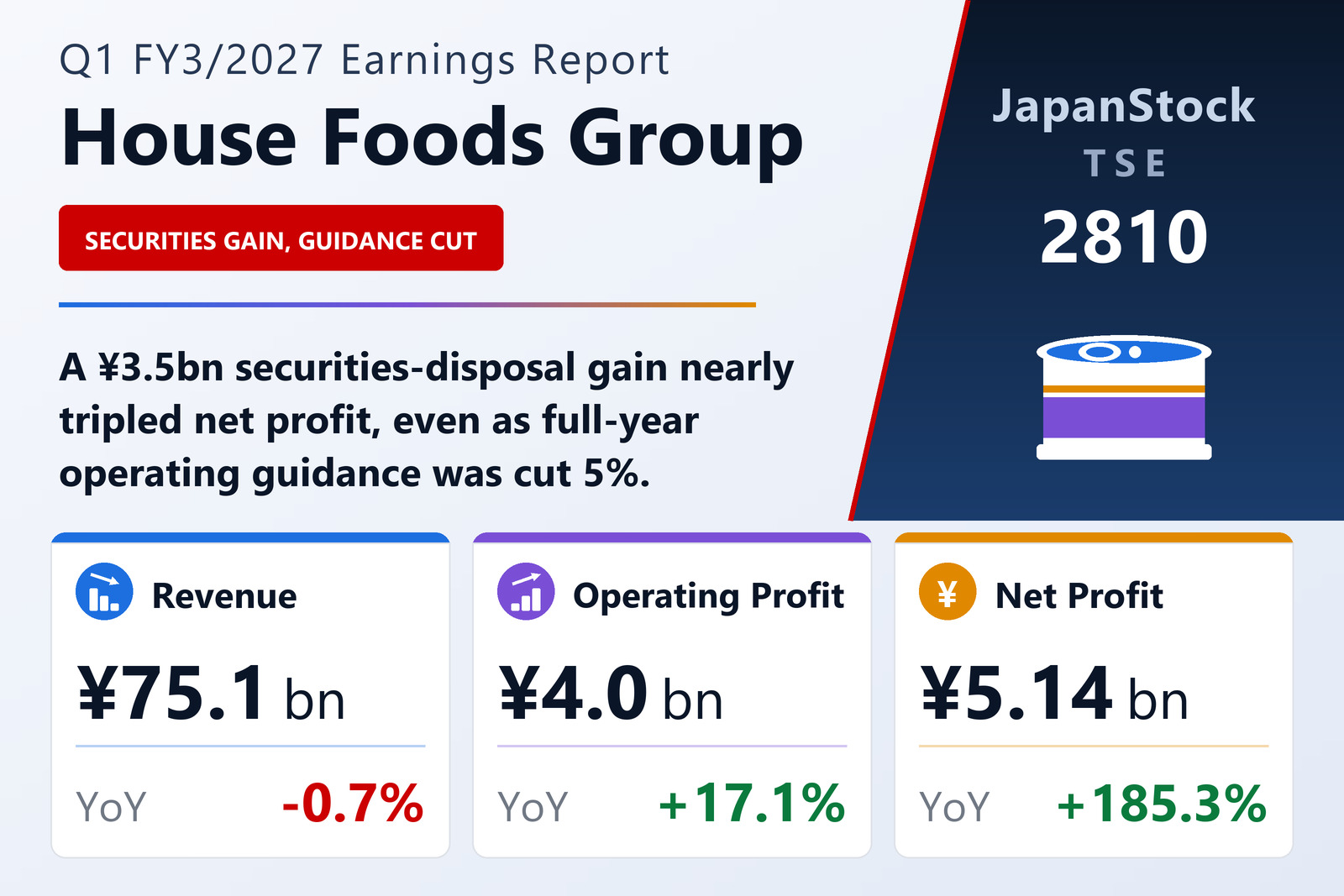
House Foods Group Inc. (TSE: 2810), Japan's dominant curry-roux manufacturer and the owner of the CoCo Ichibanya restaurant chain, reported consolidated first-quarter results for the three months to June 30, 2026 under Japanese GAAP. Revenue slipped 0.7% to ¥75,139 million, but operating profit climbed 17.1% to ¥4,001 million, ordinary profit rose 22.6% to ¥4,494 million and profit attributable to owners of the parent surged 185.3% to ¥5,136 million. Earnings per share were ¥56.98, against ¥19.20 a year earlier.
A revenue decline that is not really a revenue decline
The top-line contraction is an artefact of portfolio surgery rather than weak demand. House Foods sold Delica Chef, the subsidiary that ran its prepared-foods (sozai) business, during the fourth quarter of FY3/2026, and the company was deconsolidated. Stripping that out, management says every reporting segment grew revenue on an existing-business basis. The effect is concentrated in the Other Food-Related segment, where revenue fell 30.6% to ¥8,874 million — a ¥3,907 million drop that on its own more than accounts for the ¥560 million decline at group level.
Below the top line, the picture is straightforwardly better. Cost of sales fell to ¥46,685 million from ¥48,209 million, lifting gross profit 3.5% to ¥28,454 million even on lower revenue. Selling, general and administrative expenses rose only 1.6% to ¥24,453 million, with higher personnel costs (¥9,574 million, up ¥317 million) and advertising (¥1,924 million, up ¥157 million) partly offset by a ¥325 million reduction in freight and warehousing. The operating margin widened to 5.3% from 4.5%.
Domestic spice and health foods carry the quarter
The Spice & Seasoning Processed Foods segment — the group's largest and the home of the House-brand curry roux — grew revenue 5.3% to ¥31,327 million and operating profit 39.7% to ¥1,630 million, taking its return on sales to 5.2% from 3.9%. Volumes recovered after last year's price increases were absorbed, with roux curry, roux hashed beef and spices all rebounding; shipment-based figures show roux curry up 5.8% and spices up 3.1%, though roux stew fell 4.8%. House Foods held a 61.8% value share of Japan's roux-curry market in the quarter, with its average selling price rising ¥15 to ¥271 against a ¥17 rise to ¥260 for the market as a whole. The food-service channel was solid on restaurant-market growth and selective price revisions.
The Health Foods segment was the fastest-improving of the group in profit terms, with revenue up 4.2% to ¥4,244 million and operating profit up 52.1% to ¥541 million — a return on sales of 12.8%, four full points better than a year ago. Sales of the C1000 vitamin-drink range rose 7.8% on an expanded product line-up, more than covering a temporary volume dip at the Ukon no Chikara turmeric drink following a June 2026 price revision.
Overseas: China and Thailand shine, the U.S. stalls
The International Food segment lifted revenue 4.4% to ¥16,618 million and operating profit 17.1% to ¥1,555 million, a 9.4% return on sales. The composition matters more than the headline. The China curry business grew revenue 29.3% to ¥3,797 million and operating profit 64.6% to ¥775 million, helped by a concentration of resources on the strongest retail channels, Lunar New Year demand and new food-service customer acquisition; on a local-currency basis sales were up 18.5%. Southeast Asia added 11.1% to ¥3,241 million with profit up 38.7% to ¥673 million, driven by the Thai functional-beverage operation, where revenue rose 13.4% to ¥2,769 million and operating profit 37.6% to ¥648 million on traditional-trade distribution and zero-sugar variants.
The United States soybean business remains the group's problem child. Revenue fell 3.0% to ¥8,741 million and operating profit collapsed 79.1% to ¥48 million, leaving a return on sales of just 0.6%. Cost-structure work is proceeding to plan, but volume declines swamped it — local-currency sales were down 6.2%. Note that the segment consolidates a January–March period, so the reported yen figures also benefit from a weaker currency: the average USD rate was ¥156.45 against ¥151.21, the yuan ¥22.64 against ¥20.75 and the baht ¥4.92 against ¥4.46.
Restaurants grow sales but give back margin
The Restaurant segment, essentially Ichibanya's CoCo Ichibanya chain, was the mirror image of the rest of the group: revenue rose 7.8% to ¥16,972 million while operating profit fell 19.3% to ¥752 million and the margin narrowed to 4.4% from 5.9%. Domestic all-store sales were up 3.1% and same-store sales 2.5%, with customer counts up 0.5% and spend per customer up 1.9%, supported by broad-appeal promotions and limited-time menus, plus expansion at domestic and overseas subsidiaries. What ate the profit was input cost — rice in particular — alongside higher logistics expense. This is precisely the pressure that drove the guidance revision described below.
| Segment | Revenue Q1 FY3/27 | YoY | Operating profit Q1 FY3/27 | YoY | Margin |
|---|---|---|---|---|---|
| Spice & Seasoning Processed Foods | 31,327 | +5.3% | 1,630 | +39.7% | 5.2% |
| Health Foods | 4,244 | +4.2% | 541 | +52.1% | 12.8% |
| International Food | 16,618 | +4.4% | 1,555 | +17.1% | 9.4% |
| — United States | 8,741 | -3.0% | 48 | -79.1% | 0.6% |
| — China | 3,797 | +29.3% | 775 | +64.6% | 20.4% |
| — Southeast Asia | 3,241 | +11.1% | 673 | +38.7% | 20.8% |
| Restaurant | 16,972 | +7.8% | 752 | -19.3% | 4.4% |
| Other Food-Related | 8,874 | -30.6% | 220 | +10.7% | 2.5% |
| Subtotal | 78,035 | -0.3% | 4,699 | +18.0% | 6.0% |
| Adjustments / eliminations | -2,896 | — | -698 | — | — |
| Consolidated total | 75,139 | -0.7% | 4,001 | +17.1% | 5.3% |
Why net profit nearly tripled
Operating and ordinary profit grew respectably; the bottom line did something else entirely. The explanation sits in extraordinary items. Extraordinary income leapt to ¥3,522 million from ¥100 million, almost all of it a ¥3,504 million gain on the sale of investment securities — the disposal of cross-shareholdings, consistent with the capital-efficiency leg of the group's structural-reform programme. Extraordinary losses shrank to ¥37 million from ¥98 million, with no impairment this quarter against ¥10 million a year earlier. Pre-tax profit therefore more than doubled to ¥7,979 million from ¥3,667 million, and after ¥2,360 million of tax and ¥483 million attributable to non-controlling interests, the parent's share reached ¥5,136 million. Comprehensive income rose a more modest 250.9% to ¥3,825 million, because a ¥2,536 million negative swing in unrealised gains on securities — the flip side of selling those cross-shareholdings — partly offset the profit surge.
Balance sheet: a ¥18.96 billion share cancellation reshapes equity
Total assets fell ¥12,912 million to ¥424,363 million. Current assets dropped ¥10,258 million to ¥186,031 million as cash and deposits declined ¥12,913 million to ¥87,930 million and trade receivables fell ¥2,486 million, partly offset by ¥2,368 million more inventory and ¥1,996 million more marketable securities. Non-current assets edged down ¥2,654 million to ¥238,331 million, with a ¥5,006 million reduction in construction in progress and a ¥4,054 million fall in investment securities against a ¥4,641 million increase in buildings and structures. Liabilities fell ¥7,904 million to ¥106,655 million.
Net assets declined ¥5,008 million to ¥317,707 million, and the movement inside that line is the story. On May 29, 2026 the company cancelled 6,400,000 treasury shares, cutting both retained earnings and treasury stock by ¥18,964 million each; it separately bought back 1,220,300 shares for ¥4,174 million. Shares issued fell to 92,098,416 from 98,498,416 and treasury holdings to 2,420,314 from 7,661,927. Despite the smaller equity base the equity ratio improved to 67.9% from 67.0%, since liabilities shrank faster; book value per share edged down to ¥3,211.74 from ¥3,223.48. No quarterly cash flow statement is prepared, but depreciation was ¥3,148 million (¥3,253 million a year earlier) and goodwill amortisation ¥112 million, with capital expenditure including leases of ¥3,723 million against a full-year plan of ¥16,700 million.
Guidance: operating profit cut ¥1.0 billion, net profit and dividend untouched
Alongside the results the company revised the full-year forecast it had issued on May 11, 2026, citing further increases in raw-material and other business costs linked to conditions in the Middle East. Operating profit guidance falls ¥1,000 million to ¥17,500 million, a 5.4% reduction that leaves the forecast 4.1% below last year's ¥18,246 million. Ordinary profit is cut by the same ¥1,000 million to ¥18,700 million. Notably, the entire revision lands on one segment: Spice & Seasoning Processed Foods operating profit is trimmed 8.1% to ¥11,400 million, with every other segment's forecast left exactly as published in May.
Revenue guidance is unchanged at ¥322,500 million (+1.7%), and so is profit attributable to owners at ¥17,000 million — a 131.0% increase from last year's ¥7,360 million, which had been depressed by a heavy fourth-quarter loss. Forecast EPS is ¥195.97. Against those targets the first quarter delivered 23.3% of full-year revenue, 22.9% of operating profit and 30.2% of the net profit target, the last flattered by the securities gain. The dividend forecast is unchanged at ¥100.00 per share for FY3/2027 — ¥50.00 interim and ¥50.00 year-end — up sharply from ¥70.00 paid for FY3/2026, implying a payout ratio of 51.0% against 87.8% last year.
| Metric | Q1 FY3/2027 | Q1 FY3/2026 | YoY |
|---|---|---|---|
| Revenue (¥ million) | 75,139 | 75,699 | -0.7% |
| Gross profit (¥ million) | 28,454 | 27,490 | +3.5% |
| Operating profit (¥ million) | 4,001 | 3,418 | +17.1% |
| Ordinary profit (¥ million) | 4,494 | 3,666 | +22.6% |
| Extraordinary income (¥ million) | 3,522 | 100 | +3,422 |
| Pre-tax profit (¥ million) | 7,979 | 3,667 | +117.6% |
| Profit attributable to owners (¥ million) | 5,136 | 1,801 | +185.3% |
| Comprehensive income (¥ million) | 3,825 | 1,090 | +250.9% |
| EPS (¥) | 56.98 | 19.20 | +196.8% |
| Operating margin (%) | 5.3 | 4.5 | +0.8pt |
| Total assets (¥ million) | 424,363 | 437,275 | -3.0% |
| Net assets (¥ million) | 317,707 | 322,715 | -1.6% |
| Equity ratio (%) | 67.9 | 67.0 | +0.9pt |
| Book value per share (¥) | 3,211.74 | 3,223.48 | -0.4% |
| FY3/2027 guidance — revenue (¥ million) | 322,500 | 316,977 | +1.7% |
| FY3/2027 guidance — operating profit (¥ million) | 17,500 | 18,246 | -4.1% |
| FY3/2027 guidance — ordinary profit (¥ million) | 18,700 | 19,526 | -4.2% |
| FY3/2027 guidance — net profit (¥ million) | 17,000 | 7,360 | +131.0% |
| FY3/2027 dividend forecast (¥/share) | 100.00 | 70.00 | +42.9% |
JapanStockPulse provides informational content only and does not constitute investment advice. Figures are taken from the company's published earnings short report and may be subject to subsequent revision.