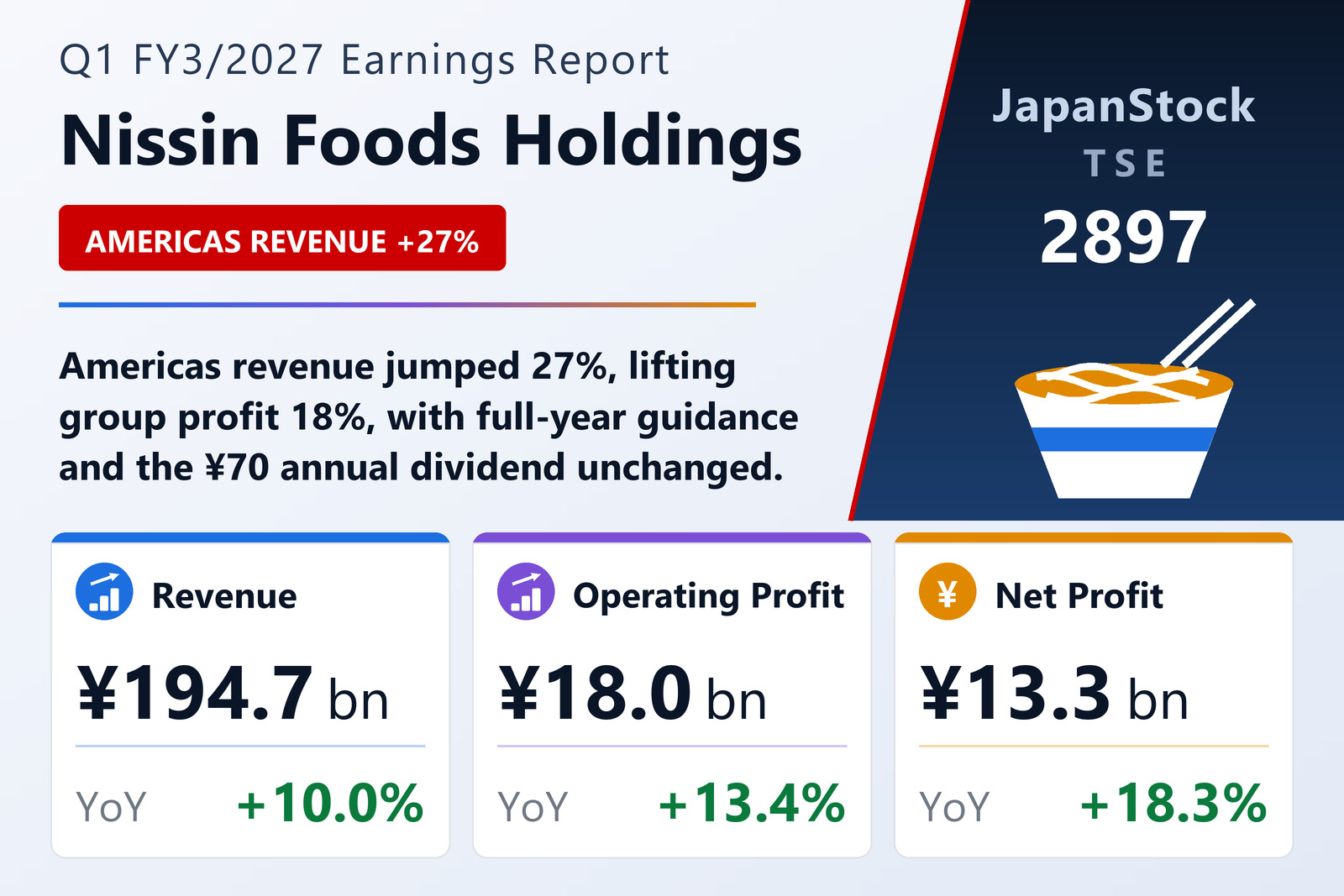
Nissin Foods Holdings Co., Ltd. (TSE: 2897), the Tokyo-based creator of instant ramen and the Cup Noodle brand, reported consolidated results for the three months to June 30, 2026 under IFRS. Revenue rose 10.0% to ¥194,665 million, operating profit climbed 13.4% to ¥17,961 million, profit before tax gained 16.5% to ¥19,347 million, and profit attributable to owners of the parent advanced 18.3% to ¥13,275 million. Basic earnings per share were ¥46.24, up from ¥38.37; diluted EPS was ¥45.93. The company's headline internal metric, core operating profit of existing businesses, rose 13.5% to ¥19,709 million.
That last figure is a company-defined measure: operating profit stripped of the profit and loss of new businesses and of non-recurring other income and expenses. Nissin has disclosed it since FY3/2022 as a gauge of how much cash the base business is generating to fund the group's new-venture programme. The quarter marks a sharp reversal from a year earlier, when net profit fell 29.3% and revenue slipped 4.3%.
A weaker yen did much of the lifting
Currency translation flattered the headline. Excluding foreign-exchange effects, revenue rose 4.7% to ¥185.4 billion and core operating profit of existing businesses rose 8.0% to ¥18.7 billion — respectable underlying growth, but roughly half the reported rate on the top line. The gap is concentrated in the overseas segments: the Americas grew 27.4% as reported but 8.7% in constant currency, and China grew 13.8% as reported against 3.5% excluding currency.
Overseas and confectionery lead; chilled and Myojo lag
The Americas was the standout, with revenue up 27.4% to ¥42,527 million and core operating profit up 23.2% to ¥2,745 million. U.S. volumes rose as prior-year price increases stuck and value-tier lines such as CUP NOODLES sold through, while Brazil grew on pricing and the Nissin Lamen range. China lifted revenue 13.8% to ¥18,994 million and core operating profit 28.3% to ¥1,631 million, driven by premium cup noodles led by the Hewei Dao (合味道) brand and Hewei Dao BIG, with inland distribution widening; Hong Kong, Vietnam and Australia also contributed. Confectionery was the strongest domestic performer, revenue up 10.2% to ¥26,154 million and core operating profit up 30.7% to ¥2,107 million, helped by Koike-ya's corn snacks, better potato yields, lower logistics costs from the Chubu plant, and three months of Ceria Royle, consolidated on February 27, 2026, whose Black Thunder Ice sold strongly.
Domestic noodles were steadier. Nissin Food Products lifted revenue just 0.4% to ¥53,171 million but grew core operating profit 9.3% to ¥8,287 million, with anniversary years for Cup Noodle, Nissin no Donbei and Nissin Yakisoba U.F.O., the June launch of Nissin Hoku-Chubei Trio, growth in the Nissin Curry Meshi cup-rice range, and the new Nissin Shin Myon bag-noodle line offsetting higher raw-material costs. Myojo Foods grew revenue 6.2% to ¥12,355 million on the Ippei-chan Yomise no Yakisoba range and Bubuka Abura Soba, but core operating profit fell 5.7% to ¥1,221 million on ingredient inflation. Chilled & Beverage was the weak spot: revenue slipped 0.8% to ¥25,933 million and core operating profit fell 9.2% to ¥2,473 million, as beverages suffered from the fading sleep-support boom that had powered the Pilkul Miracle Care range, convenience-store sales softened, and depreciation from the Kansai plant extension added cost. The Other segment, covering Europe, Asia and new businesses, grew revenue 24.4% to ¥15,528 million.
Balance sheet
Total assets rose to ¥992,227 million from ¥981,195 million at March 31, and total equity to ¥568,997 million from ¥559,817 million. Equity attributable to owners of the parent reached ¥526,077 million, lifting the ratio of equity attributable to owners to 53.0% from 52.7%. There was no change in the scope of consolidation and no change in accounting policies; the quarterly statements were not reviewed by an auditor.
Guidance held — and deliberately a range
Full-year FY3/2027 guidance is unchanged: revenue of ¥860.0 billion (+9.1%), core operating profit of existing businesses of ¥73.5 billion (+4.1%), operating profit of ¥66.0–69.5 billion (+5.9% to +11.5%), profit attributable to owners of ¥45.5–48.0 billion (+0.3% to +5.8%), and basic EPS of ¥159–¥167. The profit lines are given as ranges rather than point estimates because Nissin plans to reinvest 5–10% of core operating profit of existing businesses into new businesses; the exact spend, and therefore the exact reported profit, depends on how those initiatives progress. The framing sits inside the group's Mid- to Long-Term Growth Strategy 2030, built on three themes: strengthening cash generation in the existing businesses, EARTH FOOD CHALLENGE 2030, and advancing new businesses.
The dividend forecast is also unchanged at ¥70.00 per share for the year — ¥35.00 interim plus ¥35.00 year-end — flat against the ¥70.00 paid for FY3/2026. The company had 297,584,500 shares issued and 10,526,205 in treasury at period end, with a weighted-average count of 292,385,652. Nissin is led by President and CEO Koki Ando, with Takashi Yano as CFO.
| Metric | Q1 FY3/27 | Q1 FY3/26 | YoY |
|---|---|---|---|
| Revenue (¥ billion) | 194.67 | 177.03 | +10.0% |
| Core operating profit of existing businesses (¥ billion) | 19.71 | 17.37 | +13.5% |
| Operating profit (¥ billion) | 17.96 | 15.84 | +13.4% |
| Profit attributable to owners (¥ billion) | 13.28 | 11.22 | +18.3% |
| Basic EPS (¥) | 46.24 | 38.37 | +20.5% |
JapanStockPulse provides informational content only and does not constitute investment advice. Figures are taken from the company's published earnings short report and may be subject to subsequent revision.