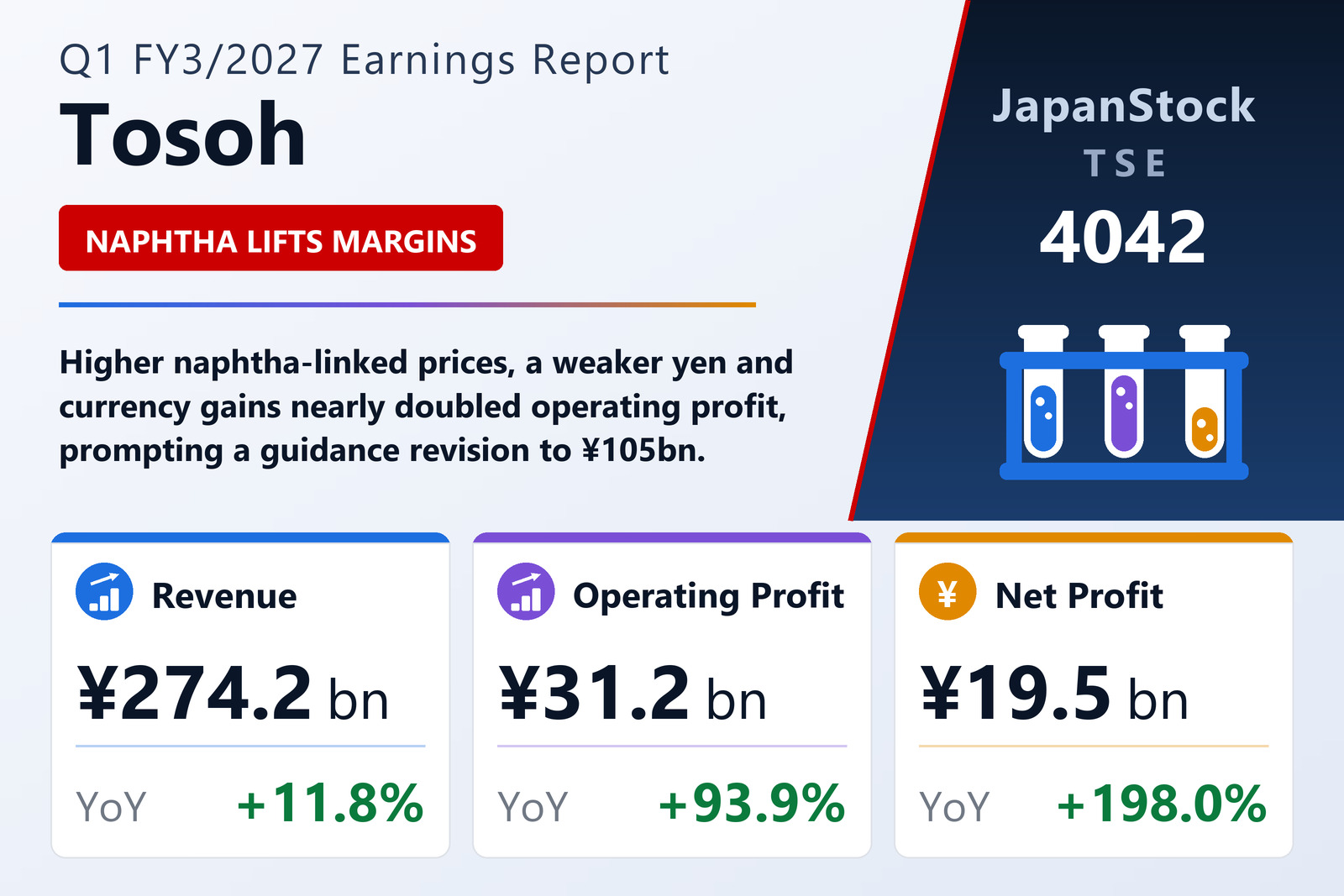
Tosoh Corporation (TSE: 4042), the Tokyo-based chemicals maker led by President Mamoru Kuwata, reported consolidated first-quarter results for the three months to June 30, 2026 under Japanese GAAP. Revenue rose 11.8% to ¥274,174 million, operating profit jumped 93.9% to ¥31,183 million, ordinary profit surged 143.6% to ¥34,302 million, and net profit attributable to owners of the parent climbed 198.0% to ¥19,456 million. Basic earnings per share were ¥63.19, up from ¥20.50. Comprehensive income swung to ¥27,683 million from ¥1,803 million a year earlier.
A price-and-inventory story more than a volume story
The scale of the profit jump owes more to input costs and currency than to demand. Escalating tensions in the Middle East pushed naphtha prices and overseas market prices for Tosoh's main products sharply higher, while a weaker yen lifted selling prices — together adding ¥29.0 billion to revenue. That same naphtha spike produced a large positive inventory valuation swing which, combined with higher shipments of value-added and advanced materials, lifted operating profit by ¥15.1 billion. Foreign-exchange gains then improved non-operating income, taking the increase at the ordinary-profit line to ¥20.2 billion. Investors should read the quarter accordingly: the inventory valuation benefit and FX gains are mark-to-market effects that can reverse if crude and naphtha retreat.
A new five-segment structure
Effective this quarter Tosoh reorganised its reporting from four segments — Petrochemicals, Chlor-Alkali, Specialty Products and Engineering — into five: Basic Materials, Value-Added Materials, Bioscience, Advanced Materials and Water Treatment Engineering, with prior-year figures restated on the new basis. The swing factor was Basic Materials, where revenue rose to ¥124.8 billion from ¥111.7 billion and the segment moved from a ¥3.4 billion operating loss to a ¥5.7 billion profit. Ethylene, propylene and cumene shipments fell on a scheduled turnaround year at the Yokkaichi ethylene plant, but naphtha-driven price increases lifted realisations and overseas strength raised cumene prices; polyethylene shipments rose on pre-emptive buying tied to Middle East disruption plus solid HDPE demand for semiconductors, and PVC resin shipments and prices both improved. Caustic soda volumes rose at Nanyo but export prices fell, vinyl chloride monomer output slipped on feedstock-procurement concerns, and cement shipments were weak domestically even as prices rose.
Value-Added Materials more than doubled operating profit to ¥8.2 billion from ¥3.9 billion on revenue of ¥42.9 billion (up 13.9%), as chloroprene rubber shipments rose on Middle East-driven demand with butadiene strength lifting prices, HDI-based hardeners gained on both volume and price, and ethylene amines benefited from stronger Asian enquiries. Together the two chain businesses lifted operating profit to ¥13.9 billion from ¥0.5 billion. Among the advanced businesses, Bioscience held revenue flat at ¥15.4 billion while operating profit rose to ¥5.7 billion from ¥4.6 billion, and Advanced Materials grew revenue to ¥34.3 billion from ¥30.1 billion with operating profit of ¥3.2 billion, led by high-silica zeolite demand from automotive and environmental applications at home and Asian automotive and petrochemical-catalyst uses abroad. Water Treatment Engineering was the one decliner: revenue rose to ¥42.0 billion from ¥37.8 billion, but operating profit slipped to ¥6.6 billion from ¥7.2 billion.
Balance sheet expands, equity ratio dips
Total assets grew to ¥1,468,941 million at June 30 from ¥1,408,950 million at March 31, while net assets edged up to ¥928,684 million from ¥919,141 million and shareholders' equity rose to ¥841,178 million from ¥831,752 million. Because assets expanded faster than equity, the equity ratio eased to 57.3% from 59.0% — still a conservative capital structure for a commodity-exposed chemicals producer.
Guidance revised up; dividend held at ¥100
Tosoh revised its FY3/2027 forecast. For the first half it now guides revenue of ¥580.0 billion (+16.2%), operating profit of ¥50.0 billion (+11.8%), ordinary profit of ¥52.0 billion (+13.7%) and net profit of ¥28.0 billion (+279.5%), with EPS of ¥90.94. For the full year it guides revenue of ¥1,170.0 billion (+14.7%), operating profit of ¥105.0 billion (+9.9%), ordinary profit of ¥107.0 billion (+0.2%) and net profit of ¥59.0 billion (+41.8%), with EPS of ¥191.63. Notably, the ¥31.18 billion booked in the first quarter alone already covers roughly 30% of the full-year operating profit target — a sign management is not extrapolating the quarter's inventory and currency tailwinds. The annual dividend forecast is unchanged at ¥100.00 per share (¥50.00 interim plus ¥50.00 year-end), matching the FY3/2026 payout. There was no change in the scope of consolidation, special quarterly accounting treatment was applied, and the quarterly statements were not reviewed by an auditor.
| Metric | Q1 FY3/2027 | Q1 FY3/2026 | YoY |
|---|---|---|---|
| Revenue (¥ billion) | 274.17 | 245.13 | +11.8% |
| Operating profit (¥ billion) | 31.18 | 16.08 | +93.9% |
| Ordinary profit (¥ billion) | 34.30 | 14.08 | +143.6% |
| Net profit attrib. to owners (¥ billion) | 19.46 | 6.53 | +198.0% |
| Basic EPS (¥) | 63.19 | 20.50 | +208.2% |
| Equity ratio (%, vs Mar 31, 2026) | 57.3 | 59.0 | -1.7 pt |
JapanStockPulse provides informational content only and does not constitute investment advice. Figures are taken from the company's published earnings short report and may be subject to subsequent revision.