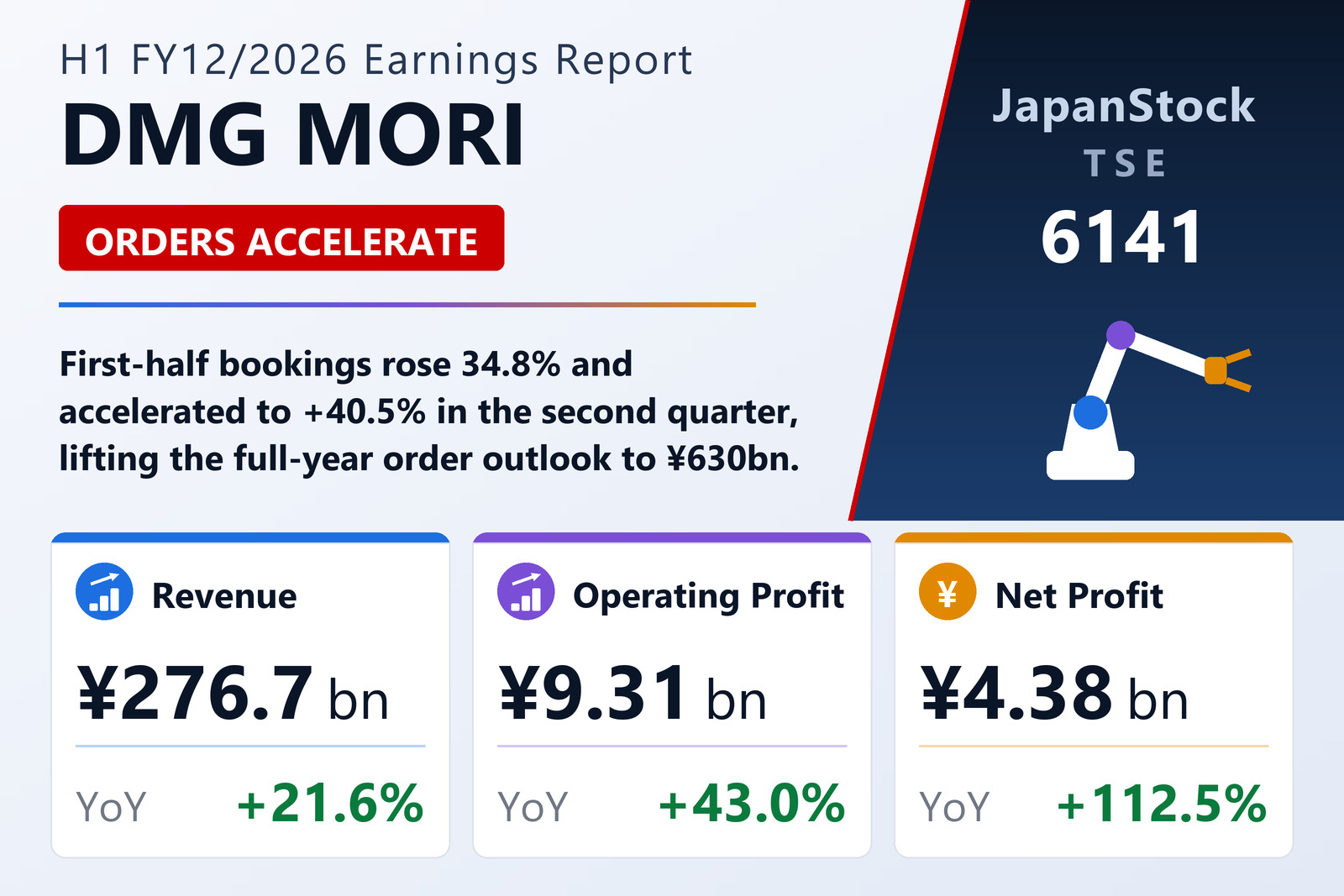
DMG MORI CO., LTD. (TSE: 6141), one of the world's largest builders of cutting machine tools, reported IFRS consolidated results for the first six months of the year to December 2026 (January 1 – June 30). Revenue rose 21.6% to ¥276,729 million (€1,500 million), reversing a 13.7% decline a year earlier, while EBITDA reached ¥27.8 billion (€151 million). Operating profit climbed 43.0% to ¥9,311 million (€50 million), profit before tax rose 81.6% to ¥5,933 million and profit attributable to owners of the parent more than doubled, up 112.5% to ¥4,378 million. Basic earnings per share were ¥23.09, against ¥7.94 a year earlier, after deducting the interest attributable to hybrid-capital holders. Total comprehensive income jumped 329.1% to ¥10,991 million. Euro figures use the January–June 2026 average rate of ¥184.5.
Orders jumped 35% — and accelerated through the half
The headline number was not revenue but bookings. Consolidated orders for the first half reached ¥335.2 billion, up 34.8% on January–June 2025, and the pace built as the half progressed: first-quarter orders were up 28.8% year on year, second-quarter orders up 40.5%. Growth was broad rather than concentrated, coming both from five-axis and multi-tasking "MX" machines with automation and from BX basic machines. The average order price per machine edged up from the FY2025 average of ¥79.6 million (€471,000) to ¥81.8 million (€443,000). The machine order backlog swelled from ¥240.0 billion at the end of December 2025 to ¥303.0 billion at the end of June 2026, a cushion management expects to convert into second-half revenue. On that strength the company raised its full-year order outlook to ¥630.0 billion from ¥580.0 billion, a 20.4% year-on-year increase.
Defence budgets and AI-driven semiconductor capex behind the demand
Capital-investment demand held firm worldwide in the growth sectors DMG MORI serves — aerospace, space, defence, power generation, energy, marine, semiconductor-related and medical — and orders were strong across all regions. Management links the momentum to expanded government defence budgets and to machine-tool demand generated by AI-related semiconductor investment, both of which fit the company's "MX" (Machining Transformation) proposition of process integration and automation. Aftermarket work added a steady layer: MRO, spare parts and engineering orders came in at ¥73.7 billion, up 23.3%. Group companies also punched above their weight — Magnescale, which makes ultra-high-resolution laser scales used in semiconductor production equipment, and Saki Corporation, which develops automated inspection systems for electronic module boards.
Capacity and product investment
The half was busy on the capital-spending side. A topping-out ceremony was held in May 2026 for the European headquarters and technology centre in Munich, Germany. In June 2026 the company expanded its Stipshausen site, the core base for its ultrasonic machining technology, adding production, logistics and R&D capacity aimed at semiconductor, optics, medical and aerospace applications. Magnescale opened a Nara plant in April 2026 to expand output of high-precision "Laser Scale" linear encoders for semiconductor equipment, giving the unit a two-site business-continuity structure alongside Isehara. New products included the ULTRASONIC 80 Precision five-axis machine for hard-and-brittle materials, the WH-AMR 10 2nd Generation autonomous mobile robot, and a "Condition Agent" predictive-maintenance function added to the CELOS Club digital service that reads machine operating data through AI. DMG MORI was also selected for METI and NEDO's GENIAC programme to build a manufacturing physical-AI platform from production-equipment data, and was named to the CDP 2025 climate-change A List for a second consecutive year and to the water-security A List for the first time.
Balance sheet firmer; guidance split between the operating and bottom lines
Total assets rose from ¥868,965 million at the end of December 2025 to ¥881,440 million, and total equity from ¥342,155 million to ¥353,329 million. Equity attributable to owners of the parent reached ¥352,661 million, lifting the equity ratio from 39.2% to 40.0% and per-share equity from ¥2,444.41 to ¥2,499.46 (both figures include hybrid capital). Treasury shares fell to 1,230,942 from 3,034,960 out of 142,325,934 shares issued.
DMG MORI revised the full-year FY12/2026 forecast it issued on May 1, and the revision carries an unusual split. Revenue is guided at ¥580.0 billion (+12.6%) and operating profit at ¥30.0 billion (+58.1%) — a sharp step up — yet profit attributable to owners of the parent is guided down 35.5% to ¥15.5 billion, with basic EPS of ¥93.26. The assumed exchange rates are ¥154.1 to the dollar and ¥182.3 to the euro. The annual dividend is held unchanged at ¥105.00 (¥50.00 interim plus ¥55.00 year-end), matching FY12/2025, with payments starting September 11, 2026.
| Metric | H1 FY12/26 | H1 FY12/25 | YoY |
|---|---|---|---|
| Revenue (¥ billion) | 276.73 | 227.49 | +21.6% |
| Operating profit (¥ billion) | 9.31 | 6.51 | +43.0% |
| Profit before tax (¥ billion) | 5.93 | 3.27 | +81.6% |
| Profit attrib. to owners (¥ billion) | 4.38 | 2.06 | +112.5% |
| Basic EPS (¥) | 23.09 | 7.94 | +190.8% |
| Orders received (¥ billion) | 335.2 | 248.7 | +34.8% |
JapanStockPulse provides informational content only and does not constitute investment advice. Figures are taken from the company's published earnings short report and may be subject to subsequent revision.