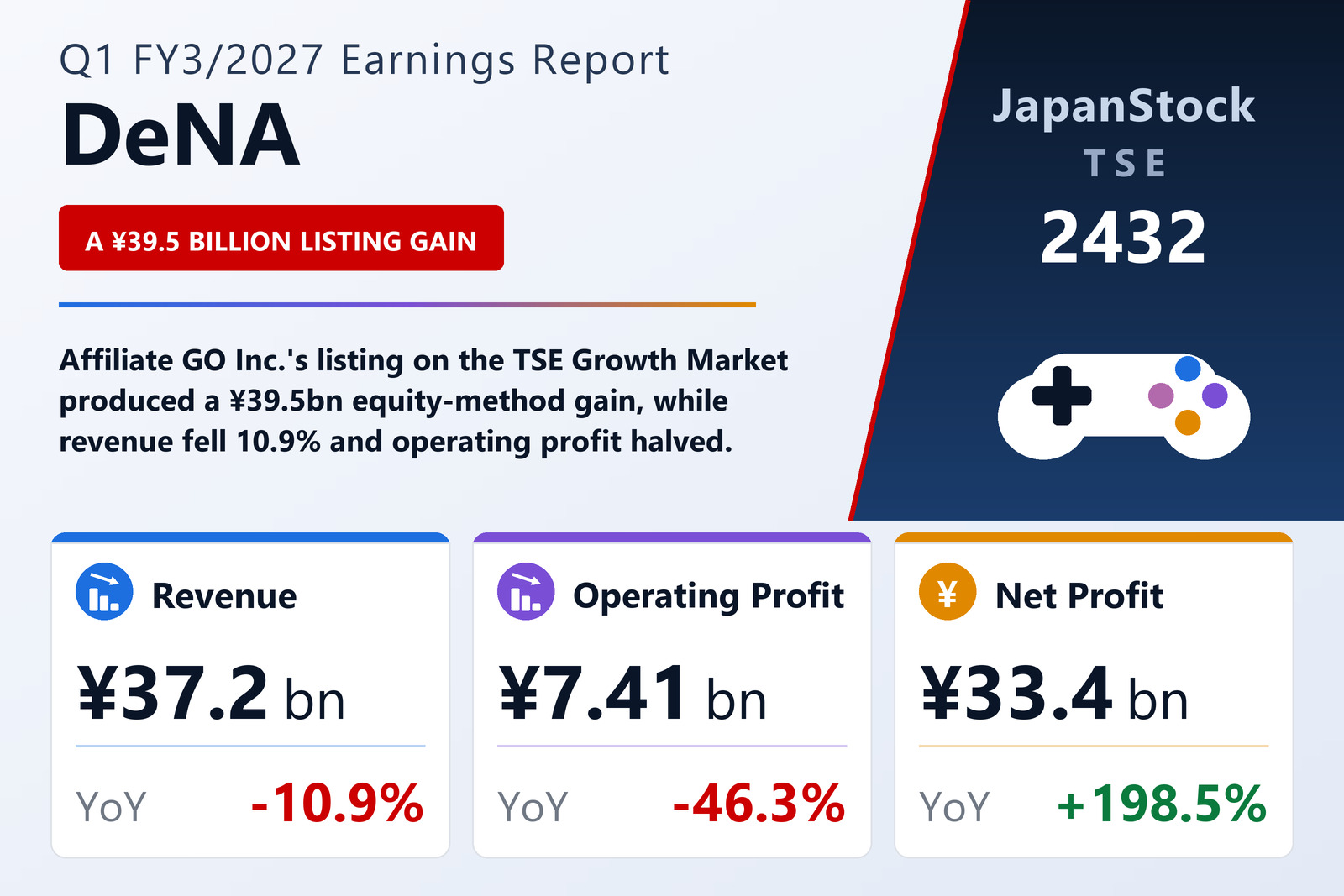
DeNA Co., Ltd. (TSE: 2432) reported consolidated results for the first quarter of the year to March 31, 2027 — the three months from April 1 to June 30, 2026 — under IFRS. Revenue fell 10.9% to ¥37,166 million and operating profit dropped 46.3% to ¥7,411 million, yet profit before tax surged 213.5% to ¥49,753 million and profit attributable to owners of the parent rose 198.5% to ¥33,438 million. Basic earnings per share came to ¥333.13, against ¥100.54 a year earlier; diluted EPS was ¥332.33.
A ¥39.5 billion gain from GO's Tokyo listing
The gap between a halved operating profit and a tripled pre-tax profit is explained almost entirely by a single item below the operating line. GO Inc., an equity-method associate, listed on the Tokyo Stock Exchange Growth Market on June 16, 2026. In connection with the listing DeNA sold part of its holding of GO common shares through a secondary offering, and GO was consequently removed from the scope of equity-method associates. DeNA states that the difference between the transfer consideration and the consolidated carrying amount of the shares transferred, together with the valuation gain from remeasuring its residual interest in GO at fair value, came to ¥39,517 million, recognised in the quarterly income statement within "share of profit (loss) of investments accounted for using the equity method."
That line totalled ¥40,571 million for the quarter, up 2,272.7% from ¥1,710 million a year earlier, with the remainder reflecting the performance of continuing associates including Cygames, Inc. Net finance items added a further ¥1,771 million, as finance income rose 144.9% to ¥1,839 million and finance costs fell 82.5% to ¥68 million. After income tax expense of ¥16,125 million, quarterly profit was ¥33,627 million, up 203.6%. Total comprehensive income moved the other way, falling 14.5% to ¥29,142 million, weighed down by a ¥4,319 million after-tax loss on investments in equity instruments.
Operating profit halves as Game revenue drops a third
Beneath the one-off gain, the operating business softened. Cost of sales rose 5.2% to ¥17,765 million on higher Sports & Smart City costs, partly offset by lower performance-linked payment fees in Live Streaming and Game, while selling, general and administrative expenses fell 2.7% to ¥11,976 million. Reported segment profit was ¥7,426 million after ¥628 million of unallocated corporate costs, and net other income and expenses of minus ¥15 million took operating profit to ¥7,411 million.
The Game business was the main drag, with revenue down 33.2% to ¥12,120 million and segment profit down 62.0% to ¥3,826 million, which the company attributes to trends at Pokémon Trading Card Game Pocket, released in October 2024. Live Streaming was broadly flat, at ¥9,725 million of revenue (−2.5%) and ¥994 million of segment profit (−0.8%), as Pococha held steady in Japan and IRIAM turned its first-ever quarterly profit domestically. Sports & Smart City — enlarged this year by folding the Smart City operations in alongside the sports business after BASEGATE Yokohama Kannai's grand opening in March 2026, with prior-year figures restated — became the largest revenue segment at ¥13,216 million (+16.0%), with segment profit up 24.4% to ¥4,551 million; the Yokohama DeNA BayStars performed well despite fewer home games, and two directly operated facilities opened inside BASEGATE. Healthcare & Medical revenue slipped 3.9% to ¥1,610 million but the segment loss narrowed to ¥748 million from ¥1,353 million as fixed-cost reductions took hold around the Join medical communication app and Join Mobile Clinic. New businesses and other, which houses the group's AI initiatives, posted revenue of ¥621 million (−7.7%) and a wider loss of ¥570 million, against ¥310 million.
Buybacks and the share sale reshape the balance sheet
Total assets fell ¥28,350 million from the March 31, 2026 year-end to ¥304,894 million. Current assets dropped ¥29,981 million to ¥114,695 million, on an ¥18,616 million fall in cash and equivalents and a ¥10,856 million fall in receivables, while non-current assets edged up ¥1,631 million to ¥190,198 million as other long-term financial assets (+¥4,799 million) and goodwill (+¥2,364 million) offset a ¥5,193 million decline in equity-method investments. Total liabilities fell ¥14,168 million to ¥78,288 million and total equity fell ¥14,182 million to ¥226,605 million; equity attributable to owners of the parent was ¥218,272 million, and the ratio of owners' equity to total assets rose to 71.6% from 69.8%. The current ratio stood at 235.6%.
Cash flow reflected both the disposal and an aggressive buyback. Operating activities used ¥4,941 million, against a ¥6,950 million inflow a year earlier, chiefly on ¥15,459 million of income tax payments. Investing activities generated ¥31,534 million, driven by ¥36,569 million of proceeds from the sale of associate shares. Financing activities used ¥45,161 million, including ¥36,306 million spent acquiring treasury shares — which lifted the treasury holding to 28,504,571 shares from 14,758,913 at the year-end and cut the average share count to 100,375,065 from 111,435,066. Period-end cash and equivalents were ¥84,430 million.
Full-year guidance unchanged; dividend still undetermined
DeNA left the FY3/2027 forecast it published on May 12, 2026 unchanged: revenue of ¥154,000 million (+4.3%), IFRS operating profit of ¥15,000 million (−19.8%) and Non-GAAP operating profit of ¥15,000 million (−46.7%). Non-GAAP operating profit is the company's rules-based adjusted measure: starting from IFRS operating profit, it excludes one-off costs and one-off gains arising from acquisitions and from business or organisational changes, together with the effect of adjustments to accounting timing. No forecast is given for profit attributable to owners of the parent — DeNA says a reasonable estimate is difficult while it prioritises an update of its business-portfolio and business-creation strategy, and that it will disclose promptly once there is something to announce.
On shareholder returns, DeNA paid no interim dividend and ¥66.00 at the year-end for FY3/2026, an annual total of ¥66.00. The FY3/2027 dividend forecast is undetermined: the company says it will decide later, after examining earnings trends, in line with its basic dividend policy, and will announce the figure as soon as it is fixed. The filing reports no material subsequent events, and the quarterly statements were not reviewed by an accounting auditor.
| Metric | Q1 FY3/2027 | Q1 FY3/2026 | YoY |
|---|---|---|---|
| Revenue (¥ million) | 37,166 | 41,727 | -10.9% |
| Operating profit (¥ million) | 7,411 | 13,800 | -46.3% |
| Equity-method investment income (¥ million) | 40,571 | 1,710 | +2,272.7% |
| Profit before tax (¥ million) | 49,753 | 15,871 | +213.5% |
| Quarterly profit (¥ million) | 33,627 | 11,076 | +203.6% |
| Profit attrib. to owners of the parent (¥ million) | 33,438 | 11,203 | +198.5% |
| Total comprehensive income (¥ million) | 29,142 | 34,076 | -14.5% |
| Basic EPS (¥) | 333.13 | 100.54 | +231.3% |
| Total assets (¥ million, vs FY3/2026 year-end) | 304,894 | 333,244 | -8.5% |
| Owners' equity ratio (%) | 71.6 | 69.8 | +1.8pt |
| FY3/2027 revenue guidance (¥ million) | 154,000 | — | +4.3% |
| FY3/2027 operating profit guidance (¥ million) | 15,000 | — | -19.8% |
JapanStockPulse provides informational content only and does not constitute investment advice. Figures are taken from the company's published earnings short report and may be subject to subsequent revision.