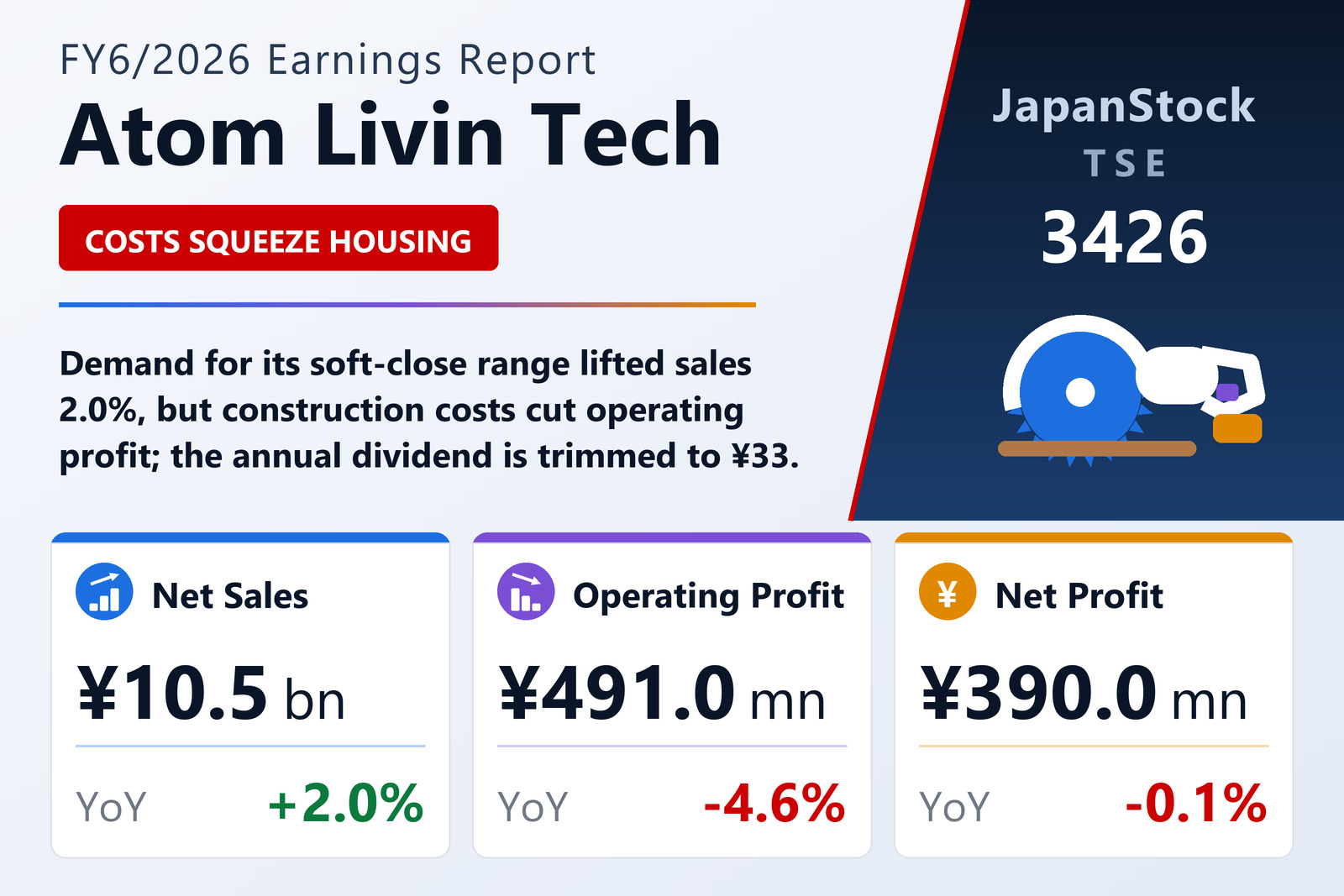
Atom Livin Tech Co., Ltd. (TSE: 3426), a 123-year-old planner and developer of interior building hardware — door and sliding-door fittings, soft-close mechanisms and related interior hardware sold through the hardware wholesale channel — reported non-consolidated results for the year ended June 30, 2026 under Japanese GAAP. Net sales rose 2.0% to ¥10,506 million, but operating profit fell 4.6% to ¥491 million. Ordinary profit edged up 1.0% to ¥566 million and net profit was essentially flat at ¥390 million, down 0.1%. Earnings per share were ¥97.87, against ¥97.97 a year earlier.
Soft-close range carries the top line
Revenue growth came almost entirely from product mix. The company expanded its proprietary soft-close product range and developed a new hanger roller for overhead sliding doors. The EM series carrying that roller can be removed without tools, improving maintenance efficiency after installation, and its higher load rating pushes the range beyond ordinary housing into commercial and institutional buildings — shops, offices, and education, medical and welfare facilities. That reach into non-residential work matters as detached-housing volumes keep shrinking.
Margins, however, did not follow. The operating margin narrowed to 4.7% from 5.0%, as cost inflation outpaced the modest price and mix gains. Return on equity slipped to 3.7% from 3.8%, while return on total assets on an ordinary-profit basis improved to 4.8% from 4.5%.
A housing market squeezed by construction costs
Japan's economy recovered moderately over the year on improving employment and income and firm inbound demand, but price inflation held back consumer spending. In housing — Atom Livin Tech's core market — government support such as expanded mortgage tax deductions and energy-efficiency subsidies helped at the margin, yet higher raw-material and energy costs pushed construction costs up and suppressed demand, leaving housing starts weak. Chronic construction-labour shortages and worries about rising mortgage rates kept buyers cautious.
Management's longer-term read is that housing starts keep shrinking on demographics and longer building lifespans, while the industry shifts from volume to quality — with rising demand for functionality, design and lower environmental impact. The company operates under its "12th Medium-Term Management Plan" spanning the 71st to 73rd fiscal terms, of which FY6/2026 was the middle year, under the corporate spirit "build on tradition, challenge change."
Debt-free balance sheet, cash flow swings positive
Total assets stood at ¥11,897 million against net assets of ¥10,710 million, for an equity ratio of 90.0% — an unusually strong, essentially debt-free position. Book value per share rose to ¥2,684.39 from ¥2,614.26. Operating cash flow swung sharply back into positive territory at +¥943 million, from an outflow of ¥1,154 million a year earlier. Investing outflow narrowed to ¥1,067 million from ¥1,894 million and financing outflow was ¥131 million, leaving year-end cash and equivalents at ¥1,669 million, down from ¥1,924 million.
Showroom, brand and channel initiatives
During the year the company launched "monoLAB.", a semi-custom furniture brand made by Japanese craftsmen, at its Atom CS Tower showroom in Shimbashi, Tokyo, offering millimetre-level made-to-order sizing. The showroom also displays child-care-friendly products alongside hotel, children's-facility and senior-facility room mock-ups. In April 2026 the company held its "2026 Spring New Product Exhibition, Tokyo" at the same building to open new sales channels. Its Hiroshima sales office and C&D distribution centre continue to widen the range of products handled, strengthening the western-Japan market while spreading logistics risk as part of the company's business-continuity plan. Order-entry and accounting management systems were migrated to a cloud-based platform.
Dividend trimmed for the year ahead
For FY6/2026 the company paid an interim dividend of ¥16.50 and a year-end dividend of ¥17.50, for an annual total of ¥34.00 — unchanged from the prior year, when the ¥34.00 comprised a ¥17.50 interim (¥15.00 ordinary plus a ¥2.50 commemorative payment) and a ¥16.50 year-end. Total dividends came to ¥135 million, a payout ratio of 34.7% and a dividend on equity of 1.3%. For FY6/2027 the company guides ¥16.50 at both the interim and year-end stages, an annual ¥33.00 and a payout ratio of 32.1%.
Guidance: a modest recovery
For the year ending June 30, 2027 management guides net sales of ¥10,620 million (+1.1%), operating profit of ¥530 million (+7.8%), ordinary profit of ¥610 million (+7.6%) and net profit of ¥410 million (+5.0%), with EPS of ¥102.76. The first-half plan is flatter still: net sales of ¥5,360 million (+0.0%), operating profit of ¥290 million (+4.1%), ordinary profit of ¥340 million (+8.1%) and net profit of ¥220 million (+2.3%), for EPS of ¥55.14 — implying the profit recovery is weighted towards the second half.
| Metric | FY6/2026 | FY6/2025 | YoY |
|---|---|---|---|
| Net sales (¥ million) | 10,506 | 10,297 | +2.0% |
| Operating profit (¥ million) | 491 | 515 | -4.6% |
| Ordinary profit (¥ million) | 566 | 561 | +1.0% |
| Net profit (¥ million) | 390 | 390 | -0.1% |
| Basic EPS (¥) | 97.87 | 97.97 | -0.1% |
| Equity ratio (%) | 90.0 | 89.9 | +0.1pt |
| Operating cash flow (¥ million) | 943 | -1,154 | — |
| Investing cash flow (¥ million) | -1,067 | -1,894 | — |
| Annual dividend (¥) | 34.00 | 34.00 | 0.0% |
| FY6/2027 net sales guidance (¥ million) | 10,620 | 10,506 | +1.1% |
| FY6/2027 operating profit guidance (¥ million) | 530 | 491 | +7.8% |
JapanStockPulse provides informational content only and does not constitute investment advice. Figures are taken from the company's published earnings short report and may be subject to subsequent revision.