Revenue grew 7.6%; gross profit grew twice as fast, and the costs below it did not move
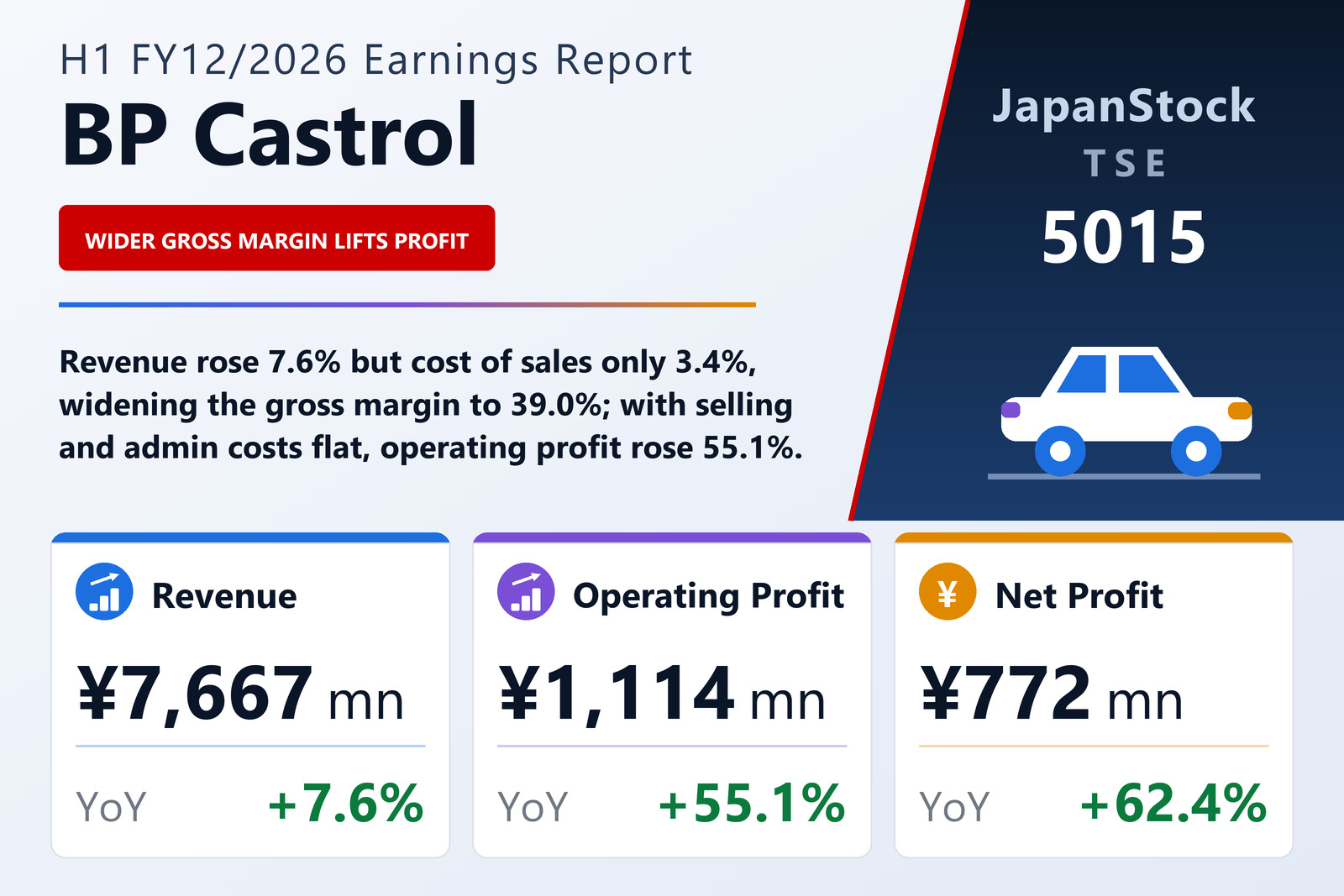
BP Castrol K.K. (TSE: 5015), which sells lubricants as part of the bp group, published non-consolidated first-half results for the six months from January 1 to June 30, 2026 on August 5, 2026 under Japanese GAAP. Revenue rose 7.6% to ¥7,667 million, operating profit 55.1% to ¥1,114 million, ordinary profit 47.5% to ¥1,147 million and interim net profit 62.4% to ¥772 million, for earnings of ¥33.63 per share against ¥20.71. The filing names the Tokyo Stock Exchange as the listing venue. The company reports a single segment — the sale of lubricants and incidental business — so no segment breakdown is published, and the interim financial statements were not reviewed by an auditor.
The arithmetic is short. Cost of sales rose only 3.4% to ¥4,676 million against revenue growth of 7.6%, so gross profit rose 15.1% to ¥2,990 million and the gross margin widened from 36.5% to 39.0%. Selling, general and administrative expenses edged down 0.2%, to ¥1,876 million from ¥1,879 million. With that cost base flat, the whole ¥392 million gain in gross profit reached the operating line, which rose by ¥395 million, and the operating margin moved from 10.1% to 14.5%.
Selling prices and cost control against a tight lubricant supply market
The filing's own explanation centres on costs. It describes procurement in the lubricant market as unstable, with crude oil, base oil and additive prices, logistics costs and exchange rates all moving, alongside regional and grade-specific supply-demand conditions and logistics constraints. Supply constraints and cost pressure persisted in particular for low-viscosity oils and for products using high-performance base oils. The company says it made stable supply its top priority, using its global and domestic procurement network to secure raw materials, and managed inventory with supply to key customers in mind. On earnings, it says continued cost management and the optimisation of selling prices absorbed part of the cost increases. The margin figures above are the measurable result; the filing does not quantify the price and cost effects separately.
On sales, the company says high-value-added products and exclusive products sold steadily, and that it worked to maintain and strengthen its customer base across its sales channels and to make more use of digital channels. It continued brand marketing, including support for motorsport activities, and pursued efficiency measures including digital transformation. In its market backdrop, the filing notes that new-vehicle sales, standard and mini vehicles combined, were about 107% of the prior-year period, with demand firm around compact cars, hybrids and mini vehicles, while rising prices and persistently high vehicle prices have made consumers more price-sensitive.
Below the operating line: a currency swing, and a one-off that did not recur
Non-operating income fell to ¥41 million from ¥59 million. Interest income rose to ¥25 million from ¥14 million, but the prior-year half had a foreign-exchange gain of ¥21 million, whereas this half booked a foreign-exchange loss of ¥8 million as a non-operating expense. That is why ordinary profit grew more slowly than operating profit, at 47.5%. Below ordinary profit the order reversed: the prior-year half carried an extraordinary loss of ¥47 million in special retirement payments and this half had none, so pre-tax profit rose 57.1% to ¥1,147 million. Income taxes rose 47.3% to ¥375 million, an effective rate of about 32.7% against 34.9%, and net profit rose 62.4% to ¥772 million.
Money lent to the bp group's in-house bank is more than half of total assets
Total assets rose 8.4% to ¥14,072 million from ¥12,986 million at December 31, 2025. The largest single item is a short-term loan, which rose by ¥1,088 million to ¥7,473 million, about 53% of total assets; the filing explains that the loan is to BP International Limited, which operates the bp group's in-house bank. Cash and deposits were only ¥206 million. Accounts receivable fell by ¥916 million to ¥2,053 million, while merchandise and finished goods rose by ¥547 million to ¥1,587 million. On the liabilities side, accounts payable rose by ¥602 million to ¥1,056 million and accrued expenses by ¥380 million to ¥879 million, taking current liabilities to ¥3,596 million. Non-current assets rose by ¥118 million, mainly on a ¥148 million increase in prepaid pension cost.
Net assets rose 1.7% to ¥10,245 million: net profit added ¥772 million to retained earnings and dividends took out ¥596 million. Because liabilities grew faster than equity, the equity ratio fell from 77.6% to 72.8%, a 4.8-point move that reflects the higher payables and accruals; no borrowings appear on the balance sheet. The filing does not include a cash flow statement for the half.
Full-year forecast revised — and the implied second half is far less profitable
BP Castrol revised the full-year forecast it had published on February 9, 2026, citing first-half results, and refers readers to a same-day notice comparing its first-half non-consolidated forecast with actual results; the tanshin itself does not print the earlier figures. The revised FY12/2026 forecast is revenue of ¥18,328 million (+24.8%), operating profit of ¥1,666 million (+6.7%), ordinary profit of ¥1,730 million (+5.4%) and net profit of ¥1,142 million (+8.7%), for earnings per share of ¥49.74.
Read against the half just reported, the forecast has an unusual shape. The first half delivered 41.8% of forecast revenue but 66.9% of forecast operating profit and 67.6% of forecast net profit. The implied second half is revenue of about ¥10,661 million, well above the ¥7,667 million just reported, but operating profit of only about ¥552 million against ¥1,114 million, an operating margin of roughly 5.2% against 14.5%, and net profit of about ¥370 million. The forecast therefore assumes much higher sales at a much lower margin in the second half. The tanshin does not explain why.
A higher interim dividend, and an annual payout slightly above forecast earnings
The interim dividend is ¥28.00 per share against ¥20.00 a year earlier, with payment scheduled to begin on August 28, 2026. The dividend forecast was also revised, in a separate notice the same day: the year-end dividend is now forecast at ¥22.00, against ¥26.00 for FY12/2025, for an annual total of ¥50.00 against ¥46.00, up 8.7%. That annual dividend is slightly above the forecast earnings per share of ¥49.74, and the ¥28.00 interim payment equals about 83% of the ¥33.63 earned in the half.
A change of parent company is still pending
The filing repeats that, as announced on December 26, 2025 in a notice on an expected change of parent company, the bp group's transfer of its Castrol business to Stonepeak is subject to conditions including regulatory approvals, and that BP Castrol will disclose promptly if any material matter arises. The wider backdrop the company describes is a Japanese economy in moderate recovery, clouded by uncertainty over U.S. trade policy, energy-price swings linked to rising geopolitical tension in the Middle East, higher raw-material and logistics costs, and financial-market movements.
| Metric | H1 FY12/2026 | H1 FY12/2025 | Change |
|---|---|---|---|
| Revenue (¥ million) | 7,667 | 7,123 | +7.6% |
| Gross profit (¥ million) | 2,990 | 2,598 | +15.1% |
| Gross margin | 39.0% | 36.5% | +2.5 pt |
| SG&A expenses (¥ million) | 1,876 | 1,879 | −0.2% |
| Operating profit (¥ million) | 1,114 | 718 | +55.1% |
| Operating margin | 14.5% | 10.1% | +4.4 pt |
| Ordinary profit (¥ million) | 1,147 | 778 | +47.5% |
| Pre-tax profit (¥ million) | 1,147 | 730 | +57.1% |
| Net profit (¥ million) | 772 | 475 | +62.4% |
| EPS (¥) | 33.63 | 20.71 | +62.4% |
| Total assets (¥ million) | 14,072 | 12,986 | +8.4% |
| Net assets (¥ million) | 10,245 | 10,076 | +1.7% |
| Equity ratio | 72.8% | 77.6% | −4.8 pt |
| FY12/2026 guidance — revenue (¥ million) | 18,328 | — | +24.8% |
| FY12/2026 guidance — operating profit (¥ million) | 1,666 | — | +6.7% |
| FY12/2026 guidance — ordinary profit (¥ million) | 1,730 | — | +5.4% |
| FY12/2026 guidance — net profit (¥ million) | 1,142 | — | +8.7% |
| FY12/2026 guidance — EPS (¥) | 49.74 | — | — |
| Interim dividend per share (¥) | 28.00 | 20.00 | +40.0% |
| Annual dividend per share (¥) | 50.00 | 46.00 | +8.7% |
JapanStockPulse provides informational content only and does not constitute investment advice. Figures are taken from the company's published earnings short report and may be subject to subsequent revision.