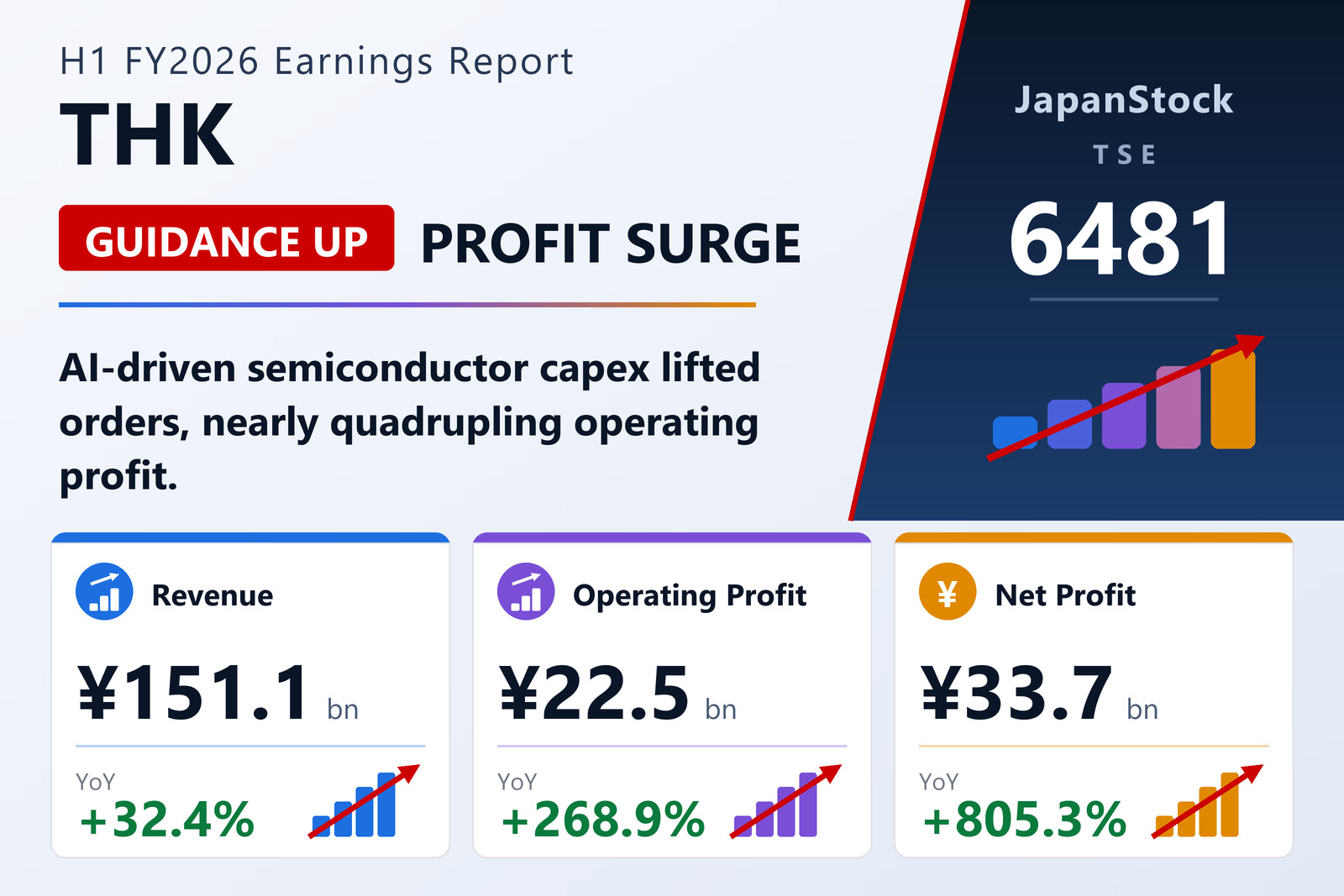
THK Co., Ltd. (TSE: 6481), a leading manufacturer of linear motion guides and ball screws, reported consolidated results for the first half of the fiscal year ending December 31, 2026 (January 1 – June 30, 2026) under IFRS. Revenue from continuing operations rose 32.4% to ¥151,067 million, operating profit surged 268.9% to ¥22,483 million and profit before tax climbed 221.7% to ¥22,092 million. Profit attributable to owners of the parent, which combines continuing and discontinued operations, leapt 805.3% to ¥33,744 million. The company raised its full-year guidance the same day.
AI-related capex drives a 32% revenue jump
Growth came from the industrial equipment business, THK's continuing operation, where order intake ran strong on expanding capital investment centred on semiconductor-related demand tied to artificial intelligence. A weaker yen than a year earlier added further support. Revenue rose ¥36,930 million year on year. On the cost side, the cost-of-sales ratio fell 4.6 points to 65.7% as higher volume and the benefits of the structural-reform programme outweighed reform-related expenses and the impact of U.S. tariffs. Selling, general and administrative expenses rose 5.7% to ¥28,949 million but shrank as a share of revenue, down 4.8 points to 19.2%. A voluntary "Next Career Support" programme announced on February 12, 2026 added ¥740 million of costs. The result was an operating margin of 14.9%, up 9.6 points. Finance income of ¥1,208 million and finance costs of ¥1,600 million left profit before tax at ¥22,092 million.
Automotive divestiture delivers a ¥16.4 billion gain
Under a management policy of achieving a return on equity above 10% at an early date — announced with the February 2025 results — THK paired structural reform in industrial equipment with "selection and concentration" in transport equipment, while placing greater emphasis on controlling the equity that sits in the denominator of ROE. Judging that the transport equipment business would not clear its expected cost of capital and return on invested capital over time, the company agreed on February 2, 2026 to sell it to AP87 Inc., a special-purpose company indirectly funded by a fund advised by Advantage Partners. The share and receivable transfers completed on June 1, 2026, removing 11 consolidated subsidiaries from the group, among them THK RHYTHM AUTOMOTIVE CANADA, THK RHYTHM AUTOMOTIVE MICHIGAN and THK RHYTHM MEXICANA.
The business was classified as a discontinued operation under IFRS 5 from the fourth quarter of the previous fiscal year, and prior-period figures were restated on the same basis — which is why no year-on-year percentage is shown for the restated year-earlier revenue, operating profit and pre-tax profit lines. Completion produced a ¥16,436 million gain on transfer, arising largely from recycling the cumulative translation differences of the divested foreign operations. That gain is the main reason bottom-line profit rose more than nine-fold while operating profit rose less than four-fold.
China and Japan lead the regional recovery
Segment revenue, which includes inter-segment transactions, improved across every region. Japan generated ¥63,351 million, up 18.8%, on recovering demand in electronics-related applications and machine tools; segment profit reached ¥27,163 million against ¥2,150 million a year earlier, the jump reflecting the ¥16,436 million transfer gain booked there. China was the fastest-growing region at ¥49,922 million, up 40.9%, with segment profit up 92.0% to ¥8,318 million on broadly firm demand. The Americas added ¥44,922 million, up 2.4% on recovering electronics demand and the weaker yen, though segment profit slipped 14.8% to ¥534 million. Europe reached ¥34,679 million, up 2.4%, and narrowed its segment loss by ¥466 million to ¥294 million. The Other region, covering India, ASEAN and other markets, grew 39.5% to ¥13,577 million as the customer base widened, lifting segment profit 707.3% to ¥1,806 million.
Balance sheet reshaped by the disposal
Total assets ended the half at ¥480,597 million, up ¥7,605 million from the previous year-end. Assets held for sale fell ¥36,126 million as the divestiture closed, more than offset by increases in other financial assets (¥13,633 million), trade and other receivables (¥10,707 million), cash and cash equivalents (¥6,916 million), inventories (¥5,275 million) and property, plant and equipment (¥1,193 million). Liabilities fell ¥2,641 million to ¥204,600 million: bonds and borrowings rose ¥16,607 million and trade payables ¥3,824 million, against a ¥28,377 million reduction in liabilities directly associated with assets held for sale.
Equity rose ¥10,247 million to ¥275,996 million. Retained earnings added ¥19,765 million and other components of equity ¥9,886 million, while capital surplus fell ¥1,015 million, other components of equity related to the disposal group fell ¥14,142 million and non-controlling interests fell ¥4,416 million to nil. With no minority interests left, equity attributable to owners of the parent equals total equity, and the ratio of owners' equity to total assets improved to 57.4% from 55.3%.
Cash flow absorbs the transaction
Operating activities generated ¥18,868 million, against ¥20,302 million a year earlier. Pre-tax profit of ¥22,092 million, pre-tax profit from discontinued operations of ¥15,582 million, depreciation and amortisation of ¥11,713 million and a ¥4,515 million increase in trade payables were partly offset by the non-cash ¥16,436 million transfer gain, a ¥13,899 million build in receivables, a ¥3,356 million build in inventories and ¥4,193 million of income taxes paid. Investing activities used ¥23,660 million, up from ¥8,967 million, comprising ¥8,681 million of property purchases and a ¥13,898 million outflow related to the transport-business transfer. Financing activities used ¥3,461 million, far below the prior year's ¥42,169 million: ¥30,000 million of short-term borrowings offset ¥10,000 million of bond redemptions, ¥2,185 million of long-term repayments, ¥13,759 million of dividends paid and a ¥6,563 million capital reduction paid to non-controlling shareholders. Cash and cash equivalents closed at ¥116,924 million, down ¥3,609 million from the year-end and above the ¥101,527 million held a year earlier.
Guidance raised; dividend set by an 8% DOE policy
THK revised its full-year forecast on August 5, 2026. It now guides revenue of ¥310,000 million (+28.9%), operating profit of ¥48,000 million (+232.5%), profit before tax of ¥47,100 million (+199.1%) and profit attributable to owners of ¥54,800 million, for earnings per share of ¥488.97. The full-year growth rates are calculated against prior-year figures restated for continuing operations.
The dividend forecast was revised at the same time under a policy of paying an 8% dividend on equity (DOE). The interim dividend is set at ¥96.00 per share against ¥123.00 a year earlier, with a year-end forecast of ¥99.00 for an annual total of ¥195.00, compared with ¥246.00 paid for the previous fiscal year. Payment of the interim dividend is scheduled to begin on September 11, 2026. The company reported no material subsequent events.
| Metric | H1 FY12/26 | H1 FY12/25 | YoY |
|---|---|---|---|
| Revenue (¥ billion) | 151.07 | 114.14 | +32.4% |
| Operating profit (¥ billion) | 22.48 | 6.10 | +268.9% |
| Operating margin | 14.9% | 5.3% | +9.6pt |
| Profit before tax (¥ billion) | 22.09 | 6.87 | +221.7% |
| Profit attrib. to owners (¥ billion) | 33.74 | 3.73 | +805.3% |
| Basic EPS (¥) | 301.18 | 32.72 | +820.5% |
| Gain on business transfer (¥ billion) | 16.44 | — | — |
| Owners' equity ratio | 57.4% | 55.3% | +2.1pt |
| Operating cash flow (¥ billion) | 18.87 | 20.30 | -7.1% |
| FY12/26 revenue guidance (¥ billion) | 310.00 | — | +28.9% |
| FY12/26 operating profit guidance (¥ billion) | 48.00 | — | +232.5% |
| FY12/26 profit attrib. guidance (¥ billion) | 54.80 | — | — |
| Annual dividend forecast (¥) | 195.00 | 246.00 | -20.7% |
JapanStockPulse provides informational content only and does not constitute investment advice. Figures are taken from the company's published earnings short report and may be subject to subsequent revision.