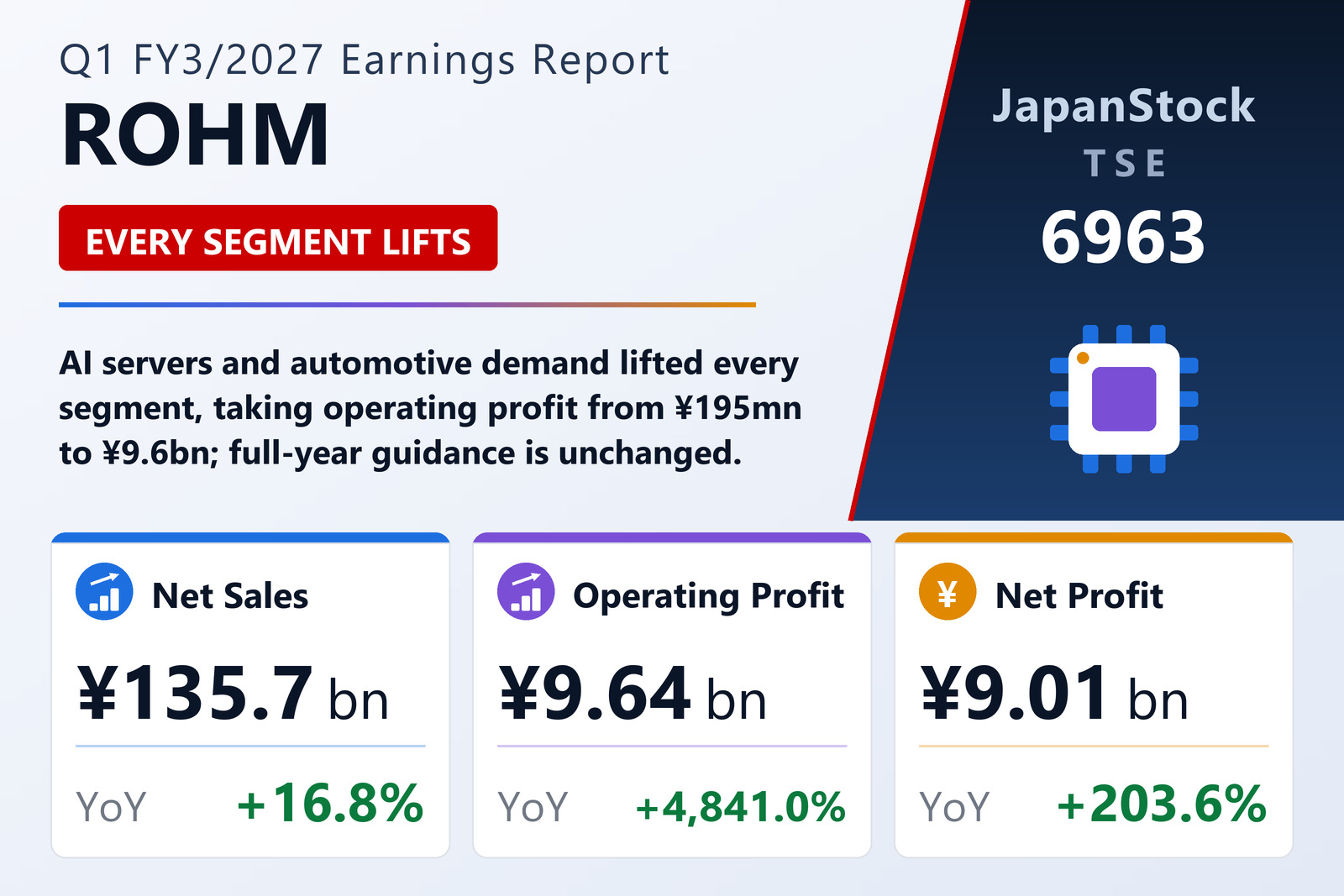
ROHM Co., Ltd. (TSE: 6963), the Kyoto-based analogue and power-semiconductor maker and one of the world's leading suppliers of silicon-carbide (SiC) power devices, reported consolidated first-quarter results for the three months to June 30, 2026 under Japanese GAAP. Net sales rose 16.8% to ¥135,739 million, and operating profit came in at ¥9,635 million — against just ¥195 million in the same quarter a year earlier, when profitability had all but evaporated. Ordinary profit jumped 352.6% to ¥11,243 million and net profit attributable to owners of the parent rose 203.6% to ¥9,006 million, for basic earnings per share of ¥23.33 versus ¥7.69. Diluted EPS was ¥19.90, against ¥6.55.
AI servers and an automotive rebound
Demand improved across almost every end market Rohm serves. Computer and storage demand stayed firm, centred on AI servers, as generative-AI adoption continued to pull data-centre investment forward. The automotive market remained resilient on electrification and rising electronic content per vehicle, although customers stayed cautious about the pace of battery-EV demand growth. Industrial-equipment demand recovered, led by factory automation. Consumer electronics were the one soft spot, still working through an adjustment phase.
Every segment moved the right way
The LSI segment — Rohm's largest — lifted net sales 13.3% to ¥62,128 million and segment profit 69.0% to ¥7,314 million. Automotive sales grew, led by body and infotainment applications; industrial-equipment demand recovered; and computer & storage sales rose sharply on server products. Consumer and home-appliance products remained in an adjustment phase.
Semiconductor Devices, the SiC-heavy segment, grew net sales 25.2% to ¥58,932 million and cut its segment loss to ¥945 million from ¥6,263 million a year earlier — a dramatic narrowing that accounts for most of the group's operating-profit swing. SiC power devices were solid on automotive xEV products and on computer & storage server products; silicon power devices were solid in automotive and rose sharply for servers; general-purpose devices and LEDs improved, led by industrial equipment; and semiconductor lasers grew on office-equipment products.
The smaller units also contributed. Modules lifted net sales 1.0% to ¥8,073 million and segment profit 18.1% to ¥1,015 million, as print-head sales rose for office equipment and optical modules gained on smartphone sensors. Other — chiefly resistors — grew net sales 4.4% to ¥6,604 million on strength in shunt resistors and high-power, high-reliability products for industrial equipment, though segment profit slipped 11.3% to ¥903 million.
Lower depreciation flows straight to the bottom line
Operating profit benefited from two forces at once: higher sales, and lower depreciation following the impairment charges Rohm booked in the previous fiscal year. EBITDA — which the company defines simply as operating profit plus depreciation — rose 38.5% to ¥18,467 million, a smaller gain than the operating-profit line precisely because the depreciation component shrank.
Management is continuing a structural-reform programme aimed at building a business base less exposed to market swings and at improving profitability ahead of any future scale-up: reorganising production sites, optimising the business portfolio and pricing, and bringing the SiC business to profitability. Development and sales of server-bound products are also being stepped up.
Balance sheet and dividend
Total assets stood at ¥1,298,202 million, up ¥14,643 million from the ¥1,283,559 million recorded at the fiscal year-end, as cash, deposits and trade receivables rose while investment securities fell. Liabilities edged down ¥1,532 million to ¥523,410 million, with higher trade payables offset by lower accrued expenses. Net assets reached ¥774,792 million from ¥758,616 million, and shareholders' equity ¥774,127 million from ¥757,964 million, lifting the equity ratio to 59.6% from 59.1%. Comprehensive income was ¥25,818 million, against ¥1,938 million a year earlier.
Rohm paid ¥50.00 per share for FY3/2026 (¥25.00 interim plus ¥25.00 year-end). For FY3/2027 it again forecasts ¥50.00 for the full year, unchanged from its previous announcement, but has not yet split the total between interim and year-end payments.
Guidance unchanged
Full-year guidance was left exactly as previously announced: net sales of ¥510,000 million (+6.0%), operating profit of ¥30,000 million (+176.1%), ordinary profit of ¥36,000 million (+87.3%) and net profit attributable to owners of ¥29,000 million, with EPS of ¥75.12.
It is worth noting the shape of that guidance against the first quarter just delivered: Q1 operating profit of ¥9.6 billion already represents about 32% of the ¥30.0 billion full-year target, and Q1 net profit of ¥9.0 billion about 31% of the ¥29.0 billion target. That is an observation about how the year is tracking rather than a prediction — semiconductor quarters are rarely evenly distributed, and Rohm has kept its numbers unchanged.
| Metric | Q1 FY3/27 | Q1 FY3/26 | YoY |
|---|---|---|---|
| Net sales (¥ billion) | 135.74 | 116.21 | +16.8% |
| Operating profit (¥ billion) | 9.64 | 0.20 | +4,841.0% |
| Ordinary profit (¥ billion) | 11.24 | 2.48 | +352.6% |
| Net profit attrib. to owners (¥ billion) | 9.01 | 2.97 | +203.6% |
| Basic EPS (¥) | 23.33 | 7.69 | +203.4% |
| EBITDA (¥ billion) | 18.47 | 13.33 | +38.5% |
| Segment: LSI — net sales (¥ billion) | 62.13 | 54.83 | +13.3% |
| Segment: Semiconductor Devices — net sales (¥ billion) | 58.93 | 47.07 | +25.2% |
| Segment: Modules — net sales (¥ billion) | 8.07 | 7.99 | +1.0% |
| Segment: Other — net sales (¥ billion) | 6.60 | 6.33 | +4.4% |
| FY3/27 guidance: net sales (¥ billion) | 510.00 | — | +6.0% |
| FY3/27 guidance: operating profit (¥ billion) | 30.00 | — | +176.1% |
| FY3/27 guidance: ordinary profit (¥ billion) | 36.00 | — | +87.3% |
| FY3/27 guidance: net profit (¥ billion) | 29.00 | — | — |
| FY3/27 guidance: EPS (¥) | 75.12 | — | — |
JapanStockPulse provides informational content only and does not constitute investment advice. Figures are taken from the company's published earnings short report and may be subject to subsequent revision.