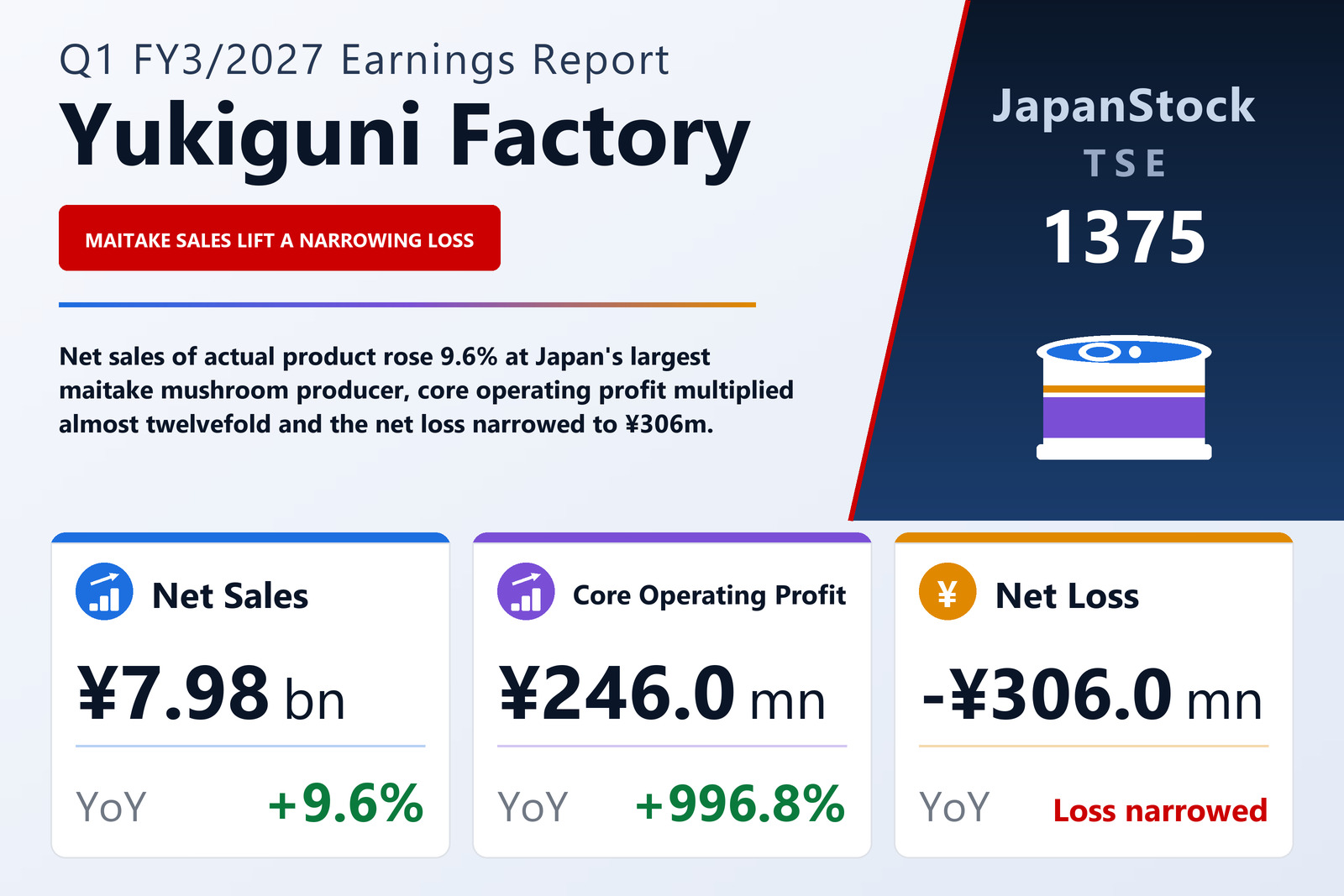
Yukiguni Factory Co., Ltd. (TSE: 1375), Japan's largest producer of maitake mushrooms, reported consolidated first-quarter results for the year to March 2027 under IFRS on August 6. Total revenue rose 15.4% to ¥10,202 million; net sales — the part of that figure representing actual product sold to customers — climbed 9.6% to ¥7,983 million. The operating loss narrowed to ¥433 million from ¥719 million a year earlier, the loss before tax to ¥471 million from ¥736 million, and the loss attributable to owners of the parent more than halved to ¥306 million from ¥636 million. Basic loss per share improved to ¥7.70 from ¥15.95. Core operating profit, the group's preferred underlying measure, multiplied almost twelvefold to ¥246 million. Neither the full-year earnings forecast nor the dividend forecast was revised, and the company disclosed no material subsequent events.
Two top lines: ¥10,202 million of revenue, ¥7,983 million of sales
Yukiguni Factory reports two different top-line numbers and they are not interchangeable. Net sales of ¥7,983 million is what the group actually sold to customers in the three months to June 30. Total revenue of ¥10,202 million is that figure plus ¥2,218 million of fair-value gains on mushrooms still growing in the company's cultivation houses.
In plain terms: IAS 41 "Agriculture" treats a mushroom in cultivation as a biological asset and requires it to be carried at fair value less costs to sell from the moment cultivation begins until harvest. As the crop grows its measured value rises, and that unrealised increase is booked as revenue before anything has been sold. When the mushrooms are then harvested and sold, the accumulated amount is charged back out through cost of sales. That is why cost of sales carried ¥2,963 million of IAS 41 fair-value amounts this quarter, up 20.6% from ¥2,457 million, against the ¥2,218 million added to revenue — a net drag of ¥745 million on operating profit. Stripping the IAS 41 element out, the underlying cost of sales — materials, personnel and similar costs on goods actually sold, which the company discloses voluntarily for comparability with peers — was ¥5,465 million against ¥4,952 million, within a total cost of sales of ¥8,429 million.
The practical consequence for a reader is that total revenue grew 15.4% and net sales 9.6%, and the entire gap between those two growth rates is a measurement of unsold crop in the growing rooms rather than commercial momentum. Every segment figure the company discloses, and the core EBITDA margin, is calculated on net sales, not on total revenue.
Every product line grew — but maitake grew on volume alone
Net sales in the Mushroom business segment rose 9.2% to ¥7,873 million, with all four product lines ahead of the prior year.
Maitake, the group's flagship, contributed ¥3,947 million, up 11.4% — but the composition matters: the average selling price fell year on year and the gain came entirely from higher volume. The company has been pushing seasonal in-store displays and a wider range of recipe suggestions to broaden usage occasions, and rolled out a new standard product built from large cuts of its premium whole-cluster "Kiwami" maitake as part of a push on shelf share and premium branding. Eryngii (king oyster) sales rose 5.0% to ¥949 million, with both volume and unit price above the prior year, helped by a pack range running from small to large and by convenience-oriented pre-sliced products. Bunashimeji (brown beech) rose 4.2% to ¥1,756 million, again on both higher volume and higher price; here the company built its plan around single-cluster packs and steady pricing, watching the fresh-produce market and switching in differently sized twin-cluster packs as supply and demand shifted. Other mushrooms grew fastest of the four, up 13.4% to ¥1,219 million, with button mushrooms benefiting from stable production and quality plus promotional support, and honshimeji, hatakeshimeji and the mushrooms and exotic mushrooms handled by the group's overseas subsidiaries all adding sales.
Outside mushrooms, the Other segment — chiefly health foods and a culture-medium activator — grew 48.5% to ¥110 million from a small base, the steepest percentage gain anywhere in the group.
The mushroom segment's loss more than halves
On the segment result line, which the company reports on an operating-profit basis, the Mushroom business narrowed its loss to ¥420 million from ¥720 million and the Other segment to ¥14 million from ¥32 million, for a combined segment loss of ¥435 million against ¥753 million. Adjustments — the line that carries corporate costs not allocated to segments — contributed a positive ¥1 million this year against a positive ¥34 million last year, producing the reported operating loss of ¥433 million. There are no inter-segment sales.
Below the operating line, finance income fell to ¥9 million from ¥44 million and finance costs eased to ¥48 million from ¥61 million, taking the loss before tax to ¥471 million. An income tax benefit of ¥164 million, against ¥95 million a year earlier, brought the quarterly loss down to ¥306 million — all of it attributable to owners of the parent, since the group no longer carries non-controlling interests, which had absorbed ¥4 million of the prior-year loss.
Core operating profit multiplies almost twelvefold
Because the IAS 41 swings can obscure the underlying business, management directs investors to a set of non-IFRS measures. Core operating profit strips out the IAS 41 fair-value impact, other income and expenses such as impairment losses and fixed-asset retirement losses, and any temporary items; core EBITDA then adds back depreciation and amortisation. On that basis the quarter reads considerably better than the headline loss suggests. Core operating profit came in at ¥246 million against ¥22 million a year earlier — a rise of 996.8%, or close to twelve times — and core EBITDA rose 44.4% to ¥831 million, reflecting ¥587 million of depreciation and amortisation against ¥555 million a year earlier. The core EBITDA margin, measured against net sales, widened to 10.4% from 7.9%. The company notes that no temporary gains or losses arose in either the current or the prior-year quarter, so the year-on-year comparison of these measures is uncontaminated by one-offs. It also cautions that these are not IFRS-defined metrics, are calculated differently by peers, and should not be treated as substitutes for the statutory figures.
A build-out in research and new-business capability
The quarter also captured the effect of a sequence of organisational moves aimed at extending the group beyond its core mushroom operation. On November 1, 2025 the Research and Development Office was upgraded into a full Research and Development Division, concentrating investment in research intended to create new value. On April 1, 2026 — the first day of the quarter under review — the company established a Business Development Division, charged with opening markets for new businesses and processed foods and with creating new business models. And in July 2026, just after the quarter closed, the group opened a new research base in the Kanto region called Kinoko Mirai Lab, intended to deepen collaboration with customers, universities and other research institutions and to speed up its response to market needs. Management frames all three as part of securing medium- to long-term growth at a time when persistent price inflation, currency volatility and geopolitically driven swings in energy costs continue to feed through into raw-material prices.
Guidance and dividend held; the year's profit is back-end loaded
Yukiguni Factory left its full-year forecasts for the year to March 2027 unchanged from the guidance published on May 11, 2026. It expects total revenue of ¥56,910 million (up 6.5%), operating profit of ¥4,140 million (down 4.1%), profit before tax of ¥3,950 million (down 5.8%) and profit attributable to owners of the parent of ¥2,540 million (down 14.1%), for basic earnings per share of ¥63.69. On the reference measures, net sales are guided to ¥39,640 million (up 4.7%), core operating profit to ¥3,960 million (down 4.3%) and core EBITDA to ¥6,450 million (up 0.4%), for a core EBITDA margin of 16.3%. The contrast with the June quarter is stark: delivering ¥4,140 million of full-year operating profit after a ¥433 million first-quarter loss requires roughly ¥4,573 million from the remaining nine months — a reminder of how heavily mushroom demand, and therefore this company's earnings, concentrates in the colder half of the year. The dividend forecast was likewise unchanged at ¥5.00 at the interim and ¥15.00 at the year-end, ¥20.00 in total, down from the ¥23.00 paid for the year to March 2026. The company reported no material subsequent events and no going-concern issues.
A much smaller cash burn — but cash still fell ¥1,992 million
Operating activities used ¥625 million of cash, a sharp improvement on the ¥2,283 million consumed a year earlier. The main inflows were a ¥596 million release from biological assets, a ¥498 million reduction in trade and other receivables and a ¥177 million increase in trade and other payables; set against these were ¥879 million of income tax paid, a ¥589 million reduction in employee benefit liabilities and the ¥471 million pre-tax loss. Investing activities used ¥428 million, up from ¥127 million, almost entirely the ¥432 million spent on property, plant and equipment for equipment renewal in the mushroom business. Financing used ¥940 million against ¥690 million, dominated by ¥751 million of dividends paid and ¥128 million of scheduled long-term borrowing repayments. Cash and cash equivalents therefore fell ¥1,992 million over the quarter to ¥1,976 million — which still compares with ¥809 million at the same point a year ago, when the far heavier operating outflow had pulled the balance down from ¥3,903 million.
Balance sheet: assets down ¥2,400 million, equity down ¥1,057 million
Total assets fell ¥2,400 million to ¥35,286 million. Current assets dropped ¥3,071 million to ¥8,617 million, driven by the ¥1,992 million fall in cash, a ¥596 million decline in biological assets as fair-value gains unwound, and a ¥495 million reduction in trade and other receivables. Non-current assets rose ¥671 million to ¥26,669 million, mainly ¥503 million more property, plant and equipment and ¥147 million more deferred tax assets. Total liabilities fell ¥1,342 million to ¥21,573 million: current liabilities dropped ¥1,201 million to ¥10,266 million as the ¥879 million income-tax payment cleared the accrued-tax balance to just ¥1 million, employee benefit liabilities fell ¥589 million and other liabilities ¥617 million, partly offset by an ¥871 million rise in trade and other payables; non-current liabilities eased ¥141 million to ¥11,307 million on ¥126 million of scheduled borrowing repayment. Interest-bearing borrowings still total ¥15,308 million — ¥4,422 million due within a year and ¥10,886 million beyond it — against ¥1,976 million of cash.
Equity fell ¥1,057 million to ¥13,713 million, all of it attributable to owners of the parent. The statement of changes in equity sets out the movement directly: a ¥306 million quarterly loss, ¥5 million of other comprehensive income, ¥2 million of share-based payment credited to capital surplus and ¥757 million of dividends — the FY3/2026 year-end payment of ¥19.00 per share, of which ¥751 million had settled in cash by quarter-end. Retained earnings fell ¥1,064 million to ¥19,482 million. Because assets shrank alongside, the ratio of equity attributable to owners edged down only to 38.9% from 39.2%. Shares issued were unchanged at 39,910,700 with 27,878 held in treasury, and the weighted average count was 39,874,372 against 39,882,215. There were no significant changes to the scope of consolidation and no changes in accounting policies or estimates, and the quarterly consolidated financial statements were not subject to review by a certified public accountant or audit corporation.
| Metric | Q1 FY3/2027 | Q1 FY3/2026 | YoY |
|---|---|---|---|
| Total revenue (incl. IAS 41 fair-value gains) | 10,202 | 8,838 | +15.4% |
| Net sales (product actually sold) | 7,983 | 7,284 | +9.6% |
| IAS 41 fair-value gains included in revenue | 2,218 | 1,553 | +42.8% |
| IAS 41 fair-value amounts in cost of sales | 2,963 | 2,457 | +20.6% |
| Net sales — maitake | 3,947 | 3,544 | +11.4% |
| Net sales — eryngii | 949 | 904 | +5.0% |
| Net sales — bunashimeji | 1,756 | 1,685 | +4.2% |
| Net sales — other mushrooms | 1,219 | 1,075 | +13.4% |
| Net sales — Other segment | 110 | 74 | +48.5% |
| Gross profit | 1,773 | 1,428 | +24.2% |
| SG&A expenses | 2,235 | 2,183 | +2.4% |
| Operating profit / (loss) | −433 | −719 | Loss narrowed |
| Segment result — Mushroom business | −420 | −720 | Loss narrowed |
| Loss before tax | −471 | −736 | Loss narrowed |
| Loss attrib. to owners | −306 | −636 | Loss narrowed |
| Basic EPS (¥) | −7.70 | −15.95 | Loss narrowed |
| Core operating profit | 246 | 22 | +996.8% |
| Core EBITDA | 831 | 575 | +44.4% |
| Core EBITDA margin (vs net sales) | 10.4% | 7.9% | +2.5 pt |
| Operating cash flow | −625 | −2,283 | Outflow narrowed |
| Investing cash flow | −428 | −127 | Outflow wider |
| Financing cash flow | −940 | −690 | Outflow wider |
| Cash & equivalents, period end | 1,976 | 809 | +144.3% |
JapanStockPulse provides informational content only and does not constitute investment advice. Figures are taken from the company's published earnings short report and may be subject to subsequent revision.