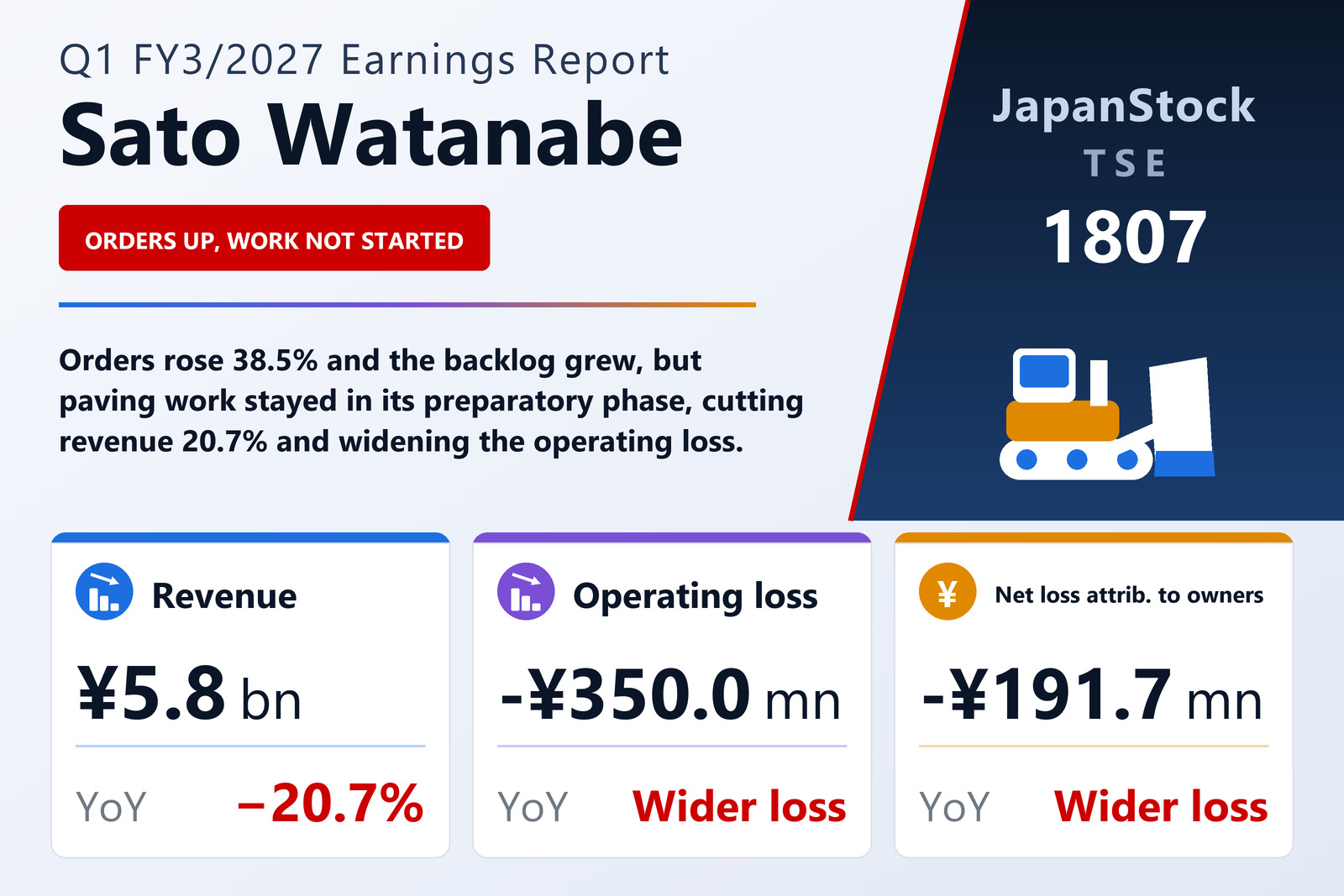
Sato Watanabe Co., Ltd. (TSE: 1807), a road-paving and civil-engineering contractor that also manufactures and sells asphalt mixture, reported consolidated results for the first quarter of the fiscal year ending March 31, 2027 (April 1 to June 30, 2026) under Japanese GAAP. Orders received climbed 38.5% to ¥7,588 million, but revenue fell 20.7% to ¥5,804 million, the operating loss widened to ¥350.0 million from ¥241.0 million, the recurring loss to ¥240.3 million from ¥105.1 million, and the net loss attributable to owners of the parent to ¥191.7 million from ¥82.2 million. The two headline figures point in opposite directions for a straightforward reason: orders are booked when contracts are awarded, while revenue is recognised as work physically progresses — and in the seasonally thinnest quarter of the year, very little of it did.
A 38.5% jump in orders, and a backlog that grew instead of shrinking
Orders reached ¥7,588 million against ¥5,480 million a year earlier, and the gain was broad across the construction business. Paving orders rose 39.8% to ¥4,837 million and civil-engineering orders 72.2% to ¥1,729 million, lifting the construction subtotal 47.1% to ¥6,567 million — 86.5% of all orders, up from 81.5%. Product sales contributed ¥1,021 million, essentially flat against ¥1,015 million. The effect on the backlog is the part worth watching: work in hand carried forward closed the quarter at ¥16,406 million, up 8.8% year on year and ¥1,860 million above the ¥14,546 million the group started the year with. That reverses the prior-year pattern, when an opening backlog of ¥16,920 million was drawn down to ¥15,078 million over the same three months. Within the closing figure, paving accounts for ¥13,144 million and civil engineering for ¥3,261 million, the latter lifting its share to 19.9% from 14.7%.
Why revenue fell: paving and civil engineering both stalled
Management said the carried-over construction backlog entering the quarter was in line with a normal year, but the opening months were given over mainly to preparatory work ahead of full-scale construction, so progress on site stalled. The revenue split shows it plainly: paving revenue fell 21.3% to ¥3,836 million and civil-engineering revenue 33.9% to ¥946 million, taking construction revenue down 24.2% to ¥4,783 million. Gross profit fell faster than revenue, dropping 30.6% to ¥259.8 million and narrowing the gross margin to 4.5% from 5.1%. With selling, general and administrative expenses almost unchanged at ¥609.7 million against ¥615.3 million, that ¥114.6 million shortfall in gross profit passed almost entirely through to the operating line, widening the operating loss by ¥109.0 million. The pattern is structural rather than a warning signal in Japanese contracting: public works are concentrated in the January-to-March run-up to the government's fiscal year-end, which leaves April to June the thinnest stretch of the calendar for a paving specialist.
Asphalt holds its volume as construction shrinks around it
The products division was the steadier half of the business. National demand for asphalt mixture continues to trend lower, yet Sato Watanabe held production volume steady and lifted product sales fractionally, to ¥1,021 million from ¥1,015 million. The company also kept passing raw-material cost inflation through into selling prices, and gross profit on product sales finished above the prior-year quarter. Because construction revenue shrank around it, the division's share of group revenue jumped to 17.6% from 13.9% — a mix shift that flatters its weight in the group, but one that does rest on a genuine hold on volume in a declining national market. Asphalt plants carry heavy fixed costs, so keeping volume while widening the spread is what stopped the segment from amplifying the quarter's loss.
Dividend income narrows the loss; a securities mark hits comprehensive income
Below the operating line, non-operating income of ¥114.8 million — dominated by ¥82.7 million of dividend income from the group's securities portfolio — cut the ¥350.0 million operating loss down to a recurring loss of ¥240.3 million. That cushion was thinner than a year earlier, when non-operating income of ¥149.6 million included ¥128.2 million of dividends. After a ¥4.3 million gain on the sale of fixed assets and a ¥17.1 million loss on their retirement, the pre-tax loss came to ¥253.1 million; a ¥59.2 million tax credit left a net loss of ¥193.9 million, of which ¥191.7 million was attributable to owners of the parent. The larger deterioration sat below the profit line altogether: a ¥276.4 million negative revaluation of available-for-sale securities pushed comprehensive income to a loss of ¥485.9 million, against positive ¥19.7 million a year earlier.
Collections shrink the balance sheet and lift the equity ratio
Total assets fell to ¥30,620 million at June 30 from ¥32,673 million at the March year-end. Current assets dropped 8.8% to ¥16,247 million: notes and accounts receivable on completed construction fell ¥3,549 million as the previous year-end's billings were collected, while cash and deposits rose ¥1,014 million to ¥7,409 million. Non-current assets slipped 3.3% to ¥14,373 million, mostly on a ¥403 million decline in the carrying value of investment securities. Liabilities came down faster than assets, falling 13.5% in total to ¥8,435 million: current liabilities dropped 15.8% to ¥5,884 million as notes and accounts payable fell ¥505 million and accrued income taxes ¥393 million, while non-current liabilities fell 7.6% to ¥2,551 million as deferred tax liabilities of ¥192 million were extinguished entirely. Net assets eased 3.2% to ¥22,185 million, with retained earnings down ¥441 million on the dividend payment and the valuation difference on available-for-sale securities down ¥278 million. Because liabilities shrank faster than the asset base, the owners' equity ratio actually improved, to 72.1% from 69.8% — an unusually strong capital position for a contractor of this size, and the reason a quarter of this kind is comfortably absorbed.
A Hokkaido merger, a buyback, and unchanged guidance
On June 1, 2026 the company absorbed its wholly owned subsidiary Asunaro Doro Co., Ltd., a paving, civil-engineering and asphalt-mixture business, whose offices have been taken over and continue to operate as Sato Watanabe's Hokkaido Branch. Because this was a transaction under common control, the loss on extinguishment of the merged subsidiary's shares was recorded as an extraordinary loss in the parent-only accounts but is eliminated on consolidation, so there is no impact on consolidated results. Two further decisions were taken at the August 6 board meeting, after the quarter had closed. The company resolved to buy back up to 200,000 of its own shares — 3.2% of shares outstanding excluding treasury stock — for up to ¥406 million, executed on August 7 through the Tokyo Stock Exchange's off-auction ToSTNeT-3 facility, citing stronger shareholder returns and improved capital efficiency. It also resolved to absorb a second wholly owned subsidiary, machinery-rental business SW Techno Co., Ltd., effective October 1, 2026. Separately, 12,517 treasury shares were disposed of on July 24 at ¥1,803 apiece as restricted-stock compensation for four directors and five executive officers. The FY3/2027 forecast is unchanged from the figures published on May 11, 2026, and the company said it will disclose any revision as appropriate. The group continues to work through the Sato Watanabe Group Medium-Term Management Plan for fiscal 2024 to 2026, whose three basic policies are improving earning power, strengthening capital and financial strategy, and advancing ESG management. With most of the year's construction revenue still ahead of it and a backlog growing again, the first quarter says more about timing than about the trajectory of the year.
| Metric | Latest | Prior period | Change |
|---|---|---|---|
| Revenue (Q1, ¥ mn) | 5,804.1 | 7,322.3 | −20.7% |
| Cost of sales (Q1, ¥ mn) | 5,544.3 | 6,948.0 | −20.2% |
| Gross profit (Q1, ¥ mn) | 259.8 | 374.3 | −30.6% |
| SG&A expenses (Q1, ¥ mn) | 609.7 | 615.3 | −0.9% |
| Operating loss (Q1, ¥ mn) | −350.0 | −241.0 | Wider loss |
| Recurring loss (Q1, ¥ mn) | −240.3 | −105.1 | Wider loss |
| Net loss attrib. to owners (Q1, ¥ mn) | −191.7 | −82.2 | Wider loss |
| Comprehensive income (Q1, ¥ mn) | −485.9 | 19.7 | To loss |
| Orders received (Q1, ¥ mn) | 7,588 | 5,480 | +38.5% |
| Order backlog at quarter-end (¥ mn) | 16,406 | 15,078 | +8.8% |
| Total assets (¥ mn, vs. FY-end) | 30,620 | 32,673 | −6.3% |
| Net assets (¥ mn, vs. FY-end) | 22,185 | 22,920 | −3.2% |
JapanStockPulse provides informational content only and does not constitute investment advice. Figures are taken from the company's published earnings short report and may be subject to subsequent revision.