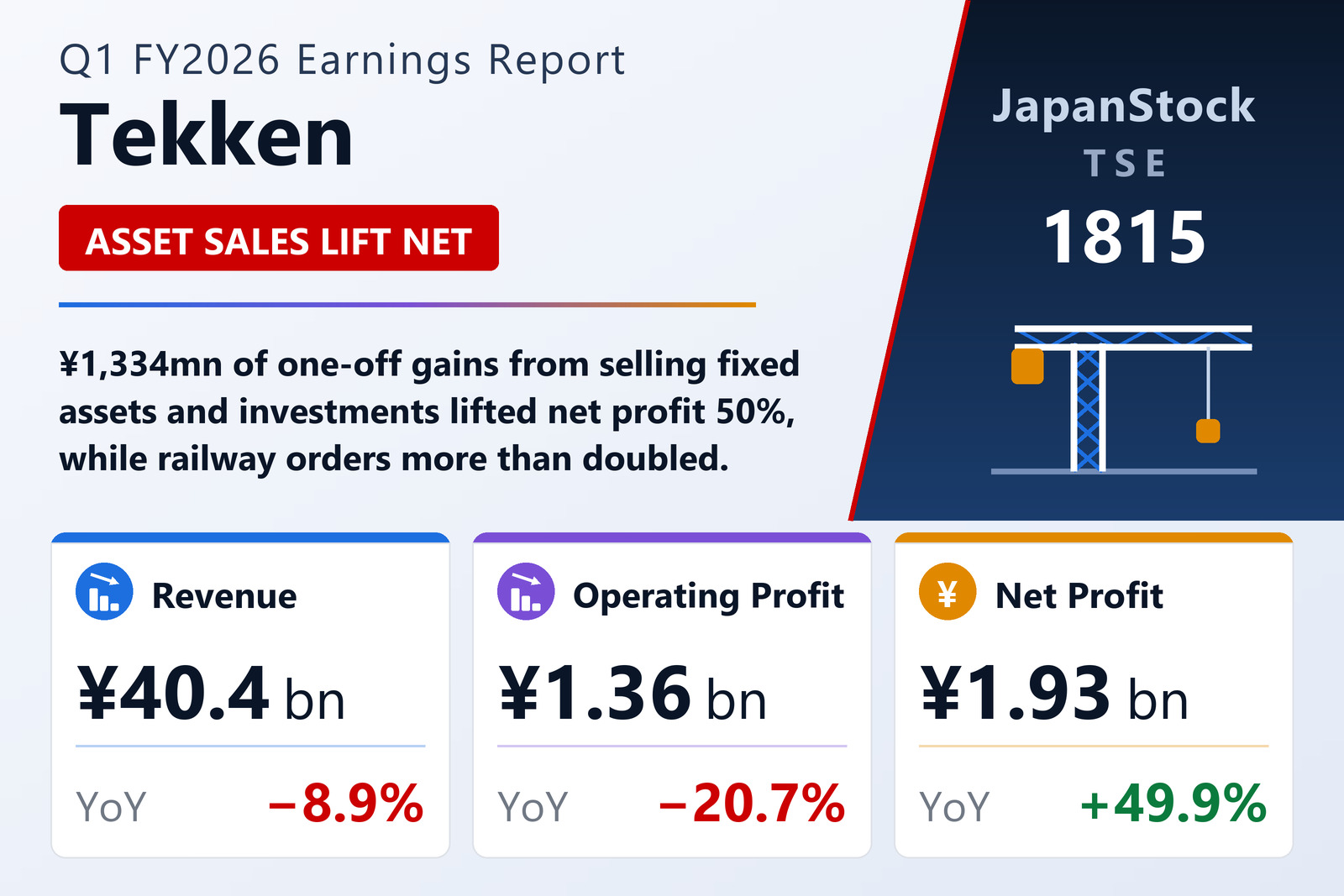
Tekken Corporation (TSE: 1815), the Tokyo-based civil engineering and building contractor whose business was built around Japan's national railway network, reported consolidated first-quarter results under Japanese GAAP on August 6. For the three months from April 1 to June 30, 2026 — the opening quarter of the fiscal year ending March 2027 — revenue fell 8.9% to ¥40,429 million, operating profit fell 20.7% to ¥1,358 million, and ordinary profit fell 20.5% to ¥1,577 million. Net profit attributable to owners of the parent nonetheless rose 49.9% to ¥1,926 million, lifting quarterly earnings per share to ¥138.32 from ¥92.29.
The divergence between falling operating profit and rising net profit is explained entirely below the ordinary-profit line. Tekken booked ¥1,334 million of extraordinary gains in the quarter — ¥840 million on the sale of fixed assets and ¥494 million on the sale of investment securities — against none at all a year earlier, while extraordinary losses shrank to ¥10 million from ¥68 million. Pre-tax profit therefore rose 51.6% to ¥2,902 million from ¥1,914 million, and after a ¥934 million tax charge (an effective rate of 32.2%) and ¥41 million attributable to non-controlling interests, the parent line landed at ¥1,926 million. Comprehensive income moved the other way, to a negative ¥109 million from a positive ¥3,075 million, because net unrealised gains on available-for-sale securities fell ¥2,067 million over the quarter.
Management attributed the revenue decline to a comparison problem rather than a demand problem: the year-earlier quarter contained the completion and handover of a large building-construction project that did not repeat. Two structural points frame the whole set of numbers. First, Tekken flags an explicit seasonal skew — because contracts concentrate completion and handover in the fourth quarter, revenue booked in the first three quarters is structurally far lighter than in the final one, so a Q1 run-rate cannot be annualised. Second, on the profit side the company said building-construction profitability improved, but that this was more than offset by the absence of a profit recognised on an overseas civil engineering contract in the prior-year quarter.
Construction margins improve even as revenue shrinks
Completed construction revenue — the core line — fell 8.1% to ¥38,792 million from ¥42,223 million, while the ancillary business contributed ¥1,637 million against ¥2,147 million. Yet construction gross profit was almost flat at ¥3,906 million against ¥3,959 million, which means the construction gross margin widened to 10.1% from 9.4% — a meaningful improvement for a Japanese contractor still absorbing higher material and labour costs. Total gross profit was ¥4,402 million against ¥4,637 million, and selling, general and administrative expenses rose to ¥3,043 million from ¥2,924 million, which is what pushed operating profit down 20.7%.
Below the operating line, non-operating income fell to ¥540 million from ¥717 million and non-operating expenses fell to ¥321 million from ¥447 million. The mix shifted: dividend income edged up to ¥476 million from ¥458 million and foreign exchange swung to a ¥45 million gain from a ¥191 million loss, but interest expense rose sharply to ¥315 million from ¥225 million — a 40% increase that reflects the Bank of Japan's rate normalisation working through roughly ¥73.1 billion of bank borrowings. Depreciation was essentially unchanged at ¥266 million against ¥267 million. No consolidated cash flow statement is prepared for the first quarter.
Civil engineering profit falls by a third; building construction nearly doubles its margin
The segment split shows where the two offsetting forces sat. Civil engineering, Tekken's largest business, held revenue almost steady at ¥21,250 million (down 2.3%) but segment profit fell 34.7% to ¥676 million from ¥1,036 million — this is where the missing overseas contract profit shows up, and the segment margin compressed to 3.2% from 4.8%. Building construction did the opposite: revenue dropped 14.3% to ¥17,541 million on the tough completion comparison, yet segment profit rose 89.4% to ¥267 million from ¥141 million, taking the margin to 1.5% from 0.7%. Real estate was the weakest line, with revenue down 28.2% to ¥1,461 million and profit down 42.1% to ¥257 million. The small ancillary and other businesses — the latter mainly insurance agency work — contributed ¥50 million and ¥106 million of profit respectively, both up strongly on tiny bases.
Railway orders more than double, but overall intake falls 27.8%
The order book is the most informative part of the disclosure, and it points in two directions at once. On a parent-company basis, total order intake fell 27.8% to ¥42,027 million from ¥58,232 million. Civil engineering orders dropped 39.5% to ¥20,249 million, driven by a 50.2% collapse in domestic public-sector work to ¥10,326 million from ¥20,747 million and a 24.3% fall in domestic private work to ¥9,901 million. Building-construction orders fell 12.1% to ¥21,777 million, with private-sector work down 13.5% to ¥21,118 million partly offset by public-sector work up 77.0% to ¥658 million.
Against that, the single most striking figure in the release is railway work. Railway-related orders more than doubled, up 106.8% to ¥30,473 million from ¥14,732 million, and their share of total intake jumped to 72.5% from 25.3%. In other words, Tekken's order book has re-concentrated hard around the rail franchise that defines the company, even as the aggregate number shrank on lumpy public-works timing. Completed construction work on a parent basis fell 9.0% to ¥38,354 million, of which the railway portion rose 12.4% to ¥16,549 million, or 43.1% of the total against 34.9% a year earlier. Overseas work continued to wind down, with completed overseas revenue down 79.0% to ¥335 million. For the full year, Tekken guides to parent-company orders of ¥180,000 million, a 19.9% decline from the exceptionally strong ¥224,734 million booked in FY March 2026, itself a 24.2% increase.
Balance sheet shrinks ¥20.8 billion as the year-end settlement cycle unwinds
Total assets fell ¥20,761 million to ¥235,145 million from ¥255,907 million at the March year-end — a routine seasonal unwind for a contractor that settles a large share of its work in the fourth quarter. Notes and accounts receivable from completed construction fell ¥10,245 million to ¥102,730 million, other current assets fell ¥3,735 million to ¥12,065 million, and cash and deposits fell ¥3,365 million to ¥21,403 million. Current assets ended at ¥155,285 million and non-current assets at ¥79,860 million, within which investment securities fell ¥3,052 million to ¥39,852 million as the company sold holdings and mark-to-market values dropped, and property, plant and equipment was ¥34,628 million.
Liabilities fell ¥18,267 million to ¥158,893 million, driven by an ¥8,372 million reduction in accounts payable–other to ¥7,143 million and a ¥4,200 million reduction in trade payables to ¥28,607 million. Short-term borrowings stood at ¥52,421 million and long-term borrowings at ¥20,652 million. Net assets fell ¥2,494 million to ¥76,251 million, almost entirely because of the ¥2,067 million decline in net unrealised gains on securities; shareholders' equity was ¥75,893 million and, because the asset base shrank faster than equity, the equity ratio actually rose to 32.3% from 30.6%. Retained earnings slipped to ¥37,400 million from ¥37,676 million as the ¥170 per share year-end dividend paid out during the quarter exceeded quarterly earnings. There were no changes to the scope of consolidation, no changes in accounting policy, and the quarterly statements were not subject to audit review.
Full-year guidance left unchanged
Tekken kept the consolidated guidance it issued on May 14, 2026 completely intact, saying first-quarter performance was broadly within expectations. For the year to March 2027 it targets revenue of ¥185,000 million (+2.9%), operating profit of ¥6,600 million (+17.4%), ordinary profit of ¥5,700 million (−3.0%) and net profit attributable to owners of ¥6,300 million (+25.3%). Note the unusual shape: guided ordinary profit sits below guided operating profit, implying the company expects net non-operating costs for the year as interest expense keeps climbing — the reverse of the first quarter, when non-operating items added ¥219 million. First-quarter progress was 21.9% of the revenue target, 20.6% of operating profit, 27.7% of ordinary profit and 30.6% of net profit; given the fourth-quarter completion skew, those ratios are consistent with plan rather than ahead of it.
A two-for-one stock split on October 1 rebases the dividend and EPS figures
The most consequential item for shareholders is a corporate action decided at a July 14 board meeting and disclosed here as a material subsequent event. Tekken will split each ordinary share into two, effective October 1, 2026, with a record date of September 30. Shares outstanding rise from 14,973,956 to 29,947,912, and the articles of incorporation will be amended to lift authorised shares from 29,847,600 to 59,695,200. Share capital is unchanged, and share-based compensation points for directors will be adjusted at the same ratio. The stated purpose is to lower the investment unit price, improve liquidity and broaden the shareholder base.
Because of the split, two guidance figures must be read carefully. The FY March 2027 year-end dividend forecast of ¥115.00 per share is a post-split figure. Against the ¥170.00 paid for FY March 2026 that looks like a 32% cut; on a like-for-like pre-split basis the forecast is ¥230.00, a 35.3% increase. Tekken pays no interim dividends, so ¥115.00 is also the full-year total. The same applies to the earnings-per-share guidance of ¥226.12, which equates to ¥452.23 before the split. For reference, had the split been applied from the start of the prior year, first-quarter EPS would read ¥69.16 this year against ¥46.15 last year. At the June 30 balance sheet date the company held 1,043,054 treasury shares, and the weighted average share count for the quarter was 13,930,914.
| Metric | Q1 FY3/2027 | Q1 FY3/2026 | YoY |
|---|---|---|---|
| Revenue (¥ million) | 40,429 | 44,370 | −8.9% |
| Completed construction revenue (¥ million) | 38,792 | 42,223 | −8.1% |
| Gross profit (¥ million) | 4,402 | 4,637 | −5.1% |
| Operating profit (¥ million) | 1,358 | 1,712 | −20.7% |
| Ordinary profit (¥ million) | 1,577 | 1,983 | −20.5% |
| Pre-tax profit (¥ million) | 2,902 | 1,914 | +51.6% |
| Net profit attrib. to owners (¥ million) | 1,926 | 1,285 | +49.9% |
| Earnings per share (¥) | 138.32 | 92.29 | +49.9% |
| Comprehensive income (¥ million) | −109 | 3,075 | To loss |
| Total assets (¥ million, vs Mar 31, 2026) | 235,145 | 255,907 | −8.1% |
| Net assets (¥ million, vs Mar 31, 2026) | 76,251 | 78,746 | −3.2% |
| Equity ratio (%) | 32.3 | 30.6 | +1.7 pp |
| Segment | Revenue (¥ million) | YoY | Segment profit (¥ million) | Prior-year profit (¥ million) |
|---|---|---|---|---|
| Civil engineering | 21,250 | −2.3% | 676 | 1,036 |
| Building construction | 17,541 | −14.3% | 267 | 141 |
| Real estate | 1,461 | −28.2% | 257 | 444 |
| Ancillary businesses | 66 | +106.3% | 50 | 13 |
| Other | 109 | +36.3% | 106 | 78 |
| Consolidated | 40,429 | −8.9% | 1,358 | 1,712 |
JapanStockPulse provides informational content only and does not constitute investment advice. Figures are taken from the company's published earnings short report and may be subject to subsequent revision.