A margin quarter, not a volume quarter
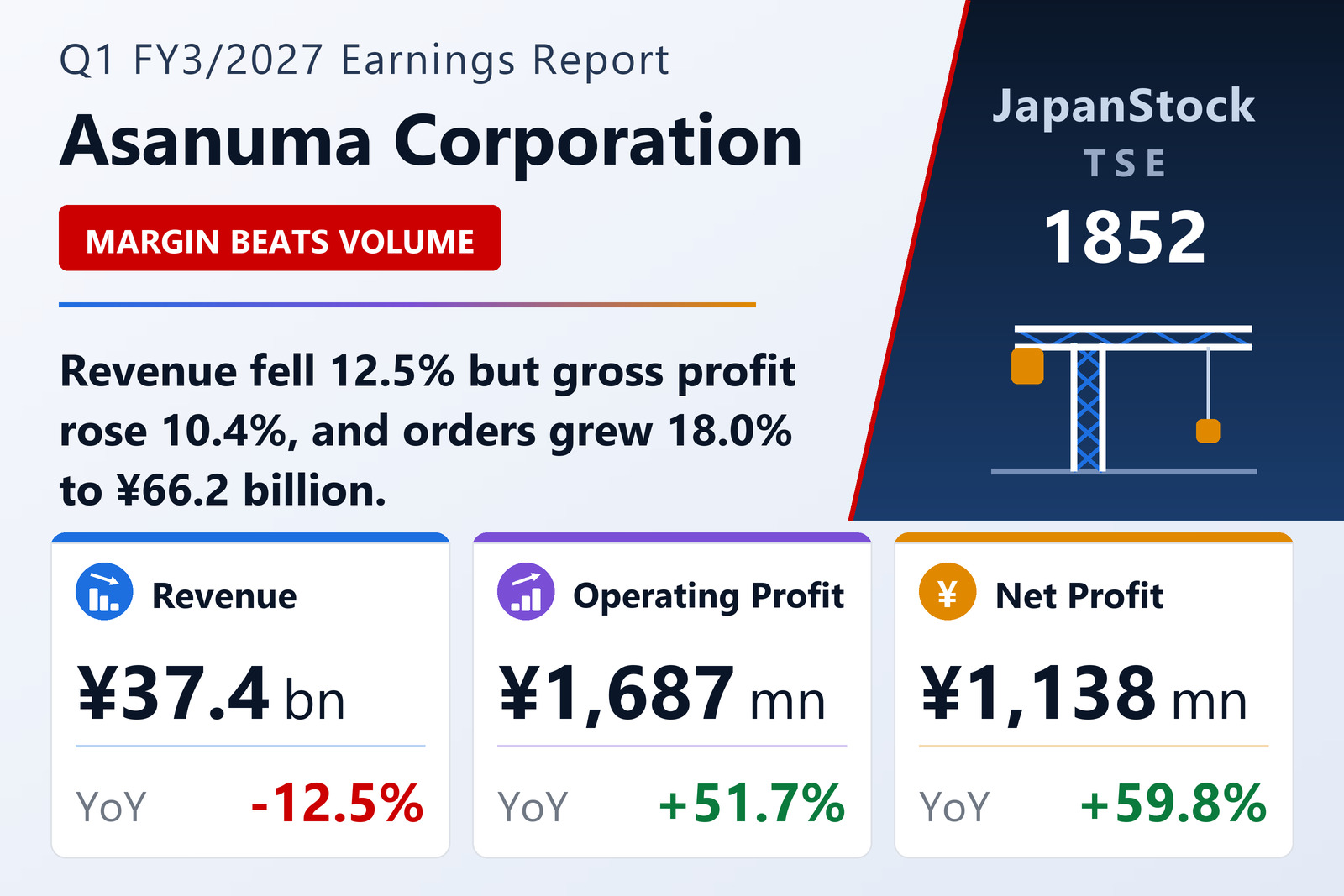
Asanuma Corporation (TSE: 1852), the Osaka-headquartered general contractor that builds under two reporting segments — Building and Civil Engineering — published consolidated results for the first quarter of FY3/2027, the three months from April 1 to June 30, 2026, under Japanese GAAP on August 6, 2026. Revenue fell 12.5% to ¥37,369 million from ¥42,707 million. Every line below it went the other way: gross profit up 10.4%, operating profit up 51.7%, ordinary profit up 56.9%, net profit attributable to owners of parent up 59.8%. The revenue decline is also a base effect — the year-ago quarter had itself grown 32.7%.
The whole gap between a shrinking top line and a surging operating line opens up in two places, and both are small in absolute terms. Gross profit rose to ¥4,421 million from ¥4,005 million, an increase of ¥416 million, which on 12.5% less revenue means the gross margin widened to 11.83% from 9.38% — 2.45 percentage points. Selling, general and administrative expenses then fell 5.5%, to ¥2,734 million from ¥2,893 million, releasing another ¥159 million. Add the two and you have the entire ¥575 million operating-profit gain that took the line to ¥1,687 million from ¥1,112 million. The operating margin reached 4.51% against 2.60%.
For a general contractor that is the shape of a better order book working through the profit-and-loss account rather than a bigger one. Construction revenue is recognised as work progresses, so the mix of jobs being executed this quarter was set by bids won in earlier periods; a 2.45-point margin gain says those jobs carry better terms than the ones they replaced, at a moment when the industry is passing through crude-oil-driven cost inflation.
Below the operating line the movements are modest but all favourable. Non-operating income rose to ¥116 million from ¥103 million, non-operating expenses fell to ¥100 million from ¥130 million, and within them interest expense eased to ¥73 million from ¥84 million — together lifting ordinary profit to ¥1,703 million, growth of 56.9% against operating profit's 51.7%. Extraordinary items were immaterial, so pre-tax profit of ¥1,705 million is effectively the ordinary line. Tax of ¥565 million represents an effective rate of 33.1% against 34.1% a year earlier, and its composition is worth noting: only ¥72 million was current tax, with ¥492 million a deferred charge — which is the income-statement counterpart of the ¥399 million reduction in deferred tax assets visible on the balance sheet. After ¥1 million to non-controlling interests, net profit attributable to owners of parent was ¥1,138 million, and earnings per share ¥14.10 against ¥8.84.
Comprehensive income of ¥1,085 million rose 80.3% — faster than net profit — because the drag from other comprehensive income shrank rather than because anything operational improved. Other comprehensive income was negative ¥54 million against negative ¥113 million: a ¥232 million valuation loss on available-for-sale securities (a ¥189 million gain a year earlier) was more than offset by a ¥118 million positive currency translation adjustment, where the prior-year quarter had carried a ¥348 million negative swing.
Building drove the profit; the revenue mix shifted to public work
Building, which is roughly four-fifths of the group, is where both halves of the story sit. Its revenue fell 15.4% to ¥29,999 million from ¥35,440 million — a steeper decline than the group's — yet segment profit rose 12.1% to ¥3,439 million from ¥3,069 million. That is a segment margin of 11.46% against 8.66%, a 2.80-point improvement that on its own accounts for essentially all of the group's gross-margin gain.
Civil Engineering was flat on revenue at ¥6,489 million, down 0.1% from ¥6,495 million, with segment profit up 8.8% to ¥758 million from ¥697 million — a margin of 11.68% against 10.73%. The small "Other" category, which holds maintenance and real estate, produced revenue of ¥880 million, up 14.2%, and segment profit of ¥155 million, which the company describes as up 125.3%. Combined segment profit was ¥4,353 million against ¥3,835 million, up 13.5%, and the unallocated corporate expense that reconciles it to the consolidated operating line was ¥2,665 million against ¥2,723 million — down 2.1%, so the overhead base held broadly steady while segment profit grew.
The customer mix underneath consolidated revenue moved sharply, and in the opposite direction to the order book discussed below. Revenue from government customers rose 26.2% to ¥7,811 million from ¥6,191 million, while revenue from private customers fell 20.6% to ¥26,868 million from ¥33,849 million. Overseas revenue was essentially flat at ¥2,688 million against ¥2,665 million. The 12.5% group decline is therefore entirely a private-sector construction-in-progress phenomenon; the public-works side of the business was busier, not quieter.
Orders up 18% — and almost entirely private
The forward book grew while revenue shrank. Consolidated orders received reached ¥66,241 million, up 18.0%, made up of ¥63,101 million in Building, up 23.4%, and ¥3,140 million in Civil Engineering, down 37.1%. Because Building orders now stand at more than twice the segment's quarterly revenue, the mismatch between the two is the single most useful number in this filing: work is being booked faster than it is being burned.
The parent-only supplementary disclosure shows what changed underneath. Non-consolidated orders were ¥64,223 million, up 16.4% from ¥55,162 million, and the split by customer is dramatic. Orders from government customers collapsed 69.0% to ¥2,470 million from ¥7,970 million, while orders from private customers rose 30.9% to ¥61,752 million from ¥47,192 million. Within Building, government orders fell 72.8% to ¥1,798 million while private orders rose 36.9% to ¥59,644 million, taking the segment to ¥61,442 million, up 22.4%. Civil Engineering lost ground on both sides: government orders down 50.4% to ¥672 million and private orders down 41.8% to ¥2,108 million, for a segment total of ¥2,780 million, down 44.2%.
The result is a book that is now 96.2% private against 85.6% a year earlier, with the government share down to 3.8% from 14.4%. That concentration cuts both ways. Private building work is where the margin improvement described above is coming from, and management notes that private construction investment has been solid as housing recovered from the previous year's reaction and non-residential kept growing. But it also means the group's near-term intake is now tied to corporate capital-expenditure appetite at a point when the company itself flags supply-chain disruption and crude-oil-driven construction-cost inflation as reasons that appetite could be restrained.
One number sets expectations for the rest of the year. Asanuma's own parent-only order forecast for FY3/2027 is ¥156,000 million, a 25.1% decline from the ¥208,197 million booked in FY3/2026, which had itself grown 23.0%. The ¥64,223 million taken in the first quarter is 41.2% of that full-year forecast — so on the company's own plan, order intake is expected to slow markedly from here rather than compound at first-quarter rates.
A Singapore painting business joins the group
FY2026 is the third and final year of Asanuma's Three-Year Medium-Term Plan (FY2024–FY2026), which is organised around six focus themes. Two of them produced concrete action in the quarter.
Under "strengthening the renovation business" — and specifically its stated sub-goal of strengthening renovation across ASEAN — the board resolved on May 19, 2026 to buy T3 International Pte. Ltd., a Singapore company that carries out exterior- and interior-wall painting of buildings, and completed the share purchase on June 16, 2026. Asanuma took 80.0% of the voting rights for cash consideration of S$8,000 thousand, with advisory and related fees of approximately ¥82 million.
The accounting matters for anyone reading the profit lines above. The deemed acquisition date is April 1, 2026, but only the balance sheet has been consolidated for this quarter, so none of the acquired company's results appear in the first-quarter income statement. Assets taken on totalled ¥1,265 million (¥1,206 million current, ¥58 million non-current) against liabilities of ¥177 million (¥166 million current, ¥10 million non-current), and provisional goodwill of ¥119 million arose, attributed mainly to the excess earning power expected from future business development. Because the purchase-price allocation is not yet complete, that goodwill figure is provisional and the amortisation period will only be fixed once the allocation is refined. Two balance-sheet lines carry the trace: goodwill rose ¥87 million to ¥766 million from ¥679 million — broadly the ¥119 million added net of the ¥43 million of goodwill amortisation charged in the quarter — and non-controlling interests rose to ¥670 million from ¥446 million, the 20% of T3 that stayed with its sellers.
The second move sits under "strengthening the domestic core business" and "promoting DX": the group has decided to consolidate the multiple systems and paper-based processes used on its construction sites onto a single common platform, and is rolling that out to all sites during FY2026. It is the kind of initiative whose payoff, if it arrives, shows up in exactly the line that improved this quarter — site-level cost of construction.
A smaller balance sheet with a stronger equity ratio
Total assets fell 8.1% in three months, to ¥108,641 million at June 30, 2026 from ¥118,176 million at March 31. Current assets fell 9.0% to ¥89,672 million, and one line explains it: notes and accounts receivable from completed construction contracts fell ¥13,205 million to ¥55,265 million as the group collected on work completed at the March year-end. Cash and deposits absorbed part of that, rising ¥3,660 million to ¥27,550 million. Non-current assets fell 3.2% to ¥18,969 million on a ¥336 million decline in investment securities and the ¥399 million reduction in deferred tax assets already noted.
The other side of the collection cycle is on the liability side. Total liabilities fell 12.5% to ¥59,466 million. Current liabilities fell 16.3% to ¥42,731 million, chiefly a ¥4,965 million reduction in accounts payable for construction contracts, to ¥17,367 million, and a ¥3,405 million fall in accrued consumption tax. Non-current liabilities were near-flat, down 1.0% to ¥16,735 million on a ¥123 million decline in net defined benefit liability; bonds stood unchanged at ¥390 million and long-term borrowings at ¥12,395 million against ¥12,473 million.
Net assets fell 2.1% to ¥49,174 million, and here the driver is the dividend rather than the result. Retained earnings dropped ¥1,202 million despite the ¥1,138 million earned, because the ¥29.00 year-end dividend declared for FY3/2026 — roughly ¥2.34 billion on 80.7 million shares — was paid out during the quarter. Shareholders' equity ended at ¥48,504 million against ¥49,759 million.
The equity ratio nonetheless improved to 44.6% from 42.1%. That is not a strengthening of the capital base — equity fell 2.5% — but an arithmetic consequence of the asset side contracting 8.1%, more than three times as fast. A ratio that rises because the denominator shrank on a working-capital swing will reverse just as mechanically when receivables rebuild during the year, and it should be read that way. No quarterly cash-flow statement is prepared; depreciation for the quarter was ¥208 million against ¥229 million.
Guidance and dividend both held
Asanuma left its FY3/2027 full-year forecast unchanged from the figures published on May 13, 2026: revenue of ¥175,500 million, up 0.1%; operating profit of ¥7,780 million, up 7.9%; ordinary profit of ¥7,530 million, up 6.8%; and net profit attributable to owners of parent of ¥5,180 million, down a rounded 0.0%, for EPS of ¥64.22.
Measured against those targets the first quarter delivered 21.3% of guided revenue and 21.7% of guided operating profit, with 22.6% of ordinary profit and 22.0% of net profit — all a shade ahead of a straight-line quarter, though for a contractor whose revenue is back-weighted toward the fiscal year-end that is a weak signal on its own. More telling is the margin implied by the unchanged plan: full-year guidance embeds an operating margin of 4.43%, slightly below the 4.51% just delivered, so management is not yet extrapolating this quarter's profitability across the year. Holding the forecast after a 51.7% operating-profit gain is a deliberately conservative stance.
The dividend is likewise held at an annual ¥45.00 per share for FY3/2027, matching FY3/2026, although the split moves forward: ¥17.00 at the interim and ¥28.00 at the year-end, against ¥16.00 and ¥29.00. On guided EPS of ¥64.22 that is a payout ratio of roughly 70%, a demanding level that leaves the distribution dependent on the full-year forecast being met.
On the environment, the company describes a Japanese economy in gradual recovery, with firm corporate earnings and improving employment and income conditions, set against continuing inflation, unstable resource and energy prices and heightened geopolitical risk including the Middle East. In construction specifically, public investment held firm on national-resilience policy while private investment was solid — the backdrop that produced a 30.9% rise in private orders and a 69.0% collapse in public ones at the parent level, a mix shift that will define what this book converts into over the remaining three quarters.
| Metric | Q1 FY3/2027 | Q1 FY3/2026 | Change |
|---|---|---|---|
| Orders received (¥ million) | 66,241 | — | +18.0% |
| Revenue (¥ million) | 37,369 | 42,707 | −12.5% |
| Gross profit (¥ million) | 4,421 | 4,005 | +10.4% |
| Gross margin | 11.83% | 9.38% | +2.45 pt |
| SG&A expenses (¥ million) | 2,734 | 2,893 | −5.5% |
| Operating profit (¥ million) | 1,687 | 1,112 | +51.7% |
| Operating margin | 4.51% | 2.60% | +1.91 pt |
| Ordinary profit (¥ million) | 1,703 | 1,085 | +56.9% |
| Net profit attrib. to owners of parent (¥ million) | 1,138 | 712 | +59.8% |
| Comprehensive income (¥ million) | 1,085 | 602 | +80.3% |
| EPS (¥) | 14.10 | 8.84 | +59.5% |
| Building — orders received (¥ million) | 63,101 | — | +23.4% |
| Building — revenue (¥ million) | 29,999 | 35,440 | −15.4% |
| Building — segment profit (¥ million) | 3,439 | 3,069 | +12.1% |
| Civil engineering — orders received (¥ million) | 3,140 | — | −37.1% |
| Civil engineering — revenue (¥ million) | 6,489 | 6,495 | −0.1% |
| Civil engineering — segment profit (¥ million) | 758 | 697 | +8.8% |
| Other — revenue (¥ million) | 880 | 771 | +14.2% |
| Other — segment profit (¥ million) | 155 | 68 | +125.3% |
| Unallocated corporate expense (¥ million) | −2,665 | −2,723 | −2.1% |
| Parent-only orders received (¥ million) | 64,223 | 55,162 | +16.4% |
| Parent-only orders — government (¥ million) | 2,470 | 7,970 | −69.0% |
| Parent-only orders — private (¥ million) | 61,752 | 47,192 | +30.9% |
| Total assets (¥ million) | 108,641 | 118,176 | −8.1% |
| Net assets (¥ million) | 49,174 | 50,205 | −2.1% |
| Shareholders' equity (¥ million) | 48,504 | 49,759 | −2.5% |
| Equity ratio | 44.6% | 42.1% | +2.5 pt |
| FY3/2027 guidance — revenue (¥ million) | 175,500 | — | +0.1% |
| FY3/2027 guidance — operating profit (¥ million) | 7,780 | — | +7.9% |
| FY3/2027 guidance — ordinary profit (¥ million) | 7,530 | — | +6.8% |
| FY3/2027 guidance — net profit (¥ million) | 5,180 | — | −0.0% |
| FY3/2027 guidance — EPS (¥) | 64.22 | — | — |
| Annual dividend per share (¥) | 45.00 | 45.00 | unchanged |
JapanStockPulse provides informational content only and does not constitute investment advice. Figures are taken from the company's published earnings short report and may be subject to subsequent revision.