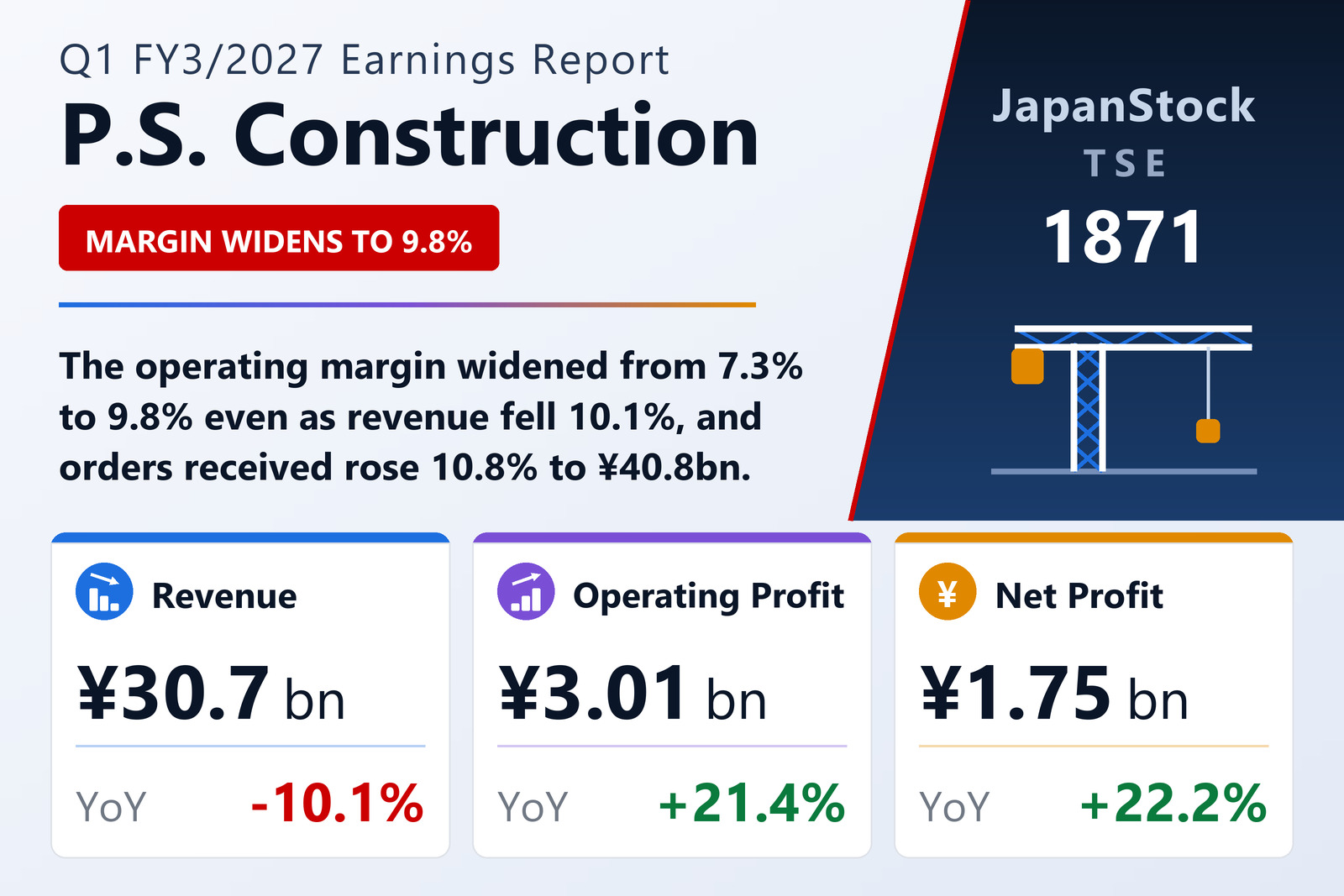
P.S. Construction Co., Ltd. (TSE: 1871), the prestressed-concrete specialist formerly known as P.S. Mitsubishi Construction, released consolidated first-quarter results for the year to March 2027 on August 6 under Japanese GAAP. Revenue fell 10.1% to ¥30,665 million against an unusually strong year-earlier quarter that had itself grown 7.7%, yet every profit line moved higher: operating profit rose 21.4% to ¥3,012 million, recurring profit 16.0% to ¥2,873 million and net profit attributable to owners of the parent 22.2% to ¥1,752 million. Basic earnings per share came to ¥37.43 against ¥30.67, and comprehensive income jumped 43.5% to ¥2,336 million. The single most telling number is the margin: operating profitability widened from 7.3% to 9.8%, so the group earned more money on roughly ¥3.5 billion less work.
Margins do the heavy lifting as civil engineering profit jumps 25%
Civil Engineering, the group’s largest reporting segment and the home of its prestressed-concrete bridge and infrastructure business, turned over ¥17.0 billion, down 10.4%, but lifted segment profit 25.4% to ¥3.8 billion. Building Construction generated ¥11.7 billion of revenue, down 16.4%, with segment profit essentially flat at ¥1.2 billion (–0.7%). The Affiliated Companies segment was the only unit to grow its top line, up 29.0% to ¥4.6 billion with profit 12.1% higher at ¥0.9 billion, while the residual Other segment contributed ¥0.1 billion. Segment profit is struck before unallocated corporate costs and inter-segment eliminations, which is why the parts sum to more than group operating profit. The comparatives are also not quite like-for-like: on April 1, 2026 the company absorbed its consolidated subsidiary P.S. Concrete Co., Ltd. by merger, and that business, previously reported inside Affiliated Companies, has been redistributed into Civil Engineering and Building Construction according to its content, with prior-year segment percentages recalculated on the new basis. Management described a construction market in which demand held firm — private capital expenditure and infrastructure work in particular — against persistently high materials prices, supply constraints on construction materials, rising labour unit costs and a continuing shortage of skilled construction workers.
Orders received climb 10.8% to ¥40.8 billion
The most forward-looking figure in the release moved the right way. Orders received in the three months totalled ¥40.8 billion, up 10.8% year on year and comfortably ahead of the ¥30.7 billion of revenue recognised — a book-to-bill ratio of roughly 1.33, meaning the quarter added to the work in hand rather than drawing it down. For a contractor that books revenue as construction progresses, the gap between intake and output is a more reliable guide to the next several quarters than the reported top line, which largely reflects projects won in earlier periods. The company said it continued to execute the initiatives set out in its Medium-Term Management Plan 2025, which runs from fiscal 2025 through fiscal 2027.
Balance sheet: receivables collected, borrowings trimmed, equity ratio up to 46.9%
Total assets ended the quarter at ¥137,165 million, ¥5.2 billion lower than at the March 2026 year-end. Current assets fell ¥5.8 billion to ¥107.8 billion, dominated by a ¥15.9 billion reduction in notes receivable, accounts receivable from completed construction contracts and contract assets, plus a ¥1.8 billion fall in accrued income — the seasonal unwinding of the March completion peak. Non-current assets edged up ¥0.5 billion to ¥29.3 billion, chiefly on a ¥0.7 billion increase in investment securities. On the funding side, current liabilities dropped ¥4.4 billion to ¥56.1 billion, with trade payables on construction contracts down ¥2.4 billion and short-term borrowings down ¥1.6 billion; non-current liabilities rose ¥0.3 billion to ¥16.7 billion, leaving total liabilities ¥4.0 billion lower at ¥72.8 billion. Net assets slipped ¥1.2 billion to ¥64,280 million as retained earnings fell ¥1.7 billion, the year-end dividend payment outweighing the quarter’s profit, so book value per share eased to ¥1,372.94 from ¥1,398.68. Because liabilities shrank faster than equity, the equity ratio improved to 46.9% from 46.0%. No consolidated cash-flow statement is prepared for the first quarter, and the quarterly financial statements were not subject to review by a certified public accountant or audit corporation.
Guidance unchanged at ¥142.6 billion; the dividend is rebalanced to ¥101
P.S. Construction left untouched the full-year forecast it published on May 14, 2026: revenue of ¥142,600 million (–4.5%), operating profit of ¥10,800 million (–16.5%), recurring profit of ¥10,600 million (–16.6%) and net profit of ¥7,800 million (–16.4%), for earnings per share of ¥166.67. Against that, the first quarter delivered 21.5% of the revenue target but 27.9% of the operating-profit target and 22.5% of the net-profit target, so the unchanged guidance implicitly assumes margins narrow over the balance of the year rather than holding at the first quarter’s 9.8%. The dividend plan is likewise unchanged, though its shape has shifted: after paying ¥40.00 at the interim and ¥80.00 at the year-end for a ¥120.00 total in FY3/2026, the company intends to pay ¥50.50 at each of the interim and the year-end in FY3/2027, for ¥101.00 a year — a lower annual figure but a materially larger first-half payment. Two changes to the consolidation perimeter took effect during the quarter: Toyo Seisakusho Co., Ltd. joined the group and P.S. Concrete Co., Ltd. left it on absorption into the parent. Shares issued stood at 47,486,029 with 666,593 held in treasury, and the weighted-average count used for per-share figures was 46,819,442, excluding 574,548 shares held by an officer-remuneration BIP trust.
| Metric | Q1 FY3/2027 | Q1 FY3/2026 | YoY |
|---|---|---|---|
| Revenue (¥ billion) | 30.67 | 34.12 | -10.1% |
| Operating profit (¥ billion) | 3.01 | 2.48 | +21.4% |
| Operating margin (%) | 9.8 | 7.3 | +2.5pt |
| Recurring profit (¥ billion) | 2.87 | 2.48 | +16.0% |
| Net profit attrib. to owners (¥ billion) | 1.75 | 1.43 | +22.2% |
| Basic EPS (¥) | 37.43 | 30.67 | +22.0% |
| Comprehensive income (¥ billion) | 2.34 | 1.63 | +43.5% |
| Orders received (¥ billion) | 40.8 | 36.8 | +10.8% |
| Total assets (¥ billion, vs FY3/2026 year-end) | 137.17 | 142.46 | -3.7% |
| Net assets (¥ billion, vs FY3/2026 year-end) | 64.28 | 65.49 | -1.8% |
| Equity ratio (%, vs FY3/2026 year-end) | 46.9 | 46.0 | +0.9pt |
| FY3/2027 operating profit guidance (¥ billion) | 10.80 | 12.94 | -16.5% |
| FY3/2027 annual dividend forecast (¥) | 101.00 | 120.00 | -15.8% |
JapanStockPulse provides informational content only and does not constitute investment advice. Figures are taken from the company's published earnings short report and may be subject to subsequent revision.