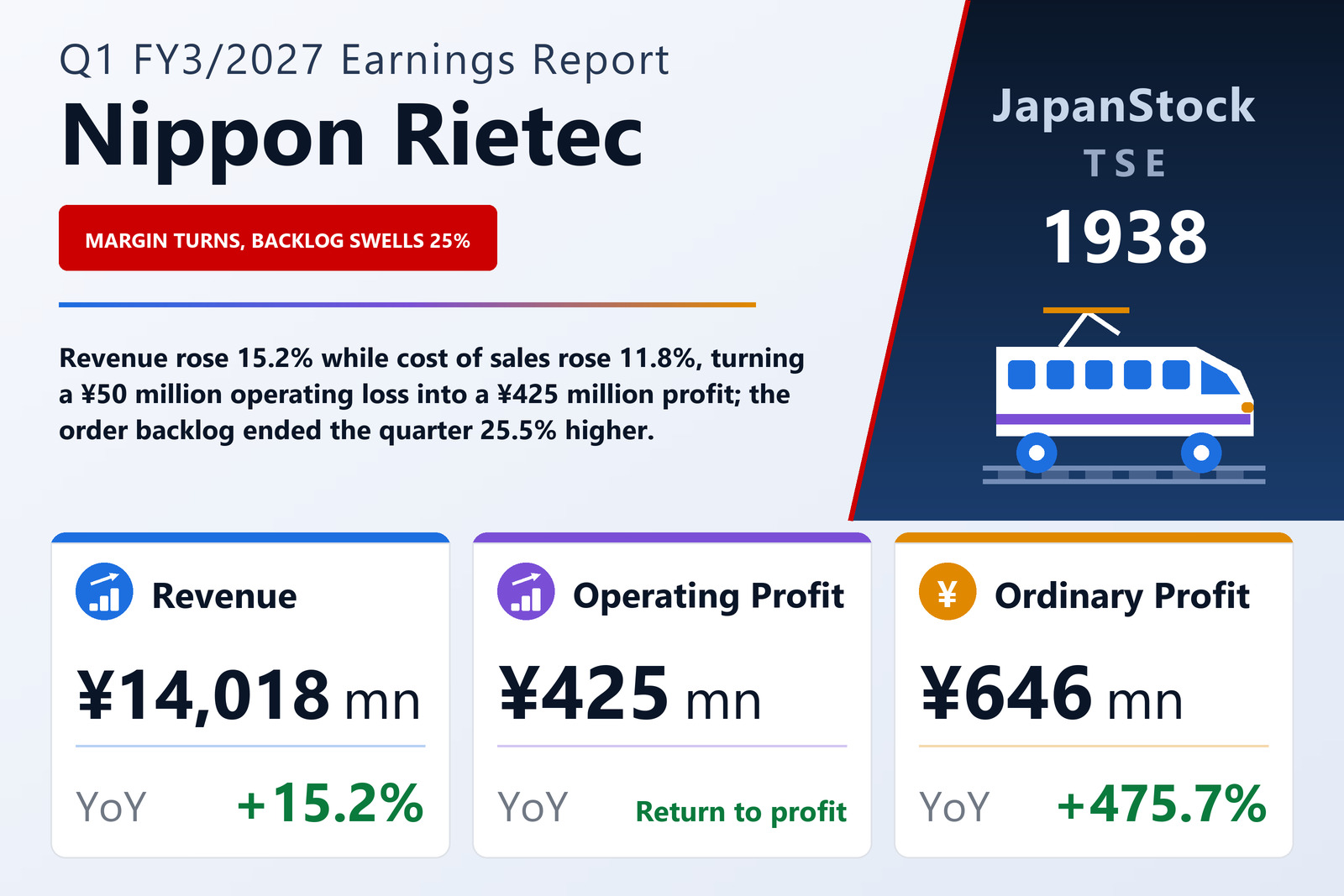
Revenue grew 15.2%, cost of sales 11.8% — and the operating line crossed zero
Nippon Rietec Co., Ltd. (TSE: 1938), the electrical-facility contractor whose four construction departments cover railway electrical equipment, road equipment, indoor and outdoor electrical installations and overhead transmission lines, published consolidated first-quarter results for the three months from April 1 to June 30, 2026 on August 6, 2026 under Japanese GAAP. Revenue rose 15.2% to ¥14,018 million, the operating line swung from a ¥50 million loss to a ¥425 million profit, ordinary profit rose 475.7% to ¥646 million and profit attributable to owners of the parent was ¥406 million against ¥18 million, for earnings of ¥16.39 per share against ¥0.74. The filing names the Tokyo Stock Exchange as the listing venue and does not state a market segment.
The arithmetic between those lines is the whole quarter. Cost of sales rose 11.8% to ¥12,176 million against revenue growth of 15.2% — a gap of roughly three and a half percentage points applied to a cost base above ¥12,000 million. Gross profit therefore rose 43.4% to ¥1,842 million, almost three times the rate of revenue, and the gross margin widened from 10.6% to 13.1%, a gain of about 2.6 points. Selling, general and administrative expenses grew only 6.1% to ¥1,417 million, far slower than revenue, so more than the whole of that gross-margin gain reached the operating line: the operating margin moved from −0.4% to 3.0%. The company attributes the improvement to the revenue effect itself together with continuing price negotiations, productivity gains and cost control. It names no one-off item.
Below the operating line, dividends received and a lighter tax charge carry the rest
Ordinary profit reached ¥646 million against ¥112 million, a rise of 475.7%, well ahead of the operating line — because for a business of this size the non-operating account is large in relation to operating profit. Non-operating income was ¥326 million against ¥263 million, of which dividends received were ¥211 million against ¥160 million and gains on sales of goods ¥98 million against ¥91 million. Non-operating expenses were ¥104 million against ¥101 million, almost all of it an equity-method investment loss of ¥84 million (¥85 million a year earlier) and interest expense of ¥7 million (¥11 million). Net non-operating income of ¥221 million is therefore worth about half of the quarter's entire operating profit, which is the arithmetic reason the ordinary line rose so much faster than the operating one.
Below that, an extraordinary gain of ¥1.6 million on the sale of fixed assets replaced the prior year's ¥9.7 million loss on disposal, so pre-tax quarterly profit rose 531.8% to ¥648 million from ¥102 million. Income taxes were ¥242 million against ¥84 million, an effective rate of 37.4% against 82.2% — the earlier figure distorted by a near-breakeven pre-tax base rather than by anything in this quarter. There are no non-controlling interests, so quarterly profit and profit attributable to owners of the parent are the same ¥406 million, against ¥18 million; the filing itself prints no percentage for that line, the prior-year base being too small for one to carry much meaning. Comprehensive income rose only 68.3% to ¥463 million, far less than net profit, because other comprehensive income fell to ¥56 million from ¥257 million — chiefly a smaller valuation gain on securities, ¥105 million against ¥381 million.
Electrical facility construction is 93% of revenue, and railway work is half of that
The group reports three segments, and one of them is very nearly the whole company. Electrical Facility Construction booked external revenue of ¥13,061 million, up 14.1% — 93% of group revenue — with segment profit of ¥1,123 million, up 55.3%. Ancillary Businesses followed at ¥856 million, up 36.2%, with segment profit of ¥159 million against ¥43 million. Real Estate Leasing, at ¥100 million, up 0.5%, earned ¥16 million against ¥15 million. The three segment profits total ¥1,300 million against ¥783 million a year earlier; an adjustment of −¥875 million (−¥833 million last year), almost all of it company-wide expenses of ¥891 million that are not allocated to any segment, is what reduces that total to the ¥425 million of operating profit actually reported.
Within the construction segment the filing's supplementary schedule splits four departments, and they moved very differently. Railway electrical equipment was the largest at ¥6,600 million, up 9.2%, a little over half of construction revenue and the slowest grower of the three departments that grew at all. Transmission-line equipment grew fastest, 46.1% to ¥3,530 million, an increase of ¥1,114 million that is the single biggest contributor to group growth. Road equipment rose 30.8% to ¥2,127 million. Against those, indoor and outdoor electrical installations fell 40.8% to ¥802 million — the one department to shrink, and the filing offers no explanation for it. The four together came to ¥13,061 million, up 14.1%.
The market the company describes, and the orders it won
The filing's own account of the environment is even-handed. It describes a Japanese economy in moderate recovery on improving employment and income, continued wage rises, strong inbound demand helped by the weak yen and active corporate capital spending, while naming the Bank of Japan's stepwise policy-rate increases, price trends and geopolitical risk including the Middle East as downside factors. For construction specifically it calls private capital investment firm in ageing-infrastructure countermeasures, national-resilience work and the transmission grid and next-generation energy infrastructure that a digitalising, decarbonising society requires — but says the operating environment has grown markedly harder on a chronic labour shortage and rising labour and material costs, making productivity gains and proper margin discipline indispensable. The quarter is the second year of Medium-Term Management Plan 2027, the first step toward the company's NR Vision 2035 long-term vision, under which it is strengthening the earning power of existing businesses while accelerating into growth areas such as data centres and next-generation energy infrastructure.
The quarter opened with carried-over construction work of ¥59,624 million against ¥47,717 million a year earlier, and orders kept coming: ¥17,154 million, up 18.3%. Railway electrical equipment took ¥8,716 million, up 14.3%, on work including station interlocking-device replacement; transmission-line equipment ¥3,619 million, up 22.2%, including pylon rebuilding; road equipment ¥3,013 million, up 12.9%; and indoor and outdoor electrical installations ¥1,805 million, up 45.3%, on public-sector electrical refurbishment — so the department whose revenue fell hardest booked the fastest order growth. The filing also names large data-centre-related electrical work among the contracts won.
The order backlog at June 30, 2026 stood at ¥63,717 million, up 25.5% on the same date a year earlier, an increase of ¥12,948 million. Transmission lines supplied ¥7,386 million of that, the department's backlog rising 72.0% to ¥17,638 million; railway electrical equipment still held the largest absolute backlog at ¥31,200 million, up 12.7%, with indoor and outdoor installations at ¥8,756 million, up 19.6%, and road equipment at ¥6,120 million, up 11.0%. A backlog worth roughly four and a half times a single quarter's revenue is the strongest forward indicator in the filing, and most of its growth sits in the business the company says it is expanding into.
The balance sheet shrank ¥8,855 million, almost all of it receivables
Total assets fell 8.7% to ¥92,480 million from ¥101,335 million at March 31, 2026, a decline of ¥8,855 million that is essentially one line: notes and accounts receivable on completed construction fell ¥11,688 million to ¥36,529 million as the prior year's fourth-quarter handovers were collected. Cash rose ¥985 million to ¥9,380 million and costs on uncompleted contracts rose ¥848 million to ¥1,921 million as new work went into progress. Liabilities fell ¥7,286 million to ¥24,779 million: trade payables down ¥4,176 million, the bonus provision down ¥2,311 million to ¥530 million and income taxes payable down ¥1,873 million to ¥64 million, against new short-term borrowings of ¥500 million where there had been none. Net assets fell ¥1,568 million to ¥67,700 million, retained earnings down ¥1,625 million on the year-end dividend while the securities valuation reserve rose ¥98 million. Because assets fell faster than equity, the equity ratio rose from 68.4% to 73.2%; with no non-controlling interests, equity and net assets are the same figure. Shares issued were unchanged at 25,117,717 and treasury stock unchanged at 337,168.
Guidance unchanged — and the first quarter is 5.8% of it
Nippon Rietec left the full-year FY3/2027 forecast it published on May 12, 2026 untouched: revenue of ¥75,300 million (+1.7%), operating profit of ¥7,350 million (+3.3%), ordinary profit of ¥8,360 million (+6.9%), profit attributable to owners of ¥6,140 million (+10.6%) and earnings of ¥247.42 per share. The quarter just reported is 18.6% of guided revenue but only 5.8% of guided operating profit, and the filing explains that gap rather than leaving it hanging: fixed costs such as selling and administrative expenses accrue roughly evenly across the four quarters, while the completion and handover of construction work concentrates in the fourth, so both revenue and profit are seasonally weighted to the year-end. Read that way, a first quarter that merely crossed into profit is consistent with the forecast rather than at odds with it.
The dividend forecast was likewise unrevised. No dividend is payable for the first quarter and the filing sets no payment start date; the company forecasts ¥47.00 at the half-year and ¥50.00 at the year-end, an annual ¥97.00 against the ¥82.00 paid for FY3/2026, all of which came as a single year-end payment. That is an increase of 18.3% and a payout of about 39% of the guided ¥247.42 of earnings per share. The filing adds that these quarterly consolidated statements are not subject to review by a certified public accountant or audit firm, and that no supplementary explanatory material or results briefing accompanies them.
| Metric | Q1 FY3/2027 | Q1 FY3/2026 | Change |
|---|---|---|---|
| Revenue (¥ million) | 14,018 | 12,173 | +15.2% |
| Gross profit (¥ million) | 1,842 | 1,284 | +43.4% |
| Gross margin | 13.1% | 10.6% | +2.6 pt |
| SG&A expenses (¥ million) | 1,417 | 1,335 | +6.1% |
| Operating profit (¥ million) | 425 | −50 | loss to profit |
| Ordinary profit (¥ million) | 646 | 112 | +475.7% |
| Net profit attrib. to owners of parent (¥ million) | 406 | 18 | +2,128.3% |
| EPS (¥) | 16.39 | 0.74 | +2,114.9% |
| Orders received (¥ million) | 17,154 | 14,495 | +18.3% |
| Order backlog (¥ million) | 63,717 | 50,768 | +25.5% |
| Electrical Facility Construction — revenue (¥ million) | 13,061 | 11,444 | +14.1% |
| Electrical Facility Construction — segment profit (¥ million) | 1,123 | 723 | +55.3% |
| Ancillary Businesses — revenue (¥ million) | 856 | 628 | +36.2% |
| Ancillary Businesses — segment profit (¥ million) | 159 | 43 | +270.6% |
| Real Estate Leasing — revenue (¥ million) | 100 | 100 | +0.5% |
| Real Estate Leasing — segment profit (¥ million) | 16 | 15 | +4.6% |
| Total assets (¥ million) | 92,480 | 101,335 | −8.7% |
| Net assets (¥ million) | 67,700 | 69,269 | −2.3% |
| Equity ratio | 73.2% | 68.4% | +4.8 pt |
| FY3/2027 guidance — revenue (¥ million) | 75,300 | — | +1.7% |
| FY3/2027 guidance — operating profit (¥ million) | 7,350 | — | +3.3% |
| FY3/2027 guidance — ordinary profit (¥ million) | 8,360 | — | +6.9% |
| FY3/2027 guidance — net profit (¥ million) | 6,140 | — | +10.6% |
| FY3/2027 guidance — EPS (¥) | 247.42 | — | — |
| Annual dividend per share (¥) | 97.00 | 82.00 | +18.3% |
JapanStockPulse provides informational content only and does not constitute investment advice. Figures are taken from the company's published earnings short report and may be subject to subsequent revision.