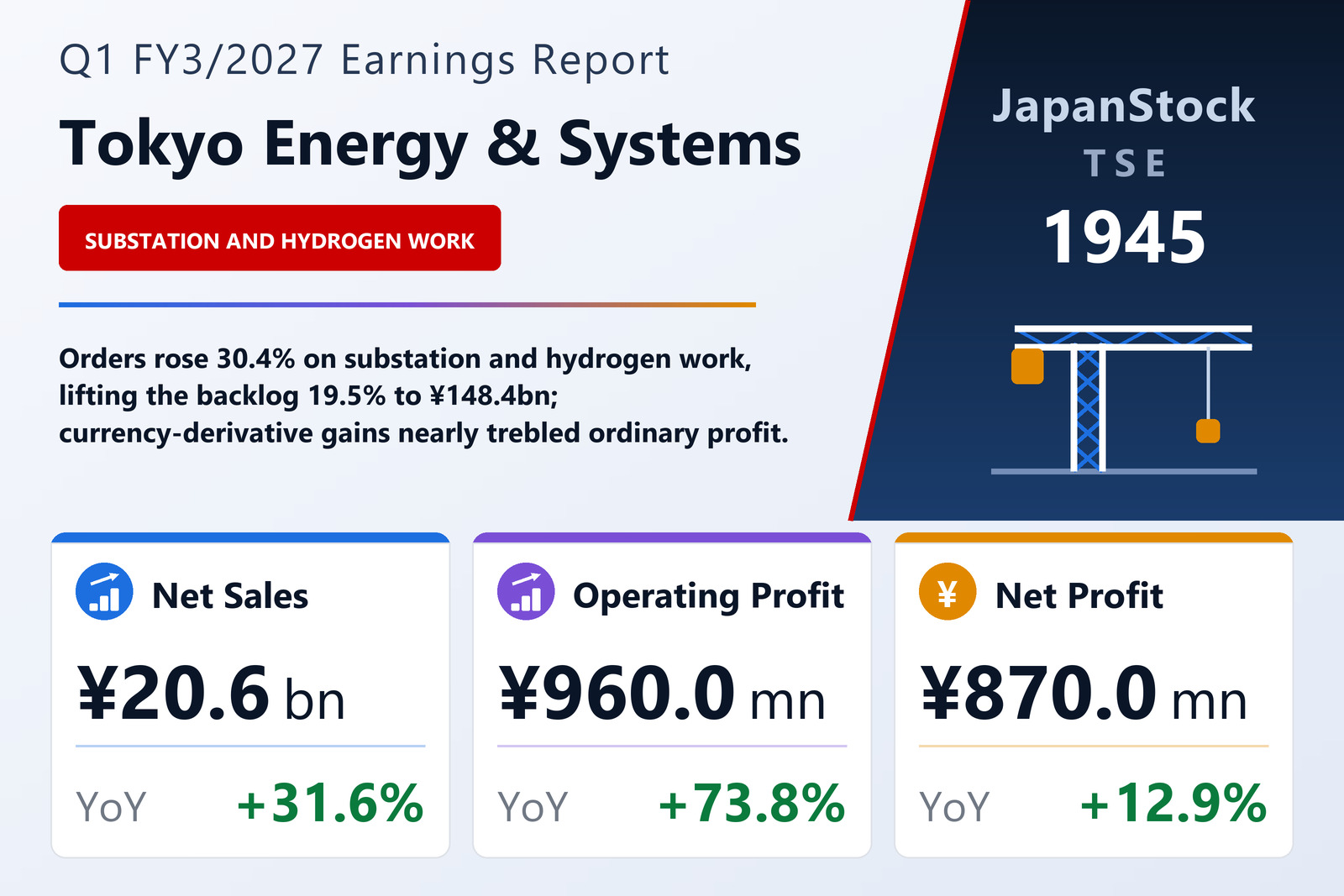
Tokyo Energy & Systems Inc. (TSE: 1945), the electrical and mechanical plant engineering contractor that builds and maintains thermal, nuclear and renewable power stations as well as general industrial facilities, reported consolidated first-quarter results for the year to March 2027 under Japanese GAAP. Net sales rose 31.6% to ¥20,594 million, operating profit jumped 73.8% to ¥960 million, ordinary profit nearly trebled with a 176.9% gain to ¥1,277 million, and net profit attributable to owners of the parent rose 12.9% to ¥870 million. Basic earnings per share came in at ¥26.28, against ¥23.15 a year earlier. The company, led by President Toshiaki Majima, operates six branches and three regional offices across Japan and is in the final year of its 2024 Medium-Term Management Plan.
Substations, hydrogen and refinery work drive a 30% order surge
Orders received climbed 30.4% to ¥24,050 million in the three months to June 30, outrunning the sales line and pushing the order backlog carried forward up 19.5% to ¥148,386 million — more than seven times a single quarter's revenue and the clearest signal in the release of how much work the company has already secured. Management attributed the intake to new substation construction, extra-high-voltage receiving and transforming equipment for a recycling plant tied to decarbonisation and the circular economy, construction work for a liquefied-hydrogen supply chain, and additional maintenance volume from staff stationed on site at a refinery. Revenue growth came from a partly different mix: progress on Fukushima Daiichi decommissioning-related work, thermal-power maintenance, new and expanded substation projects driven by rising electricity demand, and on-site PPA solar installations. Operating profit rose on the higher volume together with what the company described as a sustained focus on profitability at the order-taking stage and gains in on-site productivity.
Construction Works carries the quarter as Other Businesses slip into loss
The Construction Works segment — which spans the Green Energy, Energy and Nuclear divisions plus the Welding & Inspection Center and the Overseas Business Department — took orders of ¥22,551 million (+32.9%) on growth in the Energy division, booked net sales of ¥19,235 million (+35.0%) on the Energy and Green Energy divisions, and delivered segment profit of ¥2,007 million (+48.4%). Other Businesses — power generation, real estate, leasing and rental, insurance agency, and manufacturing, sales and wholesale — was flat to lower: orders edged up 3.3% to ¥1,521 million while net sales slipped 1.4% to ¥1,382 million and the segment swung to a loss of ¥1 million from a ¥54 million profit a year earlier. The concentration is stark: Construction Works accounted for roughly 93% of consolidated sales in the quarter and effectively all of the group's segment profit.
Currency derivatives lift ordinary profit as the balance sheet contracts
The gap between the 73.8% rise in operating profit and the 176.9% jump in ordinary profit is largely non-operational. As the yen weakened, the company booked valuation gains on unsettled forward foreign-exchange contracts held to hedge the currency risk on fuel purchases, which flowed through non-operating income. Below that line, net profit grew a more modest 12.9% even though it included compensation received for natural-disaster damage, recorded as an extraordinary gain — the prior-year quarter had its own favourable items, leaving a tougher comparison. Comprehensive income moved the other way, falling 48.6% to ¥623 million from ¥1,211 million. On the balance sheet at June 30, total assets fell ¥9,250 million to ¥110,078 million, driven mainly by the collection of notes and accounts receivable from completed construction contracts; total liabilities dropped ¥8,713 million to ¥38,163 million on lower income taxes payable and trade payables for construction; and net assets eased ¥537 million to ¥71,914 million on lower retained earnings. Because liabilities shrank faster than assets, the equity ratio rose to 65.3% from 60.7% at the March year-end.
Employee indicted over a Gunma village tender
Separately from the results, the company disclosed that on June 16, 2026 an employee was arrested in connection with a construction tender put out by the village of Ueno in Gunma Prefecture, and that on July 3, 2026 the employee was indicted. Tokyo Energy & Systems said it deeply regrets the situation and apologised to customers and other stakeholders. It added that it will cooperate fully with the authorities' investigation and with the judicial process, and that it has established a Special Investigation Committee to establish the facts, put recurrence-prevention measures in place and further strengthen compliance, with the aim of restoring trust. No financial impact from the matter was quantified in the quarterly release.
Guidance and dividend left unchanged as power demand builds
Management made no revision to either its earnings or its dividend forecast. For the full year to March 2027 the company continues to guide to net sales of ¥95,000 million (+14.3%), operating profit of ¥7,300 million (+54.1%), ordinary profit of ¥7,500 million (+35.9%) and net profit attributable to owners of ¥5,200 million (+21.3%), for forecast earnings per share of ¥156.93. On that basis the first quarter delivered about 21.7% of guided sales and 13.2% of guided operating profit — a normal skew for a contractor whose revenue is recognised as projects complete through the year. The dividend forecast is unchanged at an annual ¥77.00 per share (¥38.00 interim, ¥39.00 year-end), up from ¥63.00 paid for the year to March 2026 (¥28.00 interim, ¥35.00 year-end). The demand backdrop is supportive: capital spending on decarbonisation and on restarting nuclear power stations, plus new data centres driven by generative AI, is lifting electricity demand and the grid investment that follows it. Against that, the company flagged higher material prices, lengthening procurement lead times, a chronic labour shortage and continuing uncertainty in the Middle East.
| Metric | Q1 FY3/2027 | Q1 FY3/2026 | YoY |
|---|---|---|---|
| Net sales (¥ million) | 20,594 | 15,645 | +31.6% |
| Operating profit (¥ million) | 960 | 552 | +73.8% |
| Ordinary profit (¥ million) | 1,277 | 461 | +176.9% |
| Net profit attrib. to owners (¥ million) | 870 | 771 | +12.9% |
| Comprehensive income (¥ million) | 623 | 1,211 | −48.6% |
| Basic EPS (¥) | 26.28 | 23.15 | +13.5% |
| Orders received (¥ million) | 24,050 | — | +30.4% |
| Order backlog (¥ million) | 148,386 | — | +19.5% |
| Equity ratio (%, vs Mar 31, 2026) | 65.3 | 60.7 | +4.6pt |
| FY3/2027 net sales guidance (¥ million) | 95,000 | — | +14.3% |
| FY3/2027 operating profit guidance (¥ million) | 7,300 | — | +54.1% |
| FY3/2027 net profit guidance (¥ million) | 5,200 | — | +21.3% |
| FY3/2027 annual dividend forecast (¥) | 77.00 | 63.00 | +22.2% |
JapanStockPulse provides informational content only and does not constitute investment advice. Figures are taken from the company's published earnings short report and may be subject to subsequent revision. Balance-sheet figures are compared against March 31, 2026.