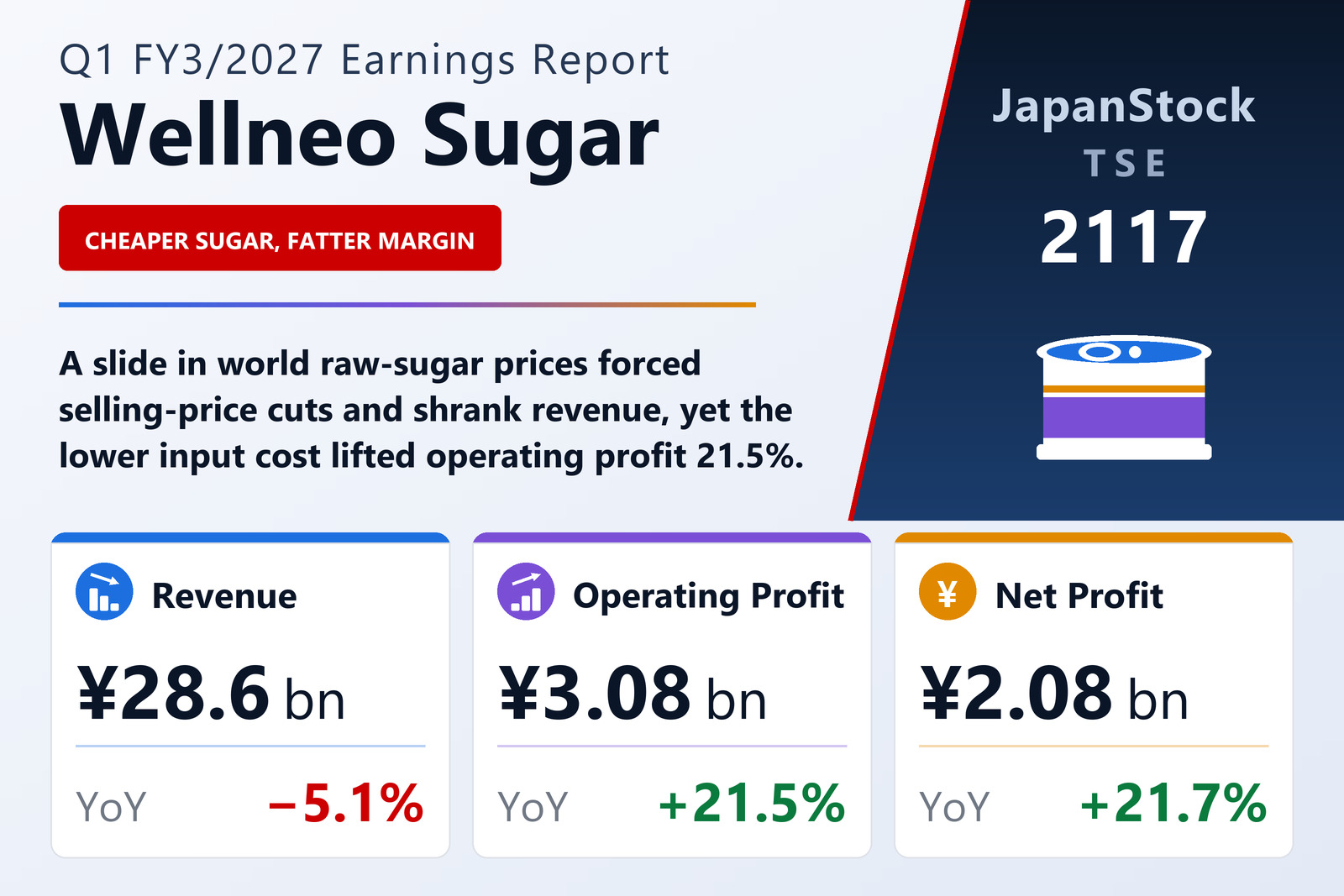
Wellneo Sugar Co., Ltd. (TSE: 2117) reported consolidated first-quarter results under IFRS on August 6. The figures cover the three months from April 1 to June 30, 2026 — the opening quarter of a fiscal year that ends in March 2027. Revenue fell 5.1% to ¥28,601 million from ¥30,154 million, but every profit line moved the other way: operating profit rose 21.5% to ¥3,077 million, profit before tax 22.9% to ¥3,153 million, and profit attributable to owners of the parent 21.7% to ¥2,079 million. Basic earnings per share came in at ¥63.52 against ¥52.39 a year earlier. There were no non-controlling interests in the current quarter, so profit for the period and profit attributable to the parent were the same ¥2,079 million; a year earlier ¥36 million of the ¥1,745 million total had gone to minorities.
The mechanism behind the divergence is visible one line down the income statement. Cost of sales fell faster than revenue — to ¥22,346 million from ¥24,377 million — so gross profit rose 8.3% to ¥6,255 million even as the top line shrank, and the gross margin widened to 21.9% from 19.2%. Selling, general and administrative expenses were broadly stable at ¥3,259 million against ¥3,237 million, while other income of ¥261 million (up from ¥15 million) provided a further lift. Below the operating line, finance income of ¥101 million, finance costs of ¥62 million and a ¥37 million share of profit from equity-method investees — versus a ¥13 million loss last year — carried the result through to pre-tax profit. Income tax expense of ¥1,073 million left the ¥2,079 million bottom line.
Cheaper raw sugar shrinks the top line and widens the margin
The Sugar segment is the group in miniature: it generated ¥24,549 million of external revenue, roughly 86% of the consolidated total, and its revenue fell 5.3% year on year. Segment profit nonetheless rose 18.4% to ¥3,227 million. The company attributes the revenue decline squarely to lower selling prices passed through in response to the fall in the overseas raw-sugar market, and the profit gain to a continued emphasis on profitability over throughput. Volumes were soft on both sides of the business. In commercial and industrial products, a recovery in bread-making demand was more than offset by declines in beverages and confectionery as consumers absorbed broad price inflation, leaving volumes below the prior year. Household products also fell short of last year: shipments of rock sugar and of the group's proprietary "Kibi Sato" unrefined cane sugar were strong, but fewer home-cooking occasions weighed on the category overall.
A round trip in the raw-sugar market, from 15.5 cents to 13.2 and back
The quarter's raw-sugar market made a full round trip. New York raw-sugar futures opened the period at 15.44 cents per pound on April 1 (¥54.42 per kilogram at an exchange rate of ¥159.87 to the dollar) and set the quarter's high of 15.50 cents on April 2. From there prices slid to the period low of 13.22 cents on April 17 — ¥46.75 per kilogram — as production progressed smoothly in major producing countries and the Middle East showed signs of de-escalation. Prices then recovered to close the quarter at 14.34 cents on June 30 (¥51.65 per kilogram at ¥163.39 to the dollar), lifted by weather risk in producing regions and a firmer dollar. Note that the yen weakened from ¥159.87 to ¥163.39 across the three months, which cushioned part of the dollar-denominated decline in yen terms. Domestically, the refined-sugar quotation for superfine white sugar in Tokyo was unchanged from the previous year-end at ¥241–243 per kilogram — a flat domestic reference price against a falling input cost, which is the arithmetic behind the margin expansion.
Food & Wellness slips as a fitness impairment offsets ingredient growth
The smaller Food & Wellness segment, which houses the food-science and fitness businesses, posted external revenue of ¥4,052 million, down 3.9%, and segment profit of ¥124 million, down 17.3%. Within food science, shipments of the group's proprietary "Kibi Oligo" from Okinawa and Amami remained stable, while "Cup Oligo" (galacto-oligosaccharide) and CI (cyclodextran) production ran to plan at the Mihama Bio Plant, where capacity has been built out. Functional food materials including rutin and hesperidin at consolidated subsidiary Toyo Sugar Refining Co., Ltd. held firm. Subsidiary Tsukioka Film Pharma Co., Ltd. reported lower revenue but higher profit, helped by the sale of idle land. The drag came from fitness: adult membership at full-service clubs continued to lack growth, and although the children's school business expanded its intake capacity and grew school membership steadily, an impairment loss booked during the quarter turned higher revenue into lower profit. The warehousing business was broadly flat. Group-wide, the cash-flow statement shows an impairment loss of ¥163 million, against none a year earlier. Unallocated corporate costs, which are excluded from segment profit, fell to ¥274 million from ¥343 million.
Lease additions inflate both sides of the balance sheet
Total assets stood at ¥108,013 million at June 30, up ¥2,185 million from the March year-end. Current assets slipped ¥792 million to ¥40,042 million: trade and other receivables rose ¥323 million, but inventories fell ¥748 million and the ¥357 million of assets held for sale was cleared to zero. Non-current assets rose ¥2,978 million to ¥67,970 million, driven almost entirely by a ¥2,225 million increase in right-of-use assets to ¥3,434 million, with other financial assets up ¥401 million and property, plant and equipment up ¥201 million to ¥21,516 million. The liability side mirrors it. Current liabilities eased ¥316 million to ¥24,241 million as a ¥2,000 million increase in borrowings, to ¥12,010 million, was more than offset by a ¥2,117 million reduction in trade and other payables to ¥6,941 million. Non-current liabilities jumped ¥2,206 million to ¥6,277 million, of which a ¥2,076 million rise in lease liabilities accounts for almost all. Total liabilities finished at ¥30,519 million, up ¥1,889 million. Equity edged up ¥296 million to ¥77,493 million — ¥2,079 million of quarterly profit plus ¥386 million of after-tax other comprehensive income, less ¥2,128 million of dividends — and the ratio of equity attributable to owners of the parent fell 1.2 points to 71.7%, an unusually high figure that reflects a balance sheet carrying almost no leverage beyond working-capital borrowings. Treasury shares held in the executive share-delivery trust stood at ¥156 million and 59,400 shares.
Operating cash flow swings to a ¥868 million inflow
Operating cash flow turned positive at an inflow of ¥868 million, against an outflow of ¥987 million a year earlier. Pre-tax profit of ¥3,153 million and ¥636 million of depreciation and amortisation were the main sources, with the ¥163 million impairment added back; income tax payments of ¥1,771 million and a combined ¥1,198 million working-capital drag — lower inventories offset by higher receivables and lower payables — were the principal uses. Investing activities consumed ¥686 million, well below the prior year's ¥1,717 million, as ¥1,231 million of spending on property, plant, equipment and intangibles was partly funded by ¥360 million of proceeds from asset disposals and ¥248 million from the sale of investment property. Financing activities used ¥276 million, a sharp reversal from a ¥2,610 million inflow a year earlier: a ¥2,000 million net increase in short-term borrowings was absorbed by ¥2,090 million of dividend payments and ¥185 million of lease repayments. Cash and cash equivalents ended the quarter at ¥10,367 million, down ¥94 million.
Guidance unchanged as the Toyo Sugar merger approaches
Wellneo Sugar made no change to the interim or full-year consolidated forecasts published with its FY3/2026 results on May 14, 2026. The quarter is the third year of the mid-term plan "WELLNEO Vision 2027", which runs from April 2024 to March 2028 and is built on strengthening the Sugar and Food & Wellness segments in tandem. The most consequential dated item on the calendar is the absorption merger of consolidated subsidiary Toyo Sugar Refining, scheduled for October 2026. Management expects the combination to create a five-plant national production footprint and to allow optimisation across procurement, production, logistics and sales, alongside an integration of core IT systems intended to improve data use and productivity — a direct response to rising energy, packaging and other input costs, and positioning for what the company expects to be an accelerating consolidation of the Japanese sugar industry. On the growth side, Toyo Sugar is building a new functional-materials plant with construction proceeding on schedule toward full operation in April 2027, following the start of full "Cup Oligo" production at the Mihama Bio Plant in April 2025 and of CI production there in April 2026. Management's stated ambition is for food science to become the group's second earnings pillar after sugar. Dividends of ¥2,128 million were distributed during the quarter, representing the prior year's year-end payout, and the tanshin reported no going-concern issues; the interim review report from Toyo Audit Corporation is dated August 6, 2026.
| Metric | Q1 FY3/2027 | Q1 FY3/2026 | YoY |
|---|---|---|---|
| Revenue (¥ million) | 28,601 | 30,154 | −5.1% |
| Gross profit (¥ million) | 6,255 | 5,776 | +8.3% |
| Operating profit (¥ million) | 3,077 | 2,532 | +21.5% |
| Profit before tax (¥ million) | 3,153 | 2,566 | +22.9% |
| Profit attributable to owners of the parent (¥ million) | 2,079 | 1,708 | +21.7% |
| Basic earnings per share (¥) | 63.52 | 52.39 | +21.2% |
| Operating cash flow (¥ million) | 868 | −987 | To inflow |
| Total assets (¥ million, vs Mar 31, 2026) | 108,013 | 105,827 | +2.1% |
| Total equity (¥ million, vs Mar 31, 2026) | 77,493 | 77,197 | +0.4% |
| Equity ratio (owners of the parent) | 71.7% | 72.9% | −1.2 pt |
| Cash and cash equivalents (¥ million) | 10,367 | 10,461 | −0.9% |
| Segment | Revenue (¥ million) | YoY | Segment profit (¥ million) | Prior year (¥ million) | YoY |
|---|---|---|---|---|---|
| Sugar | 24,549 | −5.3% | 3,227 | 2,725 | +18.4% |
| Food & Wellness | 4,052 | −3.9% | 124 | 150 | −17.3% |
| Reportable segments total | 28,601 | −5.1% | 3,351 | 2,875 | +16.6% |
| Unallocated corporate costs | — | — | −274 | −343 | — |
| Consolidated operating profit | 28,601 | −5.1% | 3,077 | 2,532 | +21.5% |
JapanStockPulse provides informational content only and does not constitute investment advice. Figures are taken from the company's published earnings short report and may be subject to subsequent revision.