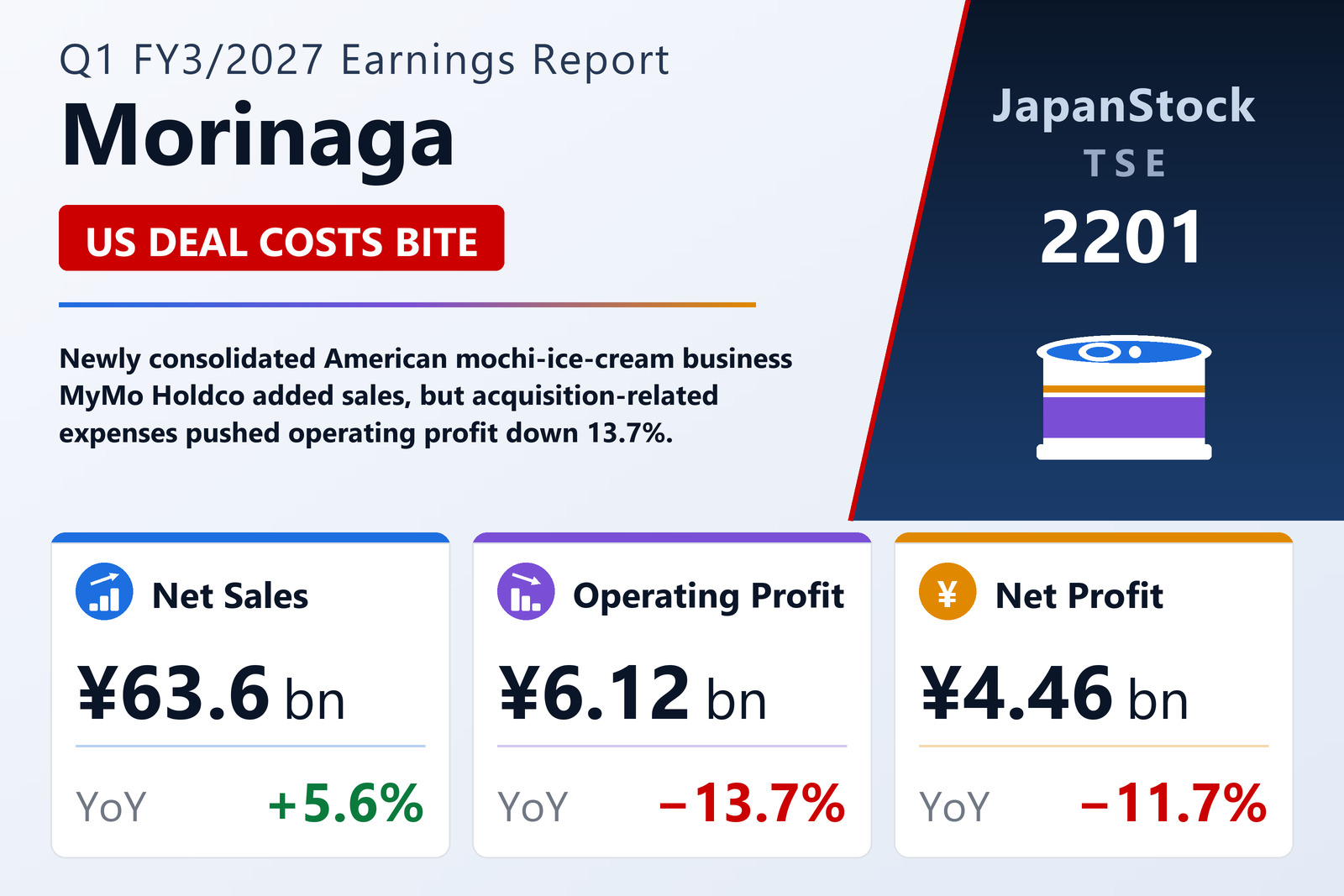
Morinaga & Co., Ltd. (TSE: 2201) reported consolidated first-quarter results for the year to March 2027 under Japanese GAAP on August 6. Net sales rose 5.6% to ¥63,617 million, an increase of ¥3,364 million, but operating profit fell 13.7% to ¥6,123 million, ordinary profit fell 13.7% to ¥6,214 million and profit attributable to owners of the parent dropped 11.7% to ¥4,458 million. Earnings per share came to ¥53.09 against ¥59.62 a year earlier. The squeeze did not come from the factory floor: cost of sales rose only 4.8% to ¥37,083 million, slower than sales, so gross profit improved 6.6% to ¥26,533 million and the gross margin widened to 41.7% from 41.3%. The entire problem sat one line lower, in selling, general and administrative expenses, which jumped 14.8% to ¥20,410 million and consumed 32.1% of sales against 29.5% a year before. One line moved sharply the other way: comprehensive income jumped 74.2% to ¥5,297 million from ¥3,041 million, almost entirely because the foreign-currency translation adjustment swung from minus ¥2,012 million to plus ¥1,062 million. The quarter covers April 1 to June 30, 2026, and falls in the final year of the confectioner's "2024 Medium-Term Management Plan" — the second stage of a road map toward its "2030 Management Plan."
A mochi-ice-cream acquisition rewrites the top line — and the profit line
Essentially all of the quarter's growth came from outside Japan, and from a single transaction. On April 1, 2026 Morinaga completed the purchase of 100% of MyMo Holdco, Inc., the holding company that indirectly owns all interests in The Mochi Ice Cream Company, LLC — the largest mochi ice cream manufacturer in the United States. The board had resolved on the deal and signed the share transfer agreement on March 6, 2026. Consideration was US$130 million in cash, or ¥20,818 million at the settlement rate on the acquisition date, and MyMo plus three of its subsidiaries were the four new entrants to the scope of consolidation. Morinaga framed the deal as the acquisition of a complete United States value chain, arguing that the American ice cream market is on a stable medium-to-long-term growth path with visible momentum behind single-serve novelties, clean-label formulations and premiumisation.
The accounting consequences are what turned a strong revenue quarter into a weak profit one. The transaction generated ¥17,249 million of goodwill, a provisional figure because the purchase price allocation was not complete at quarter-end, to be amortised on a straight-line basis over 12 years. Amortisation of ¥359 million was already charged in the three months, against nil a year earlier. Advisory and other acquisition-related costs added US$5 million, or ¥892 million. Assets taken on at the combination date were ¥17,231 million (¥2,493 million current, ¥14,738 million non-current) against liabilities of ¥2,956 million. Management said rising raw-material and logistics costs had been broadly absorbed by price revisions — the damage to profit was the deal, not the cost base.
Domestic confectionery holds its ground; frozen desserts flat, nutrition slips
Within the Food Manufacturing division, the domestic businesses shrank 1.3% in aggregate to ¥48,994 million, with domestic operating profit down 5.5% to about ¥5,656 million. The Confectionery & Food business posted sales of ¥21,041 million, down 0.6%, yet lifted operating profit 3.6% to ¥2,263 million — April price revisions across snacks, chocolate and candy and on selected cocoa products took hold alongside tighter control of selling expenses. Category by category the picture was mixed, and the company's own domestic sales index (prior year = 100) makes the spread plain. "Morinaga Biscuits" finished level at 99 after June sales recovered on stay-at-home demand generated by the rainy season and typhoons. "Hi-Chew" was also flat at 99, an effort to sharpen the eating occasion associated with each sub-brand having yet to land. "Morinaga Ramune" was the standout at 110, as messaging around glucose's functional value during moments of concentration converted into repeat purchase, led by bottled and individually wrapped formats. Chocolate dragged: "Carré de Chocolat" came in at 90 despite strong sales of the relaunched "Cacao 88" and inclusion products such as "Gianduja" and "Langue de Chat"; "DARS" fell hardest at 73 as good sales of "DARS <Milk>" and "White DARS" failed to offset revenue lost to SKU rationalisation; and "Chocoball" reached 96 for the same reason after the SKU count on "Ōdama Chocoball" was cut. In food, "Morinaga Cocoa" registered 93 as the April price revision reduced volumes despite health-habit and chilled-summer-drink marketing, while "Morinaga Amazake" was exactly flat at 100.
The Frozen Desserts business was almost perfectly static on the top line at ¥15,110 million, down just ¥6 million or 0.0%, but converted price revisions into a 3.0% operating-profit gain to ¥1,663 million in the face of raw-material and freight inflation. The "Jumbo" family was the engine at an index of 106: "Choco Monaka Jumbo" ran new television commercials built on the popular factory-tour content to broaden its buyer base, while "Vanilla Monaka Jumbo" pushed the "texture value" of its "Combination Vanilla." Everything else in the range fell. "Ita Choco Ice" slumped to 75 — box gimmicks allowing multi-session eating and a summer-limited edition could not offset the reactionary drop against a limited-time product launched in the same period last year. "The Crepe" reached 91 and "Ice Box" 94, the latter despite in-store campaigns and limited-edition clear cups that pulled forward midsummer shelf placement, undone by unseasonable weather.
The "in" nutrition business was the weakest domestic performer, with sales down 3.1% to ¥7,805 million and operating profit down 11.0% to ¥1,597 million on raw-material inflation and the revenue shortfall. "in Jelly" came in at 96: the company brought forward its summer-limited launches to capture heatstroke-prevention demand, betting on the lengthening summer that has Japan talking about a "two-season" year, only for low June temperatures and more rainy days to stall both sports and heat-countermeasure demand. "in Bar" ran at 104, steadily capturing a nutritionally balanced food market that continues to grow on meal-replacement demand. The small direct-to-consumer business was the quarter's best proportional performer, sales up 2.6% to ¥2,705 million and operating profit up 53.8% to ¥201 million on higher revenue and disciplined advertising: "Oishii Collagen Drink" landed at 98, front-loaded advertising winning new customers but existing-customer churn running ahead of plan, while "Oishii Aojiru," the candidate second pillar, sold well. Operating subsidiaries were the one outright casualty, sales down 12.8% to ¥2,331 million and profit swinging ¥332 million to a ¥68 million operating loss: Aunt Stella's fill-your-own-bag and Aunt Stella birthday events at its nationwide directly managed stores failed to revive sales that have been sluggish since last year's price revision, and Morinaga Market Development saw sales at major theme parks stagnate.
Overseas is now almost a fifth of the group
The geographic mix shifted decisively in a single quarter. Domestic sales slipped 1.0% to ¥51,610 million while overseas sales surged 47.8% to ¥12,007 million, lifting the overseas ratio to 18.9% from 13.5%. The United States business alone grew 65.1% to ¥9,105 million, with operating profit up 16.9% to ¥673 million even after absorbing freight inflation and the new goodwill amortisation. Beneath that headline the existing American business was merely holding on: "HI-CHEW" continued to struggle in the convenience-store channel, which carries a high share of its sales, as inflation weighed on shoppers, so Morinaga leaned into large mass retailers — restoring SKU counts on products cut back last year and introducing seasonal-event lines — which was enough to bring the brand back to roughly flat year on year. The incremental growth was MyMo's, where flagship "my mochi ice cream" kept selling strongly through big-box retail. China, Taiwan and exports added 12.2% to ¥2,816 million and 5.2% to ¥226 million of profit, with HI-CHEW and imported Japanese products both performing well in China, HI-CHEW strong in Taiwan, and exploratory expansion continuing across East and Southeast Asia, Oceania and Europe to establish HI-CHEW as a global brand. Outside Food Manufacturing, Food Wholesale grew sales 4.5% to ¥1,995 million but saw profit collapse 57.5% to ¥125 million, while Real Estate & Services lifted sales 7.5% to ¥497 million and profit 13.2% to ¥227 million.
Where the ¥975 million of operating profit went
The decline is worth tracing line by line, because the operating businesses lost far less than the group did. Reportable-segment profit before corporate allocation fell only ¥392 million, from ¥7,326 million to ¥6,934 million. What did the real damage was the adjustment line — unallocated head-office costs, which widened from minus ¥228 million to minus ¥811 million, a ¥583 million deterioration that accounts for roughly 60% of the ¥975 million drop in operating profit. Morinaga attributes those costs mainly to general administrative expenses and new-business development spending not attributable to any reportable segment. Inside SG&A, freight and storage rose 11.1% to ¥5,541 million and now absorb 8.7% of sales; salaries and allowances rose 14.2% to ¥3,165 million; sales promotion rose 9.8% to ¥1,898 million; and the residual "other" category — which is where the deal costs and goodwill amortisation land — jumped 32.1% to ¥6,352 million, or 10.0% of sales against 8.0%. The only SG&A line to fall was advertising, down 3.2% to ¥2,449 million. Below operating profit the picture was better than the headline suggests: a ¥443 million gain on sale of fixed assets helped lift extraordinary income to ¥460 million from ¥37 million, so pre-tax profit fell a milder 9.1% to ¥6,513 million even as operating profit fell 13.7%.
Goodwill appears, borrowings multiply eightfold, and no cash-flow statement
Consolidating MyMo left an unmistakable mark on the balance sheet. Total assets rose to ¥250,505 million at June 30 from ¥225,921 million at the March year-end, an increase of ¥24,584 million or 10.9% in three months — of which ¥23,524 million was the increase in Food Manufacturing segment assets alone. The composition tells the story: goodwill went from nil to ¥16,890 million (the ¥17,249 million arising, less the ¥359 million already amortised), notes and accounts receivable rose to ¥30,514 million from ¥28,448 million, and machinery and vehicles rose to ¥25,476 million from ¥23,843 million, while cash and deposits fell to ¥25,477 million from ¥26,419 million on the seasonal payment of income taxes, bonuses and dividends. The funding is equally visible: short-term borrowings jumped to ¥25,000 million from ¥3,000 million, borrowed specifically to pay for the MyMo shares, pushing total liabilities up ¥22,019 million to ¥104,244 million even as accrued income taxes fell to ¥1,270 million from ¥4,560 million and the bonus provision fell to ¥1,923 million from ¥3,346 million. Bonds at ¥9,000 million and long-term borrowings at ¥7,000 million were unchanged. Net assets grew only ¥2,565 million to ¥146,261 million — quarterly profit and the positive translation adjustment offset by dividends paid — and shareholders' equity reached ¥144,420 million from ¥141,956 million. Because assets expanded roughly ten times faster than equity, the equity ratio fell 5.1 points to 57.7% from 62.8%, a step down that reflects acquisition financing rather than any deterioration in trading. Share count barely moved: 86,111,638 shares in issue, unchanged, with treasury holdings of 2,142,426 including 80,784 shares held by the directors' remuneration BIP trust, and a weighted average of 83,969,242 against 84,647,206.
Investors looking for a cash-flow statement will not find one. Morinaga explicitly states that no consolidated statement of cash flows was prepared for the first quarter, as permitted for Japanese quarterly reporting. In its place the company discloses the two figures needed to approximate cash earnings: depreciation of ¥2,565 million, up from ¥2,455 million, and goodwill amortisation of ¥359 million against nil a year earlier. On that simplified basis EBITDA — the measure Morinaga itself defines as operating profit plus depreciation plus goodwill amortisation — works out to roughly ¥9,047 million, against ¥9,553 million a year earlier.
An antitrust inspection hangs over the ice-cream business
Buried in the notes is the quarter's most consequential non-financial disclosure. On June 16, 2026, Morinaga was subject to an on-site inspection by the Japan Fair Trade Commission on suspicion of violating the Antimonopoly Act in connection with shipping prices for ice cream and frozen confectionery. The company says it will cooperate fully, that the investigation is ongoing, and that the effect on its financial position and results of operations is currently unknown — the item is carried as a contingent liability rather than provisioned. The timing is awkward: frozen desserts are the very category where the group has just spent ¥20.8 billion buying an American platform, and where domestic price revisions were the reason segment profit rose this quarter. Elsewhere in the notes the housekeeping was clean — no going-concern issues, no material change in shareholders' equity, and no global minimum tax recognised, the company having applied paragraph 7 of Practical Issues Task Force No. 46. The quarterly consolidated financial statements were subject to a voluntary review by Deloitte Touche Tohmatsu LLC, whose unmodified conclusion is dated August 5, 2026.
Guidance and dividend both left untouched
Morinaga made no change to either its earnings forecast or its dividend plan, explicitly reaffirming the guidance issued on May 11, 2026. For the full year to March 2027 it continues to guide to net sales of ¥257,000 million, up 8.6%, operating profit of ¥22,800 million, up 1.8%, ordinary profit of ¥22,200 million, down 2.0%, and net profit of ¥16,500 million, down 7.1%, for earnings per share of ¥196.03. First-half guidance is for sales of ¥131,000 million, up 7.5%, operating profit of ¥12,100 million, down 9.4%, ordinary profit of ¥11,900 million, down 11.5%, and net profit of ¥9,200 million, down 16.6%, with EPS of ¥109.30. The first quarter therefore delivered 24.8% of the full-year sales target and 26.9% of the operating-profit target — a running start on profit, given that the guidance already anticipates a soft first half and a second-half recovery once the deal costs annualise. On distributions, the company holds to ¥35.00 at the interim and ¥35.00 at the year-end for ¥70.00 annually, up from ¥65.00 paid for the year to March 2026 (¥32.50 plus ¥32.50), a 7.7% increase being funded through a year in which bottom-line profit is guided lower. The four businesses Morinaga designates as priority areas under the 2030 plan — "in," frozen desserts, direct-to-consumer and the United States — together generated ¥35,400 million of sales, or 55.7% of the group total, up from 53.2% a year earlier.
| Metric | Q1 FY3/2027 | Q1 FY3/2026 | YoY |
|---|---|---|---|
| Net sales | 63,617 | 60,253 | +5.6% |
| Cost of sales | 37,083 | 35,370 | +4.8% |
| Gross profit | 26,533 | 24,882 | +6.6% |
| SG&A expenses | 20,410 | 17,784 | +14.8% |
| Operating profit | 6,123 | 7,098 | −13.7% |
| Ordinary profit | 6,214 | 7,204 | −13.7% |
| Pre-tax profit | 6,513 | 7,162 | −9.1% |
| Profit attrib. to owners of parent | 4,458 | 5,046 | −11.7% |
| Comprehensive income | 5,297 | 3,041 | +74.2% |
| Earnings per share (¥) | 53.09 | 59.62 | −11.0% |
| Domestic sales | 51,610 | 52,130 | −1.0% |
| Overseas sales | 12,007 | 8,122 | +47.8% |
| Overseas sales ratio (%) | 18.9 | 13.5 | +5.4 pt |
| Depreciation | 2,565 | 2,455 | +4.5% |
| Goodwill amortisation | 359 | 0 | New |
| Total assets (vs Mar 31, 2026) | 250,505 | 225,921 | +10.9% |
| Goodwill (vs Mar 31, 2026) | 16,890 | 0 | New |
| Short-term borrowings (vs Mar 31, 2026) | 25,000 | 3,000 | +733.3% |
| Total liabilities (vs Mar 31, 2026) | 104,244 | 82,225 | +26.8% |
| Net assets (vs Mar 31, 2026) | 146,261 | 143,696 | +1.8% |
| Equity ratio (%) | 57.7 | 62.8 | −5.1 pt |
| Annual dividend per share (¥) | 70.00 | 65.00 | +7.7% |
| Business | Sales | YoY | Op. profit | YoY |
|---|---|---|---|---|
| Confectionery & Food | 21,041 | −0.6% | 2,263 | +3.6% |
| Frozen Desserts | 15,110 | −0.0% | 1,663 | +3.0% |
| "in" Nutrition | 7,805 | −3.1% | 1,597 | −11.0% |
| Direct-to-Consumer | 2,705 | +2.6% | 201 | +53.8% |
| Operating subsidiaries | 2,331 | −12.8% | −68 | To loss |
| Domestic subtotal | 48,994 | −1.3% | 5,656 | −5.5% |
| United States | 9,105 | +65.1% | 673 | +16.9% |
| China, Taiwan & exports | 2,816 | +12.2% | 226 | +5.2% |
| Overseas subtotal | 11,922 | +48.5% | 899 | +13.7% |
| Food Manufacturing total | 60,916 | +5.6% | 6,556 | −3.3% |
| Food Wholesale | 1,995 | +4.5% | 125 | −57.5% |
| Real Estate & Services | 497 | +7.5% | 227 | +13.2% |
| Other | 208 | −1.7% | 24 | −50.3% |
| Corporate costs / eliminations | — | — | −811 | Wider |
| Consolidated total | 63,617 | +5.6% | 6,123 | −13.7% |
JapanStockPulse provides informational content only and does not constitute investment advice. Figures are taken from the company's published earnings short report and may be subject to subsequent revision.