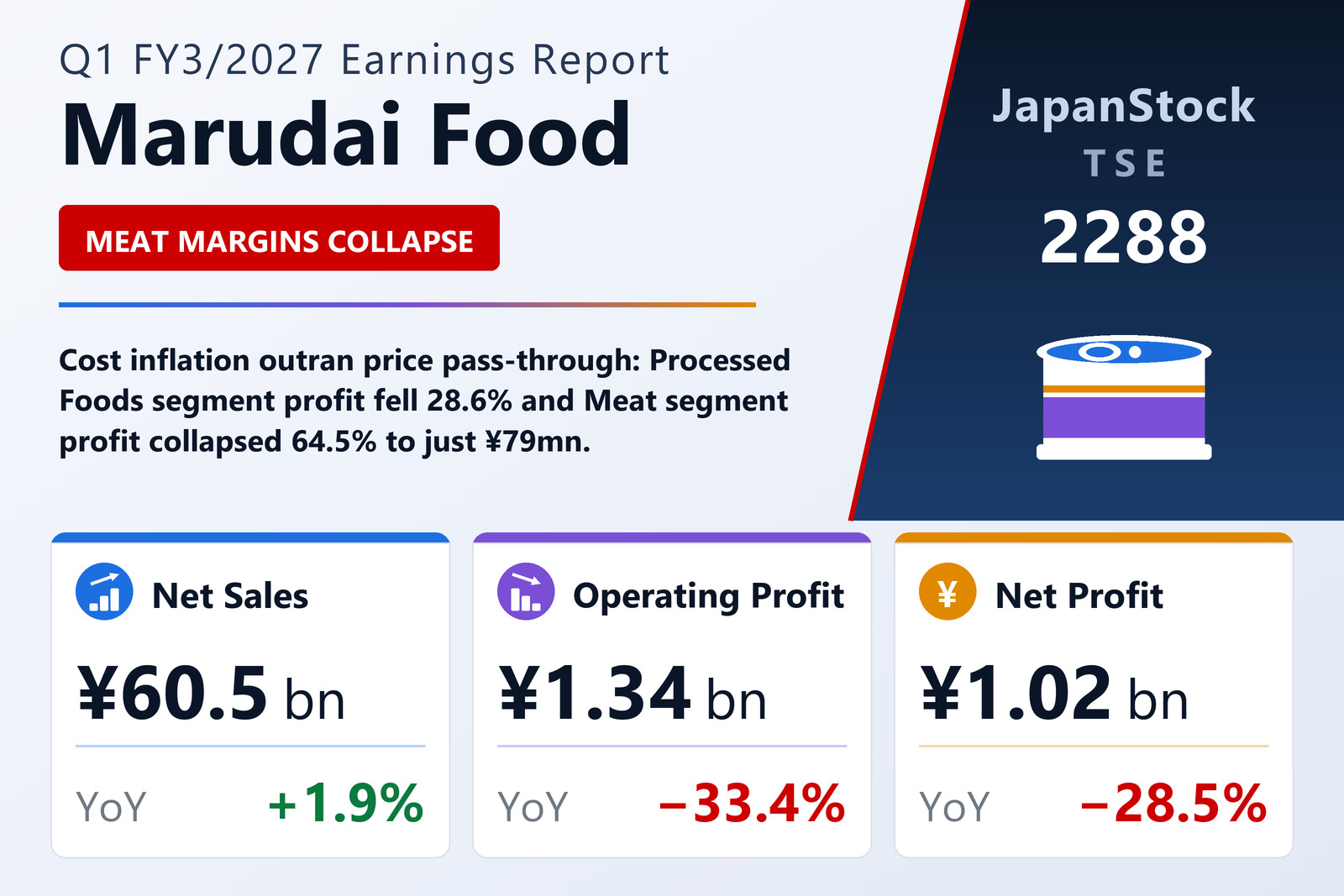
Marudai Food Co., Ltd. (TSE: 2288) reported consolidated first-quarter results under Japanese GAAP on August 6, covering April 1 to June 30, 2026 — the opening three months of the fiscal year ending March 2027. Net sales rose 1.9% to ¥60,529 million, but operating profit fell 33.4% to ¥1,340 million, ordinary profit fell 31.4% to ¥1,389 million, and profit attributable to owners of the parent fell 28.5% to ¥1,016 million. Basic earnings per share came to ¥42.16 against ¥58.06 a year earlier. The Osaka-based ham, sausage and prepared-foods maker — a mid-cap integrated food manufacturer guiding to ¥245 billion of annual sales — is a clean illustration of the squeeze running through Japan's protein processors: revenue keeps growing because prices have been raised, but raw-material, labour and logistics costs are rising faster than the pass-through.
Revenue up, gross profit down: the pass-through is not keeping pace
The mechanics are visible one line below the top line. Cost of sales rose 2.9% to ¥51,176 million, outpacing the 1.9% increase in sales, so gross profit fell 3.2% to ¥9,352 million and the gross margin narrowed to 15.5% from 16.3% — a contraction of roughly 0.8 percentage points, worth close to ¥500 million at this quarter's revenue. Selling, general and administrative expenses compounded the pressure, rising 4.8% to ¥8,012 million as wage and distribution costs climbed. Below the operating line the picture was steadier: non-operating income of ¥142 million against ¥94 million of expenses (including ¥61 million of interest) left ordinary profit marginally above operating profit at ¥1,389 million, and ¥33 million of gains on fixed-asset disposals against ¥11 million of disposal losses produced pre-tax profit of ¥1,411 million. A ¥392 million tax charge left ¥1,019 million of quarterly net profit, of which ¥2 million belonged to non-controlling interests. Comprehensive income fell far more steeply than net profit — down 75.7% to ¥478 million — because a ¥494 million negative swing in valuation differences on available-for-sale securities absorbed most of the earnings.
Processed Foods: prepared dishes grow, ham and sausage shrink
Processed Foods, the larger reporting segment at two-thirds of group revenue, grew sales just 0.7% to ¥40,240 million while segment profit fell 28.6% to ¥1,270 million — a ¥509 million decline that accounts for three-quarters of the group's ¥673 million operating-profit shortfall. The two halves of the segment moved in opposite directions. Ham and sausage sales fell 2.2% to ¥18,002 million. Marudai pushed its flagship Kunseiya smoked range hard, running a limited-edition SAMURAI BLUE officially licensed line tied to Japan's national football team and a recipe collaboration with the cookery personality Ryuji, but the promotional effort did not offset the underlying volume loss: with households economising against general price inflation and price competition intensifying, unit sales of core roast-ham products and value-pack wieners both declined. Prepared and cooked foods rose 3.2% to ¥22,237 million, and now outsell ham and sausage by more than ¥4.2 billion a quarter. Salad chicken held firm, the Bistro Club rich-curry and foodservice curry lines expanded, and the Sundubu Korean-style stew series grew on sustained promotion. Desserts and beverages were the other bright spot, helped by limited-edition launches, convenience-store dessert supply and higher sales of pre-whipped cream into commercial kitchens.
Meat: volumes and prices both up, margin almost gone
The Meat segment did the opposite — it delivered the group's revenue growth and almost none of its profit. Sales rose 4.5% to ¥20,259 million, the fastest growth in the group, as domestic beef held roughly flat, Australian beef was pushed harder and mass-retail channels stayed firm, while both domestic and imported pork saw unit prices and volumes rise together. But segment profit collapsed 64.5% to ¥79 million — an operating margin of just 0.4% — because the company could not pass the full increase in procurement costs from surging livestock markets through to selling prices. It is a familiar pattern in Japanese meat wholesaling, a business that buys at spot and sells on negotiated retail terms, so a rising market lands in the cost base months before it reaches the price list. That is how a 4.5% revenue gain becomes a ¥144 million profit decline. The small "Other" segment, which houses an insurance-agency business, recorded ¥29 million of sales, down 9.5%, and swung to a ¥9 million loss from ¥9 million of profit.
Balance sheet: working capital and debt build, equity ratio slips below 60%
Total assets rose ¥2,722 million to ¥127,363 million against the March 2026 year-end, and the increase was almost entirely working capital: notes and accounts receivable up ¥1,623 million, merchandise and finished goods up ¥1,572 million and raw materials and supplies up ¥1,202 million, partly offset by a ¥1,419 million fall in cash and deposits. Inventory building on that scale into a quarter of falling margins is worth watching. Liabilities rose ¥4,737 million to ¥52,408 million, with interest-bearing debt up ¥3,430 million and trade payables up ¥3,269 million against a ¥2,424 million reduction in income taxes payable. Net assets fell ¥2,015 million to ¥74,955 million: the ¥1,016 million of quarterly profit was more than consumed by ¥1,709 million of dividend appropriations, ¥781 million of treasury-share purchases and the ¥494 million reduction in securities valuation reserves. The equity ratio dropped 2.9 points to 58.2% from 61.1%, and net assets per share eased to ¥3,094.92 from ¥3,134.17. The balance sheet remains conservative by sector standards — shareholders' equity of ¥74,106 million against ¥127,363 million of assets — but the direction of travel is clear.
Operating cash flow swings ¥4.3 billion into deficit
Cash generation deteriorated sharply. Operating cash flow was an outflow of ¥847 million against a ¥3,434 million inflow a year earlier, a ¥4,281 million swing, as the working-capital build and tax payments overwhelmed pre-tax profit of ¥1,411 million and ¥1,188 million of depreciation. Inventories absorbed ¥2,788 million and receivables a further ¥1,636 million, against ¥3,269 million released by trade payables; income taxes took ¥2,763 million. Investing cash flow was an outflow of ¥1,696 million, slightly wider than last year's ¥1,514 million, with ¥1,839 million spent on fixed assets for capacity expansion, rationalisation and quality upgrades against ¥148 million of disposal proceeds. Financing turned to an inflow of ¥1,124 million from a ¥1,844 million outflow, as a ¥3,830 million net increase in short-term borrowing more than covered ¥1,632 million of dividend payments, ¥781 million of buybacks and ¥296 million of long-term debt and lease repayments. Cash and equivalents ended the quarter at ¥8,376 million, down ¥1,419 million from the year-end and below the ¥9,059 million held a year earlier.
Guidance held, dividend lifted to ¥80, buyback completed
Marudai left both its interim and full-year forecasts, published on May 14, unchanged. For the year to March 2027 it targets net sales of ¥245,000 million (+2.8%), operating profit of ¥8,000 million (+6.6%), ordinary profit of ¥8,400 million (+5.9%) and profit attributable to owners of ¥6,400 million, down 34.6%, for earnings per share of ¥266.80; the first half is guided to ¥123,000 million of sales and ¥4,300 million of operating profit. Implied by the company's own percentage changes, FY3/2026 net profit was close to ¥9.8 billion — above that year's ordinary profit — so the guided 34.6% fall reflects the non-recurrence of extraordinary gains rather than an operating deterioration. Holding operating-profit guidance after a quarter like this one nonetheless implies a demanding remaining nine months: the first quarter delivered just 16.8% of the full-year operating-profit target, against 26.8% a year earlier, so management is implicitly assuming that price revisions and cost recovery bite from the second quarter onward. The annual dividend forecast is ¥80.00 per share — ¥40.00 at the interim and ¥40.00 at the year-end — up from the ¥70.00 paid entirely at the year-end in FY3/2026, and is also unrevised. The company notes that its ¥266.80 EPS forecast already reflects the treasury shares repurchased during the first quarter.
Two capital-management actions sit in the subsequent-events note. Marudai completed the share buyback authorised by its board on February 24, 2026, purchasing a final 36,800 shares for ¥83.2 million on the Tokyo Stock Exchange between July 1 and July 6 and bringing the cumulative total under that authorisation to 572,000 shares for ¥1,299.9 million — effectively the full ¥1.3 billion ceiling, against a maximum of 650,000 shares, or 2.66% of shares outstanding excluding treasury. The programme, originally scheduled to run to September 30, is now closed. Separately, on July 27 the board approved the disposal of 63,300 treasury shares as restricted stock at ¥2,281 per share, or ¥144.4 million, in a third-party allotment to the Marudai Food employee shareholding association, with a payment date of August 27, 2026. Treasury holdings stood at 2,560,892 shares at June 30 against 2,218,252 at the year-end, out of 26,505,581 shares issued, and the average share count for the quarter fell to 24,118,745 from 24,480,118.
| Metric | Q1 FY3/2027 | Q1 FY3/2026 | Change |
|---|---|---|---|
| Net sales | 60,529 | 59,383 | +1.9% |
| Cost of sales | 51,176 | 49,724 | +2.9% |
| Gross profit | 9,352 | 9,659 | −3.2% |
| Gross margin | 15.5% | 16.3% | −0.8pt |
| SG&A expenses | 8,012 | 7,644 | +4.8% |
| Operating profit | 1,340 | 2,014 | −33.4% |
| Ordinary profit | 1,389 | 2,026 | −31.4% |
| Profit before income taxes | 1,411 | 2,046 | −31.0% |
| Profit attrib. to owners of parent | 1,016 | 1,421 | −28.5% |
| Basic EPS (¥) | 42.16 | 58.06 | −27.4% |
| Comprehensive income | 478 | 1,972 | −75.7% |
| Operating cash flow | −847 | 3,434 | −4,281 |
| Total assets (vs Mar 31, 2026) | 127,363 | 124,641 | +2.2% |
| Net assets (vs Mar 31, 2026) | 74,955 | 76,971 | −2.6% |
| Equity ratio (vs Mar 31, 2026) | 58.2% | 61.1% | −2.9pt |
| Net assets per share (¥, vs Mar 31, 2026) | 3,094.92 | 3,134.17 | −1.3% |
| Segment | Net sales | YoY | Segment profit | Prior-year segment profit |
|---|---|---|---|---|
| Processed Foods | 40,240 | +0.7% | 1,270 | 1,780 |
| — Ham & sausage | 18,002 | −2.2% | — | — |
| — Prepared & cooked foods | 22,237 | +3.2% | — | — |
| Meat | 20,259 | +4.5% | 79 | 223 |
| Other | 29 | −9.5% | −9 | 9 |
| Consolidated total | 60,529 | +1.9% | 1,340 | 2,014 |
JapanStockPulse provides informational content only and does not constitute investment advice. Figures are taken from the company's published earnings short report and may be subject to subsequent revision.