A 3.3% revenue rise and a 10.4% profit rise, earned in different places
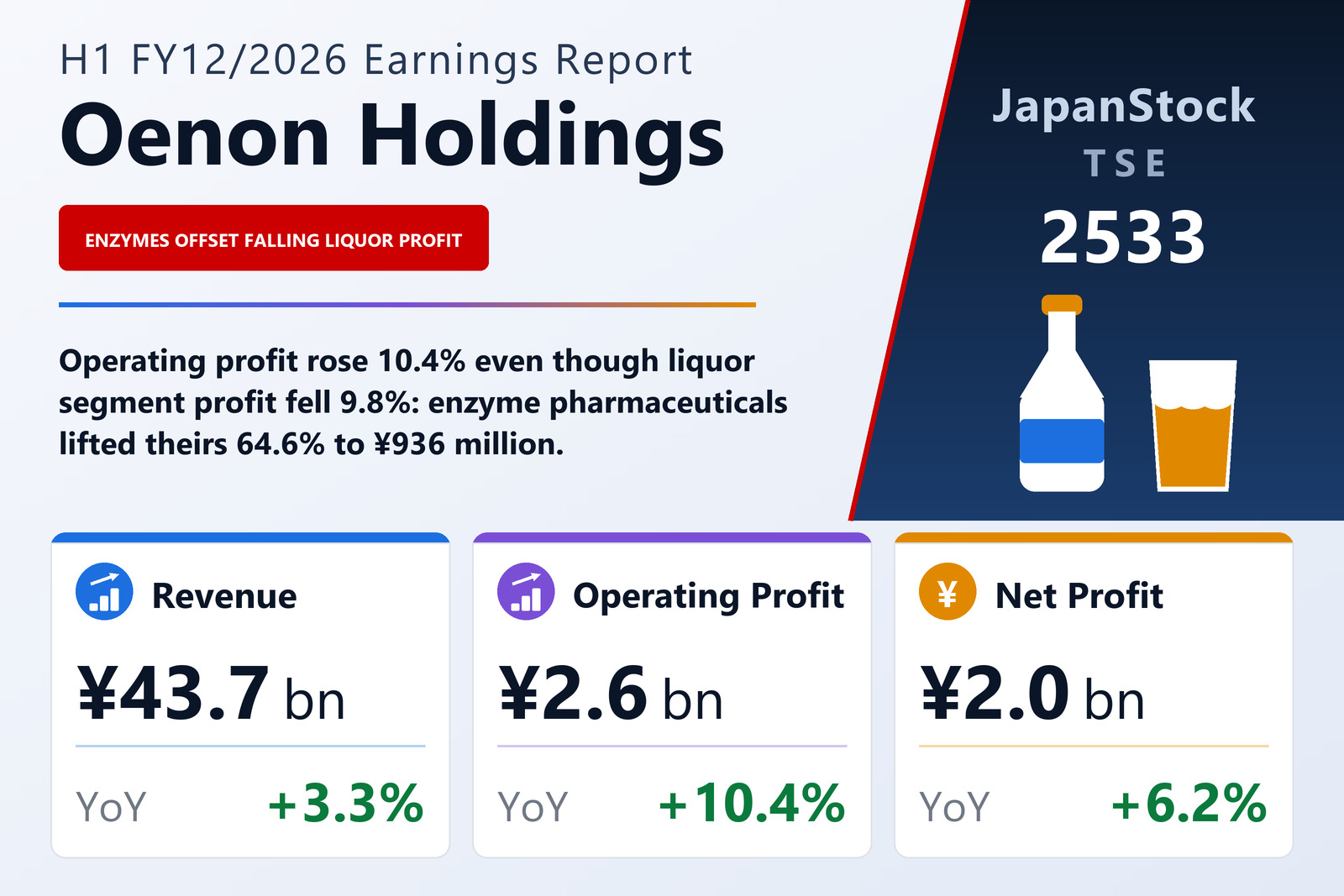
Oenon Holdings, Inc. (TSE: 2533), the Japanese group that makes shochu, chuhai, sake, synthetic sake, mirin and Western spirits, supplies alcohol for beverage and industrial use, and runs enzyme-pharmaceutical and real-estate businesses alongside them, published consolidated first-half results for the six months from January 1 to June 30, 2026 on August 6, 2026 under Japanese GAAP. Revenue rose 3.3% to ¥43,673 million, operating profit 10.4% to ¥2,557 million, ordinary profit 10.5% to ¥2,650 million and profit attributable to owners of the parent 6.2% to ¥1,970 million, for earnings of ¥35.06 per share against ¥32.57. The filing gives the listing as the Tokyo Stock Exchange and names no market segment.
The group arithmetic is narrow but positive. Cost of sales rose 2.7% to ¥35,496 million against revenue growth of 3.3%, so gross profit grew faster than either, 6.0% to ¥8,177 million, and the gross margin widened from 18.3% to 18.7%. Selling, general and administrative expenses rose 4.1% to ¥5,620 million — faster than revenue, but slower than gross profit — leaving operating profit up 10.4% and the operating margin at 5.9% against 5.5%. On a group view the half looks like modest, orderly improvement. The segment note says something different.
Alcoholic beverages sold more and earned less
The drinks business is 92% of group revenue, and it grew: segment sales to external customers were ¥39,997 million, up 2.4%. Segment profit went the other way, falling 9.8% to ¥1,219 million. The company publishes its own bridge for that ¥132 million decline, and it is unusually explicit: higher volume added ¥110 million of gross profit and higher selling prices added ¥250 million, but rising raw-material costs took ¥380 million out of it and personnel and other selling costs a further ¥150 million, with product mix adding back ¥38 million. Price increases, in other words, recovered about two thirds of the input-cost rise and none of the cost inflation below it.
Underneath the segment total the product lines moved together rather than apart. Shochu, the largest line, rose 1.2% to ¥17,387 million — within it, kourui shochu slipped 0.4% to ¥5,895 million while otsurui shochu rose 2.1% to ¥11,492 million. Chuhai and other ready-to-drink products rose 3.3% to ¥9,741 million, sake 2.4% to ¥1,748 million, synthetic sake 2.5% to ¥861 million and alcohol sold as a raw material 0.7% to ¥6,933 million; only mirin fell, 3.4% to ¥163 million. Western spirits were the fastest-growing line at ¥2,778 million, up 11.6%. The company attributes the shochu gain to its blended "Sugomugi" and "Sugoimo" and authentic "Hakata no Hana" ranges offsetting weaker private-label volume, the RTD gain to private-label products and its "NIPPON PREMIUM" regional-ingredient chuhai, and the Western-spirits gain to chuhai concentrates and its "Kokun" whisky, with raw-material Western spirits declining. Within the alcohol line, beverage-grade alcohol was firm and industrial alcohol fell. The backdrop it describes for the category is a shrinking, ageing population, fewer drinking occasions and thriftier consumers — in its own words, intensifying competition.
The whole of the half's growth happened in the first quarter
The company's supplementary materials break the half into quarters, and the second one reverses the first. In April–June 2026 revenue fell 1.9% to ¥22,406 million, gross profit fell 6.5% to ¥4,177 million while SG&A still rose, and operating profit fell 20.4% to ¥1,289 million, ordinary profit 20.5% to ¥1,337 million and net profit attributable to owners 21.9% to ¥1,030 million, or ¥18.37 per share against ¥23.15. The drinks segment carried that reversal almost alone: its second-quarter sales fell 2.7% to ¥20,589 million and its profit 47.6% to ¥583 million. Every figure reported for the half is therefore a first-quarter figure diluted by a weaker second, and the filing offers no separate commentary on the quarter.
Enzymes are 6.8% of revenue and all of the profit growth
The enzyme-pharmaceutical segment reported revenue of ¥2,966 million, up 17.8%, and segment profit of ¥936 million, up 64.6%, which the company puts down to strong overseas enzyme sales and to contract fermentation work. That is ¥367 million of additional profit from a business worth 6.8% of group revenue, against the drinks segment's ¥132 million decline — so the group's ¥240 million operating-profit increase is more than accounted for by the smaller business, with the larger one subtracting from it. Real estate was flat and highly profitable: revenue ¥665 million, up 0.7%, profit ¥396 million, up 1.7%, a margin near 60% that turns 1.5% of group revenue into roughly 15% of group operating profit. The remaining warehousing and cargo-handling operations, reported as Other, contributed ¥43 million of revenue and ¥5 million of profit. Segment revenues are sales to external customers and sum to group revenue apart from the rounding the filing's truncation to whole millions introduces.
Below the operating line, and a balance sheet that shrank
Non-operating income of ¥207 million against expenses of ¥114 million — the income helped by subsidies, the expense including ¥76 million of interest — lifted ordinary profit slightly faster than operating profit, to ¥2,650 million, up 10.5%. Below it the year-earlier period was the stronger one: extraordinary income fell to ¥89 million from ¥120 million as gains on fixed-asset sales halved to ¥69 million, and extraordinary losses rose to ¥33 million from ¥23 million. Pre-tax interim profit was ¥2,706 million, up 8.4%, income taxes ¥728 million and interim profit ¥1,978 million; non-controlling interests took ¥7 million this year against a ¥3 million loss last year, so profit attributable to owners of the parent rose only 6.2% where operating profit rose 10.4%. Comprehensive income was ¥2,209 million, up 20.0%, lifted by ¥329 million of unrealised gains on securities.
Total assets fell ¥3,420 million to ¥55,815 million against December 31, 2025, as trade receivables dropped ¥5,037 million to ¥14,690 million on the business's seasonality and inventories rose ¥1,829 million to ¥10,251 million. Liabilities fell further, by ¥4,684 million to ¥27,575 million: accrued liquor tax alone came down ¥3,728 million to ¥5,045 million and accrued expenses ¥1,305 million, while short-term borrowings rose ¥2,500 million to ¥4,450 million. Net assets rose ¥1,264 million to ¥28,240 million on retained earnings. The equity ratio therefore climbed from 44.2% to 49.2% — a five-point move produced mainly by the balance sheet contracting, not by new capital, and one that should be expected to partly unwind as the seasonal liabilities rebuild.
Operating cash flow turned positive by ¥412 million, and stayed small
Operating cash flow was an inflow of ¥35 million against an outflow of ¥377 million a year earlier, a ¥412 million improvement. The composition explains the small number: the ¥5,037 million fall in receivables and ¥2,706 million of pre-tax profit were largely consumed by the ¥3,728 million reduction in accrued liquor tax and the ¥1,829 million build in inventory. Investing cash flow was an outflow of ¥1,109 million, chiefly ¥1,110 million spent on fixed assets, with capital expenditure for the half at ¥525 million against ¥451 million. Financing provided ¥1,021 million, as the ¥2,500 million increase in short-term borrowings funded ¥626 million of dividends, ¥316 million of share buybacks and ¥300 million of long-term debt repayment. Cash and cash equivalents ended the half at ¥826 million, ¥53 million lower than at the year-end. Under a May 12, 2026 board resolution the company bought 649,300 of its own shares during the half, taking treasury stock to ¥3,151 million.
Guidance untouched — and it implies a much weaker second half
Oenon left the full-year FY12/2026 forecast it published on February 10, 2026 unchanged: revenue of ¥89,000 million (+1.6%), operating profit of ¥3,950 million (−4.5%), ordinary profit of ¥4,000 million (−6.8%) and profit attributable to owners of ¥2,900 million (−6.5%), for earnings per share of ¥51.47. Read against the half just delivered, that guidance is demanding in one direction and undemanding in the other. It puts 49.1% of guided full-year revenue in the first half but 64.7% of guided operating profit, leaving an implied second half of about ¥1,393 million of operating profit against the ¥1,820 million earned in the second half of 2025. The filing does not explain that implied decline; it says only that the forecast is unrevised.
The segment detail behind the forecast points the same way as the half. Full-year drinks profit is guided to ¥1,900 million against ¥2,555 million in 2025, a 25.7% fall, while enzyme pharmaceuticals are guided to ¥1,270 million against ¥807 million, up 57.3% — the same division of labour the first half showed, deepened. On revenue the plan is for drinks to add 0.8% to ¥82,240 million and enzymes to add 14.9% to ¥5,335 million. The dividend forecast was also left unrevised at ¥12.00 per share for the year against ¥11.00, up 9.1%, all of it at the year-end with no interim payment; no payment start date is given. That is a payout of about 23% of the ¥51.47 of guided earnings per share.
| Metric | H1 FY12/2026 | H1 FY12/2025 | Change |
|---|---|---|---|
| Revenue (¥ million) | 43,673 | 42,268 | +3.3% |
| Cost of sales (¥ million) | 35,496 | 34,553 | +2.7% |
| Gross profit (¥ million) | 8,177 | 7,714 | +6.0% |
| Gross margin | 18.7% | 18.3% | +0.4 pt |
| SG&A expenses (¥ million) | 5,620 | 5,397 | +4.1% |
| Operating profit (¥ million) | 2,557 | 2,316 | +10.4% |
| Operating margin | 5.9% | 5.5% | +0.4 pt |
| Ordinary profit (¥ million) | 2,650 | 2,398 | +10.5% |
| Net profit attrib. to owners of parent (¥ million) | 1,970 | 1,855 | +6.2% |
| EPS (¥) | 35.06 | 32.57 | +7.6% |
| Comprehensive income (¥ million) | 2,209 | 1,841 | +20.0% |
| Alcoholic Beverages — revenue (¥ million) | 39,997 | 39,044 | +2.4% |
| Alcoholic Beverages — segment profit (¥ million) | 1,219 | 1,352 | −9.8% |
| Enzymes & Pharmaceuticals — revenue (¥ million) | 2,966 | 2,517 | +17.8% |
| Enzymes & Pharmaceuticals — segment profit (¥ million) | 936 | 568 | +64.6% |
| Real Estate — revenue (¥ million) | 665 | 660 | +0.7% |
| Real Estate — segment profit (¥ million) | 396 | 389 | +1.7% |
| Other — revenue (¥ million) | 43 | 44 | −2.1% |
| Other — segment profit (¥ million) | 5 | 6 | −16.7% |
| Total assets (¥ million) | 55,815 | 59,235 | −5.8% |
| Net assets (¥ million) | 28,240 | 26,976 | +4.7% |
| Equity ratio | 49.2% | 44.2% | +5.0 pt |
| Capital expenditure (¥ million) | 525 | 451 | +16.6% |
| FY12/2026 guidance — revenue (¥ million) | 89,000 | — | +1.6% |
| FY12/2026 guidance — operating profit (¥ million) | 3,950 | — | −4.5% |
| FY12/2026 guidance — ordinary profit (¥ million) | 4,000 | — | −6.8% |
| FY12/2026 guidance — net profit (¥ million) | 2,900 | — | −6.5% |
| FY12/2026 guidance — EPS (¥) | 51.47 | — | — |
| Annual dividend per share (¥) | 12.00 | 11.00 | +9.1% |
JapanStockPulse provides informational content only and does not constitute investment advice. Figures are taken from the company's published earnings short report and may be subject to subsequent revision.