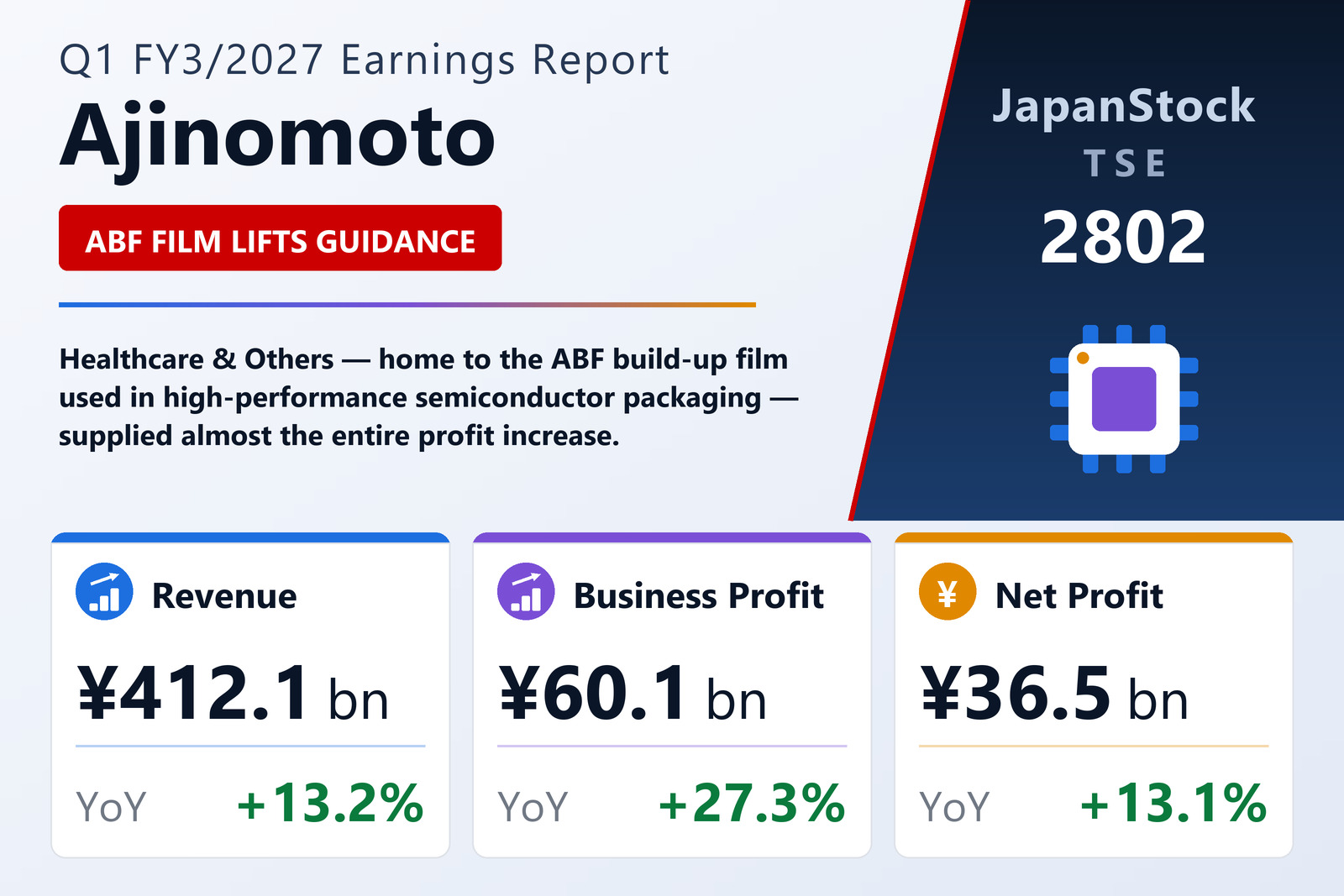
Ajinomoto Co., Inc. (TSE: 2802), the Tokyo-based group behind AJI-NO-MOTO seasoning, Gyoza frozen dumplings and a portfolio of amino-acid science businesses, reported consolidated first-quarter results for the year to March 2027 under IFRS. Revenue for the three months to June 30 rose 13.2% to ¥412,105 million, business profit — the group's headline earnings measure — climbed 27.3% to ¥60,116 million, profit before tax rose 14.4% to ¥54,994 million and profit attributable to owners of the parent gained 13.1% to ¥36,452 million. Basic earnings per share were ¥38.11, against ¥32.62 a year earlier. Alongside the results, the company under president and chief executive Shigeo Nakamura raised the full-year forecast it had issued on May 7.
Electronic materials for AI servers carry the quarter
The swing factor sits outside the food aisle. Healthcare & Others — the segment that houses Ajinomoto Build-up Film (ABF), the insulating layer used in the packaging substrates of high-performance processors — grew first-quarter revenue 22.8% to ¥97.0 billion, an increase of ¥18.0 billion, while its business profit surged 63.3% to ¥25.1 billion, up ¥9.7 billion. That single segment therefore contributed roughly three-quarters of the group's ¥12.8 billion business-profit gain while accounting for less than a quarter of revenue. Segment business margin reached about 25.9%, several times the group average, and management pointed to strong demand for electronic materials used in high-performance substrates for AI accelerators, servers and networking equipment. The same demand is what allowed the company to lift its full-year numbers: Ajinomoto explicitly stated that the entire revenue and business-profit upgrade came from Healthcare & Others, with the Seasonings & Foods and Frozen Foods forecasts left exactly where they were in May.
Seasonings hold up; Frozen Foods margin slips
The core food business remained solid without being spectacular. Seasonings & Foods, still the largest unit by some distance, lifted revenue 11.9% to ¥238.7 billion and business profit 13.0% to ¥41.0 billion, a segment margin of roughly 17.2%. Frozen Foods was the weak spot: revenue rose 5.6% to ¥72.5 billion, but business profit fell 23.2% to ¥2.1 billion from ¥2.7 billion, compressing the segment margin to about 2.9% from 3.9% and underlining how thin the returns are in that category relative to the rest of the group. The residual Other segment grew revenue 29.8% to ¥3.7 billion while its business profit slipped 14.0% to ¥1.6 billion, and corporate and common costs widened 7.2% to a ¥9.9 billion charge against segment profit. Segment figures are disclosed in units of ¥100 million, so the components do not add precisely to the consolidated total.
What Ajinomoto means by "business profit"
Readers comparing Ajinomoto with other IFRS reporters should note that "business profit" (事業利益) is a management-defined subtotal, not an IFRS-mandated line. Ajinomoto calculates it as revenue less cost of sales, selling expenses, research and development expenses and general and administrative expenses, plus its share of profit of associates and joint ventures. Critically, it excludes other operating income and other operating expenses — impairments, disposal gains and losses, restructuring charges and similar items — which is precisely why it moves differently from the statutory lines beneath it. That divergence is visible this quarter: business profit rose 27.3%, but profit before tax advanced only 14.4% and net profit attributable to owners 13.1%, so items sitting below the business-profit line consumed roughly half of the operational improvement. On the group's own preferred measure, the business-profit margin widened to about 14.6% from 13.0%.
Balance sheet expands on a large financing inflow
Total assets grew to ¥1,940,438 million at June 30 from ¥1,812,346 million three months earlier, a ¥128.1 billion increase. Total equity was broadly flat at ¥848,397 million against ¥844,275 million, and equity attributable to owners of the parent edged up to ¥774,552 million from ¥770,819 million — so the owners' equity ratio fell to 39.9% from 42.5% as the asset base outgrew the capital base. The driver is visible in the cash-flow statement: financing activities produced a net inflow of ¥93,639 million, nearly three times the ¥34,010 million of the prior-year quarter. Operating cash flow, by contrast, softened to ¥18,409 million from ¥30,419 million, and investing outflows narrowed to ¥22,542 million from ¥28,983 million. Cash and cash equivalents ended the quarter at ¥196,979 million, essentially unchanged from ¥197,921 million a year earlier. Total comprehensive income nearly doubled, rising 97.5% to ¥48,702 million from ¥24,664 million, reflecting currency and valuation movements below the profit line. There were no significant changes in the scope of consolidation during the quarter and no material subsequent events.
Guidance raised, with Middle East risk now inside the numbers
Ajinomoto revised its FY3/2027 forecast upward across the top three lines. It now guides to revenue of ¥1,732,000 million (+9.4% year on year), ¥9.0 billion above the May 7 plan; business profit of ¥202,000 million (+11.5%), up ¥5.0 billion; and profit attributable to owners of the parent of ¥123,500 million, up ¥3.5 billion — though that line still implies an 8.3% decline year on year, a reminder that the prior year carried items below the business-profit line that will not repeat. Forecast basic earnings per share is ¥129.84, and the guidance assumes a full-year exchange rate of ¥150 to the U.S. dollar. The company said the revision reflects a re-review of economic and sales conditions and of raw-material costs, including the impact of heightened Middle East tensions that had not previously been factored in. First-quarter progress against the revised targets is running comfortably: 23.8% of guided revenue, 29.8% of business profit and 29.5% of net profit. By segment, Seasonings & Foods has delivered ¥238.7 billion of a ¥998.6 billion full-year revenue target (23.9%) and ¥41.0 billion of ¥145.9 billion in business profit (28.1%); Frozen Foods ¥72.5 billion of ¥310.6 billion (23.4%) and ¥2.1 billion of ¥12.1 billion (17.7%); Healthcare & Others ¥97.0 billion of ¥406.8 billion (23.8%) and ¥25.1 billion of ¥85.0 billion (29.6%); and Other ¥3.7 billion of ¥15.8 billion (23.6%) and ¥1.6 billion of ¥5.1 billion (32.4%), against a full-year corporate cost allowance of ¥46.2 billion. The dividend forecast is unchanged from the previous announcement; FY3/2026 paid ¥48.00 a share for the year, split evenly between a ¥24.00 interim and a ¥24.00 year-end payment.
| Metric | Q1 FY3/2027 | Q1 FY3/2026 | YoY |
|---|---|---|---|
| Revenue (¥ billion) | 412.11 | 364.01 | +13.2% |
| Business profit (¥ billion) | 60.12 | 47.24 | +27.3% |
| Business profit margin (%) | 14.6 | 13.0 | +1.6pt |
| Profit before tax (¥ billion) | 54.99 | 48.07 | +14.4% |
| Profit attrib. to owners (¥ billion) | 36.45 | 32.22 | +13.1% |
| Basic EPS (¥) | 38.11 | 32.62 | +16.8% |
| FY3/2027 revenue guidance (¥ billion) | 1,732.00 | — | +9.4% |
| FY3/2027 business profit guidance (¥ billion) | 202.00 | — | +11.5% |
| FY3/2027 profit attrib. guidance (¥ billion) | 123.50 | — | −8.3% |
JapanStockPulse provides informational content only and does not constitute investment advice. Figures are taken from the company's published earnings short report and may be subject to subsequent revision.