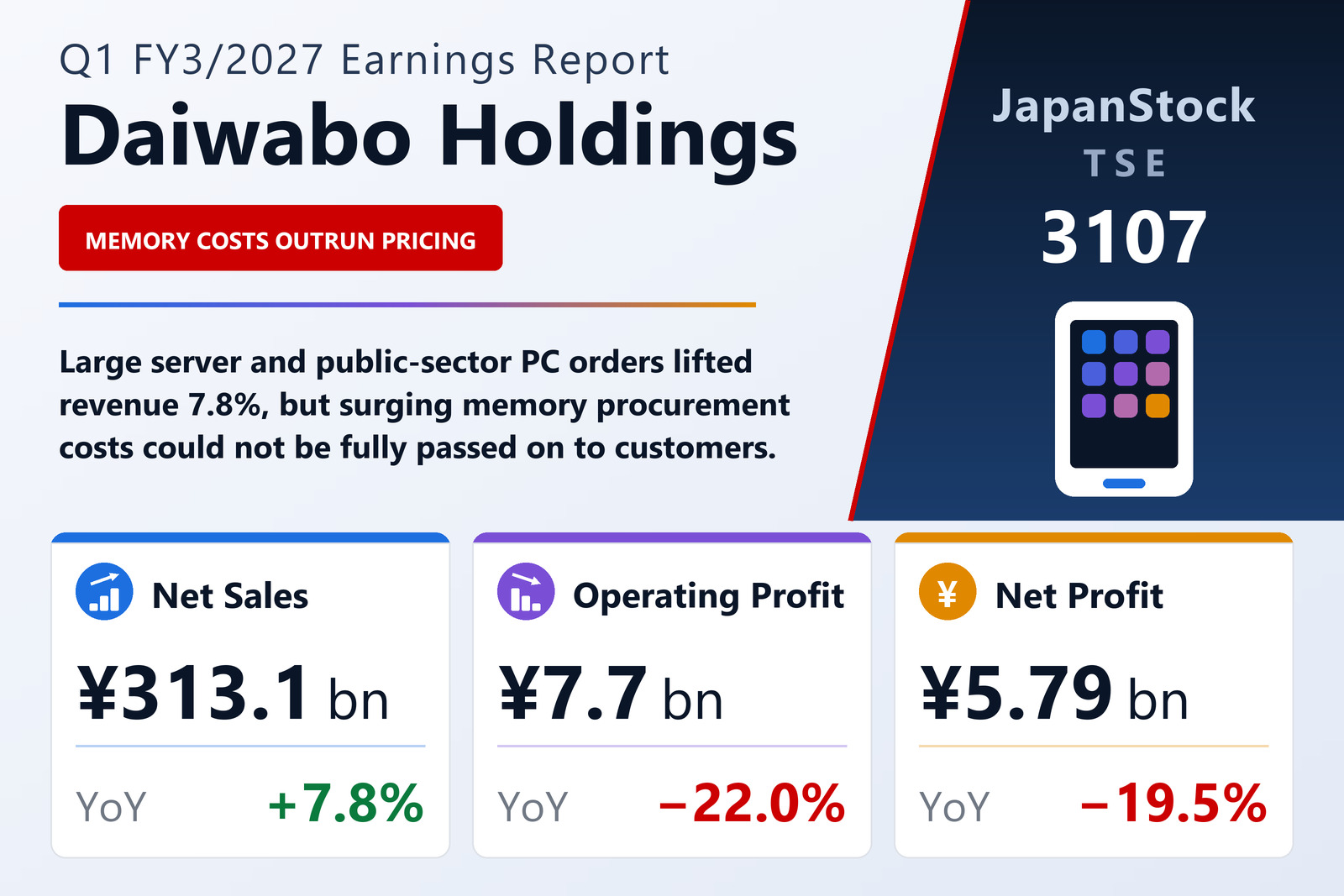
Daiwabo Holdings Co., Ltd. (TSE: 3107) reported consolidated first-quarter results for the fiscal year ending March 2027 under Japanese GAAP on August 6. Net sales rose 7.8% to ¥313,148 million, but operating profit fell 22.0% to ¥7,701 million, ordinary profit slipped 22.1% to ¥7,873 million and profit attributable to owners of the parent declined 19.5% to ¥5,795 million. Basic earnings per share came in at ¥66.82 against ¥80.19 a year earlier. It was close to the mirror image of the year-earlier quarter, when the same business had delivered a 27.5% jump in sales and a 131.1% surge in operating profit: this time the group moved appreciably more product and kept appreciably less of it.
Revenue up, every profit line down
The gap between the top and the bottom of the income statement is the whole story of the quarter. Operating margin narrowed to 2.5% from 3.4% — on a business this thin, nine-tenths of a percentage point is more than a quarter of the margin — and ¥22,547 million of incremental revenue came alongside a ¥2,175 million fall in operating profit. Comprehensive income held up far better, at ¥6,748 million against ¥6,957 million, a decline of only 3.0%, because items routed outside profit or loss moved in the group's favour even as reported earnings fell. Earnings per share fell 16.7%, less than the 19.5% drop in net profit, thanks to a smaller share count: the weighted average number of shares outstanding fell to 86,734,574 from 89,726,349 after continued buybacks.
IT infrastructure distribution: more boxes, thinner margins
The IT Infrastructure Distribution business — the group's Daiwabo Joho System operation, and the source of 99% of consolidated revenue — grew net sales 8.1% to ¥310,098 million while operating profit fell 21.4% to ¥7,461 million. Management is blunt about the cause. With AI demand driving memory prices sharply higher and PC prices rising across the market, the company bought strategically ahead of announced increases in order to hold its own supply prices steady, but could not pass the full rise in materials and procurement costs through to selling prices. A heavy weighting of large-ticket contracts, which carry lower percentage margins, compounded the squeeze; both profit and profit margin finished below the prior year.
On the demand side every channel grew. Corporate sales rose despite a payback in PC demand after the Windows 10 end-of-support cycle, carried by large server-led projects. Public-sector sales rose on a run of PC contracts. Education rose even though the peak of the second phase of the GIGA School programme has passed, helped by high-school GIGA deployments and large school-administration systems. Consumer sales rose through both e-commerce and mass retailers. Alongside the hardware, the company continued to recruit new technology vendors, develop its own services and expand subscription revenue through its iKAZUCHI subscription-management portal — the strategic answer to a distribution model whose box margins are being compressed.
Industrial machinery: the order book builds while sales slip
The much smaller Industrial Machinery segment posted net sales of ¥3,050 million, down 21.1%, and operating profit of ¥236 million, down 37.7%. The decline is a timing story rather than a demand story. In machine tools, orders rose sharply year on year as shipbuilding and energy customers stayed strong and the core aircraft industry continued to recover — but revenue fell because the prior-year quarter included the delivery of large machines and because this year's revenue is expected to concentrate in the second quarter. The automatic machinery division was weaker on substance, with unit sales of core products below the prior year and both sales and profit down accordingly. Between them the two divisions account for about 1% of group revenue and 3% of segment operating profit; the swing factor for Daiwabo remains distribution.
Inventory build lifts the balance sheet; buybacks trim net assets
Total assets grew ¥14,873 million to ¥476,946 million over the three months, driven mainly by an increase in merchandise and finished goods — consistent with management's description of buying ahead of price rises. That inventory was funded with debt: liabilities rose ¥14,941 million to ¥307,185 million, chiefly through short-term borrowings. Net assets edged down ¥67 million to ¥169,761 million as retained earnings were offset by treasury share purchases; the treasury holding rose to 2,153,637 shares from 1,565,462 while issued shares were unchanged at 88,479,028. With assets growing and equity flat, the equity ratio fell to 35.6% from 36.8%. Daiwabo does not present a full cash-flow statement at the first quarter, but the direction is legible from the balance sheet alone: working capital absorbed cash, and short-term debt filled the gap.
Guidance untouched — and it still assumes a double-digit revenue decline
The company left the full-year forecast it published on May 13 completely unchanged. For the year to March 2027 it continues to guide to net sales of ¥1,189,000 million (−12.0%), operating profit of ¥36,500 million (−17.4%), ordinary profit of ¥36,700 million (−18.3%) and net profit of ¥25,300 million (−21.0%), for earnings per share of ¥291.09. First-half guidance is net sales of ¥567,050 million (−13.7%) and operating profit of ¥16,500 million (−26.5%). Measured against those targets the first quarter delivered 55.2% of the half-year sales but only 46.7% of the half-year operating profit, and 26.3% and 21.1% of the respective full-year figures. The arithmetic implies a second quarter of roughly ¥253,900 million in sales and ¥8,800 million in operating profit — a sequential revenue step down of about 19% — leaving ¥621,950 million of sales and ¥20,000 million of operating profit for the second half. A guided full-year revenue decline sits awkwardly beside a first quarter that grew 7.8%, and reflects the fading of the Windows 10 replacement and GIGA School waves that inflated the comparative year.
On shareholder returns the message is more comfortable. The dividend forecast is also unchanged at ¥55.00 at the interim and ¥55.00 at the year-end, for ¥110.00 for the year, up from ¥105.00 in FY3/2026 (a ¥50.00 interim and a ¥55.00 year-end). That is a rise of about 4.8% in a year in which net profit is guided to fall more than 20%, and equates to a payout ratio of roughly 38% on guided EPS. There were no changes to the scope of consolidation, no changes in accounting policy or estimates, and the quarterly statements were not reviewed by an accounting auditor. Supplementary explanatory materials were prepared and an earnings briefing was held alongside the release.
| Metric | Q1 FY3/2027 | Q1 FY3/2026 | YoY |
|---|---|---|---|
| Net sales (¥ mn) | 313,148 | 290,601 | +7.8% |
| Operating profit (¥ mn) | 7,701 | 9,876 | −22.0% |
| Ordinary profit (¥ mn) | 7,873 | 10,111 | −22.1% |
| Profit attrib. to owners of parent (¥ mn) | 5,795 | 7,195 | −19.5% |
| Comprehensive income (¥ mn) | 6,748 | 6,957 | −3.0% |
| Basic EPS (¥) | 66.82 | 80.19 | −16.7% |
| Operating margin | 2.5% | 3.4% | −0.9 pt |
| IT Infrastructure Distribution — net sales (¥ mn) | 310,098 | — | +8.1% |
| IT Infrastructure Distribution — operating profit (¥ mn) | 7,461 | — | −21.4% |
| Industrial Machinery — net sales (¥ mn) | 3,050 | — | −21.1% |
| Industrial Machinery — operating profit (¥ mn) | 236 | — | −37.7% |
| Total assets (¥ mn, vs. Mar 31, 2026) | 476,946 | 462,072 | +3.2% |
| Equity ratio | 35.6% | 36.8% | −1.2 pt |
| FY3/2027 guidance — net sales (¥ mn) | 1,189,000 | — | −12.0% |
| FY3/2027 guidance — operating profit (¥ mn) | 36,500 | — | −17.4% |
JapanStockPulse provides informational content only and does not constitute investment advice. Figures are taken from the company's published earnings short report and may be subject to subsequent revision.