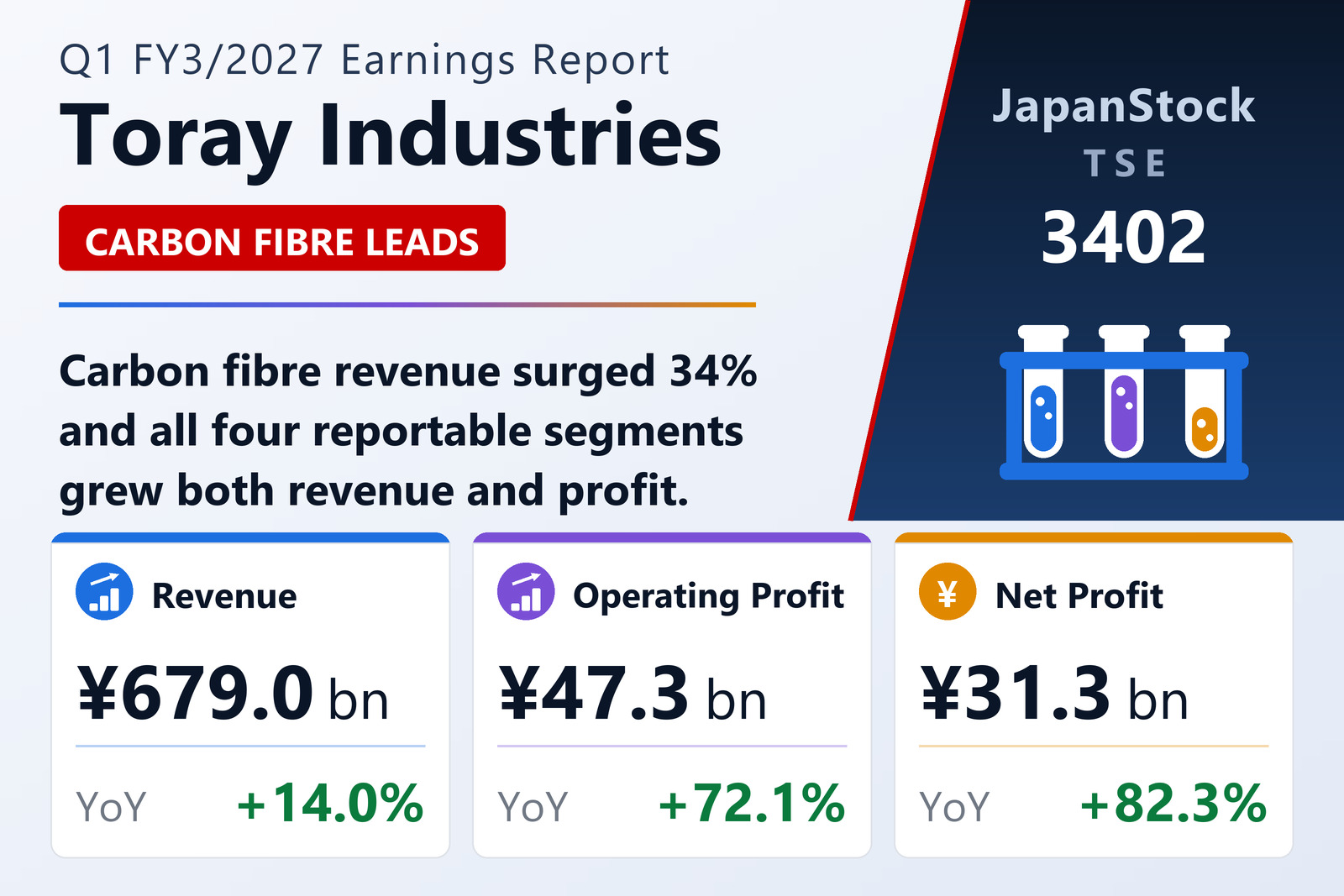
Toray Industries, Inc. (TSE: 3402) reported consolidated first-quarter results under IFRS on August 6. The figures cover the three months from April 1 to June 30, 2026 — the opening quarter of the year ending March 2027. Revenue rose 14.0% to ¥678,967 million, core operating income — the company's headline profit measure, defined as operating income excluding non-recurring gains and losses — climbed 66.6% to ¥48,432 million, and operating income rose 72.1% to ¥47,330 million. Profit before tax was ¥49,069 million, up 73.8%, and profit attributable to owners of the parent reached ¥31,262 million, up 82.3%. Basic earnings per share almost doubled, to ¥21.47 from ¥11.16.
The comparison base flatters those percentages and should be stated plainly: in the same quarter a year earlier Toray's core operating income had fallen 20.9% and parent profit had dropped 36.1%. This quarter is a recovery from a weak period, not a step onto new ground. Even so, the absolute numbers are the group's strongest opening quarter in years, and the improvement is unusually broad — all four reportable segments and the "Other" grouping raised revenue and profit simultaneously, which is not something Toray has managed often across a portfolio spanning apparel fibres, engineering plastics, optical and capacitor films, carbon fiber and reverse-osmosis membranes.
Profit grew nearly five times faster than revenue
The operating leverage is visible line by line. Gross profit rose 21.9% to ¥147,252 million on cost of sales of ¥531,715 million, lifting the gross margin to 21.7% from 20.3%. Selling, general and administrative expenses grew only 9.6% to ¥100,658 million — well below the 14.0% revenue increase — and other income more than tripled to ¥3,705 million against other expenses of ¥2,969 million. The core operating margin widened to 7.1% from 4.9%. Bridging core operating income to reported operating income, Toray added a ¥1,035 million gain on the sale of fixed assets and deducted a ¥1,828 million loss on disposal and a ¥309 million impairment charge, arriving at ¥47,330 million. Below that line, finance income of ¥2,748 million and finance costs of ¥5,116 million were roughly offset, while equity-method income rose to ¥4,107 million from ¥3,059 million, carrying profit before tax to ¥49,069 million. Income tax expense of ¥15,088 million implies an effective rate of 30.7%, down from 34.1%. Total comprehensive income reached ¥35,792 million, up 149.9%, helped by a ¥19,720 million foreign-currency translation gain. One further mechanical point matters: earnings per share rose 92.4% against an 82.3% rise in parent profit, because the weighted average share count fell 5.3% to 1,456,336,917 from 1,537,324,791 after the ¥33,435 million buyback Toray executed in the equivalent quarter a year ago.
Four segments instead of five, effective this quarter
Toray changed its reporting structure with this filing. Under "IGNITION 2028", the medium-term management programme launched in fiscal 2026 and built around return on invested capital as its governing metric, the group repositioned its water-treatment and its pharmaceutical and medical devices businesses as activities sharing a single value axis — human health and quality of life — and merged them into a new Water Treatment & Healthcare segment. Reportable segments therefore fall from five (Fibers & Textiles, Performance Chemicals, Carbon Fiber Composite Materials, Environment & Engineering, and Life Science) to four, with the residual engineering, industrial machinery, housing and construction materials and analysis-services activities now sitting inside "Other". Prior-year segment figures have been restated on the new basis, so the comparisons below are like-for-like.
Fibers & Textiles: price pass-through against a raw-material shock
The group's largest business by revenue posted external sales of ¥259,898 million, up 8.3%, and core operating income of ¥17,972 million, up 18.3%, for a margin of 6.9% against 6.3%. Apparel applications ran into intensified competition from overseas products, and Toray said it concentrated on capturing what demand there was. Industrial applications, led by automotive, returned to a moderate recovery. Both were hit by the surge in raw-material prices flowing from the deterioration of the Middle East situation, and the company's response was explicit: emergency price pass-through combined with cost improvement. That this segment still expanded its margin while absorbing a feedstock shock is the clearest evidence in the filing that Toray's pricing discipline is holding.
Performance Chemicals: films for capacitors and optics drive a 69% profit jump
Performance Chemicals was the quarter's single biggest profit contributor. External revenue rose 14.1% to ¥251,092 million and core operating income jumped 69.4% to ¥23,054 million, widening the margin to 9.0% from 6.1%. Resins and chemicals faced the same Middle East-driven feedstock inflation but pushed price increases through while volumes held solid. Films were the standout: sales into multilayer ceramic capacitors and other electronic-component uses, and into optical applications, both ran strongly — a direct read-through from the AI and semiconductor investment cycle that the company cited as the main support for an otherwise uncertain global economy. Electronic and information materials were mixed: OLED-related and circuit materials suffered from weak Chinese panel demand and intensified competition, while power-inductor applications grew.
Carbon Fiber Composite Materials: aerospace lifts revenue 34%
The fastest-growing part of the group, and the one that most defines Toray's global position as the world's largest carbon fiber producer, delivered external revenue of ¥89,663 million, up 34.1%, and core operating income of ¥7,927 million, up 71.3% — a margin of 8.8% against 6.9%. Toray attributed the advance to steady expansion in aerospace and in space and defence applications, with sports and general industrial uses also on a recovering trend. The filing does not break out volume against price, nor does it quantify individual end-markets, so the aerospace attribution should be read as management's qualitative characterisation rather than a disclosed split. On external revenue the segment is still only 13% of the group; on incremental profit it contributed ¥3,300 million of the ¥18,954 million rise in aggregate segment profit.
Water Treatment & Healthcare and Other
The newly constituted Water Treatment & Healthcare segment more than doubled its profit, with external revenue up 13.8% to ¥40,740 million and core operating income up 126.6% to ¥3,136 million, taking the margin to 7.7% from 3.9%. In water treatment, weak Chinese market conditions persisted, but reverse-osmosis membrane shipments for a large Middle East project and solid sales in the Americas — the business's principal market — carried the result. In pharmaceuticals and medical devices, drug sales were sluggish; the improvement came from shifting the blood-dialyser line-up towards higher value-added products and from cost reduction. The "Other" grouping — comprehensive engineering, industrial machinery, housing, building and civil engineering materials, and analysis and testing services — lifted external revenue 13.2% to ¥37,574 million and more than tripled core operating income to ¥2,439 million from ¥763 million. Corporate items subtracted ¥6,096 million against ¥6,501 million a year earlier, of which unallocated headquarters research expense was ¥5,981 million.
A ¥3.49 trillion balance sheet inflated by the weaker yen
Total assets stood at ¥3,492,091 million at June 30, only ¥15,115 million above the March year-end, with both sides of the balance sheet lifted by the yen translation of overseas subsidiaries. Inventories built up to ¥576,065 million from ¥538,586 million, and assets held for sale jumped to ¥36,597 million from ¥453 million, offsetting declines in trade and other receivables (to ¥620,771 million from ¥642,708 million) and in retirement benefit assets (to ¥90,098 million from ¥114,474 million, after a ¥15,346 million remeasurement loss). Liabilities fell ¥4,986 million to ¥1,544,154 million, driven by current bonds and borrowings dropping to ¥366,627 million from ¥380,968 million and deferred tax liabilities to ¥50,501 million from ¥56,534 million, partly offset by non-current bonds and borrowings rising to ¥494,947 million. Equity rose ¥20,101 million to ¥1,947,937 million, mainly through other components of equity; equity attributable to owners of the parent reached ¥1,817,139 million and the ratio of equity attributable to owners of the parent improved to 52.0% from 51.8%. Shares issued were unchanged at 1,504,481,403, with treasury shares easing to 47,819,230 from 48,344,096.
Cash flow: inventories absorbed most of the earnings gain
This is the quarter's principal caveat. Operating cash flow rose only 8.6% to ¥54,131 million against an 82.6% rise in profit, because working capital consumed the difference: inventories drew ¥37,913 million of cash against ¥16,356 million a year earlier, and the release from receivables shrank to ¥21,502 million from ¥33,011 million, only partly offset by trade payables contributing ¥12,080 million against a ¥7,563 million outflow. Depreciation and amortisation was ¥34,069 million. A far lighter tax bill helped — income taxes paid fell to ¥16,692 million from ¥38,790 million — but the operating subtotal before interest and tax actually fell, to ¥71,802 million from ¥87,923 million. Investing outflows narrowed to ¥33,186 million from ¥50,607 million as purchases of property, plant, equipment and intangibles were cut 34.8% to ¥32,746 million, so free cash flow swung to a positive ¥20,945 million from a negative ¥751 million. Financing was an outflow of ¥25,005 million against ¥4,953 million, the difference being last year's ¥53,931 million net short-term borrowing raised alongside the buyback; this year net short-term borrowings barely moved at ¥589 million, long-term proceeds of ¥18,539 million ran below ¥25,762 million of repayments, dividends took ¥14,145 million from parent shareholders and ¥2,098 million from non-controlling interests, and there were no treasury share purchases. Cash and equivalents closed at ¥263,929 million, against ¥228,608 million a year earlier.
Interim guidance raised, full year untouched, dividend up 30%
Toray revised its first-half forecast upward. Cumulative six-month revenue is now guided to ¥1,390.0 billion from ¥1,370.0 billion, core operating income to ¥87.0 billion from ¥73.0 billion — a 19.2% increase to the target — and interim profit attributable to owners of the parent to ¥45.0 billion from ¥40.0 billion, with interim EPS of ¥30.90 against ¥27.48. Measured against the prior-year interim actuals of ¥1,234.3 billion, ¥67.9 billion and ¥36.9 billion, that is growth of 12.6%, 28.2% and 21.8%. The implied second quarter is notably more cautious than the first: ¥38.6 billion of core operating income against the ¥48.4 billion just delivered. Management is assuming ¥155 to the dollar for July to September, and flags Middle East-driven fuel and raw-material price spikes and supply constraints, US trade and foreign policy, the trajectory of AI-related demand and continued Chinese weakness as the swing factors. Full-year guidance was left unchanged at revenue of ¥2,830.0 billion (+9.5%), core operating income of ¥160.0 billion (+12.7%), parent profit of ¥90.0 billion (+13.2%) and EPS of ¥61.80 — figures the company says it will revisit at the second-quarter announcement. The first quarter alone has already delivered 30.3% of the full-year core operating income target and 34.7% of the profit target. The dividend forecast is unrevised and generous: an annual ¥26.00 per share against ¥20.00 last year, a 30% increase, split into an interim ¥13.00 — comprising a ¥10.00 ordinary dividend plus a ¥3.00 commemorative dividend — and a year-end ¥13.00.
Soda Aromatic sold to Samyang, ¥8 billion gain due in the second quarter
One transaction sits between the balance sheet and the guidance. On May 29, 2026, Toray signed a share transfer agreement to sell its entire 66% holding in Soda Aromatic Co., Ltd., a Performance Chemicals subsidiary, jointly with Mitsui & Co., which held the remaining 34%, to Samyang Japan Co., Ltd., a subsidiary established by South Korea's Samyang Corporation. At June 30 the company had classified ¥27,303 million of assets and ¥7,665 million of liabilities as held for sale in respect of the deal. The transfer completed on July 1, 2026, and Toray expects to recognise a gain on sale of approximately ¥8.0 billion after tax in the interim period. Because core operating income is defined to exclude non-recurring items, a disposal gain of this kind would land in reported profit and in the ¥45.0 billion interim parent-profit target rather than in the ¥87.0 billion core operating income line — a distinction worth holding onto when the half-year numbers arrive. Toray reported no other material subsequent events, and the quarterly consolidated financial statements were not subject to audit or review.
| Metric | Q1 FY3/2027 | Q1 FY3/2026 | YoY |
|---|---|---|---|
| Revenue (¥ million) | 678,967 | 595,829 | +14.0% |
| Core operating income (¥ million) | 48,432 | 29,073 | +66.6% |
| Operating income (¥ million) | 47,330 | 27,506 | +72.1% |
| Profit before tax (¥ million) | 49,069 | 28,238 | +73.8% |
| Profit for the period (¥ million) | 33,981 | 18,606 | +82.6% |
| Profit attrib. to owners of the parent (¥ million) | 31,262 | 17,151 | +82.3% |
| Basic EPS (¥) | 21.47 | 11.16 | +92.4% |
| Diluted EPS (¥) | 21.44 | 11.14 | +92.5% |
| Total comprehensive income (¥ million) | 35,792 | 14,320 | +149.9% |
| Core operating margin | 7.1% | 4.9% | +2.3 pt |
| Operating cash flow (¥ million) | 54,131 | 49,856 | +8.6% |
| Capital expenditure (¥ million) | 32,746 | 50,230 | −34.8% |
| Total assets (¥ million, vs Mar 31, 2026) | 3,492,091 | 3,476,976 | +0.4% |
| Equity attrib. to owners of the parent (¥ million, vs Mar 31, 2026) | 1,817,139 | 1,800,058 | +0.9% |
| Equity attrib. to owners ratio | 52.0% | 51.8% | +0.2 pt |
| Segment | Revenue (¥ million) | YoY | Core operating income (¥ million) | Prior year (¥ million) | YoY |
|---|---|---|---|---|---|
| Fibers & Textiles | 259,898 | +8.3% | 17,972 | 15,192 | +18.3% |
| Performance Chemicals | 251,092 | +14.1% | 23,054 | 13,608 | +69.4% |
| Carbon Fiber Composite Materials | 89,663 | +34.1% | 7,927 | 4,627 | +71.3% |
| Water Treatment & Healthcare | 40,740 | +13.8% | 3,136 | 1,384 | +126.6% |
| Other | 37,574 | +13.2% | 2,439 | 763 | +219.7% |
| Reportable segment total | 678,967 | +14.0% | 54,528 | 35,574 | +53.3% |
| Corporate & eliminations | — | — | −6,096 | −6,501 | — |
| Consolidated | 678,967 | +14.0% | 48,432 | 29,073 | +66.6% |
JapanStockPulse provides informational content only and does not constitute investment advice. Figures are taken from the company's published earnings short report and may be subject to subsequent revision.