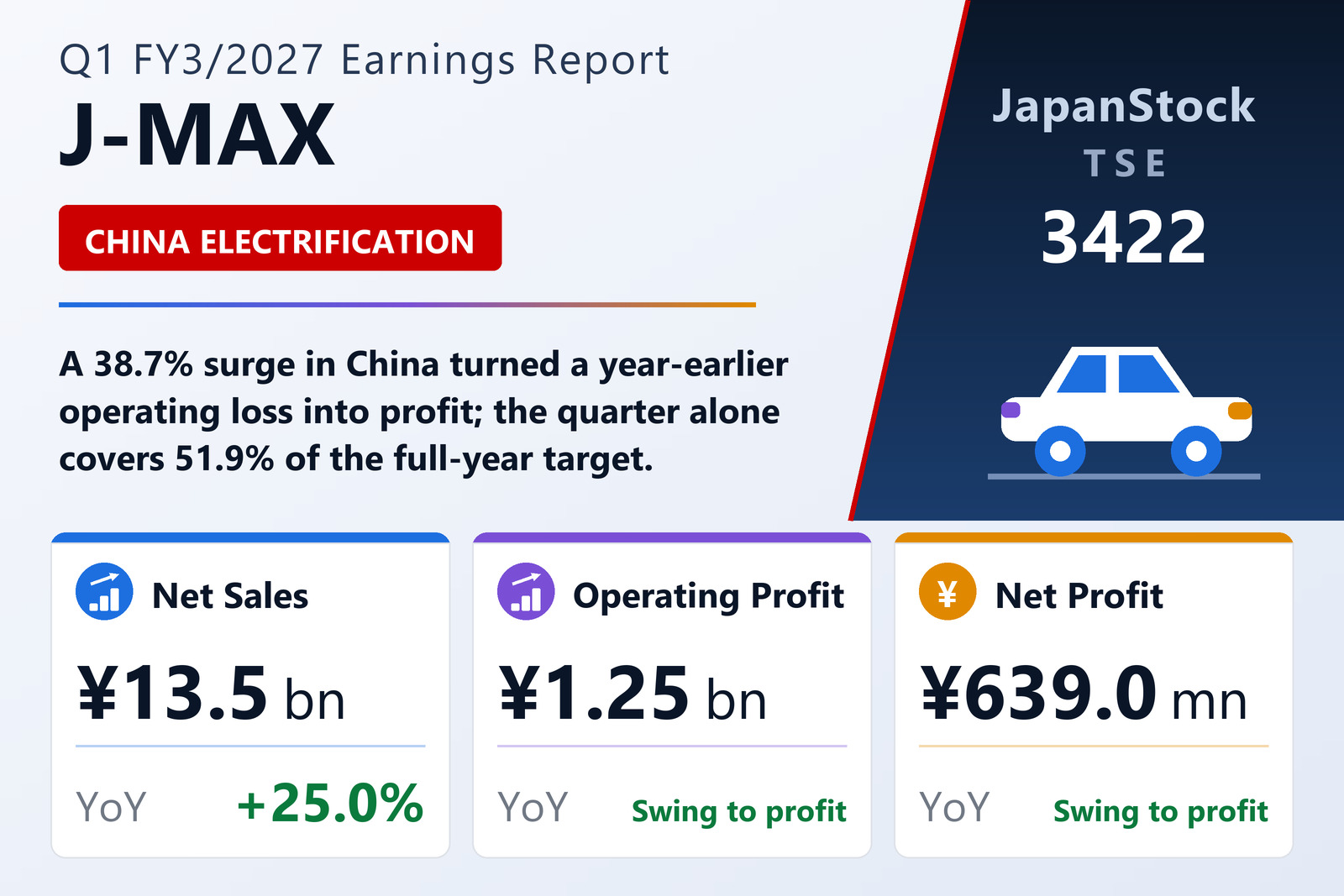
J-MAX Co., Ltd. (TSE / NSE: 3422), the press-formed automotive body and electrification components maker headquartered in Ogaki, Gifu Prefecture, reported consolidated results for the first quarter of the fiscal year ending March 2027 — the three months from April 1 to June 30, 2026 — that swung from loss to profit at every line of the income statement. Net sales rose 25.0% to ¥13,541 million, against ¥10,831 million a year earlier. Operating profit came in at ¥1,245 million, reversing an operating loss of ¥58 million; ordinary profit reached ¥1,088 million against a ¥296 million ordinary loss; and profit attributable to owners of the parent was ¥639 million, against a ¥367 million net loss. Basic earnings per share were ¥55.75, compared with a loss per share of ¥32.02.
A clean sweep from loss to profit
The turnaround was broad rather than cosmetic. All four headline profit lines flipped sign in the same quarter, and comprehensive income swung to a positive ¥1,329 million from a negative ¥1,331 million — a year-on-year movement of roughly ¥2.66 billion once translation adjustments on the group's Thai and Chinese subsidiaries are included. That gap between ordinary profit of ¥1,088 million and operating profit of ¥1,245 million reflects the non-operating cost of financing and currency at a group that carries substantial overseas manufacturing assets, while the step down from ordinary profit to ¥639 million of net profit reflects tax and minority interests across those subsidiaries. J-MAX, led by president Eiji Yamazaki, is in the fourth year of a five-year medium-to-long-term plan built on two pillars: strengthening the legacy press-forming business that supplies Japanese vehicle makers, and creating new businesses centred on electrification. This quarter is the clearest evidence yet that the second pillar is beginning to carry weight.
China does the heavy lifting
By geography, China supplied the swing. Segment net sales rose 38.7% to ¥7,328 million and ordinary profit reached ¥937 million against an ordinary loss of ¥240 million a year earlier. Production of electrification components for vehicle-battery makers rose sharply, and on top of that volume effect the company recovered previously unrecovered die-investment costs on models reaching the end of mass production — a one-time but real contribution. China alone now accounts for about 54% of consolidated sales and more than the whole group's ordinary profit. Japan was the second engine: net sales rose 23.6% to ¥4,925 million and ordinary profit more than doubled, up 101.1% to ¥525 million, as higher output of automotive parts for key customers combined with increased sales of dies and equipment tied to new-model launches, while continued reductions in manufacturing expenses widened the margin. Thailand was the one soft spot on the top line: net sales fell 18.3% to ¥1,350 million as output of parts for key customers dropped for both domestic and export demand, yet ordinary profit still rose 138.1% to ¥43 million on continued cuts to manufacturing and selling, general and administrative expenses — a reminder that the group's cost programme is running in parallel with the volume recovery.
Balance sheet strengthens as the equity ratio climbs
The financial position improved materially over the three months. Total assets edged down to ¥61,495 million at June 30, 2026 from ¥62,109 million at the March year-end, while net assets rose to ¥22,237 million from ¥20,950 million and shareholders' equity to ¥20,404 million from ¥19,150 million. The combination — a slightly smaller balance sheet carrying a larger equity base — lifted the equity ratio to 33.2% from 30.8%, a 2.4-point improvement in a single quarter. For a capital-intensive press-forming business that has been funding die and tooling investment in China and Thailand, that shift matters: it reduces the leverage overhang that has constrained the shares and gives management more room to fund the electrification build-out from retained earnings rather than incremental borrowing.
A harder market than the headline numbers suggest
Management's read of the operating environment is notably more cautious than the results. Globally, the recovery remained gradual: Middle East geopolitical risk and higher crude prices weighed on some regions, offset by firmer consumer spending and rising capital expenditure tied to global AI demand. In the United States, tax cuts under the OBBBA fiscal legislation supported consumption while solid AI demand widened capex growth; in China, infrastructure-led investment picked up but consumer spending stayed soft; in Japan, improving employment and income underpinned a gradual consumer recovery with capex and production holding firm. Within the auto industry the picture is tighter. Japanese new-vehicle sales were solid on stable parts supply and new-model effects, but material, energy and labour costs are rising, and continued U.S. additional tariffs plus tighter trade policy on steel and aluminium keep the outlook uncertain for a company whose core input is pressed metal. In Thailand, high household debt and tighter auto-loan screening kept domestic sales weak while export-bound production stalled on slower overseas demand. In China, as new-energy vehicles spread, aggressive new-model launches by domestic manufacturers have intensified competition, leaving the environment for Japanese vehicle makers difficult and pushing them to review production structures and pursue structural reform — a dynamic that cuts both ways for J-MAX, which sells to Japanese OEMs in Japan but to vehicle-battery makers in China.
Guidance unchanged despite a front-loaded quarter
Against that backdrop, J-MAX left its FY3/2027 forecast entirely unchanged from the previous announcement. For the first half it still guides to net sales of ¥25,000 million (+5.9%), operating profit of ¥1,500 million (+92.9%), ordinary profit of ¥1,100 million (+161.0%), net profit of ¥700 million (+1.2%) and EPS of ¥60.98. For the full year it guides to net sales of ¥50,000 million (−3.7%), operating profit of ¥2,400 million (+29.1%), ordinary profit of ¥1,600 million (+40.2%), net profit of ¥1,000 million (+12.2%) and EPS of ¥87.11. The arithmetic is striking: the first quarter alone delivered 51.9% of the full-year operating profit target and 68.0% of the ordinary profit target, and its ¥13,541 million of sales represent 54.2% of the half-year revenue guide. Either the company expects the die-cost recovery and the China volume surge to fade over the balance of the year, or the forecast is conservative — and the unchanged full-year revenue guide of a 3.7% decline against a quarter that grew 25.0% points to genuine caution about the second half. Shareholders, meanwhile, get a clear signal: the dividend forecast is unchanged but implies ¥8.00 per share for FY3/2027 (¥4.00 interim, ¥4.00 year-end), up from the ¥5.00 actually paid for FY3/2026 (¥2.00 interim, ¥3.00 year-end) — a 60% increase.
| Metric | Q1 FY3/2027 | Q1 FY3/2026 | YoY |
|---|---|---|---|
| Net sales (¥ million) | 13,541 | 10,831 | +25.0% |
| Operating profit / loss (¥ million) | 1,245 | −58 | Swing to profit |
| Ordinary profit / loss (¥ million) | 1,088 | −296 | Swing to profit |
| Profit / loss attrib. to owners (¥ million) | 639 | −367 | Swing to profit |
| Comprehensive income (¥ million) | 1,329 | −1,331 | Swing to profit |
| Basic EPS (¥) | 55.75 | −32.02 | Swing to profit |
| Equity ratio (%) | 33.2 | 30.8 | +2.4pt |
| H1 FY3/2027 net sales guidance (¥ million) | 25,000 | — | +5.9% |
| H1 FY3/2027 operating profit guidance (¥ million) | 1,500 | — | +92.9% |
| FY3/2027 net sales guidance (¥ million) | 50,000 | — | −3.7% |
| FY3/2027 operating profit guidance (¥ million) | 2,400 | — | +29.1% |
| FY3/2027 ordinary profit guidance (¥ million) | 1,600 | — | +40.2% |
| FY3/2027 net profit guidance (¥ million) | 1,000 | — | +12.2% |
| FY3/2027 annual dividend forecast (¥) | 8.00 | 5.00 | +60.0% |
JapanStockPulse provides informational content only and does not constitute investment advice. Figures are taken from the company's published earnings short report and may be subject to subsequent revision.