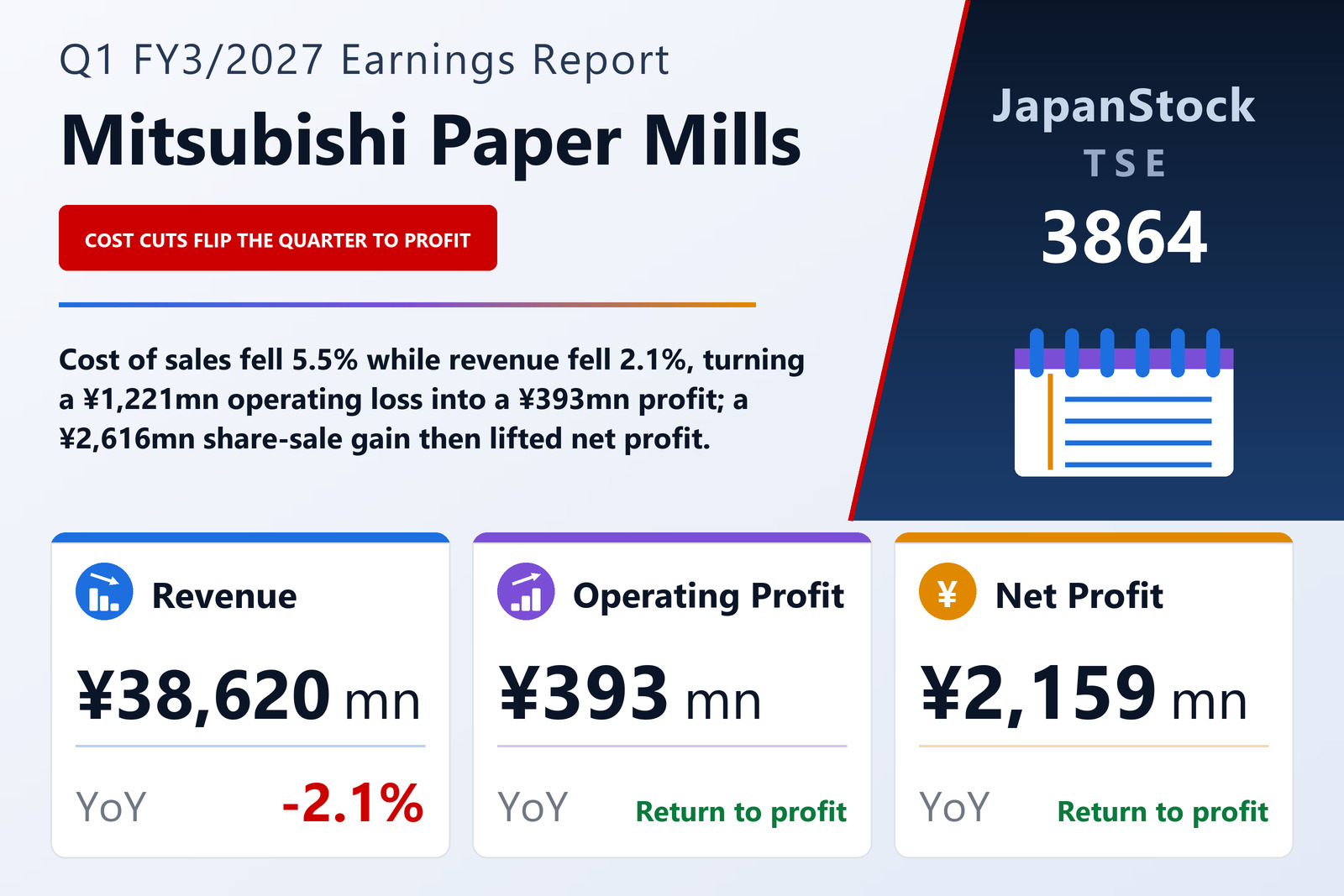
Revenue fell 2.1%, cost of sales fell 5.5%, and the gap between them is the whole swing
Mitsubishi Paper Mills Limited (TSE: 3864), the paper maker whose mills at Hachinohe, Kitakami, Takasago, Kyoto and Fuji turn out printing and packaging paper, market pulp, thermal and carbonless papers and functional materials such as separators for energy-storage devices and water-treatment membrane substrates, published consolidated first-quarter results for the three months from April 1 to June 30, 2026 on August 6, 2026 under Japanese GAAP. Revenue fell 2.1% to ¥38,620 million. Operating profit was ¥393 million against an operating loss of ¥1,221 million a year earlier, ordinary profit ¥611 million against an ordinary loss of ¥1,093 million, and profit attributable to owners of the parent ¥2,159 million against a loss of ¥1,316 million, for earnings of ¥49.29 per share against a loss of ¥30.04. The filing names the Tokyo Stock Exchange as the listing venue and does not state a market segment.
The swing is entirely a cost story, because revenue did not help. Cost of sales fell 5.5% to ¥33,653 million while revenue fell only 2.1%, so gross profit rose 29.2% to ¥4,967 million and the gross margin widened from 9.7% to 12.9%. Selling, general and administrative expenses fell a further 9.7% to ¥4,574 million. Put in money rather than percentages: revenue was ¥841 million lower, gross profit ¥1,122 million higher and SG&A ¥493 million lower, and those last two together account for the ¥1,614 million improvement in operating profit that the company's own segment table records. The operating margin moved from −3.1% to 1.0%. The filing attributes the cost reduction chiefly to the effects of the business restructuring carried out in the previous year at the German subsidiary, Mitsubishi HiTec Paper Europe GmbH, and says those savings came through despite higher raw material and fuel prices.
Why net profit is more than five times operating profit
Below the operating line the quarter changes character. Non-operating income of ¥498 million — dividends received of ¥286 million, a foreign-exchange gain of ¥117 million, other income of ¥84 million, equity-method investment income of ¥7 million and ¥1 million of interest — exceeded non-operating expenses of ¥280 million, of which ¥219 million was interest paid, lifting ordinary profit to ¥611 million. Extraordinary income of ¥2,653 million then arrived, almost all of it a ¥2,616 million gain on sales of investment securities against ¥3 million a year earlier, alongside ¥37 million of gains on disposal of fixed assets. Extraordinary losses were ¥173 million: ¥41 million on disposal of fixed assets and ¥131 million of disaster losses. Pre-tax profit was therefore ¥3,091 million, income taxes ¥929 million and quarterly profit ¥2,162 million, of which ¥2 million was attributable to non-controlling interests. The securities gain on its own is larger than the entire net profit and more than six times the operating profit.
The company explains where those shares came from. During the quarter it sold all of the shares held in its retirement-benefit trust as part of a programme of reducing policy shareholdings under the Corporate Governance Code, taking such holdings to 16% of net assets and meeting ahead of schedule a stated target of below 20%. It says it is in discussion with outside experts on a partial return of the trust assets, is aiming to complete that within the current fiscal year, and would look to apply any proceeds to growth investment and shareholder returns. The other side of the transaction shows up immediately: comprehensive income was only ¥1,037 million against quarterly profit of ¥2,162 million, because other comprehensive income was −¥1,124 million, dominated by a ¥1,072 million negative remeasurement of defined-benefit plans. Against the prior year this is still a wide improvement — comprehensive income was −¥2,225 million — but part of what the income statement recognised was offset inside equity.
Functional Products earned the profit; Paper Materials more than halved its loss
All three reporting segments moved, and only one of them grew. Paper Materials was the largest at ¥20,399 million, up 1.4%, and cut its segment loss from ¥1,218 million to ¥453 million. Functional Products shrank to ¥18,562 million, down 5.5%, yet turned a segment profit of ¥832 million from ¥24 million — a move the filing declines to express as a percentage because it exceeds 1,000%. Engineering, much the smallest, fell 45.8% to ¥838 million on lower outside construction revenue at the engineering subsidiaries, with segment profit down 34.5% to ¥27 million. These segment figures include intersegment sales and transfers of ¥1,179 million, which is why the three add to ¥39,800 million against group revenue of ¥38,620 million; the same elimination removes ¥13 million of profit.
The causes are specific and differ by segment. In Functional Products, separators for energy-storage devices sold more by value on overseas capacitor demand, water-treatment membrane substrates gained despite intensifying competition in China, total heat exchange elements were level on firm United States demand, and nonwovens for building materials, decorative-laminate base paper and tape base paper all rose on price revisions passing through higher raw material costs. Against that, carbonless paper fell on weaker demand and imaging products fell on the reaction to a strong prior-year quarter in Europe, while the German operation saw both volume and sales value fall as European and neighbouring markets stayed weak — even as its own earnings improved on the restructuring. The segment therefore recorded lower revenue and much higher profit. In Paper Materials, printing paper fell on shrinking domestic demand and on raw material and fuel procurement disrupted by the situation in the Middle East, while packaging paper rose on bleached kraft paper at home and on wider export channels, and market pulp rose on exports helped by a newly launched softwood grade. Engineering is the one segment the filing explains in a single line: less outside construction work.
An earthquake at Hachinohe, and a maintenance shutdown moved to November
Two events at the Hachinohe mill sit behind the Paper Materials numbers and pull in opposite directions. An earthquake off Iwate Prefecture on June 25, 2026 registered up to lower-6 on the Japanese intensity scale in Hachinohe, Aomori; some equipment was damaged and production affected, but the company reports no injuries and no environmental impact, and operations resumed after safety checks. The ¥131 million disaster loss booked in extraordinary losses covers restoration costs and part of the fixed costs of the stoppage caused by intermittent earthquakes off Sanriku and Iwate during the quarter, following the December 2025 earthquake off the east coast of Aomori. Pulling the other way, the mill's annual periodic maintenance shutdown — previously held every June, and therefore inside the comparative quarter — has been moved to November from this fiscal year, so the quarter just reported carried none. The filing quantifies neither effect, so how much of the ¥765 million reduction in the Paper Materials loss each accounts for is not disclosed. Separately, the company is pursuing the Reborn60 Hachinohe renewal project announced in December 2025, which envisages ¥25.0 billion of investment by fiscal 2030.
The balance sheet barely grew, but its composition moved
Total assets rose ¥1,787 million to ¥224,564 million from March 31, 2026, an increase of 0.8% that the filing attributes mainly to higher deferred tax assets; within investments and other assets, the line labelled other rose from ¥1,519 million to ¥4,229 million. Liabilities rose ¥1,407 million to ¥120,998 million on higher interest-bearing debt and income taxes payable: commercial paper doubled from ¥3,000 million to ¥6,000 million and income taxes payable more than doubled from ¥4,538 million to ¥10,341 million. Underneath that near-flat total, roughly ¥7.2 billion moved from non-current to current — current liabilities rose from ¥82,286 million to ¥90,914 million while non-current liabilities fell from ¥37,303 million to ¥30,083 million, the latter driven by an other non-current liabilities line falling from ¥11,288 million to ¥4,093 million. Net assets rose ¥380 million to ¥103,566 million, the quarterly profit partly offset by the fall in accumulated remeasurements of defined-benefit plans, and the equity ratio slipped from 46.3% to 46.1%. No quarterly cash flow statement was prepared; depreciation was ¥1,349 million against ¥1,442 million.
Guidance unchanged, and the dividend raised to ¥20.00
Mitsubishi Paper Mills left the full-year FY3/2027 forecast it published on May 14, 2026 untouched: revenue of ¥175,000 million, up 11.1%, operating profit of ¥6,000 million, ordinary profit of ¥6,000 million, up 248.8%, profit attributable to owners of ¥6,500 million, up 242.0%, and earnings of ¥148.31 per share. No percentage change is printed against the operating-profit line, so the prior-year base for it is not disclosed in this document. The filing also carries a first-half line: revenue of ¥85,000 million, up 7.6%, operating profit of ¥1,000 million, ordinary profit of ¥1,000 million, up 176.1%, net profit of ¥2,500 million and earnings of ¥57.04 per share.
Measured against those figures the quarter is well ahead on the bottom line and well behind on the operating one. Revenue of ¥38,620 million is 22.1% of the guided full year and 45.4% of the guided first half, roughly on pace. Operating profit of ¥393 million is only 6.6% of the guided ¥6,000 million, and 39.3% of the ¥1,000 million guided for the first half — so the second quarter is expected to earn more operating profit on its own than the first did, and the second half about ¥5,000 million of the annual total. Profit attributable to owners of ¥2,159 million is already 33.2% of the guided ¥6,500 million, but that reflects the securities gain rather than trading. The dividend forecast was left unrevised at ¥7.00 at the interim and ¥13.00 at the year-end, for an annual ¥20.00 against ¥15.00 for FY3/2026 — a rise of 33.3%, and a payout of about 13% of guided earnings per share. The filing gives no dividend payment start date for this quarter.
| Metric | Q1 FY3/2027 | Q1 FY3/2026 | Change |
|---|---|---|---|
| Revenue (¥ million) | 38,620 | 39,461 | −2.1% |
| Cost of sales (¥ million) | 33,653 | 35,615 | −5.5% |
| Gross profit (¥ million) | 4,967 | 3,845 | +29.2% |
| Gross margin | 12.9% | 9.7% | +3.1 pt |
| SG&A expenses (¥ million) | 4,574 | 5,067 | −9.7% |
| Operating profit (¥ million) | 393 | −1,221 | loss to profit |
| Operating margin | 1.0% | −3.1% | +4.1 pt |
| Ordinary profit (¥ million) | 611 | −1,093 | loss to profit |
| Gain on sales of investment securities (¥ million) | 2,616 | 3 | n.m. |
| Pre-tax profit (¥ million) | 3,091 | −1,153 | loss to profit |
| Net profit attrib. to owners of parent (¥ million) | 2,159 | −1,316 | loss to profit |
| EPS (¥) | 49.29 | −30.04 | loss to profit |
| Comprehensive income (¥ million) | 1,037 | −2,225 | loss to profit |
| Functional Products — revenue (¥ million) | 18,562 | 19,633 | −5.5% |
| Functional Products — segment profit (¥ million) | 832 | 24 | n.m. |
| Paper Materials — revenue (¥ million) | 20,399 | 20,124 | +1.4% |
| Paper Materials — segment profit (¥ million) | −453 | −1,218 | loss narrowed |
| Engineering — revenue (¥ million) | 838 | 1,547 | −45.8% |
| Engineering — segment profit (¥ million) | 27 | 42 | −34.5% |
| Total assets (¥ million) | 224,564 | 222,776 | +0.8% |
| Net assets (¥ million) | 103,566 | 103,185 | +0.4% |
| Equity ratio | 46.1% | 46.3% | −0.2 pt |
| FY3/2027 guidance — revenue (¥ million) | 175,000 | — | +11.1% |
| FY3/2027 guidance — operating profit (¥ million) | 6,000 | — | — |
| FY3/2027 guidance — ordinary profit (¥ million) | 6,000 | — | +248.8% |
| FY3/2027 guidance — net profit (¥ million) | 6,500 | — | +242.0% |
| FY3/2027 guidance — EPS (¥) | 148.31 | — | — |
| Annual dividend per share (¥) | 20.00 | 15.00 | +33.3% |
JapanStockPulse provides informational content only and does not constitute investment advice. Figures are taken from the company's published earnings short report and may be subject to subsequent revision.