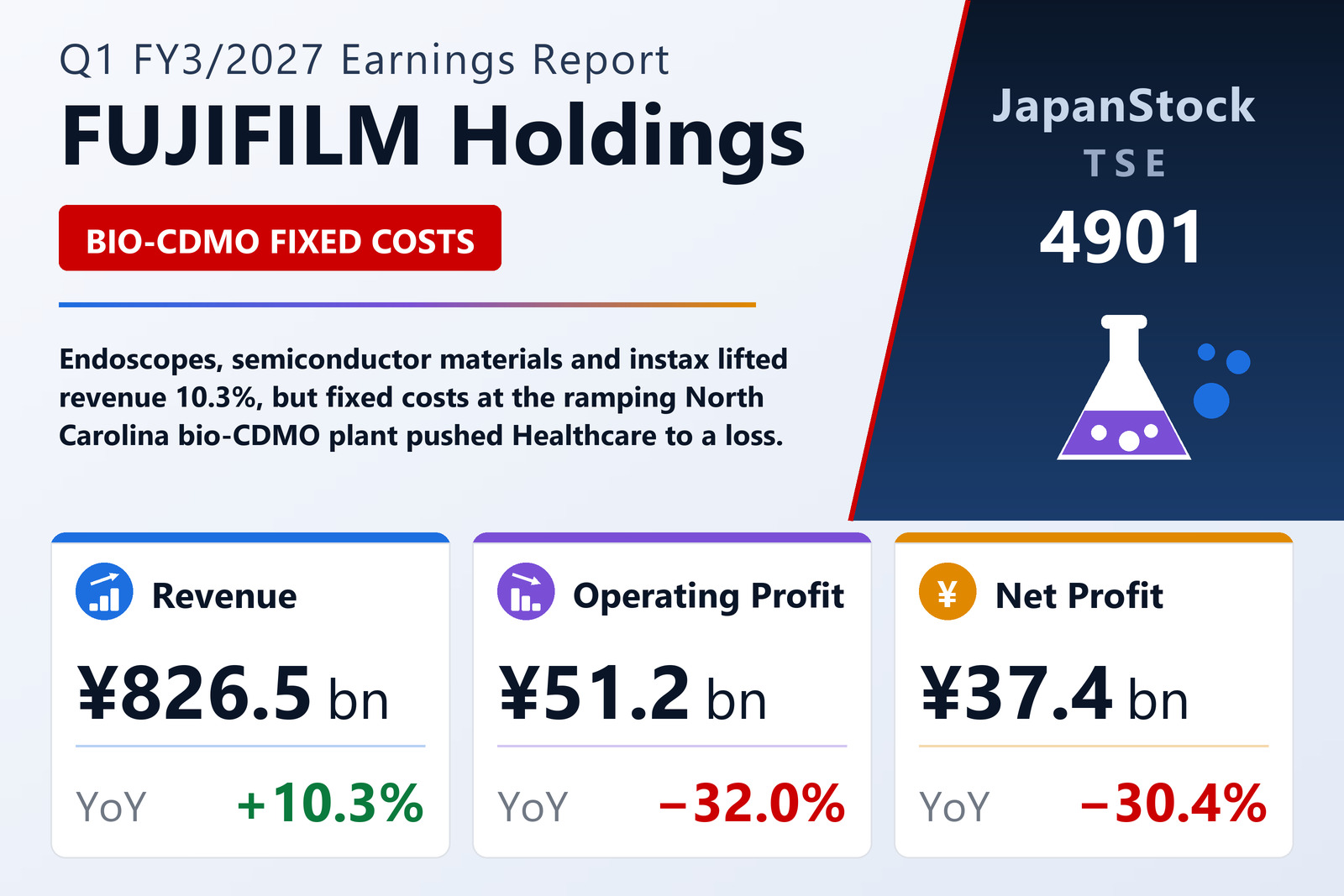
FUJIFILM Holdings Corporation (TSE: 4901) reported first-quarter consolidated results for the fiscal year ending March 2027 on August 6, covering the three months from April 1 to June 30, 2026. Fujifilm reports under U.S. GAAP rather than J-GAAP or IFRS, so the figures below use U.S. GAAP terminology. Revenue rose 10.3% to ¥826,493 million from ¥749,482 million, but operating income fell 32.0% to ¥51,184 million from ¥75,291 million, income before income taxes fell 27.6% to ¥52,100 million, and net income attributable to FUJIFILM Holdings fell 30.4% to ¥37,424 million from ¥53,767 million. Basic earnings per share came to ¥31.26 against ¥44.63, with diluted EPS at ¥31.23. The operating margin compressed to 6.2% from 10.0%. This is emphatically a cost story rather than a demand story: management attributed the growth to medical systems, semiconductor materials and imaging, and the profit decline to bio-CDMO fixed costs in Healthcare, one-time expenses booked to strengthen the Business Innovation cost structure, and higher raw-material prices.
The mechanics are visible one line below revenue. Cost of sales rose 15.1% to ¥503,075 million, well ahead of the 10.3% revenue increase, so gross profit advanced only 3.5% to ¥323,418 million and the gross margin fell to 39.1% from 41.7%. Operating expenses then grew 14.7% to ¥272,234 million, with SG&A up 16.9% to ¥229,949 million and R&D up a comparatively restrained 4.1% to ¥42,285 million. Below the operating line the picture reversed: net non-operating items swung to a positive ¥916 million from negative ¥3,337 million, chiefly because net foreign-exchange losses shrank to ¥495 million from ¥5,984 million and a ¥1,978 million gain on equity securities replaced a ¥659 million loss — which is why pre-tax income fell less (−27.6%) than operating income (−32.0%). Equity in net earnings of affiliates dropped 76.6% to ¥630 million and income taxes fell 27.2% to ¥15,154 million. A weaker yen flattered the top line throughout: the quarterly average was ¥159 to the dollar against ¥145 a year earlier and ¥185 to the euro against ¥164. Overseas revenue climbed 16.3% to ¥572,765 million — the Americas up 12.8%, Europe up 19.2% and Asia and other regions up 17.1% — lifting the overseas share to 69.3% from 65.7%, while domestic revenue slipped 1.2% to ¥253,728 million. The tanshin makes no reference to tariff costs; the drags it names are bio-CDMO fixed costs, Business Innovation one-off charges and raw-material inflation.
Healthcare: revenue up 12%, but the bio-CDMO ramp turns the segment to a loss
Healthcare — Fujifilm's largest strategic bet and the destination for the bulk of its capital spending — grew revenue 12.4% to ¥256,824 million, or 31.1% of the group, yet posted an operating loss of ¥12,677 million against a ¥4,278 million profit a year earlier. The ¥16,955 million swing was the single largest drag on group profit, taking the segment margin to −4.9% from +1.9%. Demand itself was healthy. Medical Systems grew on endoscopes selling well across Japan, the United States and Europe, on medical IT led by system-and-service sales of the SYNAPSE picture archiving and communication system in Japan and Europe, and on ultrasound diagnostic equipment in Japan and Europe. Fujifilm launched the cloud-based SYNAPSE LEAD Cloud in April 2026 and, in June, added the EG-860Z upper-gastrointestinal and EC-860ZP/M and EC-860ZP/L lower-gastrointestinal magnifying scopes to its LED-source ELUXEO endoscope platform. Bio-CDMO revenue also increased as the large-scale manufacturing facility in North Carolina, opened in the previous fiscal year, expanded utilisation — but its fixed cost base is precisely what turned the segment negative, and the arithmetic supports that reading: Healthcare depreciation jumped 39.9% to ¥24,027 million, by far the steepest increase of any segment, and the segment still absorbed ¥82,928 million of capital expenditure, roughly three-quarters of the group total, even after a 24.0% cut. Healthcare assets stood at ¥3,300,741 million, about 54% of the group balance sheet. Elsewhere in the segment, Fujifilm announced a June 2026 joint development with HORIBA of an in-line high-sensitivity Raman measurement system to give real-time visibility into biologics culture and purification steps; Life Sciences grew on higher culture-media volumes at a major pharmaceutical customer and strong sales of iPS-derived differentiated "iCell" products for drug discovery, alongside firm cosmetics sales; FUJIFILM Cellular Dynamics opened a new Wisconsin headquarters in May 2026; and the company secured Japanese manufacturing and marketing approval, also in May, for a regenerative medicine product for meniscus injury — the first product of its kind approved in Japan for that indication.
Electronics is the standout: AI-chip materials drive 25% revenue growth and a 24% margin
Electronics was the quarter's clear winner, with revenue up 25.0% to ¥127,650 million and operating income up 38.2% to ¥31,128 million, lifting the segment margin to 24.4% from 22.1% — the highest of any business. The driver is AI. Fujifilm said semiconductor materials grew sharply as sales to major foundries stayed strong and sales to large U.S. and Korean semiconductor makers recovered, on top of a prior year in which the business had already outgrown the market average by capturing advanced-node AI-chip demand. Product-level detail is unusually specific: copper-wiring CMP slurry and NTI developers, both of which Fujifilm describes as holding the world's top share, and advanced resists all grew as feature sizes shrank and interconnect layer counts rose. In back-end materials, liquid polyimide used for interlayer dielectric films in chip-to-chip connections grew with advanced AI packaging demand. At the ECTC 2026 packaging conference in May, Fujifilm presented joint research with the Belgian research institute imec on next-generation packaging miniaturisation and announced a newly developed PFAS-free polybenzoxazole insulating material — a step that makes its entire ZEMATES photosensitive insulating film line PFAS-free. The Advanced Functional Materials business added further growth from data-tape sales to large IT companies as AI drove archival data volumes higher, and in June launched a wafer-shaped circular version of its Prescale pressure-measurement film for semiconductor process inspection. Notably, the segment delivered this on only ¥5,863 million of capital expenditure, a fraction of Healthcare's, while R&D rose 15.1% to ¥8,079 million.
Business Innovation: flat revenue, and a one-off charge tips the largest segment into the red
Business Innovation, still the group's biggest business by revenue at 33.1% of the total, was effectively flat: revenue slipped 0.1% to ¥273,243 million. Profitability, however, collapsed — the segment recorded an operating loss of ¥1,445 million against a ¥15,569 million profit, a ¥17,014 million deterioration almost exactly as large as Healthcare's and driven by the one-time costs Fujifilm booked to strengthen the segment's cost structure. Within the mix, Business Solutions revenue rose as overseas core-system sales and implementation support performed well, offsetting the reaction to a prior-year surge in overseas BPO demand; in May 2026 Fujifilm launched the REiLI Business AI technology brand and opened a REiLI Business Hub in Yokohama Minatomirai to bring technology development, product planning and implementation staff together on customer AI deployments. Office Solutions revenue fell on lower exports to Europe and the United States and weaker sales into China. Graphic Communication revenue rose on inkjet head sales, and in June the company announced a Revoria Experience Center in India for high-value-added print verification and operator training. Business Innovation was the only segment whose assets shrank, down 2.0% to ¥1,440,496 million — consistent with management's guidance commentary that it expects higher gains on the sale of non-core assets in this segment over the full year.
Imaging: instax and the X series lift revenue 16%, though margin slips
Imaging grew revenue 16.2% to ¥168,776 million with operating income up 3.9% to ¥43,393 million; because revenue outran profit, the segment margin eased to 25.7% from 28.7%, but it remains the group's most profitable business alongside Electronics. Consumer Imaging led on instax, where the mid-to-high-price tier carried the growth: the instax mini Evo, on sale since 2021, and the instax WIDE 400 with a new JET BLACK colourway both sold well, while expanded production capacity allowed film sales to grow alongside hardware. The entry-level instax mini 13, launched in April 2026 with revised design and features, was described as well received globally. Professional Imaging grew on digital camera sales into Asia in particular, with the FUJIFILM X-E5 and X-T30 III launched last fiscal year joined by continued strong demand for the long-selling X100VI; Fujifilm reiterated its two-track strategy of large-format image quality in the GFX series and a quality-versus-size balance in the X series, alongside concept models such as the GFX100RF, X half and GFX ETERNA 55. The capacity investment shows in the numbers: Imaging capital expenditure jumped 146.3% to ¥7,282 million, depreciation rose 29.5% to ¥4,802 million, R&D rose 41.7% to ¥4,264 million, and segment assets grew 12.7% to ¥477,057 million, the fastest of any business.
Balance sheet, cash flow and a ¥30 billion buyback
Total assets reached ¥6,167,301 million at June 30, up ¥113,525 million from ¥6,053,776 million at the March year-end, on higher property, plant and equipment (net PP&E up ¥88,575 million to ¥2,396,883 million) and inventories (up ¥66,269 million to ¥667,065 million). Liabilities rose ¥54,361 million to ¥2,263,752 million and shareholders' equity rose ¥58,934 million to ¥3,898,484 million — a gain that owes more to the weak yen than to retained profit, since the cumulative translation adjustment alone increased ¥50,402 million. That same effect is why comprehensive income of ¥88,782 million was up 58.3% even as net income fell: ¥50,487 million of foreign currency translation adjustments sat inside it. The shareholders' equity ratio eased to 63.2% from 63.4%, the current ratio improved 0.2 point to 136.8% and the debt ratio rose 0.6 point to 58.1%. Operating cash flow was ¥92,293 million against ¥94,758 million, with depreciation of ¥50,422 million (up 23.4%) offsetting the lower net income and a ¥60,021 million inventory build weighing on the total. Investing outflows of ¥124,901 million — of which ¥107,794 million was PP&E purchases — left free cash flow at negative ¥32,608 million. Financing was a ¥6,302 million inflow, but its composition is worth reading: ¥100,000 million of long-term debt raised, against ¥42,187 million of dividends paid, ¥20,816 million of net short-term debt reduction and ¥30,002 million of treasury share purchases — up from just ¥2 million a year earlier. Shares issued fell to 1,234,150,284 from 1,243,877,184 at the previous year-end, a cancellation of about 9.7 million shares. Cash and equivalents ended at ¥150,651 million, down ¥19,902 million.
Revenue guidance raised, profit guidance held, dividend lifted to ¥75
Fujifilm raised its full-year revenue forecast 2.6% to ¥3,560,000 million from the ¥3,470,000 million published on May 12, which implies 6.0% growth on FY3/2026 revenue of ¥3,357,000 million. Every profit line, however, was left unchanged: operating income ¥365,000 million (+4.2%), income before income taxes ¥375,000 million (+2.3%), net income attributable to FUJIFILM Holdings ¥280,000 million (+1.2%), EPS ¥234.19, ROE 7.8% and ROIC 5.6%. Management's own explanation is a set of offsetting forces — stronger Electronics sales and larger expected gains on the sale of non-core Business Innovation assets on one side, a delayed earnings ramp at the bio-CDMO business and higher semiconductor memory prices on the other. The revenue upgrade is partly mechanical: full-year assumptions were revised to ¥156 to the dollar from ¥150 and ¥181 to the euro from ¥175. Investors should note the implied back-half skew — first-quarter operating income of ¥51,184 million represents just 14.0% of the full-year target. The dividend forecast was not revised and stands at ¥75.00 for the year (¥37.50 interim, ¥37.50 year-end), up from ¥70.00 paid in FY3/2026. There were no material subsequent events, no significant changes to the scope of consolidation and no changes in accounting policies; as is standard for a Japanese first quarter, the accompanying financial statements were not subject to audit or review.
| Metric | Q1 FY3/2027 | Q1 FY3/2026 | YoY |
|---|---|---|---|
| Revenue (¥ billion) | 826.49 | 749.48 | +10.3% |
| Gross profit (¥ billion) | 323.42 | 312.57 | +3.5% |
| Gross margin | 39.1% | 41.7% | −2.6pt |
| Operating income (¥ billion) | 51.18 | 75.29 | −32.0% |
| Operating margin | 6.2% | 10.0% | −3.8pt |
| Income before income taxes (¥ billion) | 52.10 | 71.95 | −27.6% |
| Net income attrib. to FUJIFILM Holdings (¥ billion) | 37.42 | 53.77 | −30.4% |
| Basic EPS (¥) | 31.26 | 44.63 | −30.0% |
| Comprehensive income (¥ billion) | 88.78 | 56.08 | +58.3% |
| Operating cash flow (¥ billion) | 92.29 | 94.76 | −2.6% |
| Free cash flow (¥ billion) | −32.61 | −25.23 | Wider outflow |
| Capital expenditure (¥ billion) | 111.18 | 130.42 | −14.8% |
| Total assets (¥ billion, vs Mar 31, 2026) | 6,167.30 | 6,053.78 | +1.9% |
| Shareholders' equity (¥ billion, vs Mar 31, 2026) | 3,898.48 | 3,839.55 | +1.5% |
| Shareholders' equity ratio (vs Mar 31, 2026) | 63.2% | 63.4% | −0.2pt |
| Segment | Revenue | YoY | Operating income | Prior year | Margin |
|---|---|---|---|---|---|
| Healthcare | 256.82 | +12.4% | −12.68 | 4.28 | −4.9% |
| Electronics | 127.65 | +25.0% | 31.13 | 22.52 | 24.4% |
| Business Innovation | 273.24 | −0.1% | −1.45 | 15.57 | −0.5% |
| Imaging | 168.78 | +16.2% | 43.39 | 41.77 | 25.7% |
| Segment total | 826.49 | +10.3% | 60.40 | 84.14 | 7.3% |
| Corporate expenses & eliminations | — | — | −9.22 | −8.85 | — |
| Consolidated | 826.49 | +10.3% | 51.18 | 75.29 | 6.2% |
JapanStockPulse provides informational content only and does not constitute investment advice. Figures are taken from the company's published earnings short report and may be subject to subsequent revision.