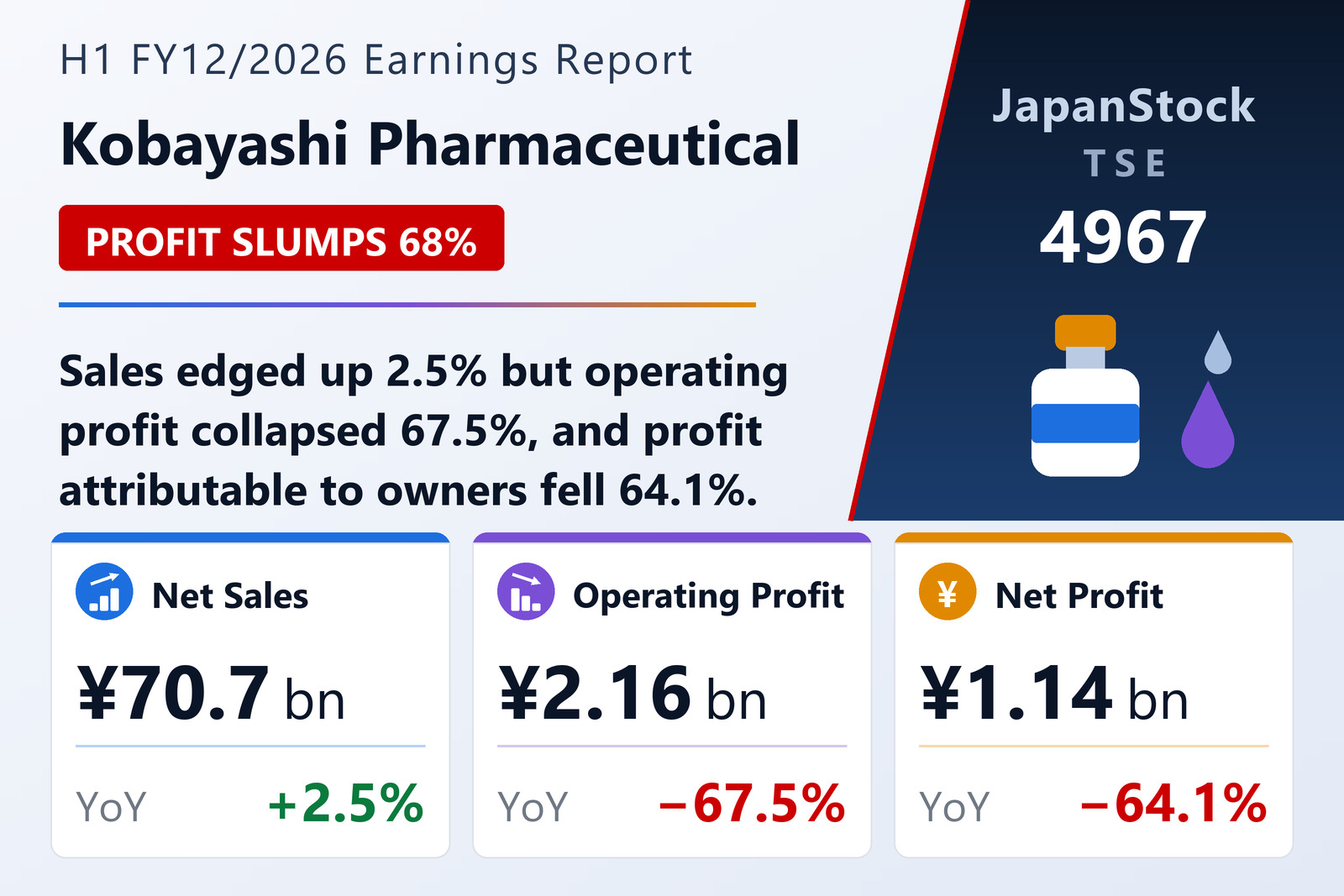
Kobayashi Pharmaceutical Co., Ltd. (TSE: 4967) reported consolidated results for the first half of the fiscal year ending December 2026 — the six months from January 1 to June 30, 2026 — under Japanese GAAP on August 6. This is an interim, or second-quarter cumulative, statement for a December year-end company, not a March-year result. Net sales rose 2.5% to ¥70,749 million, but every profit line fell hard: operating profit dropped 67.5% to ¥2,162 million, ordinary profit 58.5% to ¥3,006 million, profit before income taxes 47.7% to ¥2,221 million, and interim profit attributable to owners of the parent 64.1% to ¥1,136 million. Earnings per share came to ¥15.29 against ¥42.61 a year earlier. The operating margin compressed to just 3.1% from 9.6% — a 6.6-point contraction on a sales base that actually grew. One line moved the other way: comprehensive income swung to a positive ¥3,103 million from a negative ¥896 million, lifted by a ¥2,492 million foreign-currency translation gain routed outside the profit-and-loss account. No diluted EPS was disclosed, as the company has no dilutive potential shares outstanding.
Management framed the half against two backdrops. The first is the continuing response to the company's red-yeast-rice (beni-koji) supplement issue: Kobayashi says it is prioritising sincere compensation for those who suffered health damage while steadily executing the recurrence-prevention measures it drew up. The second is external. The release cites a rapid escalation of geopolitical risk, including military conflict arising from the situation in the Middle East, together with the resulting disruption to international logistics, higher energy prices, greater difficulty securing materials, currency volatility and tightening regulation in various countries. The company states that the direct impact of the Middle East situation on interim results was minor, but that it curtailed part of its advertising and sales-promotion activity in response.
Where the profit went: SG&A up ¥4,672 million on a gross profit that barely moved
The income statement makes the collapse easy to locate. Cost of sales rose 4.7% to ¥34,418 million, outpacing the 2.5% sales gain, so gross profit edged up only 0.5% to ¥36,330 million and the gross margin slipped to 51.3% from 52.4%. Everything else happened one line below. Selling, general and administrative expenses jumped 15.8%, or ¥4,672 million, to ¥34,168 million, taking the SG&A-to-sales ratio to 48.3% from 42.7%. Set a ¥4,672 million cost increase against a ¥185 million gross-profit gain and you have essentially the entire ¥4,486 million fall in operating profit — this was a spending decision, not a demand failure. The segment bridge tells the same story: Domestic profit fell ¥3,903 million, the International loss deepened by ¥679 million, the small "Other" segment added ¥64 million, and the inter-segment elimination improved ¥31 million.
Below the operating line the picture is less bleak. Non-operating income of ¥996 million against non-operating expenses of ¥151 million lifted ordinary profit to ¥3,006 million. Extraordinary income was ¥851 million, and extraordinary losses fell to ¥1,636 million from ¥3,175 million a year earlier — the product-recall-related loss dropped to ¥661 million from ¥2,912 million, though a new charge appeared: ¥683 million of office-integration costs for equipment relocation and disposal on completion of the Saito Monozukuri Lab, which merges the R&D functions of the Central Research Laboratory with the technology-development arm of the manufacturing division previously housed inside the Osaka Plant.
Domestic: sales held, segment profit down ¥3,903 million
The Domestic business — the group's core segment — posted sales of ¥54,617 million, up 1.8%, but segment profit of only ¥4,291 million, down 47.6% from ¥8,194 million on ¥53,660 million a year earlier. That sales figure includes inter-segment sales and transfers of ¥2,618 million, up from ¥1,903 million, so sales to external customers were ¥51,999 million. Nine new products launched this spring were credited with driving the top line: Salacia 100 Premium, a supplement targeting both post-meal blood glucose and HbA1c; Breath Care Carbonated Tablet, a tablet-format breath freshener; Bihaku Sumigaki Premium, a toothpaste that smooths the enamel surface to resist staining; and Shoshuriki ZERO Spray, an unscented deodoriser targeting ten common household and bathroom odours. Advertising, suspended during the voluntary recall of the red-yeast-rice products, has been running continuously since television campaigns restarted in earnest in July 2025.
The three domestic product groupings moved in different directions. Healthcare rose ¥569 million, or 2.0%, to ¥29,218 million. Household products slipped ¥99 million, or 0.4%, to ¥22,049 million, and disposable pocket warmers — the smallest line and the most weather-dependent — fell ¥227 million, or 23.7%, to ¥731 million. The net effect was an increase of ¥242 million, or 0.5%, in external domestic sales. The healthcare number carries a footnote that materially changes how it reads: the company terminated sales through its own online store and call centre at the end of December 2025, and the prior-year healthcare figure of ¥28,649 million still includes ¥1,483 million of that now-discontinued direct-marketing revenue. Strip it out and the comparable base falls to roughly ¥27,166 million, meaning the retained healthcare business grew closer to 7.6% rather than 2.0%.
International: sales up 8.1%, but the loss widened to ¥2,175 million
The International business sells pocket warmers, the Netsusama Sheet cooling forehead patch and the Ammeltz topical anti-inflammatory analgesic, principally in the United States, China and Southeast Asia. Kobayashi says it invested aggressively in advertising and sales promotion to expand sales — and that is precisely where the segment's red ink comes from. Sales rose 8.1% to ¥19,195 million, including inter-segment sales of ¥792 million against ¥739 million, so external sales were ¥18,403 million, up ¥1,387 million or 8.2%. The segment nevertheless posted a loss of ¥2,175 million, wider than the ¥1,496 million loss a year earlier.
The regional split is sharply divided. The United States fell ¥670 million, or 8.5%, to ¥7,217 million, on healthcare-product supply problems that have continued since the first quarter. China surged ¥1,257 million, or 34.0%, to ¥4,954 million, led by Netsusama Sheet and Ammeltz with many other products also performing well. Southeast Asia added ¥440 million, or 12.4%, to ¥3,999 million on the same two brands, and other regions rose ¥360 million, or 19.3%, to ¥2,231 million. Separately, the "Other" segment — road transport, synthetic-resin container manufacturing, real-estate management and advertising planning and production, each run on a standalone-profit basis — lifted sales 9.5% to ¥3,402 million and nearly doubled segment profit to ¥133 million from ¥69 million, though almost all of that revenue is internal: external sales were just ¥347 million against ¥3,055 million of inter-segment billings.
Guidance untouched — 83% of the profit target is now a second-half job
Kobayashi made no revision to its full-year forecast, which stands unchanged from the guidance published on February 10, 2026 alongside the FY12/2025 results. For the twelve months to December 31, 2026 it continues to guide to net sales of ¥173,000 million, up 4.4%, operating profit of ¥12,500 million, down 16.2%, ordinary profit of ¥13,000 million, down 23.5%, and net profit attributable to owners of the parent of ¥10,000 million, up 173.5%, for full-year earnings per share of ¥134.52. The arithmetic of leaving that intact is demanding. First-half sales represent 40.9% of the annual target, a normal enough weighting for a business whose pocket-warmer and cold-remedy lines skew to the colder months. But first-half operating profit is only 17.3% of the annual figure, ordinary profit 23.1%, and net profit just 11.4%. In absolute terms the second half must deliver about ¥102,251 million of sales, ¥10,338 million of operating profit and ¥8,864 million of net profit — nearly five times the operating profit booked in the first six months. The very large percentage increase pencilled in at the net line reflects an unusually depressed prior-year base, implying a FY2025 net profit of roughly ¥3.7 billion after the costs associated with the red-yeast-rice recall.
A ¥23,437 million lighter balance sheet, and operating cash flow that all but vanished
Total assets fell ¥23,437 million to ¥251,891 million. The company attributes that to a ¥15,284 million decline in cash and deposits and an ¥18,054 million decline in notes and accounts receivable, partly offset by a ¥6,121 million build in merchandise and finished goods. Liabilities fell ¥22,128 million to ¥42,192 million, driven by a ¥14,438 million drop in accounts payable–other and a ¥3,695 million drop in electronically recorded obligations. Net assets edged down ¥1,309 million to ¥209,699 million as a ¥3,323 million reduction in retained earnings was partly offset by a ¥2,492 million increase in the foreign-currency translation adjustment. Shareholders' equity was ¥208,846 million and the equity ratio jumped to 82.9% from 76.3% — an unusually strong reading produced by deleveraging rather than by retained earnings. The provision for product-recall-related loss stood at ¥1,351 million, down from ¥2,176 million at the year-end.
The interim tanshin does include a full consolidated statement of cash flows, and it is the least flattering statement in the document. Operating cash flow collapsed to ¥460 million from ¥14,206 million, a 96.8% fall. Profit before income taxes of ¥2,221 million and depreciation of ¥4,034 million were joined by an ¥18,399 million decrease in trade receivables, but that inflow was consumed by a ¥6,790 million build in inventories, a ¥4,430 million decrease in trade payables, a ¥7,846 million decrease in accounts payable–other and ¥2,032 million of income taxes paid. Investing cash flow was negative ¥10,220 million against negative ¥8,361 million, dominated by ¥10,137 million of purchases of property, plant and equipment, with ¥2,291 million placed into time deposits and ¥1,887 million withdrawn. Financing cash flow was negative ¥4,587 million against negative ¥4,508 million, essentially the ¥4,458 million of dividends paid. Free cash flow was therefore negative ¥9,760 million, against positive ¥5,845 million a year earlier, and cash and cash equivalents ended the half at ¥50,797 million, down ¥13,896 million from ¥64,693 million at the year-end.
Shares issued including treasury stock stood at 78,050,000, with 3,711,379 shares held in treasury and an average of 74,338,717 shares outstanding during the period. There were no changes to the scope of consolidation, no changes in accounting policy or estimates, and no restatements. As is standard for a Japanese second-quarter tanshin, the statements have not been reviewed by the company's auditors. One contingent-liability note deserves attention: more than two years after disclosing the health damage and voluntary recall, Kobayashi is still gathering information on and settling recall costs with corporate customers, and still processing compensation claims and medical-expense payments from affected consumers. A provision has been recognised to the extent the company can reasonably estimate the exposure, but for matters such as litigation that fall outside a reasonable estimate, it states plainly that it cannot reasonably estimate the total and that additional costs may arise.
Two subsequent events: a Chinese plant sold, a ¥3,282 million PALTAC gain in Q3
The tanshin's material subsequent-events note carries two items, both landing in the second half. First, at a board meeting held on the results date itself — August 6, 2026 — Kobayashi resolved to transfer its entire equity interest in Jiangsu Kobayashi Pharmaceutical Co., Ltd., a consolidated sub-subsidiary that manufactures over-the-counter medicines including athlete's-foot and acne treatments, to Wanquan Wante Pharmaceutical (Xiamen) Co., Ltd. The business was acquired in June 2018, when the group's Chinese holding company Kobayashi Pharmaceutical (China) Co., Ltd. bought Jiangsu Zhongdan Pharmaceutical Co., Ltd. and renamed it. Reviewing recent changes to China's pharmaceutical regulatory system and market environment alongside its own portfolio, the company concluded it can expand its Chinese OTC business without owning a factory. The transfer is scheduled for the end of October 2026 and will leave a 0% stake. Kobayashi expects to book an extraordinary loss in FY12/2026, with the amount still under review.
Second, on June 9, 2026 the board resolved to tender all of its shares in PALTAC Corporation into the tender offer conducted by Medipal Holdings Corporation. The sale completed on July 8, 2026 and will produce a ¥3,282 million gain on sale of investment securities, to be recorded as extraordinary income in the third quarter of FY12/2026. Neither item is reflected in the full-year guidance, which predates both — one confirmed gain of known size, one loss of unknown size, and no change to the numbers on the cover page.
Interim dividend raised to ¥45.00, ¥106.00 planned for the year
Despite the profit collapse, the shareholder return was increased. The company declared an interim dividend of ¥45.00 per share, up from ¥44.00 a year earlier, with payment scheduled to begin on September 3, 2026. It maintains its forecast of a ¥61.00 year-end dividend for an annual total of ¥106.00, against ¥104.00 for FY2025 (¥44.00 interim plus ¥60.00 year-end), with no revision from the previously announced dividend forecast. Dividends actually paid during the half came to ¥4,458 million — comfortably more than the ¥1,136 million earned, which is what pushed retained earnings down ¥3,323 million. At the guided full-year EPS of ¥134.52, the ¥106.00 payout implies a payout ratio of roughly 79%, a level that only makes sense if management is confident the second-half profit recovery embedded in guidance actually arrives. Kobayashi filed its semi-annual report on August 7 and held an earnings briefing for institutional investors and analysts on August 6, with supplementary presentation materials posted to its website the same day.
| Metric | H1 FY12/2026 | H1 FY12/2025 | YoY |
|---|---|---|---|
| Net sales (¥ million) | 70,749 | 69,018 | +2.5% |
| Cost of sales (¥ million) | 34,418 | 32,873 | +4.7% |
| Gross profit (¥ million) | 36,330 | 36,145 | +0.5% |
| Gross margin | 51.3% | 52.4% | −1.0 pt |
| SG&A expenses (¥ million) | 34,168 | 29,496 | +15.8% |
| Operating profit (¥ million) | 2,162 | 6,648 | −67.5% |
| Operating margin | 3.1% | 9.6% | −6.6 pt |
| Ordinary profit (¥ million) | 3,006 | 7,245 | −58.5% |
| Profit before income taxes (¥ million) | 2,221 | 4,248 | −47.7% |
| Profit attrib. to owners of parent (¥ million) | 1,136 | 3,167 | −64.1% |
| Comprehensive income (¥ million) | 3,103 | −896 | To profit |
| Earnings per share (¥) | 15.29 | 42.61 | −64.1% |
| Segment sales: Domestic (¥ million) | 54,617 | 53,660 | +1.8% |
| Segment profit: Domestic (¥ million) | 4,291 | 8,194 | −47.6% |
| Segment sales: International (¥ million) | 19,195 | 17,755 | +8.1% |
| Segment loss: International (¥ million) | −2,175 | −1,496 | Wider loss |
| Segment sales: Other (¥ million) | 3,402 | 3,106 | +9.5% |
| Segment profit: Other (¥ million) | 133 | 69 | +92.2% |
| Operating cash flow (¥ million) | 460 | 14,206 | −96.8% |
| Investing cash flow (¥ million) | −10,220 | −8,361 | Larger outflow |
| Financing cash flow (¥ million) | −4,587 | −4,508 | Larger outflow |
| Cash & equivalents, period end (¥ million) | 50,797 | 47,032 | +8.0% |
| Interim dividend per share (¥) | 45.00 | 44.00 | +¥1.00 |
JapanStockPulse provides informational content only and does not constitute investment advice. Figures are taken from the company's published earnings short report and may be subject to subsequent revision.