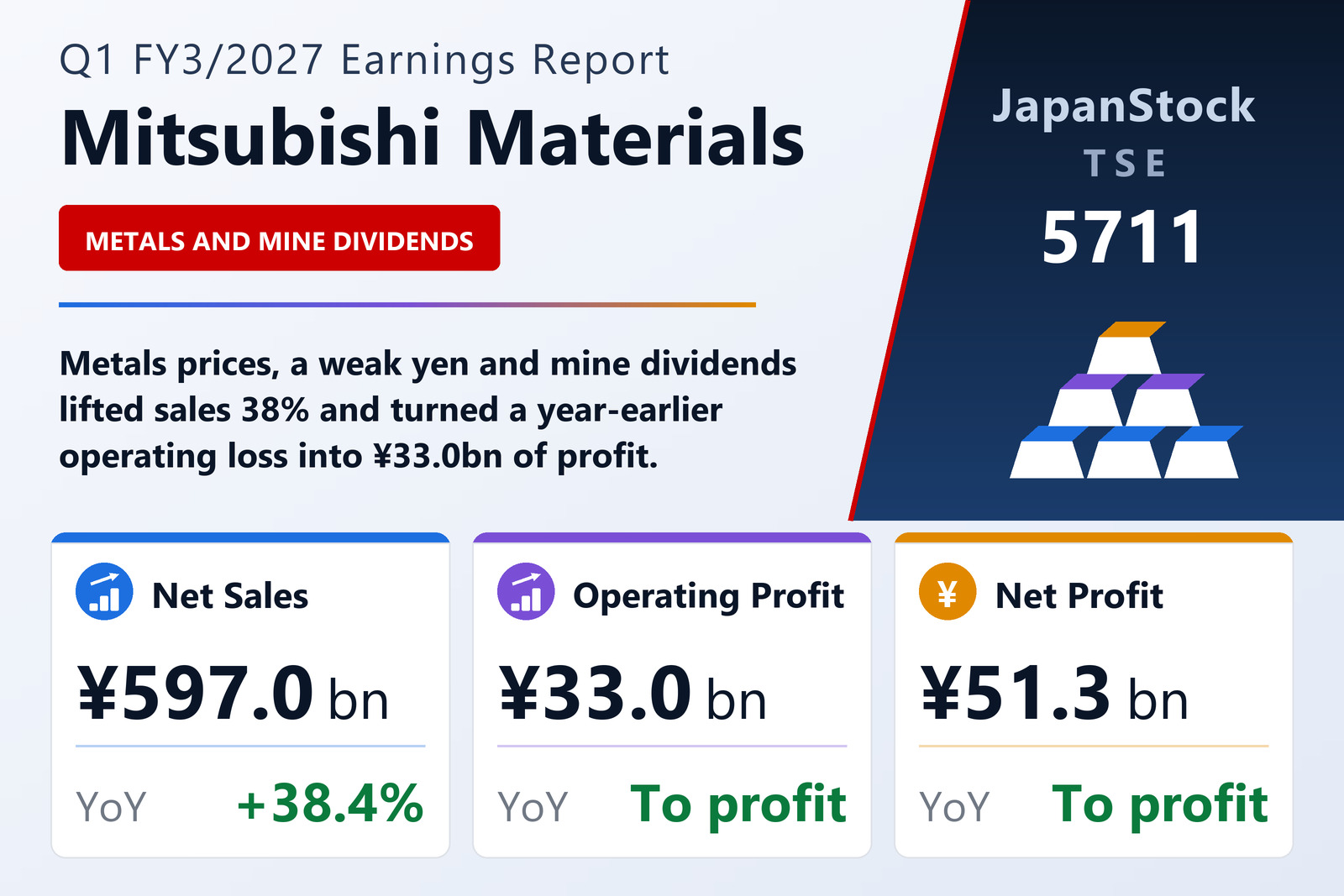
Mitsubishi Materials Corporation (TSE: 5711) reported consolidated first-quarter results under Japanese GAAP on August 6. The figures cover three months from April 1 to June 30, 2026, the opening quarter of the year to March 2027. Mitsubishi Materials is one of Japan's largest non-ferrous groups — a copper and precious-metals smelter and recycler that also makes cemented-carbide cutting tools and advanced electronic materials, holds equity stakes in overseas copper mines, and operates geothermal, hydro and solar generation. On an annualised basis this quarter's revenue run-rate approaches ¥2.4 trillion, and the balance sheet totals ¥2.94 trillion.
Every headline line reversed
The reversal was comprehensive rather than concentrated in one item. Net sales rose 38.4% to ¥597,005 million from ¥431,402 million, and because cost of sales grew far more slowly — up 32.1% to ¥530,405 million — gross profit more than doubled, up 122.3% to ¥66,599 million from ¥29,954 million. Selling, general and administrative expenses were almost flat at ¥33,605 million against ¥32,595 million, so essentially the whole gross-margin gain dropped through: operating profit came in at ¥32,994 million against a ¥2,641 million operating loss. Management attributed the improvement to three reinforcing factors — recovering automotive and semiconductor-related demand, a yen that traded weaker than a year earlier, and metal prices, notably tungsten, copper and gold, running above year-ago levels. Non-operating income then more than doubled to ¥24,294 million from ¥9,029 million, driven by dividend income of ¥12,516 million against ¥2,408 million and equity-method investment income of ¥6,834 million against ¥4,213 million, with foreign-exchange gains of ¥2,189 million where the prior year recorded none. Non-operating expenses fell to ¥5,386 million from ¥6,531 million. Ordinary profit therefore reached ¥51,902 million, against a ¥143 million loss.
Below that line the company booked ¥11,747 million of extraordinary income, almost all of it an ¥11,033 million gain on a revision of its retirement-benefit plan, against just ¥13 million a year earlier. Extraordinary losses were negligible at ¥88 million, versus ¥1,353 million in the prior-year quarter, which had carried ¥1,279 million of special retirement payments. Pre-tax profit was ¥63,561 million against a ¥1,484 million loss, income taxes came to ¥8,566 million — a modest 13.5% effective charge, since the company computes quarterly tax using an estimated annual effective rate — and ¥3,710 million was attributed to non-controlling interests. That left ¥51,284 million attributable to owners of the parent, against a ¥4,050 million loss. Depreciation edged up to ¥11,383 million from ¥11,062 million, while goodwill amortisation fell to ¥252 million from ¥447 million.
A new five-segment map took effect on April 1
This is the first quarter reported under a reorganised segment structure, and readers comparing against older filings should note the discontinuity. Following a board resolution of November 26, 2025 adopting a medium-term management strategy for fiscal 2026 to 2028, Mitsubishi Materials restructured its organisation on April 1, 2026. Everything from the collection and processing of recycled feedstock through to the manufacture of copper-alloy products and tungsten materials is now grouped as the Materials domain; further-downstream fabrication of cemented-carbide products and advanced products sits in the Products domain. The reporting segments accordingly changed from the former Metals, Advanced Products, Metalworking Solutions and Renewable Energy split to Materials, Products (Cemented Carbide), Products (Advanced Products), Resources and Renewable Energy. Prior-year comparatives have been restated onto the new basis, so the year-on-year segment comparisons below are like-for-like. Strategically, the group frames Materials as the engine for secondary-feedstock smelting, resource-circulation loops and expanded tungsten recycling; Products as the margin-accretive downstream; Resources as the vehicle securing copper-concentrate supply through mine investment; and Renewable Energy as a mixed geothermal, hydro and solar platform.
Materials swings from a ¥6.7 billion loss to a ¥26.1 billion profit
Materials is the group by weight, and it did the heavy lifting. Segment sales including inter-segment transactions rose 42.2% to ¥472,135 million from ¥332,083 million, with external sales of ¥457,227 million. Segment profit — which the company reconciles to consolidated ordinary profit rather than to operating profit — swung to ¥26,063 million from a ¥6,653 million loss, a ¥32.7 billion year-on-year improvement that on its own exceeds the entire consolidated ordinary-profit swing net of other moves. Rising prices for tungsten, copper and gold combined with the weaker yen to lift both sales and operating profit, and the ordinary line gained further from the foreign-exchange gains recorded during the quarter. It is worth naming what this segment now contains: the copper-concentrate purchasing and electrolytic-copper sales business that the group has agreed to hand to Pan Pacific Copper sits inside Materials, so the segment's shape will change materially in the fourth quarter of this fiscal year.
Carbide, AI-driven advanced products and a geothermal plant back on line
The Products domain improved on both legs. Cemented Carbide sales rose 32.6% to ¥45,434 million and segment profit rose 173.4% to ¥8,582 million from ¥3,138 million, as a broadly recovering tooling market lifted volumes and the weak yen and price improvements added on top. Advanced Products — the electronic materials and components business — grew sales 31.4% to ¥72,072 million and multiplied segment profit roughly eightfold to ¥3,485 million from ¥436 million, with management pointing squarely at expanding demand for AI-related products as the cause. Renewable Energy was the smallest but proportionally the sharpest mover: sales rose 53.5% to ¥2,118 million and segment profit rose more than tenfold to ¥1,059 million from ¥104 million, though the comparison flatters the quarter — the Appi geothermal power station was out of service from April to October last year after lightning damaged its equipment, so the prior-year base was artificially depressed. The residual Other businesses, which include cement-related and engineering operations, were broadly flat, with sales down 7.0% to ¥32,933 million and segment profit down 1.3% to ¥3,892 million.
Resources earns ¥14.0 billion without recording a yen of sales
The Resources segment is an unusual line to read. It books no sales at all — its role is to hold and manage the group's mine investments — and it carried a small operating loss of roughly ¥0.7 billion in both periods. Yet its segment profit rose 616.0% to ¥14,026 million from ¥1,959 million, making it the group's second-largest profit contributor this quarter, ahead of Cemented Carbide. The driver was straightforward: higher dividends received from the mines, which is the same ¥12,516 million of dividend income visible in the consolidated non-operating line, supplemented by equity-method income. Because that profit arrives entirely below the operating line and is tied to the distribution policies of jointly held mining assets, it is inherently less repeatable quarter to quarter than the Materials or Products contributions. Across all reporting segments, profit totalled ¥57,110 million against ¥2,929 million; eliminations and unallocated corporate costs of ¥5,208 million — comprising ¥3,495 million of inter-segment eliminations and ¥1,712 million of corporate expenses — bridge to the reported ordinary profit of ¥51,902 million.
Bullion unwinds shrink both sides of the balance sheet
Total assets fell ¥59,620 million to ¥2,940,124 million at June 30 from ¥2,999,744 million at the March year-end, and liabilities fell further, down ¥99,561 million to ¥2,147,205 million. Both moves have the same source: the group's bullion book. Lent bullion fell to ¥772,434 million from ¥813,829 million on the asset side, while bullion held on deposit fell to ¥1,097,051 million from ¥1,239,178 million on the liability side. Inventories moved the other way, with work in process up to ¥199,698 million from ¥184,670 million and raw materials and supplies up to ¥242,720 million from ¥221,644 million; trade receivables rose to ¥213,476 million from ¥198,349 million. Short-term borrowings increased to ¥330,518 million from ¥281,845 million and commercial paper to ¥100,000 million from ¥70,000 million, while long-term borrowings eased to ¥154,387 million from ¥160,225 million. Net assets rose ¥39,941 million to ¥792,919 million, with retained earnings up to ¥451,299 million from ¥406,922 million, lifting the equity ratio to 26.4% from 24.5%. The company also disclosed that its global notional-pooling arrangement for certain overseas subsidiaries carried ¥78.8 billion of deposits included in cash and deposits and ¥67.3 billion of borrowings included in short-term borrowings at quarter-end.
Guidance revised separately; no quarterly cash flow statement
Two disclosure points matter for anyone modelling the year. First, Mitsubishi Materials did not prepare a consolidated statement of cash flows for the first quarter — Japanese quarterly rules permit this, and the company disclosed only depreciation and goodwill amortisation in its place, so no operating, investing or financing cash-flow figures exist for the period. Second, the tanshin itself contains no full-year guidance table: the company revised its FY3/2027 consolidated forecast in a separate release issued the same day, titled "Notice Regarding Revision of Earnings Forecast," and directs readers there and to its supplementary quarterly briefing materials for the numbers. Nothing in this document quantifies the revised full-year outlook or a quarterly dividend decision, and the going-concern and material-changes-in-shareholders'-equity notes were both filed as not applicable.
¥70 billion of zero-coupon converts — and copper smelting heads to Pan Pacific Copper
The most consequential item in the filing is a subsequent event. On July 8, 2026 the board resolved to issue two tranches of euro-yen convertible bonds with call provisions, and payment completed on July 24: a ¥35.0 billion 2030 tranche and a ¥35.0 billion 2032 tranche, ¥70.0 billion in total. Both are zero-coupon, were offered at 102.5% of par against a 100.0% subscription price, and redeem at 100% of face value on July 24, 2030 and July 26, 2032 respectively. Initial conversion prices are ¥5,275 for the 2030 bonds and ¥5,105 for the 2032 bonds, with 3,500 warrants issued per tranche against ¥10 million face per bond, exercisable from August 7, 2026 to July 10, 2030 and July 12, 2032. The bonds are unsecured and unguaranteed. Net proceeds of roughly ¥70.0 billion are earmarked, through end-March 2029, for growth investment in the shift toward secondary-feedstock smelting and expanded tungsten recycling — the resource-circulation pivot at the centre of the new medium-term plan.
The second structural item was disclosed as additional information. On May 28, 2026 Mitsubishi Materials signed a definitive business-integration agreement to fold its copper-concentrate purchasing and electrolytic-copper, sulphuric-acid and copper by-product sales business into Pan Pacific Copper (PPC), the smelting joint venture it holds with JX Metals, Mitsui Mining & Smelting and Marubeni. The rationale is blunt: competition from overseas smelters has intensified and treatment and refining charges (TC/RC) on purchased concentrate have deteriorated sharply, with no clear improvement in sight, so the partners intend to buy concentrate jointly, consolidate common functions and streamline sales. Mechanically, PPC established a new subsidiary — PPC Materials Corporation — on July 1, 2026, and the business will pass to it through two absorption-type company splits, both effective February 1, 2027. Mitsubishi Materials will receive 94,608 newly issued PPC shares as consideration, after PPC executes a 17-for-1 stock split; the second split will increase the successor's capital by ¥2,999 million. Post-integration ownership of PPC will be Mitsubishi Materials 32.00%, JX Metals 32.50%, Mitsui Mining & Smelting 21.90% and Marubeni 13.60%. Completion remains conditional on domestic and overseas competition-authority clearances. The affected business sits in the Materials segment.
| Metric | Q1 FY3/2027 | Q1 FY3/2026 | YoY |
|---|---|---|---|
| Net sales (¥ million) | 597,005 | 431,402 | +38.4% |
| Gross profit (¥ million) | 66,599 | 29,954 | +122.3% |
| Operating profit / loss (¥ million) | 32,994 | −2,641 | To profit |
| Ordinary profit / loss (¥ million) | 51,902 | −143 | To profit |
| Profit / loss before income taxes (¥ million) | 63,561 | −1,484 | To profit |
| Profit / loss attrib. to owners of parent (¥ million) | 51,284 | −4,050 | To profit |
| Non-operating income (¥ million) | 24,294 | 9,029 | +169.1% |
| Extraordinary income (¥ million) | 11,747 | 13 | n.m. |
| Depreciation (¥ million) | 11,383 | 11,062 | +2.9% |
| Total assets (¥ million, vs Mar 31, 2026) | 2,940,124 | 2,999,744 | −2.0% |
| Net assets (¥ million, vs Mar 31, 2026) | 792,919 | 752,978 | +5.3% |
| Equity ratio | 26.4% | 24.5% | +1.9 pt |
| Segment | Sales Q1 FY3/2027 (¥ mn) | Sales Q1 FY3/2026 (¥ mn) | Segment P/L Q1 FY3/2027 (¥ mn) | Segment P/L Q1 FY3/2026 (¥ mn) |
|---|---|---|---|---|
| Materials | 472,135 | 332,083 | 26,063 | −6,653 |
| Products — Cemented Carbide | 45,434 | 34,261 | 8,582 | 3,138 |
| Products — Advanced Products | 72,072 | 54,842 | 3,485 | 436 |
| Resources | — | — | 14,026 | 1,959 |
| Renewable Energy | 2,118 | 1,380 | 1,059 | 104 |
| Other | 32,933 | 35,395 | 3,892 | 3,944 |
| Segment total | 624,694 | 457,962 | 57,110 | 2,929 |
| Eliminations / corporate | −27,689 | −26,560 | −5,208 | −3,073 |
| Consolidated | 597,005 | 431,402 | 51,902 | −143 |
JapanStockPulse provides informational content only and does not constitute investment advice. Figures are taken from the company's published earnings short report and may be subject to subsequent revision.