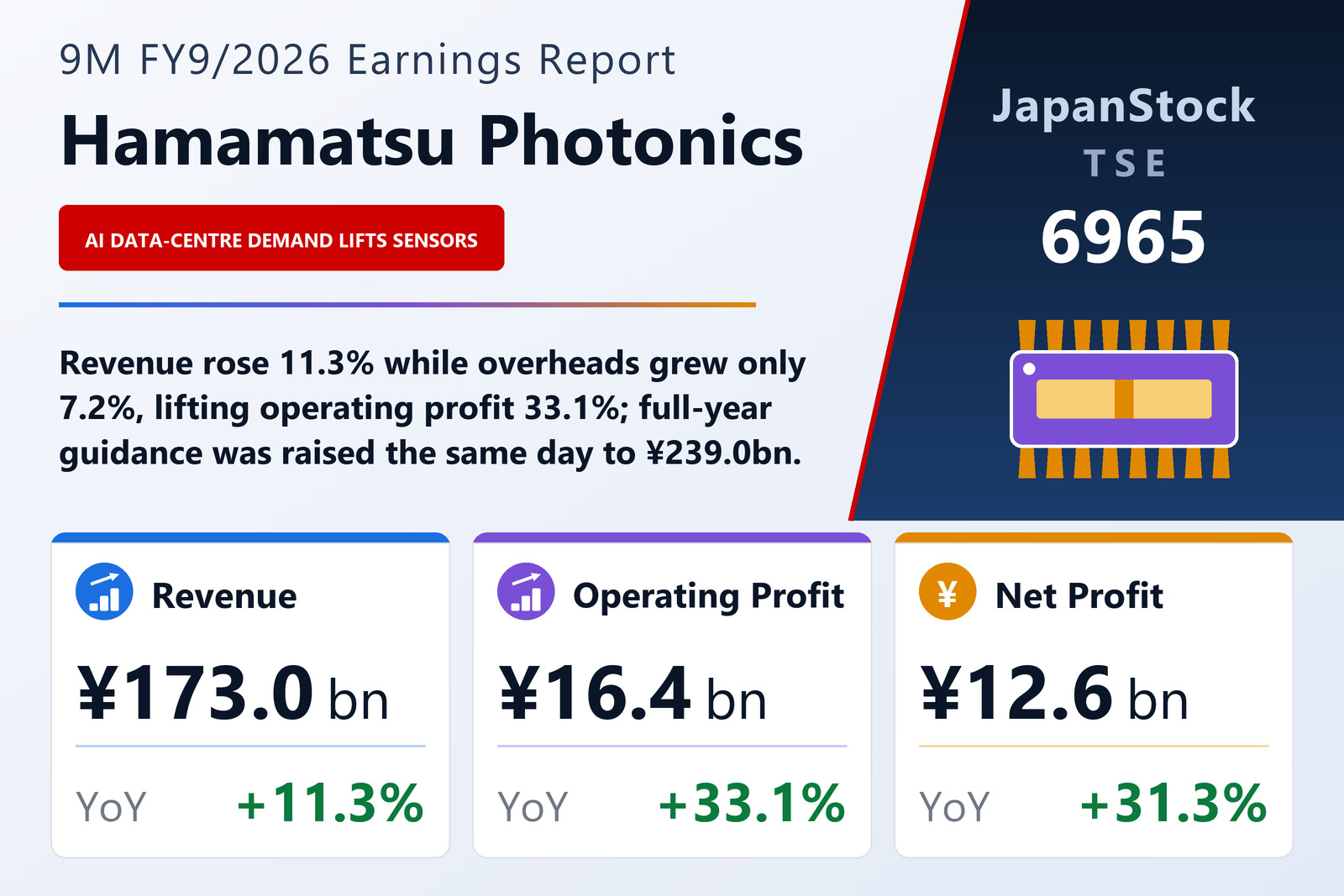
Revenue grew 11.3%, overheads only 7.2% — and that gap is the profit
Hamamatsu Photonics K.K. (TSE: 6965), the Hamamatsu-based photonics group whose products run from photomultiplier tubes and xenon lamps to opto-semiconductor devices, imaging and measurement systems and industrial lasers, published consolidated results for the first nine months of its September-ending financial year — the period from October 1, 2025 to June 30, 2026 — on August 6, 2026 under Japanese GAAP. Revenue rose 11.3% to ¥173,047 million, operating profit 33.1% to ¥16,354 million, ordinary profit 38.5% to ¥19,363 million and profit attributable to owners of the parent 31.3% to ¥12,619 million, for earnings of ¥43.05 per share against ¥31.96. The filing names the Tokyo Stock Exchange as the company's listing venue and states no market segment.
The arithmetic between those lines is unusually clean. Cost of sales rose 11.2% to ¥89,426 million, almost exactly in step with revenue, so gross profit rose 11.4% to ¥83,620 million and the gross margin was effectively flat at 48.3%. The operating gain came entirely from the line beneath it: selling, general and administrative expenses grew 7.2% to ¥67,266 million against revenue growth of 11.3%, which pulled them from 40.4% of revenue to 38.9%. That 1.5-point saving is precisely the operating margin's move, from 7.9% to 9.4%. A company that grew revenue by roughly a ninth grew operating profit by 33.1% because it held overheads down, not because it earned more on each unit it sold.
One demand story runs through three of the four segments
The filing traces the revenue growth to a single chain of demand. Expanding semiconductor demand centred on AI data centres lifted sales of photomultiplier tubes and xenon lamps used in semiconductor manufacturing and inspection equipment; rising demand for circuit-board inspection, again for AI data centres, lifted microfocus X-ray sources used in non-destructive testing; the same semiconductor demand lifted image sensors for manufacturing and inspection equipment; and buoyant AI data-centre capital spending kept sales of stealth dicing engines — the lasers that cut silicon wafers at high speed — firm. Around that the company describes an uncertain environment of continuing price inflation, volatile raw-material and energy costs on heightened geopolitical risk centred on the Middle East, and unstable international logistics.
Interest and currency add to the ordinary line; last year's one-offs subtract below it
Ordinary profit rose 38.5% to ¥19,363 million, more than five points faster than the operating line, and the gap sits in the non-operating accounts. Non-operating income nearly doubled, to ¥4,645 million from ¥2,544 million, on interest received of ¥1,592 million against ¥1,155 million, foreign-exchange gains of ¥984 million against ¥116 million and equity-method investment income of ¥438 million against ¥229 million. Non-operating expenses roughly doubled as well, to ¥1,637 million from ¥848 million, almost entirely because interest paid more than tripled, to ¥1,477 million from ¥456 million — the cost of a borrowing and lease book that expanded sharply during the period. Net of both, the non-operating accounts contributed ¥3,008 million against ¥1,696 million.
Below that the direction reverses. Extraordinary gains fell to ¥184 million from ¥2,950 million, because the prior year contained ¥1,935 million of subsidy income and ¥942 million of negative goodwill that did not recur; extraordinary losses fell to ¥106 million from ¥1,874 million, the prior year having carried a ¥1,662 million loss on reduction of fixed-asset book value. The net extraordinary contribution was therefore ¥78 million against ¥1,076 million, and pre-tax profit grew 29.1% to ¥19,441 million — slower than the ordinary line, not faster. Income taxes were ¥6,692 million against ¥5,193 million, non-controlling interests took ¥128 million against ¥257 million, and profit attributable to owners of the parent finished 31.3% higher at ¥12,619 million. Comprehensive income, at ¥25,606 million against ¥11,925 million, is twice the profit figure, because the foreign-currency translation adjustment alone added ¥12,267 million against ¥2,351 million a year earlier.
Three segments lifted profit; the laser business nearly doubled its loss
Opto-semiconductor, the largest segment, grew revenue 13.6% to ¥66,584 million and segment profit 29.8% to ¥12,741 million. Image sensors for semiconductor manufacturing and inspection equipment rose on the same AI-driven demand, and photodiodes rose in factory-automation uses such as industrial-robot control, together offsetting a fall in photodiode arrays for high-energy physics experiments after a European project was completed and delivered. Electron Tube, the second-largest segment and much the most profitable, grew revenue 9.5% to ¥58,822 million and segment profit 24.5% to ¥17,897 million — more than the whole group's operating profit, on a third of its revenue.
Imaging and Measurement grew revenue 12.5% to ¥25,759 million on semiconductor failure-analysis systems, which the company says were well received for their operability and functionality, and on pathology digital slide scanners used in remote diagnosis, where European and US demand expanded steadily. Segment profit, however, rose only 4.1% to ¥6,857 million, a third of the revenue growth rate, and the filing does not explain the divergence. Laser grew revenue 4.3% to ¥16,912 million — stealth dicing engines held firm and fibre lasers for quantum and semiconductor-inspection uses beat plan, while fibre lasers for laser microscopes declined — but its operating loss widened to ¥4,896 million from ¥2,553 million. The filing states that loss and gives no reason for its widening, which on a segment that grew revenue is the most conspicuous gap in the disclosure.
The residual Other category — a group hotel business in Iwata and the proprietary-product business of the group's Beijing subsidiary — grew revenue 22.9% to ¥4,968 million but swung to an operating loss of ¥475 million from a ¥529 million profit. Together the four reporting segments earned ¥32,600 million of segment profit against ¥28,228 million a year earlier, and including Other the group total was ¥32,124 million; unallocated corporate expenses of ¥15,095 million — chiefly group administrative costs and basic research — plus ¥674 million of intersegment eliminations cut that back to the reported ¥16,354 million. Those corporate costs were ¥831 million lower than a year earlier, and are themselves part of the overhead restraint described above.
A finished building, a ¥17.8 billion buyback, and an equity ratio five points lower
Total assets rose 7.0% to ¥486,751 million from ¥455,008 million at September 30, 2025. Current assets grew ¥14,856 million, with cash and deposits up ¥12,252 million to ¥102,811 million and trade receivables up ¥4,266 million, against a ¥3,994 million fall in securities. The fixed-asset movements tell the more interesting story: construction in progress collapsed by ¥29,143 million to ¥4,423 million as a new building and its equipment were completed and brought into service, while lease assets rose ¥17,247 million, buildings and structures ¥11,909 million and machinery and vehicles ¥10,142 million, for a net ¥16,885 million increase in fixed assets. Depreciation for the nine months was ¥14,091 million against ¥13,538 million, with goodwill amortisation of ¥2,849 million. No cash-flow statement was prepared for the period.
Liabilities rose ¥36,411 million to ¥167,965 million, chiefly on a ¥16,111 million increase in lease liabilities — the counterpart of those lease assets — and a ¥12,142 million rise in short-term borrowings to ¥65,640 million, partly offset by a ¥3,558 million reduction in long-term borrowings. Net assets fell 1.4% to ¥318,785 million even though the translation adjustment added ¥12,250 million, because the company acquired 9,736,800 of its own shares for ¥17,844 million under a board resolution of November 7, 2025. Assets up 7.0% against equity down 1.4% is the whole of the equity ratio's fall, from 70.7% to 65.2%. The buyback also cut the average share count to 293,118,904 from 300,645,235, which is why earnings per share rose 34.7% on a 31.3% rise in profit.
Guidance raised on AI demand and a weaker yen; the dividend is unchanged
Hamamatsu Photonics revised upward the full-year FY9/2026 guidance it had published on May 14, 2026. It now expects revenue of ¥239,000 million (+12.7%), operating profit of ¥22,000 million (+36.1%), ordinary profit of ¥25,500 million (+35.6%) and profit attributable to owners of ¥17,500 million (+23.2%), for earnings per share of ¥60.53 — increases of ¥7,000 million, ¥2,000 million, ¥2,000 million and ¥1,100 million respectively, or 3.0%, 10.0%, 8.5% and 6.7%. The reasons given are that sales and orders of industrial equipment, chiefly for semiconductor manufacturing and inspection, have been solid on expanding AI data-centre investment, and that the yen has run weaker than the company assumed; against that it repeats its concern over raw-material and energy prices amid Middle East geopolitical risk.
Measured against that guidance, the nine months delivered 72.4% of the revenue, 74.3% of the operating profit and 72.1% of the net profit, which leaves an implied fourth quarter of ¥65,953 million of revenue and ¥5,646 million of operating profit — an 8.6% operating margin against the 9.4% just recorded. The dividend forecast was not revised: ¥19.00 has been paid for the second quarter and ¥19.00 is forecast at the year-end, for an annual ¥38.00, the same as FY9/2025, with no third-quarter dividend. Against the guided ¥60.53 of earnings per share that is a payout of about 63%.
| Metric | 9M FY9/2026 | 9M FY9/2025 | Change |
|---|---|---|---|
| Revenue (¥ million) | 173,047 | 155,467 | +11.3% |
| Gross profit (¥ million) | 83,620 | 75,045 | +11.4% |
| Gross margin | 48.3% | 48.3% | unchanged |
| SG&A expenses (¥ million) | 67,266 | 62,759 | +7.2% |
| Operating profit (¥ million) | 16,354 | 12,286 | +33.1% |
| Operating margin | 9.4% | 7.9% | +1.5 pt |
| Ordinary profit (¥ million) | 19,363 | 13,983 | +38.5% |
| Pre-tax profit (¥ million) | 19,441 | 15,059 | +29.1% |
| Net profit attrib. to owners of parent (¥ million) | 12,619 | 9,608 | +31.3% |
| EPS (¥) | 43.05 | 31.96 | +34.7% |
| Comprehensive income (¥ million) | 25,606 | 11,925 | +114.7% |
| Electron Tube — revenue (¥ million) | 58,822 | 53,702 | +9.5% |
| Electron Tube — segment profit (¥ million) | 17,897 | 14,380 | +24.5% |
| Opto-semiconductor — revenue (¥ million) | 66,584 | 58,612 | +13.6% |
| Opto-semiconductor — segment profit (¥ million) | 12,741 | 9,816 | +29.8% |
| Imaging & Measurement — revenue (¥ million) | 25,759 | 22,890 | +12.5% |
| Imaging & Measurement — segment profit (¥ million) | 6,857 | 6,585 | +4.1% |
| Laser — revenue (¥ million) | 16,912 | 16,220 | +4.3% |
| Laser — segment profit (¥ million) | −4,896 | −2,553 | loss widened |
| Other — revenue (¥ million) | 4,968 | 4,041 | +22.9% |
| Other — segment profit (¥ million) | −475 | 529 | profit to loss |
| Total assets (¥ million) | 486,751 | 455,008 | +7.0% |
| Net assets (¥ million) | 318,785 | 323,455 | −1.4% |
| Equity ratio | 65.2% | 70.7% | −5.5 pt |
| FY9/2026 guidance — revenue (¥ million) | 239,000 | — | +12.7% |
| FY9/2026 guidance — operating profit (¥ million) | 22,000 | — | +36.1% |
| FY9/2026 guidance — ordinary profit (¥ million) | 25,500 | — | +35.6% |
| FY9/2026 guidance — net profit (¥ million) | 17,500 | — | +23.2% |
| FY9/2026 guidance — EPS (¥) | 60.53 | — | — |
| Annual dividend per share (¥) | 38.00 | 38.00 | unchanged |
JapanStockPulse provides informational content only and does not constitute investment advice. Figures are taken from the company's published earnings short report and may be subject to subsequent revision.